doctor-revision

Batch 2 of 4 Nursing Informatics Exam

Nursing Informatics - Batch 2 Cumulative Assessment
Logo

Nursing Informatics: Batch 2

ICT in Practice, Patient Education, and Research

Test your knowledge with these 30 questions.

doctor-revision

Batch 1 of 4 Nursing Informatics Exam

Nursing Informatics - Batch 1 Cumulative Assessment
Logo

Nursing Informatics: Batch 1

Foundations, DIKW, and Key Models

Test your knowledge with these 30 questions.

Communication and Counseling in Nursing

Communication and Counseling in Nursing

Communication and Counseling in Nursing : Skills

Learning Objectives

Upon completion of this module, students will be able to:

  • Define the core concepts of communication and counseling and articulate their foundational importance in all aspects of patient care.
  • Differentiate between the distinct levels of communication in nursing, from social interaction to the therapeutic use of self.
  • Identify and describe the various types of counseling practiced by nurses, including health education, motivational interviewing, and crisis intervention.
  • Analyze and apply key principles from influential nursing and psychological theories, including Hildegard Peplau's Interpersonal Relations, Carl Rogers' Person-Centered Therapy, and Motivational Interviewing.
  • Demonstrate essential therapeutic communication techniques and counseling skills through the analysis of practical, context-specific scenarios.

The Foundations of Communication and Counseling

Communication: The Cornerstone of Patient Care

Communication in nursing is far more than the simple exchange of words; it is a dynamic, two-way process involving verbal and non-verbal cues, active listening, and the establishment of a genuine human connection. It serves as the bedrock upon which all safe and effective nursing care is built.

Core Importance:

  • Building Trust: Through consistent, honest, and empathetic communication, nurses create a safe space where patients feel comfortable sharing sensitive information.
  • Understanding Patient Needs: Effective communication allows nurses to understand the holistic needs of the patient—their physical, emotional, social, and spiritual concerns.
  • Providing Therapeutic Support: Communication is a primary tool for providing comfort, empathy, and emotional support to patients and families.
  • Ensuring Patient Safety: Clear, precise, and timely communication is essential for safe medication administration, accurate assessments, and coordinated care. Miscommunication is a leading cause of medical errors.

Counseling: A Focused and Goal-Oriented Process

Counseling in nursing is a purposeful, patient-centered interaction designed to empower individuals to manage their health more effectively. It is a focused and goal-oriented process that helps patients:

  • Cope: Develop strategies to cope with a new diagnosis, the challenges of a chronic illness, or the emotional impact of a health crisis.
  • Understand: Gain a clear and deep understanding of their health condition, treatment options, and self-care responsibilities.
  • Make Decisions: Become active partners in their care by making informed decisions that align with their personal values and goals.

The Continuum of Communication in Nursing

Nursing communication exists on a continuum, ranging from simple social exchanges to profound therapeutic engagement. A skilled nurse can fluidly move along this continuum based on the patient's needs and the clinical context.

Level 1: Social Communication

Description: The polite, superficial, and conventional interaction used to initiate contact and build rapport. It follows common social norms and helps put patients at ease. Examples include greeting a patient by name and making brief, non-health-related small talk.

Caution: While essential for rapport, nurses must maintain professional boundaries and avoid oversharing personal information.

Level 2: Structured / Informational Communication

Description: The factual, task-oriented communication that forms the backbone of clinical data exchange. It must be clear, direct, and accurate. Examples include asking about pain on a scale of 0-10, giving a shift report, providing patient education, or using SBAR to communicate with a physician.

Level 3: Therapeutic / Helping Communication

Description: A patient-centered, goal-directed form of communication where the nurse helps the patient express feelings, explore problems, and find solutions. Examples include using open-ended questions ("Tell me more about..."), reflecting feelings, and using silence effectively.

Level 4: Therapeutic Use of Self (Highest Level)

Description: The deepest level where the nurse's self-awareness, authenticity, and profound empathy form the foundation of the relationship. The nurse consciously uses their genuine personality and presence as a therapeutic tool. Examples include sitting in silence with a grieving family or sharing a brief, appropriate personal insight to normalize a patient's fear.

Types of Communication & Counseling in Nursing

Nurses employ various counseling styles depending on the patient's needs and the situation.

1. Health Education and Informational Counseling

Focus: Providing clear, accurate, and understandable information. The nurse's role is a teacher, using skills like the teach-back method and simple language.
Example: Counseling a new mother on breastfeeding benefits and techniques, then asking, "Can you tell me in your own words what you will be looking for?"

2. Motivational Interviewing (MI)

Focus: A collaborative style to explore and resolve a patient's ambivalence about behavior change. The nurse's role is a guide, not a lecturer.
Example: For a patient not taking hypertension medication, asking, "What are some of the things that get in the way of taking your medicine every day?"

3. Crisis Intervention Counseling

Focus: Providing immediate, short-term psychological first aid during an acute crisis. The nurse's role is a stabilizer and safety net.
Example: Supporting a family in the ED after an unexpected death by providing a private space and connecting them with a chaplain.

4. Supportive Counseling

Focus: Providing emotional validation, empathy, and encouragement. The nurse's role is an empathizer and source of reassurance.
Example: Sitting with an anxious pre-op patient and saying, "It is completely normal to feel nervous right now. We are all here for you."

5. Decision-Making Counseling

Focus: Assisting patients in weighing the benefits and risks of treatment options to make informed decisions. The nurse's role is an advocate and information clarifier.
Example: Helping a family understand the implications of choosing palliative care versus aggressive chemotherapy.

6. Brief Action Planning (BAP)

Focus: A structured, quick technique to help patients create a specific, achievable plan (a SMART goal) for a health behavior change. The nurse's role is a coach.
Example: Helping a patient with hypertension plan to walk for 15 minutes, three days a week, and writing the plan down together.

Summary of Communication Levels and Counseling Types

This table provides a quick reference for the different levels of communication and types of counseling discussed, highlighting their primary focus, the nurse's associated role, and a key example for each.

Level/Type Primary Focus Nurse's Role Key Example
Social Communication Building Rapport Friendly Professional Greeting a patient
Informational Comm. Exchanging Facts Educator / Coordinator Teaching about a new medication
Therapeutic Comm. Exploring Feelings Helper / Facilitator Reflecting a patient's fear
Therapeutic Use of Self Deep Healing Connection Authentic Partner Sitting in silence with the grieving
Health Education Knowledge Transfer Teacher Diabetes self-management
Motivational Interviewing Intrinsic Motivation Guide Exploring ambivalence to quit smoking
Crisis Intervention Immediate Stabilization Stabilizer Supporting a family after a loss
Supportive Counseling Emotional Validation Empathizer Easing pre-operative anxiety
Decision-Making Informed Choice Advocate Explaining treatment options

Influential Theories Underpinning Communication

Effective nursing communication and counseling are not merely intuitive acts; they are grounded in well-established theoretical frameworks that provide structure, depth, and intentionality to every interaction. By understanding these foundational theories, nurses can move beyond simply 'talking to' patients to truly 'communicating with' and 'counseling' them in a purposeful and impactful manner.

1. Hildegard Peplau's Theory of Interpersonal Relations (Psychodynamic Nursing)

This foundational theory revolutionized nursing by positioning the nurse-patient relationship as the very core of nursing practice. Peplau asserted that nursing is a dynamic, evolving partnership that unfolds in distinct, yet often overlapping, phases. Peplau's work emphasizes that the nurse's role is not simply to do things to a patient, but to work with them through a therapeutic relationship.

Phase 1: Orientation

Description: This initial phase begins when the patient expresses a felt need. The nurse's primary task is to help the patient clarify their problem, understand expectations, and begin to establish trust. Both parties are strangers, and mutual acceptance begins here.

Scenario: Mr. Musoke, 45, is admitted with an acute exacerbation of heart failure, presenting with severe shortness of breath and anxiety.

Application: The nurse, Suubi, calmly introduces herself: "Good morning, Mr. Musoke. I'm Suubi, your registered nurse today. I'm here to help manage your breathing difficulties and ensure you're as comfortable as possible." By clearly stating her role and inviting questions, Suubi initiates the relationship, establishes professional boundaries, and begins to build foundational trust.

Phase 2: Identification

Description: The patient begins to identify with the nurse, seeing them as a trusted, knowledgeable helper. The patient's initial feelings of helplessness diminish as they recognize the nurse's capacity for empathy and competent care. The nurse helps the patient explore their feelings, leading to a deeper connection.

Example: A patient with newly diagnosed diabetes feels overwhelmed. As the nurse consistently listens to her fears, the patient begins to feel the nurse genuinely understands her struggle, identifying the nurse as someone who can truly help her navigate this challenge.

Phase 3: Exploitation (Working Phase)

Description: This is the core "working" phase where the patient makes full use of the nurse's expertise to work actively toward their health goals. The patient takes an active role in problem-solving, and the nurse acts as a resource person, counselor, and teacher.

Scenario (Combining Identification & Exploitation): Mrs. Nalwanga, 55, with newly diagnosed Type 2 Diabetes, is struggling with dietary changes. She says, "Nurse, I just can't give up my g-nut paste sauce and matooke!"

Application: The nurse responds empathetically: "Mrs. Nalwanga, it sounds like you're finding it incredibly hard to adjust... Let's work together to identify some realistic swaps or portion adjustments you'd be comfortable with." By acknowledging her cultural context and shifting to collaborative problem-solving, the nurse enables Mrs. Nalwanga to feel understood (Identification) and actively engage in finding solutions (Exploitation).

Phase 4: Resolution

Description: The formal conclusion of the therapeutic relationship as the patient's needs are met and they regain independence. It is a planned termination where progress is reviewed and gains are consolidated.

Scenario: Mr. Kato, 70, is preparing for discharge after a successful prostatectomy.

Application: On the day of discharge, the nurse asks Mr. Kato to demonstrate his wound care one last time and explain his medication schedule. "Excellent, Mr. Kato! You're ready. Remember, if you have any questions... please don't hesitate to call." This reinforces the patient's autonomy, validates his progress, and formally concludes the in-hospital relationship while providing a pathway for future support.

2. Carl Rogers' Person-Centered Therapy (Humanistic Theory)

Carl Rogers' highly influential humanistic theory revolutionized counseling and profoundly impacted nursing communication. The core belief is that individuals possess an inherent drive to fulfill their potential, and the nurse's role is to create a supportive emotional environment that allows the patient to access this inner wisdom and solve their own problems. This is achieved through three core conditions that facilitate therapeutic change:

1. Unconditional Positive Regard (UPR)

Description: Accepting and respecting the patient as a person of inherent worth and dignity, without judgment, regardless of their choices or behaviors. It means valuing the patient as a unique individual and conveying a non-evaluative stance to foster psychological safety.

Scenario: Mr. Kamya, a 60-year-old with severe COPD, continues to smoke despite repeated education.

Application: Instead of showing frustration, the nurse employs UPR: "Mr. Kamya, I understand that quitting smoking is incredibly difficult... My concern is for your health, and I want to support you. Let's talk about what makes it so hard for you right now, without any pressure." This non-judgmental approach keeps the door open for an honest conversation, allowing Mr. Kamya to feel safe enough to discuss his barriers without fear of condemnation.

2. Empathic Understanding

Description: The ability to accurately sense the patient's private world and feelings as if they were your own, but without losing the "as if" quality. It involves deep listening and reflecting back the patient's feelings to validate their emotional experience.

Scenario: Ms. Kyakuwa, 30, expresses overwhelming fear and despair after a new diagnosis of advanced metastatic cancer.

Application: The nurse responds with genuine concern, reflecting the depth of the patient's experience: "Ms. Kyakuwa, it sounds like receiving this news has been terrifying and incredibly overwhelming. It's a massive shock, and it must feel like your world has been turned upside down... those feelings are completely understandable." This makes her feel profoundly heard and validated.

3. Congruence (Genuineness)

Description: The nurse being authentic, transparent, and self-aware within the relationship, rather than hiding behind a professional façade. It involves aligning one's inner feelings and outer expressions to foster profound trust through authenticity.

Scenario: A young, anxious patient, Sarah, asks her nurse, "Would you be scared if this were your surgery? Are you sure everything will be okay?"

Application: Rather than giving a hollow reassurance, a congruent nurse might respond honestly: "Sarah, it's completely normal to feel scared... While I can't know exactly how you feel... I can tell you that facing surgery is a big event, and it's natural to have those worries. My role is to make sure you have all the information you need... and to support you through every step. We will be right here with you." This authentic response builds profound trust.

Motivational Interviewing (MI)

Motivational Interviewing is a powerful, evidence-based counseling method that is particularly effective for addressing the common challenge of ambivalence—the state of having mixed feelings about changing a health behavior. It represents a profound shift from the traditional, expert-led model to a collaborative, guiding partnership. MI acknowledges that forcing change often leads to resistance, whereas supporting a patient's autonomy and internal motivation makes lasting change far more likely.

Core Concept and Guiding Spirit

The fundamental premise of MI is that people are inherently ambivalent about change. The nurse's role is not to confront or persuade, but to become a collaborative partner who skillfully explores this ambivalence, listening intently and helping the patient elicit and strengthen their own reasons for change. Motivation must come from within.

The practice of MI is guided by a specific mindset or "spirit":

  • Collaboration: The nurse and patient are partners. It is a "doing with" rather than a "doing to" approach, which reduces defensiveness and invites open communication.
  • Evocation (Eliciting): The nurse's primary job is to draw out the patient's own ideas, motivations, and strengths. The nurse doesn't "install" motivation; they help the patient discover it within themselves.
  • Autonomy: The nurse must profoundly respect the patient's right to self-direction. The patient is ultimately responsible for choosing if, when, and how they change. This genuine respect for autonomy often makes lasting change more likely.

Key Techniques: OARS

OARS is a mnemonic for the core communication skills used in MI. These micro-skills are foundational for building rapport and facilitating "change talk."

O - Open-Ended Questions

These are questions that cannot be answered with a simple "yes" or "no." They are invitations for the patient to tell their story and explore their thoughts and feelings in depth.

Examples:

  • "What are some of the not-so-good things about your current eating habits?"
  • "How would you like things to be different in your health six months from now?"
  • "Tell me about a typical day for you, especially concerning your stress levels."
A - Affirmations

These are genuine statements that recognize and reinforce the patient's strengths, abilities, efforts, and good intentions, no matter how small. Affirmations are crucial for building confidence (self-efficacy).

Examples:

  • "You showed a lot of courage in coming to the clinic today to talk about this."
  • "That's a really insightful idea you have; it shows you've been thinking about this seriously."
  • "Despite how difficult it has been, you are still trying to learn more. That takes tremendous persistence."
R - Reflective Listening

Arguably the most critical skill in MI, this involves listening to what the patient says and reflecting back the meaning or essence of their message in the nurse's own words. It validates the patient's experience and confirms understanding.

Types of Reflections:

  • Simple Reflection: Repeating or rephrasing the patient's statement. (Patient: "I'm so tired of being sick." Nurse: "You're feeling utterly exhausted.")
  • Complex Reflection: Making a guess about the deeper meaning or feeling. (Patient: "I should take my medicine, but I hate the side effects." Nurse: "So, on the one hand, you feel a responsibility to your health, but on the other, the side effects are a significant hurdle.")
S - Summarizing

Summaries are a collection of reflections that pull together the patient's statements, especially their "change talk." This demonstrates that the nurse has been listening and reinforces the patient's own motivation by allowing them to hear their arguments for change.

Example:

"So let me see if I have this right... You've been feeling concerned about your energy levels and how your weight affects your ability to play with your grandchildren... you think starting with a daily 15-minute walk is something you could realistically do... Is that a fair summary?"

Applying MI Techniques in Practice

The practical application of MI skillfully integrates the OARS skills with the spirit of MI to guide conversations towards positive health changes.

1. Eliciting "Change Talk"

Description: "Change talk" is any statement from the patient that expresses a desire, ability, reason, need, or commitment to change. The goal of MI is to create an environment where the patient, not the nurse, voices the arguments for change.

Scenario: A patient with obesity, Mr. Mutebi, is at risk for diabetes and feels overwhelmed by the idea of weight loss.

Application: The nurse uses open-ended questions: "What concerns, if any, do you have about your current weight?" or "If you were to lose a small amount of weight, what do you imagine some of the good things might be?"

Why it's powerful: This is more effective than the nurse listing generic reasons. When the patient voices the benefits themselves, their internal motivation is strengthened, and they take psychological ownership of the reasons for change. It becomes their idea, not a directive.

2. Rolling with Resistance

Description: Resistance, or "sustain talk" (arguments for staying the same), is a normal part of the process. The nurse does not confront or argue with resistance but "rolls with it," acknowledging the patient's perspective to de-escalate defensiveness and keep the conversation collaborative.

Scenario: A patient, Ms. Nansamba, states, "I know I should exercise, but I just never have the time."

MI Application: The nurse uses a complex reflection: "So, time is a really significant factor for you right now... It sounds like your schedule is already completely full and finding an extra moment feels impossible. Given that, I wonder if we could just brainstorm for a minute about where even 10-15 minutes of movement might fit in?"

Why it's powerful: By not arguing, the nurse maintains a collaborative relationship. Validating the patient's feeling reduces defensiveness and keeps the conversation open. The nurse then invites the patient into a problem-solving partnership, empowering them to generate their own solutions.

3. Using the Readiness Ruler (Scaling Questions)

Description: A simple tool to assess a patient's perceived importance of and confidence in making a change. It uses scaling questions (0-10) to elicit "change talk" and explore ambivalence.

Scenario: Discussing smoking cessation with a patient, Mr. Lugolobi.

Application: The nurse asks, "On a scale from 0 to 10, where 0 is 'not important at all' and 10 is 'extremely important,' how important is it for you to quit smoking right now?" The patient says, "A 4." The crucial MI follow-up is not "Why so low?" but rather: "That's helpful, thank you. Can I ask, why did you say a 4 and not a 2 or a 3?"

Why it's powerful: This question cleverly prompts the patient to articulate their own arguments for change. They have to explain what makes them a "4"—what positive motivations they already possess (e.g., "Well, I know it's bad for my breathing, and my grandchildren have been asking me to stop..."). This elicits internal "change talk" directly from the patient, reinforcing their own motivation.

Communication in a Digital Environment


Learning Objectives

Upon completion of this module, students will be able to:

  • Define communication in an online environment and identify its primary platforms and characteristics.
  • Analyze the key benefits and potential pitfalls of digital communication in both educational and clinical nursing contexts.
  • Apply a set of best practices and "netiquette" rules to ensure all online interactions are clear, professional, and effective.
  • Evaluate online communication practices against a framework of core ethical principles, including confidentiality, professionalism, and data security.
  • Integrate professional guidelines, including those from the Uganda Nurses and Midwives Council, into their personal digital conduct.

1. What is Communication in the Online Environment?

Expanded Definition: Online communication is the process of creating and sharing meaning through digital or internet-based platforms. This process involves both asynchronous communication (where there is a time lag, like email) and synchronous communication (which happens in real-time, like a video call).

Key Platforms in Nursing Education and Practice:

  • Emails: For formal one-to-one or one-to-many communication.
  • Messaging Apps (e.g., WhatsApp, Telegram): For informal, rapid communication in student or clinical teams (with caution).
  • Virtual Classrooms & Video Calls (e.g., Zoom, Google Meet): For synchronous lectures, tutorials, and telehealth consultations.
  • Discussion Forums: Asynchronous platforms for thoughtful debate.
  • Learning Management Systems (LMS) (e.g., Moodle, Canvas): The central hub for course materials, assignments, and formal announcements.

The Central Challenge: The Absence of Cues. In face-to-face communication, we rely heavily on non-verbal cues (body language, facial expressions, tone of voice). In the online environment, these are often absent, meaning the words we type and digital cues (emojis, punctuation, capitalization) carry enormous weight and can be easily misinterpreted.

2. The Benefits of Online Communication in Nursing

Benefit Expanded Explanation and Ugandan Context Example
1. Accessibility & Flexibility Students and faculty can communicate from anywhere. Invaluable for a student on a rural placement who can still access lecture notes on Moodle.
2. Wider Reach Digital platforms collapse distance. A specialist in Kampala can provide a telehealth consultation to a nurse and patient in a remote health center.
3. Faster Information Sharing Urgent updates can be disseminated instantly. A course leader can email all students about a room change, or a WhatsApp group can quickly coordinate tasks.
4. Development of Digital Literacy Builds essential ICT competencies. Skills in using an LMS or participating in video calls are directly transferable to using EHRs in a hospital.
5. Support for Blended Learning Online tools supplement face-to-face instruction. A lecturer can post a video to watch before class, freeing up in-person time for interactive case studies.
6. Inclusive Participation Can be a more comfortable space for shy students to express themselves in a discussion forum without the pressure of speaking up in a large lecture hall.
7. Permanent Record Keeping Digital communication creates a verifiable record. A student can revisit written feedback, and important announcements can be accessed at any time.

3. Risks and Pitfalls: What Could Go Wrong

What Could Go Wrong Consequences and How to Avoid It
1. Lack of Clarity or Misunderstanding A short, direct message can be perceived as rude. Avoid by: Using polite language and providing constructive, specific feedback.
2. Delayed Response Time Significant delays can slow workflows or cause missed deadlines. Avoid by: Setting clear expectations for response times (e.g., "I will respond within 48 hours").
3. Unprofessional Language or Tone Using slang, informal abbreviations, or inappropriate emojis damages your professional reputation. Avoid by: Always maintaining a professional tone. NEVER USE ALL CAPS.
4. Privacy and Confidentiality Violations Sharing patient-identifying information on insecure platforms is a serious breach with legal and professional repercussions. Avoid by: Never discussing patient details on non-secure platforms.
5. Exclusion of Students (The Digital Divide) Not all students have reliable and affordable internet or suitable devices. Avoid by: Educators should be mindful and provide alternative ways to access materials (e.g., downloadable resources).
6. Cyberbullying or Disrespect Posting disrespectful comments creates a toxic learning environment. Avoid by: Adhering strictly to professional respect. Report any instances of cyberbullying to faculty immediately.

4. How to Communicate Effectively: The Rules of Netiquette

"Netiquette" (Network Etiquette) is the code of conduct for respectful and effective online communication.

Be Clear and Concise

Write in short, clear sentences. Use a descriptive subject line in emails and always proofread before sending.

Use Respectful Language

Always use a proper salutation and closing. Avoid sarcasm and never type in all caps, as it is perceived as shouting.

Respond in a Timely Manner

Acknowledge receipt of important messages, even if you need more time to provide a full response.

Protect Confidentiality

This is the most important rule. Do not share any personal or patient details in non-secure environments.

Be Culturally Sensitive

Remember that humor, idioms, and context may vary. Strive for clear, universally understood language.

5. A Framework for Ethical Online Communication in Nursing

Professional ethics do not disappear online; they are simply applied in a new context.

Ethical Principle Description & Example
1. Confidentiality Protecting private information. Ex: A nurse avoids posting any detail of a patient's condition in online forums or WhatsApp groups.
2. Privacy Respecting personal boundaries. Ex: Ensuring telehealth consultations are held in a private, secure environment where others cannot overhear.
3. Professionalism Maintaining appropriate tone and conduct. Ex: Using polite, clear, and respectful language in emails with students, patients, and colleagues.
4. Informed Consent Ensuring agreement before sharing information. Ex: Obtaining explicit written consent from all students before posting photos of a training session online.
5. Accountability Taking responsibility for one's digital actions. Ex: A nurse acknowledges and promptly corrects an error made in an online report.
6. Integrity and Honesty Being truthful and transparent. Ex: A nursing student ensures all online assignments are original and properly referenced.
7. Respect and Courtesy Treating others with dignity. Ex: In an online debate, a student provides counterarguments based on evidence, not personal attacks.
8. Non-maleficence Ensuring communication does not cause harm. Ex: Actively avoiding cyberbullying, gossip, or spreading misinformation.
9. Justice and Fairness Ensuring equitable treatment and access. Ex: An educator ensures all students have equal access to online materials, being mindful of the digital divide.
10. Data Protection and Security Safeguarding electronic records. Ex: Using secure, password-protected hospital portals for patient updates, never personal email or insecure messaging apps.

6. Final Checklist for Ethical Online Communication

Use professional email addresses for all official communication, not personal accounts (e.g., your.name@university.ac.ug, not coolnurse25@gmail.com).

Pause before you post. Avoid sending messages when you are emotionally upset or angry. Step away and come back later with a clear mind.

Be a steward of truth. Verify the authenticity of health-related information before sharing it online. Do not contribute to the spread of misinformation.

Know the rules. Adhere to the ICT and social media policies of your institution and the professional code of conduct of the Uganda Nurses and Midwives Council.

Maintain strict digital boundaries. Do not "friend" or follow patients on personal social media accounts. Keep your professional and personal online identities separate.

Test Your Knowledge

A quiz on Communication and Counseling in Nursing.

1. What is considered the "cornerstone of all patient care" according to the text?

  • Documentation
  • Communication
  • Medication administration
  • Physical assessment

Correct (b): The text explicitly states that Communication is the "Cornerstone of all patient care."

2. What is a primary purpose of counseling in nursing?

  • To perform medical diagnoses.
  • To help patients cope, understand, and make decisions.
  • To manage hospital administration.
  • To conduct surgical procedures.

Correct (b): Counseling is a goal-oriented process designed to help patients cope with their situations, understand their health, and make informed decisions.

3. When a nurse greets a patient and makes small talk, what level of communication is this?

  • Level 4: Therapeutic Use of Self
  • Level 3: Therapeutic / Helping Communication
  • Level 2: Structured / Informational Communication
  • Level 1: Social Communication

Correct (d): Level 1, Social Communication, is the superficial, polite interaction used to build rapport and put patients at ease, such as a simple greeting.

4. A nurse providing patient education, such as "This is how you use your new inhaler," is engaging in what level of communication?

  • Level 1: Social Communication
  • Level 2: Structured / Informational Communication
  • Level 3: Therapeutic / Helping Communication
  • Level 4: Therapeutic Use of Self

Correct (b): Level 2, Structured / Informational Communication, is factual, task-oriented, and includes providing specific patient education and instructions.

5. When a nurse reflects a patient's feelings by saying, "It sounds like you're feeling very overwhelmed," what level of communication is this?

  • Level 1: Social Communication
  • Level 2: Structured / Informational Communication
  • Level 3: Therapeutic / Helping Communication
  • Level 4: Therapeutic Use of Self

Correct (c): Level 3, Therapeutic / Helping Communication, focuses on exploring the patient's emotions and problems, often by using techniques like reflecting feelings.

6. The deepest level of communication, based on the nurse's self-awareness, authenticity, and empathy, is known as what?

  • Level 1: Social Communication
  • Level 2: Structured / Informational Communication
  • Level 3: Therapeutic / Helping Communication
  • Level 4: Therapeutic Use of Self

Correct (d): Level 4, Therapeutic Use of Self, is the highest and deepest level, where the nurse's personal attributes form the foundation of the healing relationship.

7. Counseling a newly diagnosed diabetic on blood glucose monitoring falls under which type?

  • Motivational Interviewing (MI)
  • Crisis Intervention Counseling
  • Health Education and Informational Counseling
  • Decision-Making Counseling

Correct (c): This involves providing factual information and teaching essential skills, which is the core of Health Education and Informational Counseling.

8. Which type of counseling helps a patient explore ambivalence about quitting smoking and identify their own reasons for change?

  • Health Education and Informational Counseling
  • Motivational Interviewing (MI)
  • Crisis Intervention Counseling
  • Brief Action Planning (BAP)

Correct (b): Motivational Interviewing (MI) is specifically designed to explore a patient's ambivalence and elicit their own intrinsic motivation for behavior change.

9. Providing immediate, short-term support to individuals in an acute emotional crisis is the focus of which type of counseling?

  • Health Education Counseling
  • Motivational Interviewing (MI)
  • Crisis Intervention Counseling
  • Decision-Making Counseling

Correct (c): Crisis Intervention Counseling is focused on providing immediate, short-term psychological first aid to help someone navigate an acute crisis.

10. Helping a patient and family understand the choice between hospice and chemotherapy is what type of counseling?

  • Motivational Interviewing (MI)
  • Crisis Intervention Counseling
  • Decision-Making Counseling
  • Brief Action Planning (BAP)

Correct (c): Decision-Making Counseling involves helping patients weigh the benefits, risks, and implications of different treatment options to make an informed choice.

11. Hildegard Peplau's Theory of Interpersonal Relations describes a process with how many overlapping phases?

  • Two
  • Three
  • Four
  • Five

Correct (c): Peplau's influential theory describes the nurse-patient relationship as a process with four distinct but overlapping phases: Orientation, Identification, Exploitation, and Resolution.

12. In Peplau's theory, the phase where the patient fully uses the nurse's services to address their needs is called what?

  • Orientation
  • Identification
  • Exploitation
  • Resolution

Correct (c): The "Exploitation" phase is the working phase where the patient actively engages with and utilizes the resources and services offered by the nurse to meet their health goals.

13. Carl Rogers' Person-Centered Therapy posits that the counselor's attitude is more important than their what?

  • Diagnosis
  • Techniques
  • Prescriptions
  • Documentation

Correct (b): Rogers' theory emphasizes that the therapeutic relationship, built on the counselor's attitude, is the primary agent of change, more so than any specific techniques or interventions.

14. What is one of the three core conditions in Carl Rogers' Person-Centered Therapy?

  • Confrontation
  • Judgmental assessment
  • Unconditional Positive Regard
  • Authoritarian guidance

Correct (c): The three core conditions are Unconditional Positive Regard (acceptance), Empathic Understanding, and Congruence (genuineness).

Incorrect: The other options are contrary to the principles of Rogers' non-directive, client-centered approach.

15. Using an open-ended question like, "What concerns you about your current weight?" is an example of what MI technique?

  • Rolling with Resistance
  • Using the Readiness Ruler
  • Eliciting Change Talk
  • Offering unsolicited advice

Correct (c): "Eliciting Change Talk" involves using open-ended questions to have the patient voice their own reasons and motivations for change.

Incorrect (a): Rolling with Resistance involves not arguing with a patient's resistance.

Incorrect (b): Using the Readiness Ruler involves a numerical scale.

16. Counseling is focused and goal-oriented, helping patients to cope, understand, and make _________.

Rationale: The three key goals of counseling listed are to help patients cope, understand, and make decisions about their health.

17. Level 2 communication is for assessing, informing, educating, and _________ care.

Rationale: Level 2 communication is task-oriented, which includes the important function of coordinating care between different providers and departments.

18. MI is designed to strengthen a person's own motivation and _________ to change.

Rationale: The goal of Motivational Interviewing is to build a person's internal motivation and strengthen their commitment to making a change.

19. In Peplau's theory, during the _________ phase, the patient identifies with the nurse and trust develops.

Rationale: The "Identification" phase is where the initial rapport from the orientation phase deepens into a sense of trust and connection.

20. Carl Rogers' core condition of _________ (Genuineness) means being authentic and transparent.

Rationale: Congruence is the term Rogers used to describe the counselor's state of being genuine, real, and self-aware within the therapeutic relationship.
DOCUMENTATION AND THE NURSING LANGUAGE

DOCUMENTATION AND THE NURSING LANGUAGE

DOCUMENTATION AND THE NURSING LANGUAGE : NANDA, NIC, NOC

Documentation and the Nursing Language

Nursing documentation is the systematic, accurate, and comprehensive recording of all aspects of the nursing process – from initial patient assessments and diagnoses to the planning and implementation of interventions and the evaluation of outcomes.
This encompasses both written and, increasingly, electronic formats within an Electronic Health Record (EHR) system. In contemporary healthcare, the EHR is the primary, legally binding repository for nursing documentation.

Importances of Nursing Documentation

While often perceived as a legal safeguard, accurate and thorough nursing documentation is the bedrock of professional nursing practice and the engine driving modern healthcare.

Evidence of Care & Legal Protection

It is irrefutable proof that care was delivered. In legal disputes, "if it wasn't documented, it wasn't done."

Continuity & Coordination of Care

Serves as the primary communication conduit among the multidisciplinary team, ensuring seamless care transitions.

Accountability & Professional Practice

Demonstrates the nurse's clinical judgment, decision-making, and professional accountability for their actions.

Billing, Reimbursement & Resource Justification

Justifies the services rendered, which is essential for accurate billing and impacts the financial sustainability of health institutions.

Auditing & Quality Improvement

Patient records are audited to ensure compliance with standards, identify deviations, and pinpoint areas for systemic improvement.

Research & EBP Advancement

Aggregated, de-identified nursing data from EHRs is an invaluable asset for research, helping to evaluate interventions and develop new evidence-based practices.

Nursing Language

A nursing language, or standardized nursing terminology, is a structured vocabulary specifically developed by nurses for nurses.
Its purpose is to accurately describe, communicate, and quantify the unique contributions of nursing practice – patient problems (diagnoses), interventions, and outcomes.

The Necessity of Standardized Nursing Language:

  • Enhancing Communication: Provides a common language for nurses globally, reducing ambiguity.
  • Making Nursing Work Visible: Quantifies the intellectual work and impact of nursing.
  • Facilitating Data Aggregation and Analysis: Enables researchers to extract and analyze nursing data across different settings.
  • Supporting Clinical Decision Support: Allows EHRs to integrate nursing knowledge and provide intelligent prompts or alerts.
  • Driving Evidence-Based Practice: Provides the structured data necessary to evaluate the effectiveness of nursing interventions.

Key Standardized Languages:

NANDA-I (NANDA International) – Nursing Diagnoses

Focus: Clinical judgments about patient responses to health problems. It helps nurses systematically identify and articulate problems within the nursing scope.
Example: Acute Pain related to surgical incision as evidenced by patient verbalizing pain score of 8/10.

NIC (Nursing Interventions Classification) – Nursing Interventions

Focus: A comprehensive classification of treatments that nurses perform. It provides a clear, consistent way to describe what nurses do.
Example: Pain Management, with activities like "Administer prescribed analgesia" and "Provide non-pharmacological comfort measures."

NOC (Nursing Outcomes Classification) – Nursing Outcomes

Focus: A standardized classification of patient states or behaviors that are influenced by nursing interventions. It allows nurses to objectively measure the effectiveness of their care.
Example: Pain Level, with indicators like "Patient reports pain score less than 3/10."

Omaha System

Focus: A comprehensive practice and documentation standard for community, public health, and home care settings. It is highly valuable in the Ugandan context for community health nurses and VHTs.

ICNP (International Classification for Nursing Practice) – The Global Standard

Focus: A unified, global nursing terminology developed by the ICN to represent nursing practice worldwide. It promotes data interoperability and strengthens nursing's voice on the global stage.

Data Needs in Nursing Documentation

Nurses are the largest and most consistent generators of patient data. They are at the bedside 24/7, and their constant interaction yields a wealth of information that, when systematically documented, forms the holistic narrative of a patient's health journey.

Key Data Categories Generated and Utilized by Nurses:

Patient Demographics

Content: Name, age, sex, contact details, next of kin, and unique identifiers. In Uganda, this may include tribe and district of origin for cultural context and public health tracking.

Relevance: Crucial for accurate patient identification, contextualizing care, and forming the foundational layer for all other health data.

Vital Signs

Content: Blood pressure, temperature, pulse, respiratory rate, oxygen saturation, and pain level.

Relevance: Provide immediate, critical insights into a patient's physiological status. Trends in vital signs are primary triggers for nursing interventions.

Clinical Assessments

Content: Detailed evaluations of all body systems, including pain, wound, neurological, nutritional, respiratory, and psychosocial assessments.

Relevance: Form the basis for nursing diagnoses, provide a baseline for evaluating changes, and guide the development of individualized care plans.

Nursing Interventions

Content: All actions performed by the nurse, including medication administration, patient and family education, wound care, therapeutic communication, monitoring, and ADL assistance.

Relevance: Demonstrates the direct impact of nursing care and provides data for evaluating the effectiveness of specific interventions.

Patient Outcomes

Content: The patient's measurable response to nursing interventions, including improvement in symptoms, functional gains, stabilization, and discharge readiness.

Relevance: Essential for evaluating the effectiveness of the care plan, modifying interventions, and demonstrating the value of nursing care.

The Professional Nurse and The Power of Data

Nursing is a dynamic profession with a distinct set of attributes. Understanding these characteristics is crucial to appreciating the profound impact of nursing informatics on professional practice.

Defining Characteristics of the Nursing Profession:

  • A Unique Body of Knowledge: Grounded in its own scientific discipline and evidence base.
  • A Defined Language: Standardized terminologies to articulate practice with precision.
  • A Specific Discipline: A legally defined scope of practice and professional standards.
  • A Code of Ethics: A robust ethical framework guiding moral decision-making.

Three Main Types of Nursing Activities:

  1. Managerial Activities: Leadership, coordination, delegation, and resource management.
  2. Dependent (Physician-Directed) Activities: Actions performed under medical orders (e.g., administering prescribed medications).
  3. Independent (Autonomous) Activities: Unique nursing functions initiated based on a nurse's independent assessment and judgment (e.g., patient education, developing care plans, comfort measures).

The Challenge: The Historical Invisibility of Independent Nursing Work

Historically, health information systems have been effective at capturing managerial and dependent activities. However, the crucial independent work of nurses—the clinical observations, critical thinking, patient education, and compassionate care—has too often been buried in unstructured narrative notes, remaining largely "invisible" within healthcare data systems.

Consequences of Invisible Data:

  • Inability to Analyze: Nursing's impact cannot be quantified if the data isn't structured.
  • Undervalued Contribution: The unique value of nursing is not fully recognized by policymakers or administrators.
  • Underfunding and Misallocation of Resources: It's difficult to advocate for appropriate staffing or resources when the return on investment of nursing care is unclear.
  • Limited Development of Decision Support: It's nearly impossible to design effective CDSS for nurses when nursing knowledge is not formally coded.

Increasing the Visibility of Nursing Data through EHRs

For decades, the profound impact of nursing care was difficult to quantify. Research has consistently shown that the quality and quantity of nursing care directly influence critical patient outcomes, with many adverse events linked to inadequate nursing vigilance:

  • Hospital-Acquired Infections (HAIs)
  • Pressure Injuries (Bedsores)
  • Patient Falls
  • Failure to Rescue
  • Increased Length of Hospital Stays

How EHRs Make Nursing Visible and Quantifiable

The widespread adoption of EHRs represents a transformative shift. By moving beyond free-text narrative, EHRs allow for the capture of nursing data in a structured, analyzable format.

Structured Data Capture:

Instead of subjective notes, EHRs employ dropdown menus, checkboxes, templated flowsheets, and standardized terminologies (NANDA-I, NIC, NOC). This is the critical step that transforms narrative into discrete, machine-readable data.

Data Retrieval and Analysis:

Structured data can be easily aggregated, queried, and analyzed. This allows researchers and administrators to identify patterns and correlate nursing activities with patient outcomes.

Data-Driven Advocacy for Nursing:

This newfound visibility is critical. With data-driven evidence, administrators can now see, with undeniable clarity, how factors like nurse staffing levels and specific nursing interventions directly impact patient safety, satisfaction, and efficiency.

Standardized Terminology

In nursing informatics, a standard is a formal agreement that specifies precise criteria, definitions, or formats to be used consistently across different systems. In healthcare, standards are essential for safe, effective, and interoperable communication and data exchange.

Key Organizations Driving Standardization:

ANA

The American Nurses Association endorses and advocates for standardized nursing terminologies.

ICN

The International Council of Nurses develops and promotes the global ICNP terminology.

NLN

The National League for Nursing focuses on integrating informatics into nursing education.

HL7

Health Level Seven International creates standards for exchanging electronic health information.

ISO

The International Organization for Standardization sets global standards for healthcare informatics.

Why Standardization is Crucial

Improves Communication

Ensures all providers understand each other precisely, reducing ambiguity. A coded diagnosis means the same thing in Kampala as it does in London.

Facilitates Data Aggregation & Research

Allows nursing data to be consistently collected and compared across different hospitals, regions, and countries for large-scale research.

Optimizes Resource Needs

Allows administrators to accurately plan for staffing, equipment, and budgets based on standardized data, not just anecdotes.

Enables Clinical Decision Support (CDSS)

Structured, standardized data is the fuel for CDSS, which can trigger alerts, suggest interventions, and provide guidelines to enhance patient safety.

Disadvantages of NOT Documenting with Standards

Inadequate Funding and Billing

The financial value of nursing care remains obscure, leading to underfunding and an inability to bill for nursing contributions effectively.

Poorly Allocated Nursing Resources

Decisions about staffing and training are made without objective data, often resulting in suboptimal resource allocation and increased workload.

Inability to Quantify Contribution

The true impact of nursing on patient outcomes cannot be calculated, perpetuating the invisibility of nursing's value.

Lack of Interoperability

Different facilities cannot easily exchange or understand each other's nursing data, creating silos of information and impeding coordinated care.

Key Standardized Terminologies in Detail

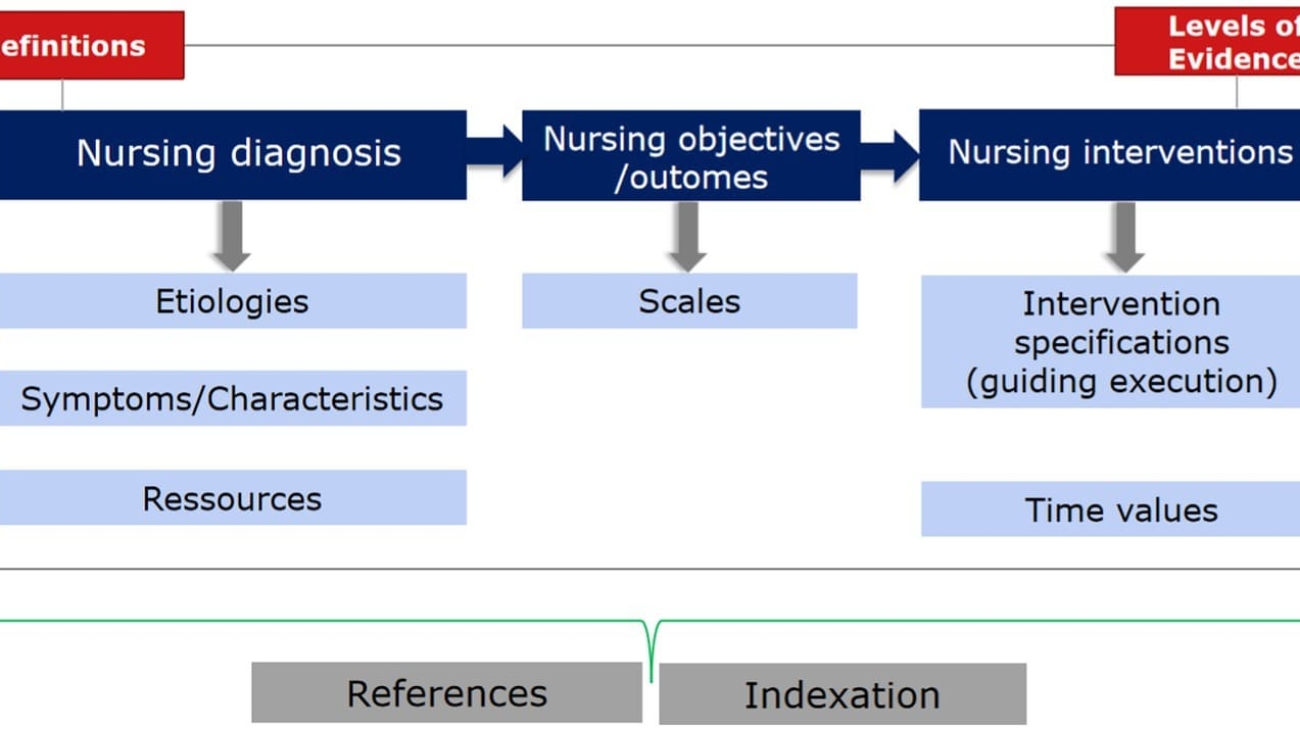
NANDA-I, NIC, NOC (NNN)

These three terminologies represent the core of the nursing process (Diagnosis, Intervention, Outcome). When used together, they create a complete, coded plan of care.

ICNP (International Classification for Nursing Practice)

A global, combinatorial standard from the ICN. Its design allows local nursing practices, like those in Uganda, to be represented in a globally understood format, facilitating international collaboration.

SNOMED CT

The most comprehensive clinical terminology in the world. Nursing concepts can be mapped to SNOMED CT, ensuring nursing data is interoperable with all other clinical data in a comprehensive EHR.

LOINC

A standard used to identify laboratory observations and clinical measurements. It provides universal codes for data like vital signs, ensuring that measurement data collected by nurses can be unambiguously understood and exchanged.

Ugandan Example: Documenting a Malaria Patient

Consider a patient with malaria. Using standardized language in an EHR creates a clear, concise, and universally understood record:

  • NANDA-I Diagnosis: "Hyperthermia related to parasitic infection (malaria)..." (Coded)
  • NIC Interventions: "Administer antipyretics as prescribed," "Monitor temperature," "Provide tepid sponge bath," "Educate patient on hydration..." (Each is coded)
  • NOC Outcomes: "Thermoregulation: Temperature returns to normal range..." and "Knowledge: Disease Management (Malaria) improved..." (Each is coded)

This structured documentation ensures every provider on the team instantly understands the patient's problem, plan of care, and expected trajectory.

Historical Nursing Classifications

The journey towards standardized nursing documentation has been a long and evolutionary process, moving from rudimentary, often subjective records to sophisticated, interoperable digital systems.

  • Early Documentation (Pre-Modern Era): Primarily narrative, unstructured, and highly variable, focusing on tasks performed rather than patient responses or clinical judgments.
  • Florence Nightingale: The Pioneer of Nursing Informatics (19th Century)

    Long before the term "informatics" existed, Nightingale systematically collected and analyzed patient statistics during the Crimean War. She used data visualization (e.g., her famous "Coxcomb" charts) to prove that nursing interventions like improved sanitation directly saved lives, providing the first scientific evidence of nursing's impact on patient outcomes.

  • Structured Formats Emerge (Mid-20th Century): Formats like SOAP notes (Subjective, Objective, Assessment, Plan) brought more organization and a logical flow to documentation, making it easier to follow a nurse's clinical reasoning.
  • Modern Classification Systems (Late 20th Century to Present): The rise of computers and evidence-based practice led to the development of systems like the Omaha System and, eventually, the internationally recognized standards we use today (NANDA-I, NIC, NOC, ICNP), designed for integration into EHRs.

Data Elements and Data Sets

To effectively manage health information, it's essential to understand its fundamental components.

  • Data Element: The smallest, most basic unit of data that holds a specific meaning (e.g., "Patient Name," "Temperature," "Gender").
  • Data Set: A structured collection of related data elements gathered for a specific purpose (e.g., to facilitate analysis or reporting).

Example: The Nursing Minimum Data Set (NMDS)

The NMDS is a globally recognized, standardized set of essential data elements collected for every patient receiving nursing care. It includes nursing care elements (diagnosis, intervention, outcome), patient demographics, and service elements (admission/discharge dates). Its purpose is to provide a consistent framework for aggregating nursing data for research, policy, and resource allocation.

Ugandan Example: Maternal and Child Health Data Set

Nurses in antenatal, postnatal, and immunization programs collect specific data elements for every mother and child. These elements include: Number of ANC Visits, Parity, Gravidity, Delivery Outcome, Child's Immunization Status, Weight at Birth, and HIV Status of Mother.

Significance: This aggregated data set, often entered into platforms like DHIS2, contributes to vital public health reports like the Uganda Demographic and Health Surveys (UDHS). The UDHS informs national health policy, program planning, and resource allocation. Without the diligent collection of these standardized data elements by nurses, evidence-based policy decisions in Uganda would be impossible.

Characteristics of a Standardized Nursing Language

A robust nursing language must have several key characteristics to be effective.

Characteristic Ugandan Context Example
1. Parsimony Uses the fewest words possible. Instead of "the surgical wound is not healing well and has pus coming out," a nurse uses: "Impaired Skin Integrity."
2. Comprehensiveness Covers all aspects of care. For an HIV patient, a nurse documents: “Ineffective Health Management,” “Risk for Infection,” and “Spiritual Distress.”
3. Mutual Exclusivity Each diagnosis refers to a unique problem. “Risk for Infection” is distinct from “Risk for Ineffective Coping.”
4. Unambiguity Each term has one clear meaning. “Acute Pain” (post-C-section) is different from “Chronic Pain” (persistent low back pain).
5. Leveling (Hierarchy) Structured from general to specific. A general diagnosis of “Impaired Mobility” can be specified as “Impaired Bed Mobility.”
6. Codifiability Can be coded for use in EHRs and national systems like DHIS2, allowing for national tracking of hospital-acquired infections.
7. Universality Applicable across all settings. “Ineffective Breastfeeding” can be used in a neonatal ICU, a rural clinic, or a home visit.
8. Reflects Nursing Practice Focuses on human responses. Instead of only documenting “Malaria,” the nurse documents: “Hyperthermia,” “Risk for Fluid Volume Deficit,” and “Activity Intolerance.”
9. Flexibility Can be updated for new health needs. The diagnosis “Risk for Infection” is flexible enough to be applied to new health threats.
10. Evidence-Based Supported by research. Using diagnoses like “Fatigue,” “Anxiety,” and “Risk for Infection” for chemotherapy patients is based on global oncology nursing evidence.

Revision: Applying NNN in Practice

Example 1: Malaria Patient with High Fever

Nursing Diagnosis (NANDA-I): Hyperthermia related to infectious process as evidenced by a body temperature of 39.5°C, flushed skin, and tachycardia.

NIC (Interventions):

  • Fever Treatment: Administer prescribed antipyretics and antimalarials. Implement cooling measures (e.g., tepid sponging).
  • Vital Signs Monitoring: Monitor temperature, pulse, and respiration every 4 hours.
  • Hydration Therapy: Encourage oral fluid intake or administer IV fluids as prescribed.

NOC (Outcomes):

  • Thermoregulation: Patient will maintain a normal body temperature (36.5–37.5°C) within 48 hours.
  • Infection Severity: Patient will show a reduction in signs of infection.

Example 2: Post-Cesarean Section Mother

Nursing Diagnosis (NANDA-I): Impaired Skin Integrity related to surgical incision as evidenced by redness and swelling around the wound edges.

NIC (Interventions):

  • Wound Care: Perform aseptic dressing changes and assess the wound for signs of infection.
  • Infection Protection: Emphasize strict hand hygiene and administer prophylactic antibiotics as prescribed.
  • Pain Management: Administer prescribed analgesics before dressing changes.

NOC (Outcomes):

  • Wound Healing: Primary Intention: Incision edges will be well-approximated with no signs of infection upon discharge.
  • Pain Level: Patient will report a pain level of less than 3/10 after interventions.

Example 3: HIV-Positive Patient with Adherence Challenges

Nursing Diagnosis (NANDA-I): Ineffective Health Management related to knowledge deficit about ART regimen as evidenced by multiple missed clinic appointments and a detectable viral load.

NIC (Interventions):

  • Health Education: Provide clear education on the importance of 100% adherence and the goal of viral suppression.
  • Motivational Interviewing: Use patient-centered communication to explore and address specific barriers to adherence.
  • Support Group Referral: Connect the patient with a peer support group and a community health worker.

NOC (Outcomes):

  • Health Beliefs: Perceived Benefit: Patient will verbalize a clear understanding of why ART is important.
  • Treatment Behavior: Illness or Injury: Patient will attend all scheduled appointments and take ART as prescribed over the next 3 months.

Assignment (Group Work)

Group Assignment Details

  1. Identify a Nursing Care Concern: Choose a common health problem in the Ugandan context (e.g., severe diarrhea and vomiting in a child, a patient with uncontrolled hypertension, a newly diagnosed diabetic patient).
  2. Presenting Signs and Symptoms: List the key subjective and objective data you would expect to find in your assessment. What is the patient/family telling you? What are you observing and measuring?
  3. Use the NANDA-I Listing: Based on your assessment data, formulate at least one appropriate nursing diagnosis. Remember to include the "related to" and "as evidenced by" components.
  4. Use the NIC Listing: Identify at least three key nursing interventions that directly address your chosen nursing diagnosis. Be specific in your actions.
  5. Use the NOC Listing: Identify at least two measurable outcomes of care. How will you know if your interventions were successful? Make sure your outcomes are specific, measurable, achievable, relevant, and time-bound (SMART).

Test Your Knowledge

A quiz on Documentation and the Nursing Language.

1. What is the definition of "Nursing documentation" according to the text?

  • A verbal report of patient status.
  • The written or electronic record of nursing assessments, interventions, and outcomes.
  • Physician's orders for patient care.
  • Hospital billing records.

Correct (b): The text directly defines "Nursing documentation" as "the written or electronic record of nursing assessments, interventions, and outcomes."

2. Which of the following is NOT listed as an importance of nursing documentation?

  • Evidence of care
  • Staff social events
  • Accountability
  • Research

Correct (b): The "Importance" section lists Evidence of care, Continuity, Accountability, Billing, Auditing, and Research. Staff social events are not related to documentation.

3. The terminology and vocabulary used by nurses to describe, communicate, and document their practice is known as what?

  • Medical jargon
  • Nursing language
  • Clinical shorthand
  • Patient narratives

Correct (b): The text defines "Nursing language" as the specific terminology and vocabulary used by nurses in their practice.

4. Which of the following is an example of "patient demographics" data?

  • Blood pressure reading
  • Pain scale score
  • Patient's age
  • Drug administration details

Correct (c): Patient demographics include data like age, sex, and contact information.

Incorrect: Blood pressure is a vital sign, pain score is a clinical assessment, and drug administration is an intervention.

5. According to the text, which type of nursing activities are often NOT captured by most information systems?

  • Managerial activities
  • Dependent or physician-directed activities
  • Independent or autonomous activities
  • All nursing activities are fully captured.

Correct (c): The text states that while managerial and dependent activities are often captured, the independent, autonomous activities of nursing are frequently not.

6. The absence of nursing data makes nursing invisible and often leads to what kind of outcomes being associated with nursing?

  • Positive patient satisfaction
  • Improved recovery rates
  • Negative outcomes (e.g., adverse events)
  • Reduced length of hospital stays

Correct (c): When nursing's contribution isn't visible in the data, nursing is often measured by negative outcomes like infections, pressure sores, and falls.

7. How do EHRs increase the visibility of nursing data?

  • By eliminating all narrative notes.
  • By storing data in unstructured formats.
  • By storing data in structured fields for analysis.
  • By allowing only physicians to access nursing notes.

Correct (c): EHRs increase data visibility by storing it in structured, retrievable fields that can be analyzed for research, quality improvement, and demonstrating nursing's impact.

8. What is a "standard" in the context of standardized terminology?

  • A flexible guideline that can be interpreted differently.
  • A documented agreement with precise criteria for consistent use.
  • A suggestion for best practice without strict adherence.
  • An informal communication method between nurses.

Correct (b): A standard is a formal, documented agreement containing precise criteria and definitions that must be used consistently to ensure clarity and interoperability.

9. Which organization is listed as responsible for creating standards in healthcare documentation?

  • WHO
  • UNESCO
  • ANA (American Nurses Association)
  • NASA

Correct (c): The text explicitly lists the ANA, ICN, and NLN as organizations responsible for creating standards.

10. What is a disadvantage of NOT documenting with standardized language?

  • Nursing care is adequately funded.
  • Nursing's contribution can be easily calculated.
  • It becomes difficult to design decision support systems.
  • Nursing resources are adequately planned.

Correct (c): Without standardized, machine-readable data, it is very difficult to build the rules and logic required for effective clinical decision support systems.

Incorrect: The other options are the opposite of what happens; without standardized data, funding, calculating contributions, and planning resources all become more difficult.

11. In standardizing terminologies, what is the second task after identifying data elements?

  • Classifying the terminology
  • Developing the terminology (e.g., NANDA)
  • Implementing the terminology in hospitals
  • Training all nurses globally

Correct (b): The process involves 1. Identifying data elements, 2. Developing the terminology, and 3. Classifying the terminology.

12. What does NANDA-I primarily describe in standardized nursing language?

  • Nursing interventions
  • Nursing diagnoses
  • Nursing outcomes
  • Medical procedures

Correct (b): NANDA-I is the standardized terminology for nursing diagnoses, such as 'Impaired Skin Integrity'.

Incorrect: NIC describes interventions, and NOC describes outcomes.

13. Which characteristic ensures that each term has one clear meaning (e.g., "Acute Pain" vs. "Chronic Pain")?

  • Parsimony
  • Comprehensiveness
  • Unambiguity
  • Leveling (Hierarchy)

Correct (c): "Unambiguity" is the characteristic that ensures each term has one clear, distinct meaning to avoid confusion.

14. When a nurse documents "Hyperthermia" for a malaria patient, this exemplifies which characteristic of nursing language?

  • Universality
  • Codifiability
  • Reflects Nursing Practice
  • Flexibility

Correct (c): This demonstrates "Reflects Nursing Practice" because it focuses on the patient's response and the nursing-relevant problem (Hyperthermia) rather than just the medical diagnosis (Malaria).

15. The Uganda Maternal and Child Health Data Set, where nurses enter ANC visits, parity, etc., is an example of what?

  • A Data Element
  • A Data Set
  • Narrative documentation
  • A medical diagnosis

Correct (b): A Data Set is a structured collection of related data elements, such as the various pieces of information collected during a maternal health visit.

Incorrect (a): A data element is a single unit, like "Parity = 2."

16. Nursing language terminology includes NIC, NOC, NANDA-I, and _________.

Rationale: The text explicitly lists NIC, NOC, NANDA-I, and OMAHA as common nursing language terminologies.

17. One of the characteristics that defines nursing as a profession is having a defined _________.

Rationale: A defined, standardized language is a key characteristic of a profession, as it allows for clear communication and the articulation of its unique body of knowledge.

18. Studies have shown that the more registered nurses there are, the fewer the _________ outcomes.

Rationale: This statement highlights the link between adequate nursing staff and improved patient safety, which can be demonstrated through the analysis of nursing data.

19. A standard is a documented agreement with precise criteria that must be used _________.

Rationale: The consistent application of a standard is what gives it power and ensures that data is comparable and unambiguous.

20. The characteristic of nursing language called _________ means it can be coded for use in EHRs.

Rationale: "Codifiability" is the specific characteristic that allows nursing concepts to be represented by codes, making them processable by computer systems.
ICT IN HEALTH & NURSING CARE

ICT in Health and Nursing Care

ICT in Health & Nursing Care : Impact of Technology

Learning Objectives

Upon successful completion of this module, students will be able to:

  • Define key concepts including Nursing Informatics, client education, discharge planning, mHealth, and health information systems within the Ugandan context.
  • Identify and Analyze various ICT methodologies used to enhance patient education and engagement.
  • Evaluate the role of nursing informatics in ensuring safe, effective, and patient-centered discharge planning.
  • Describe the structure and function of major health information systems used in Uganda, such as DHIS2 and OpenMRS.
  • Assess the benefits and significant challenges of implementing ICT solutions in both urban and rural Ugandan healthcare settings.
  • Apply theoretical frameworks, such as Roy's Adaptation Theory, to understand and facilitate the adoption of new health technologies.
  • Critically analyze case studies to understand the real-world application and impact of nursing informatics on health research and practice in Uganda.

Definition:

Information and Communication Technologies (ICT)

ICT in health and nursing care involves using digital tools to improve the efficiency, accuracy, and accessibility of clinical information, ultimately enhancing patient care. These technologies are used in various areas, such as electronic health records (EHRs), remote monitoring, and telemedicine.

While ICT offers significant benefits like reducing geographic barriers and enabling better communication, challenges persist regarding implementation, training, and potential depersonalization of care.

Nursing Informatics in Client Education

Nursing informatics in client education is the strategic and purposeful application of ICT to design, deliver, and manage educational interventions for patients, their families, and caregivers. It moves far beyond simply handing out a leaflet or giving verbal instructions. Instead, it leverages digital tools to create dynamic, interactive, and personalized learning experiences tailored to individual needs and cultural contexts.

The core objective is to significantly improve health literacy – the degree to which individuals can obtain, process, and understand basic health information to make appropriate health decisions. By integrating informatics, nurses can:

  • Foster Active Participation: Shift patients from passive reception to active engagement with their health journey using tools like interactive quizzes or goal-setting apps.
  • Ensure Cultural Relevance and Accessibility: Develop content that is culturally sensitive and available in appropriate languages and formats. In Uganda, this means reflecting local diets, practices, and languages.
  • Bridge Knowledge Gaps: Systematically help individuals comprehend complex medical conditions, treatments, and lifestyle modifications.
  • Empower Informed Decision-Making: Provide the foundation for individuals to confidently manage their conditions and participate in shared decision-making with their providers.

Advantages and Disadvantages of ICT in Healthcare

The integration of Information and Communication Technologies (ICT) into healthcare delivery offers a powerful set of tools to improve care, but it also presents significant challenges that must be carefully managed.

Advantages

  • One nurse can interact with patients remotely.
  • A single nurse can manage a larger caseload through remote monitoring.
  • Improved and faster information sharing among healthcare providers.
  • Reduced risk of cross-infection and lower patient costs (e.g., travel).
  • Doctors and nurses can hold joint remote consultations with patients and families.
  • Timely enhancements of patient self-care and health education.
  • Allows for virtual titration of medication and remote prescription changes.
  • Efficient signposting to other services, maximizing health resources.
  • Enhances public health surveillance for real-time disease outbreak detection.
  • Improves access to specialist care for rural and underserved populations.

Disadvantages

  • Potential for dehumanization of healthcare delivery.
  • Reduction of "traditional" in-person services may not be acceptable to all patients.
  • Challenge of controlling the quality and accuracy of virtual information.
  • A formulaic approach may constrain practice and inhibit professional judgment.
  • Significant investment is needed for technology and to ensure all practitioners are well-trained.
  • Patient expectations for immediate access may be unattainable or unmet.
  • Reinforcement and widening of the "digital divide."
  • Compatibility and interoperability issues across different ICT systems.
  • System failure (due to power outages, server issues) can undermine the entire healthcare process.
  • Major infrastructure gaps, including unreliable electricity and poor internet in many areas.

Summary Table

Advantages Disadvantages
  • One nurse can interact with patients remotely.
  • One nurse can manage a larger caseload.
  • Improved information sharing.
  • Reduced cross-infection and other patient 'costs'.
  • Less travel time and other health care costs.
  • Doctors and nurses can hold joint remote consultations.
  • Timely enhancements of patient self-care.
  • Virtual titration of medication and prescription changes.
  • Efficient signposting to other health services.
  • Enhanced public health surveillance.
  • Improved access to specialist care for rural areas.
  • Better data for research and health policy.
  • Dehumanization of healthcare delivery.
  • Reduction of "traditional" services may not be acceptable to all.
  • Challenge of controlling virtual information.
  • Formulaic approach may inhibit professional judgment.
  • Significant investment needed for tech and training.
  • Patient expectations may be unattainable / unmet.
  • Reinforcement of the "digital divide."
  • Compatibility issues across different ICT systems.
  • Failure of ICT can undermine the healthcare system.
  • Infrastructure gaps (power, internet).
  • High cost of data for many patients.
  • Data privacy and security risks.

The Critical and Evolving Role of Nurses in ICT-Driven Client Education

Nurses have always been at the forefront of patient education. With the advent of ICT, their role has become even more central, sophisticated, and impactful. By leveraging informatics tools, nurses can transform how they educate, leading to more effective and sustainable patient outcomes.

Reinforce with Rich, Interactive Aids

Instead of just telling a patient how to use an inhaler, a nurse can use an animated video on a tablet to visually demonstrate the technique. This enhances comprehension, especially for complex procedures or visual learners.

Provide Standardized, Evidence-Based Information

ICT platforms ensure all patients receive consistent, up-to-date information that aligns with current clinical guidelines. This reduces variations in care and minimizes misinformation.

Extend Reach Beyond Clinic Walls

Mobile technology and telehealth allow nurses to connect with patients remotely, providing education and support where it is most convenient. This is vital for patients in rural or underserved areas with transportation barriers.

Support Ongoing Self-Management

For chronic conditions like diabetes, hypertension, and HIV, nurses can use ICT to deliver personalized reminders, educational modules, and monitor patient-reported outcomes, enabling continuous support outside of clinic visits.

Assess and Adapt Education

Informatics tools can help nurses track patient engagement with educational materials (e.g., through quizzes or feedback) and adapt their teaching strategies accordingly, allowing for a more personalized and effective approach.

ICT Methodologies in Client Education

We explore specific ICT methodologies that nurses are using or can effectively use in Uganda to deliver impactful client education.

1. Multimedia Education

This methodology leverages rich sensory input—videos, animations, interactive graphics, and audio clips—to explain complex health topics. It's particularly effective for individuals with varying literacy levels, diverse language backgrounds, or for illustrating intricate procedures. The visual and auditory components can enhance engagement and memory retention significantly.

Enhanced Ugandan Examples:
  • Uganda Heart Institute: Specialized animations can demonstrate the correct method for measuring blood pressure at home using locally available devices. Videos could feature local dietitians discussing healthy, affordable food choices relevant to Ugandan cuisine.
  • Mulago National Referral Hospital (Kangaroo Mother Care): Nurses use tablets with pre-recorded, narrated videos in Luganda, Runyankore, and other languages to instruct mothers on KMC, visually explaining the technique and the benefits of skin-to-skin contact.
  • Community Health Education: In rural outreach, nurses use portable projectors to screen videos on hygiene, sanitation, or malaria prevention in community centers, followed by interactive discussions.

2. Mobile Health (mHealth) Applications

mHealth harnesses the ubiquitous nature of mobile phones to deliver health information, personalized reminders, and facilitate communication. Given that over 74% of Uganda's population has access to mobile phones, mHealth presents an unparalleled channel for reaching diverse populations, especially in remote areas.

Enhanced Ugandan Examples:
  • mTrac (SMS-based): Nurses register expectant mothers to receive automated, stage-based SMS messages in their preferred local language about antenatal care appointments, immunization schedules, and danger signs in pregnancy.
  • FamilyConnect Uganda: Registered pregnant women receive timely, actionable SMS messages with health advice, such as "Week 20: Remember to eat iron-rich foods like beans, green leafy vegetables, and meat to prevent anemia."
  • Reach Out Mbuya HIV/AIDS Initiative (ART adherence): Provides targeted SMS reminders for patients to take their ART medication, including personalized motivational messages and interactive elements where patients can confirm adherence or request support.
  • Malaria Prevention Initiative: Nurses could register households to receive SMS alerts during peak seasons, reminding them to use treated nets and seek immediate testing if symptoms appear.

3. Telehealth and Virtual Consultations

Telehealth utilizes video conferencing, audio calls, and secure messaging to facilitate remote interactions between patients and providers. This technology reduces geographical barriers, minimizes travel costs, and can improve access to specialized care, particularly in resource-limited settings.

Enhanced Ugandan Examples:
  • Connecting Karamoja to Kampala (Specialist Consults): A nurse in a rural Karamoja health center facilitates a real-time video consultation between a patient and a specialist at the Uganda Cancer Institute in Kampala, allowing for expert opinions without the costly journey.
  • Post-Discharge Wound Care: Nurses can use WhatsApp video calls to visually assess a patient's surgical wound at home, instructing them on proper care and identifying early signs of infection.
  • Mental Health Support: Telehealth can provide a discreet and accessible way for individuals to receive counseling from mental health nurses, especially where stigma is high.

4. Patient Portals and EHRs

Patient portals are secure online platforms, often integrated with the EHR, that grant patients direct access to their personal health information. These portals empower patients to view lab results, medication lists, schedule appointments, and access health education resources.

Enhanced Ugandan Examples:
  • NextGenHIMS (Discharge Summaries): While full portal adoption is growing, systems like NextGenHIMS can generate structured, personalized discharge summaries. The nurse's role is crucial to meticulously explain every detail of the summary, including medications, dosages, and follow-up appointments.
  • Future Development (Empowering Self-Management): The future holds potential for robust portals in Uganda, allowing patients to access their complete medical history, track personal health trends (e.g., blood pressure, blood glucose), communicate with nurses via secure messaging, and manage appointments online.

Nursing Informatics in Discharge Planning

Discharge planning is not merely an administrative task performed at the end of a hospital stay; it is a critical, coordinated, and interdisciplinary process that begins upon admission and continues until the patient has successfully transitioned to their next level of care. The goal is to ensure a safe, smooth, and sustainable transition, preventing complications and reducing preventable readmissions.

Nursing informatics transforms this process from a reactive, paper-based checklist into a dynamic, proactive, and technology-enhanced system. It moves from simply telling a patient what to do to equipping them with the knowledge, tools, and ongoing support necessary for self-management. This transformation involves:

  • Early Identification of Needs: Leveraging EHR data to identify high-risk patients much earlier in their hospital stay.
  • Personalized Care Plans: Utilizing informatics tools to generate individualized discharge instructions specific to the patient's condition and literacy level.
  • Seamless Information Transfer: Ensuring all relevant patient information is accurately and securely transferred to the patient and subsequent care providers.
  • Ongoing Support and Monitoring: Extending care beyond the hospital walls through digital channels for continuous education and support.

The Nurse's Pivotal Role in Ensuring Safe Transitions through Informatics

Nurses are the linchpins of effective discharge planning. By integrating informatics into their practice, nurses elevate their capacity to ensure safe and successful transitions in several key areas:

Medications

Nurses use EHRs to generate accurate, personalized medication lists, ensuring patients understand the name, purpose, dosage, schedule, side effects, administration, and proper storage of their medicines.

Follow-up Care

Nurses use electronic scheduling systems to book all necessary appointments and generate clear printouts or send SMS reminders, ensuring patients know the dates, locations, purpose, and any preparation required.

Diet and Activity

Nurses access digital guidelines, customizing them for the patient's needs and local context, discussing restrictions and recommendations using locally available and affordable foods.

Wound Care & Self-Care Procedures

Nurses use multimedia tools on tablets to visually demonstrate complex procedures like wound cleaning and dressing changes, and teach patients how to identify signs of infection.

Danger Signs

Nurses leverage ICT to create clear, concise lists of specific symptoms that require immediate medical attention, often reinforced with patient-friendly visuals (e.g., for post-surgery or post-delivery care).

Ugandan Examples

Uganda is increasingly embracing ICT in healthcare, offering inspiring examples of how informatics enhances discharge planning.

Mbarara Regional Referral Hospital – QR Code Enabled Education

Mechanics: Nurses print discharge summaries with custom QR codes linking to videos or infographics on relevant health topics (e.g., "newborn bathing techniques" or "healthy eating for diabetics using local foods").

Impact: This empowers patients to access visual and auditory information at home, at their own pace, bridging literacy gaps and improving retention.

St. Francis Hospital Nsambya – Electronic Medication Management

Mechanics: An integrated electronic system helps manage discharge medications, automates checks for drug interactions, and generates a clear, printed schedule. It also flags patients for follow-up SMS reminders for medication refills.

Impact: This significantly reduces medication errors, improves adherence, and minimizes the risk of patients running out of essential medicines.

Uganda Cancer Institute – Moderated WhatsApp Support Groups

Mechanics: Oncology nurses create and moderate secure, patient-only WhatsApp groups for patients discharged after cancer treatment.

Impact: Nurses proactively share education on managing side effects, while patients can ask questions and offer mutual support. This virtual community extends care beyond the hospital, reducing isolation and anxiety.

Smart Discharges Program (mHealth for High-Risk Children)

Mechanics: Nurses use a smartphone app to register high-risk children (e.g., from neonatal or malnutrition wards) and their caregivers. The platform then triggers personalized, stage-based SMS reminders with actionable health advice.

Impact: Research shows this program significantly changes caregiver behavior, increasing adherence to follow-up care, promoting healthy practices, and even fostering male involvement in child health.

Benefits vs. Significant Challenges of Implementing ICT Solutions in Ugandan Discharge Planning

Implementing ICT in discharge planning in Uganda brings immense benefits but also faces considerable hurdles that must be addressed for successful and equitable implementation.

Benefits

  • Reduces Readmissions & Improves Outcomes: Empowering patients with accessible information leads to fewer post-discharge complications and better long-term health.
  • Enhances Patient & Family Satisfaction: Clear instructions and ongoing support make patients feel more confident and less anxious, improving their care experience.
  • Standardizes & Elevates Quality of Education: Ensures every patient receives consistent, evidence-based educational content, reducing variability in care.
  • Strengthens Continuity of Care: ICT tools extend the nurse-patient connection beyond the hospital, enabling proactive follow-up and early intervention.
  • Empowers Patients as Active Partners: Providing direct access to information transforms patients from passive recipients to active partners in their health journey.
  • Optimizes Nurse Time & Resources: Automated reminders and digital resources can free up nurses from repetitive tasks, allowing more time for complex, personalized counseling.
  • Data Collection for Quality Improvement: ICT systems generate valuable data that can be analyzed to continuously refine and improve discharge processes.

Significant Challenges

  • Infrastructure Gaps: Limited internet connectivity (especially in rural areas), inconsistent electricity, and the high cost of mobile data are major barriers for both patients and providers.
  • Literacy Barriers (Health & Digital): Low health literacy and a lack of digital skills can prevent patients from effectively using apps or understanding digital health platforms.
  • Language Diversity: Translating and localizing all educational content into Uganda's many local languages is a massive and costly undertaking.
  • Privacy and Confidentiality Concerns: Using non-secure platforms like general WhatsApp raises significant privacy risks, while secure, purpose-built platforms can be expensive.
  • Nurse Workload and Training: High patient-to-nurse ratios leave limited time for ICT-based education, and a lack of adequate training can lead to underutilization or resistance to change.
  • Sustainability and Maintenance: Acquiring and maintaining hardware and software requires significant, sustained funding, and a lack of skilled IT support in many facilities can disrupt services.

Information Systems, mHealth, and Nursing Informatics in Health Research

Information Systems (IS) in Ugandan Healthcare

An information system (IS) is a complex, integrated framework of people, processes, and technology designed to collect, process, store, and distribute data. In the Ugandan healthcare landscape, these systems are foundational to managing patient care, conducting public health surveillance, and driving health research. They are the digital backbone upon which a more data-driven health system can be built.

Key Information Systems in Uganda:

District Health Information System 2 (DHIS2)

The cornerstone of Uganda's health data management, DHIS2 is a web-based platform used by the Ministry of Health for aggregating routine health service data from all levels of the health system.

Nursing Informatics Role: Nurses in leadership and public health roles are crucial contributors, ensuring accurate data entry for immunizations, disease incidence, etc. They use DHIS2 dashboards to monitor disease outbreaks, track health indicators, and evaluate program effectiveness, informing resource allocation and public health interventions.

OpenMRS (UgandaEMR)

An open-source Electronic Medical Record (EMR) system customized as UgandaEMR. Unlike DHIS2, it focuses on managing individual patient data for clinical care at the facility level, especially for chronic conditions like HIV/AIDS.

Nursing Informatics Role: Nurses are primary end-users, inputting patient demographics, vital signs, assessments, and medication records. They use it to track treatment adherence, monitor lab results (e.g., viral loads, CD4 counts), schedule appointments, and receive alerts, improving continuity of care.

Hospital Information Systems (HIS)

Comprehensive, integrated systems designed to manage all administrative, financial, and clinical aspects of a hospital, including patient registration, billing, and inventory control.

Nursing Informatics Role: Nurses interact with HIS for patient admission and discharge, ordering supplies, and requesting lab tests. It provides the essential administrative framework that supports clinical care.

Clinical Decision Support Systems (CDSS)

Integrated modules within EHRs that provide clinicians with evidence-based knowledge and patient-specific information to enhance decision-making.

Nursing Informatics Role: Nurses benefit from alerts for drug interactions, reminders for preventative screenings, and guidance from clinical protocols (e.g., sepsis protocols). CDSS helps reduce medical errors and improve patient safety.

Mobile Health (mHealth) in Nursing: Bridging Gaps, Empowering Care

mHealth refers to the use of mobile devices for healthcare services and information. In Uganda, with its widespread mobile phone penetration, mHealth is a transformative force, enabling nurses to extend their reach and enhance patient engagement.

Applications in Nursing Practice:

  • Health Promotion and Education: Delivering targeted health campaigns via SMS on topics like immunizations, maternal health, and malaria prevention.
  • Remote Monitoring of Chronic Conditions: Allowing patients to report health data (e.g., blood pressure, glucose levels) via their phones for remote monitoring by nurses.
  • Disease Surveillance and Outbreak Response: Enabling Community Health Workers (VHTs) to report new cases of infectious diseases in real-time.
  • Medication Adherence Support: Sending personalized medication reminders, especially for chronic conditions like HIV and TB.
  • Professional Development: Giving nurses access to continuous professional development modules and clinical guidelines on their mobile devices.

Leading mHealth Examples in Uganda:

CommCare

A flexible mobile data collection platform that allows users to build custom apps. It can guide users through structured workflows and works offline.

Impact on Nursing: Nurses train and supervise VHTs to use CommCare apps to register households, track immunizations, screen for malnutrition, and deliver consistent health education messages.

M-TIBA

A mobile health wallet that enables users to save, send, and receive funds specifically for healthcare expenses, connecting users, providers, and insurers.

Potential Impact for Uganda: Can reduce financial barriers to care, streamline payments for facilities, and enhance transparency. Nurses could interact with it for patient registration and verifying payment status.

Nursing Informatics in Health Research

Nursing informatics provides indispensable tools that are fundamentally transforming health research by streamlining data processes, enhancing data quality, and facilitating large-scale analysis.

Role of Informatics in Research:

  • Efficient and Accurate Data Collection: Replacing paper forms with electronic data capture (EDC) tools reduces errors and accelerates the research process.
  • Enabling Large-Scale Studies: Allowing researchers to conduct complex studies across vast geographical areas and large populations.
  • Facilitating Evidence-Based Practice (EBP): Providing robust evidence needed to develop and update clinical guidelines and nursing protocols.

ICT Tools for Research in Uganda:

KoboToolbox & REDCap

Powerful platforms for electronic data capture. They allow researchers to design surveys digitally, deploy them on mobile devices for offline data collection, and then upload to a secure server.

Nursing Research Example: A nurse researcher studying maternal health in Mukono can use KoboToolbox on tablets to directly collect data from mothers, reducing errors and speeding up analysis to identify gaps in service delivery.

DHIS2

While primarily an aggregate reporting system, DHIS2 is a rich source of secondary data for health research.

Nursing Research Example: A researcher can analyze anonymized, aggregated DHIS2 data to investigate trends in childhood immunization coverage across Uganda, helping to identify areas with low coverage and inform public health nursing strategies.

Statistical Software (SPSS, STATA, R)

Once data is collected electronically, it can be exported into specialized software for in-depth quantitative analysis.

Nursing Research Example: After collecting data via KoboToolbox, a nurse researcher can use STATA or R to perform rigorous statistical analysis, providing the empirical evidence needed to publish findings and influence policy.

Theoretical Framework - Roy's Adaptation Model in Nursing Informatics

Understanding Roy's Adaptation Model

Sister Callista Roy's Adaptation Model (RAM) is a prominent nursing theory that offers a powerful lens through which to understand how individuals and groups respond to environmental changes. It views the person as an adaptive system constantly interacting with a changing environment, striving to maintain physiological, psychological, and social integrity.

In nursing informatics, the introduction of new technology is a significant environmental "stimulus" that demands adaptation from nurses and students. Understanding these adaptive responses is crucial for successful technology implementation and for minimizing maladaptive outcomes like resistance or burnout.

Key Concepts of Roy's Adaptation Model Applied to Nursing Informatics:

Stimulus (Focal, Contextual, Residual)
  • Focal Stimulus: The immediate change – the integration of a new EHR, simulation lab, or mHealth app.
  • Contextual Stimuli: Other environmental factors like organizational culture, peer support, infrastructure (internet, electricity in Uganda), and workload.
  • Residual Stimuli: Unseen factors like deeply ingrained fears of technology or past negative experiences with IT systems.

Adaptive Modes: How People Respond to Stimuli

Physiological Mode

The body's physical responses. Technology can trigger stressors like eye strain from prolonged screen time, headaches from cognitive load, and musculoskeletal issues from poor ergonomics.

Self-Concept Mode

One's sense of identity and self-esteem. A nurse might initially feel anxious or incompetent when confronted with a complex new EHR, impacting job satisfaction. Mastering the technology can significantly boost self-esteem.

Role Function Mode

The roles an individual occupies. Technology often redefines a nurse's professional role to include more data analysis, telehealth coaching, or remote monitoring, which can be empowering for some but threatening for others.

Interdependence Mode

Relationships and social support systems. Technology can enhance collaboration through shared EHRs or create barriers if it leads to less face-to-face interaction or if systems are not interoperable.

Applying Roy's Adaptation Model to Nursing Education and Practice in Uganda

Roy's model provides a systematic framework for nurses and educators to proactively facilitate positive adaptation to technological changes.

Assess Adaptation Needs: Understanding the Starting Point

Before implementing new technology, a thorough assessment of psychological and social readiness is essential. Ask questions about perceptions, current competencies, and contextual factors like organizational culture and infrastructure.

Actionable Strategies:

  • Encourage early and mandatory use of Learning Management Systems (LMS) like Moodle to normalize technology use.
  • Introduce virtual simulations and serious games early in the curriculum to help students adapt in a safe environment.
  • Provide early, hands-on access to training versions ("sandboxes") of EHRs to build initial competence without fear of making real errors.

Foster Adaptive Responses: Supporting the Journey

Once needs are assessed, provide targeted interventions to facilitate positive adaptation by creating a supportive environment for learning and problem-solving.

Actionable Strategies:

  • Offer extensive, hands-on training that mirrors real-world Ugandan clinical scenarios.
  • Implement robust and accessible technical support, such as a dedicated help desk or on-site "super-users."
  • Create a transparent feedback loop where users can report challenges and suggest improvements, and act on this feedback promptly.

Promote Self-Efficacy (Confidence): Building Competence and Trust

Self-efficacy—the belief in one's capability to succeed—is critical for successful adaptation. This can be built through several methods.

Actionable Strategies:

  • Mastery Experiences: Design training that starts with simple, achievable tasks and gradually builds to more complex ones, celebrating small successes.
  • Vicarious Experiences: Pair novice learners with experienced "informatics mentors" who can model successful use of the technology.
  • Social Persuasion: Provide consistent, specific, and genuine encouragement from educators and supervisors.
  • Emotional States: Acknowledge that learning new technology can be stressful. Offer a supportive, low-pressure learning environment where asking for help is encouraged.

By systematically applying Roy's Adaptation Model, nursing informatics professionals and educators can create more humane and effective strategies for integrating technology into nursing in Uganda, leading to improved patient outcomes and a more empowered nursing workforce.

Test Your Knowledge

A quiz on ICT in Health & Nursing Care.

1. Which of the following is NOT listed as an ICT tool used to enhance client education?

  • Mobile apps
  • Fax machines
  • Videos
  • Patient portals

Correct (b): The definition of nursing informatics in client education explicitly lists mobile apps, SMS, videos, and patient portals. Fax machines are an older technology and are not mentioned in this context.

2. What ICT methodology is used at Mulago Hospital to teach mothers about kangaroo mother care?

  • Telehealth and Virtual Consultations
  • Patient Portals and EHR
  • Multimedia Education (using tablets with animations)
  • Mobile Health (mHealth) Applications (SMS reminders)

Correct (c): The example for Mulago National Referral Hospital specifically mentions that nurses use "tablets with animations to teach mothers," which falls under multimedia education.

3. The use of SMS reminders for ART adherence at Reach Out Mbuya is an example of which methodology?

  • Multimedia Education
  • Mobile Health (mHealth) Applications
  • Telehealth and Virtual Consultations
  • Patient Portals and EHR

Correct (b): Sending SMS reminders for medication adherence is a classic example of a Mobile Health (mHealth) application.

4. How do nurses at the Uganda Heart Institute use videos to educate patients?

  • Via telehealth calls at home.
  • Through patient portals post-discharge.
  • In waiting areas about lifestyle modification.
  • During formal classroom sessions.

Correct (c): The text provides a specific example of multimedia education where "patients watch videos about lifestyle modification in waiting areas" at the Uganda Heart Institute.

5. Which of the following is a primary role of Nursing Informatics in discharge planning?

  • To manage hospital billing.
  • To ensure patients understand their post-discharge care.
  • To schedule nurse shifts.
  • To conduct medical research.

Correct (b): The core role in discharge planning is ensuring a safe transition by making sure patients understand their medications, follow-up, diet, and danger signs.

Incorrect: The other options relate to administration and research, not the direct patient transition process of discharge.

6. At Mbarara Hospital, what do nurses use to link printed discharge booklets to Ministry of Health guidelines?

  • Direct hyperlinks
  • QR codes
  • SMS messages
  • Patient portals

Correct (b): The example for Mbarara Regional Referral Hospital explicitly states the use of "printed discharge booklets with QR codes linking to Ministry of Health guidelines."

7. What is a listed benefit of using nursing informatics in client education and discharge planning?

  • Increases readmission rates.
  • Limits nurse-patient communication.
  • Promotes continuity of care through ICT follow-up.
  • Discourages patient self-care.

Correct (c): A key benefit is promoting continuity of care through tools like SMS reminders, telehealth follow-ups, and accessible patient portals.

Incorrect: Informatics aims to achieve the opposite of the other options: it reduces readmissions, strengthens communication, and improves patient self-care.

8. Which is a challenge for ICT in health & nursing care in rural health facilities?

  • High digital literacy among patients.
  • Robust ICT infrastructure.
  • Limited ICT infrastructure.
  • Abundant time for nurses for ICT-based teaching.

Correct (c): A major challenge, especially in rural areas, is the lack of reliable internet, power, and necessary hardware, which is defined as limited ICT infrastructure.

Incorrect: The other options are the opposite of the listed challenges.

9. In the case study, what combination of actions by the nurse led to reduced readmissions and improved satisfaction?

  • Giving verbal instructions only.
  • Using a tablet video, a printed summary, and an SMS reminder system.
  • Referring the patient to a doctor without further education.
  • Providing a generic discharge plan for all patients.

Correct (b): The case study demonstrates a multi-faceted approach, combining multimedia education (video), clear documentation (summary), and mHealth follow-up (SMS) to achieve positive outcomes.

10. Which component of Information Systems (IS) is defined as "Designed to support nursing functions" by managing health data?

  • People
  • Processes
  • Technology
  • Structured frameworks

Correct (b): The description of collecting, storing, analyzing, and disseminating health data to support nursing functions refers to the core processes that these systems are designed to perform.

11. DHIS2, NextGen, and KoboToolbox are listed as examples of what in Uganda?

  • Specific mHealth applications
  • Information systems in nursing
  • Telehealth platforms
  • Patient education videos

Correct (b): These are all explicitly listed under the heading "Information systems in nursing: In Uganda, examples include..."

12. What is mHealth primarily defined as in the provided text?

  • The use of advanced robotic surgery.
  • The use of mobile devices, SMS, and wireless technologies in healthcare.
  • The development of new pharmaceutical drugs.
  • The management of hospital finances.

Correct (b): The definition provided for mHealth is "The use of mobile devices, SMS, mobile applications, and wireless technologies in healthcare."

13. Which ICT tool is mentioned for aggregating district health data for planning and monitoring?

  • REDCap
  • SPSS
  • DHIS2
  • M-TIBA

Correct (c): Under "ICT Tools for Research," DHIS2 is specifically described as the tool that "Aggregates district health data for planning and monitoring."

Incorrect: REDCap is for field surveys, SPSS for analysis, and M-TIBA for healthcare financing.

14. What is a challenge identified for nursing informatics in health research?

  • Unlimited ICT infrastructure.
  • Low cost of systems.
  • Abundant ICT training among nurses.
  • Data security and ethical concerns.

Correct (d): The challenges section for health research explicitly lists "Data security and ethical concerns" as a key issue.

Incorrect: The other options are the opposite of the listed challenges.

15. Roy's Adaptation Theory applied to nursing informatics focuses on how to adapt to what?

  • Regulatory policies
  • Technology stimuli
  • Economic fluctuations
  • Patient demands

Correct (b): The theory is applied to how nurses adapt to "technology stimuli" in their environment across all domains of practice.

16. The use of ICT to enhance the education of patients and caregivers is Nursing Informatics in _________ education.

Rationale: This term is used to describe patient-facing educational activities using informatics tools.

17. Nurses at St. Francis Hospital Nsambya send follow-up _________ reminders for discharge medications.

Rationale: The specific example for St. Francis Hospital Nsambya mentions the use of an electronic system to send "follow-up SMS reminders."

18. One benefit of nursing informatics is that it promotes _________ of care through ICT follow-up.

Rationale: The benefits section explicitly lists "Promotes continuity of care through ICT follow-up."

19. A hospital's patient demographics, admissions, and billing are managed by a _________ Information System (HIS).

Rationale: A Hospital Information System (HIS) is the specific term for the comprehensive system that manages these core administrative and demographic functions.

20. Roy's Adaptation Theory suggests fostering adaptive responses to technology through hands-on learning, support, and _________.

Rationale: The application of Roy's theory involves encouraging user engagement with technology through hands-on learning, providing support, and offering feedback.
Theoretical Models in Nursing Informatics

Theoretical Models in Nursing Informatics

Theoretical Models in Nursing Informatics : Theories

Theoretical Models in Nursing Informatics

Theoretical models are like maps or blueprints that help us understand concepts. In nursing informatics, these models provide a framework for understanding and applying informatics principles, guiding how we think about data, manage change, and implement technology effectively in healthcare.

1. The DIKW Model: From Data to Wisdom

This is a foundational model, often depicted as a pyramid, illustrating how raw, unprocessed facts evolve into profound understanding and expert judgment. It's crucial for understanding the value proposition of nursing informatics – transforming simple observations into actionable wisdom for patient care.

Data

Raw, isolated, and unprocessed facts without context or meaning. By itself, it doesn't tell a story or answer a question. Simplified: Just numbers, words, or observations.

Expanded Example:
  • A single blood pressure reading: "150/95 mmHg".
  • A patient's temperature: "39°C".
  • A lab result: "White Blood Cell count: 15,000".
  • A patient's complaint: "I have a headache".
  • In a Ugandan clinic: A register entry showing "Patient John Doe, Age 45, Malaria test positive".

Information

Data that has been organized, structured, processed, or interpreted within a specific context. It answers "who," "what," "where," and "when." Data with meaning.

Expanded Example:
  • A series of blood pressure readings over 24 hours (e.g., 150/95, 148/92, 155/98) showing a consistently high trend, which the EHR flags as "hypertension" based on predefined ranges. The 39°C temperature is flagged as a "fever" by comparing it to normal body temperature ranges. This gives context.
  • A patient's medication list, their history of allergies, and current lab results, all presented together in their EHR profile.
  • In a Ugandan clinic: Seeing that "John Doe, Age 45" (data points) tested positive for malaria after visiting a specific village where there's a known outbreak (context), and correlating this with his symptoms of fever and chills (more context). This provides actionable information about his condition and potential exposure.

Knowledge

The synthesis of information, often through experience, education, and research, to identify relationships, patterns, and principles. It answers "how" to apply information and understand its implications. Understanding why something is happening and what it means.

Expanded Example:
  • The nurse combines the information (consistently high blood pressure, persistent fever, high WBC count) with their clinical knowledge (nursing science). They recognize that high blood pressure increases cardiovascular risk, that a fever and high WBC count could indicate an infection (e.g., bacterial), and that the patient's complaint of headache might be related to these findings.
  • Knowing that patients on certain medications are more prone to falls or that a particular cough pattern is indicative of a specific respiratory illness.
  • In a Ugandan context: A nurse knowing that a positive malaria test in a patient from a high-transmission area, combined with a persistent fever, means they need specific antimalarial treatment and patient education on prevention.

Wisdom

The ability to apply knowledge, experience, and intuition with judgment to manage and solve problems effectively and ethically, especially in complex or novel situations. It involves understanding "why" to do something and "when" to do it, considering values and societal implications. Expert judgment and decision-making that leads to the best outcome.

Expanded Example:
  • Knowing the patient's history of sepsis and considering the current high fever and elevated WBCs, the seasoned nurse uses their wisdom not just to treat the fever symptomatically, but to immediately initiate the sepsis protocol. This involves drawing blood cultures before administering antibiotics, administering broad-spectrum antibiotics promptly, monitoring vital signs intensely, alerting the physician with a specific concern for sepsis, and educating the family on the gravity of the situation. This proactive, expert decision-making significantly improves the patient's outcome by acting rapidly and holistically.
  • A nurse informaticist, using their wisdom, might recommend designing an EHR alert system to be subtle for common benign interactions but highly prominent for life-threatening situations, balancing user experience with patient safety.
  • In a Ugandan context: A community health nurse, observing a pattern of increasing malaria cases after a specific rainfall period in their region (knowledge), uses their wisdom to mobilize community leaders for a mass bed net distribution campaign and initiate an immediate health education drive, rather than just treating individual cases as they present.

2. Graves & Corcoran's Model (1989)

This early and influential model provided a crucial conceptual framework for nursing informatics. It's often visualized as three overlapping circles (nursing science, computer science, information science) with data, information, and knowledge flowing through them, all directed towards supporting nursing practice. It was groundbreaking because it shifted the focus from merely using technology to understanding the purpose of information processing in nursing care.

Core Idea: Nursing informatics integrates the three core sciences to manage and process data, information, and knowledge effectively for the benefit of nursing practice.

Aims of the Model

The model was designed to provide a clear roadmap for nursing informatics with three primary goals:

  • Identify the information needs in nursing: To figure out exactly what information nurses need to do their jobs effectively, whether they are at the bedside, in a classroom, or managing a clinic.
  • _ Specify the sources and systems that provide information: To pinpoint where this necessary information comes from (e.g., the patient, lab results, other departments) and what technological systems (like EHRs) are needed to deliver it.
  • Show how informatics can help nurses achieve their goals: To demonstrate how technology can be a powerful tool to help nurses accomplish their objectives in all areas, including patient care, education, research, and management.

Main Components

  • Users: The people who need and use the information. This isn't just nurses; it includes doctors, administrators, technicians, and even patients and their families who interact with health information.
  • Roles: The specific functions or jobs these users perform. A person's role determines what kind of information they need. For example, a clinician needs patient data, an educator needs learning resources, a researcher needs aggregated data, and an administrator needs operational data.
  • Settings: Where the nursing activities take place. The setting heavily influences the technology and information needed. A nurse in a high-tech urban hospital has different resources and needs than a nurse in a remote community clinic or a patient's home for home care.
  • Goals: The desired outcomes or what the user is trying to accomplish. Goals can be clinical (improve patient safety), educational (enhance student learning), research-focused (discover new knowledge), or administrative (increase workflow efficiency).
  • Knowledge Base: The foundation of professional knowledge required to perform the role. For a nurse, this includes clinical guidelines, nursing theory, pharmacology, and evidence-based practice, as well as knowledge from other fields like ethics and leadership.
  • Information Technologies: The specific tools and systems used to achieve the goals. This includes hardware (computers, tablets) and software (EHRs, telehealth platforms, clinical decision support systems, virtual simulation labs, scheduling software).

Flow of the Model

The model works by systematically connecting the components. The following table shows a practical example of how to apply the model step-by-step:

Steps Examples in an Educational Context
Step 1: Identify the user and role. User: Nurse Educator
Role: Teaching
Step 2: Define the setting. Setting: Nursing school or a university's skills lab.
Step 3: Clarify the goal. Goal: Improve students’ skills and confidence in performing complex patient assessments.
Step 4: Apply knowledge & select technology. Knowledge Base: Educational theory (e.g., experiential learning), clinical assessment guidelines, and best practices in simulation.
Information Technologies: Select virtual simulation labs and interactive online case study platforms.
Step 5: Achieve the nursing outcome. Outcome: Students practice assessments in a safe, repeatable virtual environment, leading to increased competency and better preparedness for real clinical settings.

3. Theories of Change: Implementing New Technology

Implementing new technology, like a new EHR system or a telehealth platform, is a significant undertaking that requires careful management of human behavior and organizational processes. Understanding change theories is essential for successful adoption and minimizing resistance.

a) Lewin's Change Theory (Unfreeze-Change-Refreeze)

Kurt Lewin's classic model provides a simple yet powerful three-step process for managing planned change within an organization.

Step 1: Unfreezing

Preparing the organization or individuals for change by creating awareness of why the old way of doing things is no longer sufficient and establishing a felt need for change. It involves breaking down old habits and assumptions. Convincing everyone that the old way isn't working and a new way is needed.

Expanded Example: A hospital management team presents compelling data on the high rates of medication errors, documentation inefficiencies, and patient complaints linked to the current paper-based charting system. They hold town hall meetings and workshops, actively involving nursing staff, to discuss the critical need for a new EHR system to improve patient safety, streamline workflows, and enhance overall quality of care. They highlight the financial and reputational costs of not changing.

Step 2: Moving (or Changing)

The actual implementation phase where the change occurs. This stage involves significant training, communication, support, and adaptation as people learn new processes and tools. Rolling out the new system and teaching everyone how to use it.

Expanded Example: The new EHR system is rolled out systematically, perhaps unit by unit or department by department. Intensive, hands-on training sessions are conducted for all nursing staff. Specially trained "super-users" (nurses proficient in the new system) are deployed on the floors to provide immediate, peer-to-peer support. The IT department establishes a dedicated 24/7 help desk. Regular feedback sessions are held to identify and quickly address any technical glitches or workflow issues.

Step 3: Refreezing

Stabilizing the change and making it the new standard practice. This involves integrating the new methods into the organizational culture, updating policies, and reinforcing the benefits of the change. Making the new way the permanent, normal way of doing things.

Expanded Example: New hospital policies and procedures are formally established that mandate the exclusive use of the EHR for all patient documentation and order entry. Leadership publicly celebrates early successes (e.g., reduction in medication errors, improved documentation compliance). Ongoing refresher training is provided for new hires and to address advanced features. Audits are performed to ensure compliance, and the use of the EHR becomes deeply embedded in the daily workflow, becoming the "new normal."

b) Rogers' Diffusion of Innovations Theory

Everett Rogers' theory examines how new ideas, technologies, or practices spread through a social system over time. It's particularly useful for understanding how different groups of people adopt innovations at different rates, allowing for tailored communication and implementation strategies.

Adopter Categories:
Innovators (2.5%)

These are the first to adopt new ideas, often risk-takers and enthusiasts. They are eager to experiment.

Role: Often seek out new technology and are willing to try it even if it's not perfect.

Example: When a new telehealth platform is introduced in a Ugandan district, an innovator nurse might be the first to volunteer for the pilot program, eager to test its capabilities and provide early feedback, even if internet connectivity is sometimes challenging.

Early Adopters (13.5%)

Respected opinion leaders within the community or profession. They adopt new ideas early but with more thought and evaluation than innovators. They are crucial for influencing the broader group.

Role: Act as role models and champions, legitimizing the innovation.

Example: Other experienced and well-respected nurses in the district watch the innovators. Seeing the benefits, an early adopter nurse begins using the telehealth platform and actively champions its use to their peers, sharing their positive experiences and insights during staff meetings.

Early Majority (34%)

Deliberate individuals who adopt new ideas just before the average person. They need to see evidence that the innovation works and is useful.

Role: They make the innovation mainstream.

Example: After seeing positive results and hearing positive feedback from the early adopters, the majority of nurses in the district begin to adopt the telehealth platform, recognizing its practical benefits for patient care and convenience.

Late Majority (34%)

Skeptical individuals who will only adopt an innovation after a majority of people have tried it and it has become widely accepted. They are often influenced by peer pressure or economic necessity.

Role: Their adoption signals widespread acceptance.

Example: Some nurses are hesitant and prefer traditional methods. They only begin to use the telehealth platform when it becomes an established and expected part of routine practice, perhaps after a mandate or when training and support are widely available.

Laggards (16%)

Traditionalists who are the last to adopt an innovation. They are often resistant to change, prefer traditional methods, and have little to no opinion leadership.

Role: May only adopt when older options are no longer available.

Example: A few nurses may resist using the telehealth platform until there's virtually no other option for certain consultations or if their traditional methods become unsustainable. They might require significant individual support and encouragement.

Application: Understanding these categories helps implementers tailor their communication, training, and support strategies to each group to maximize adoption.

4. General Systems Theory

This theory views any organization, like a hospital, a clinic, or even a patient's body, as a complex system. It posits that a system is made up of many interconnected parts (subsystems) that work together to achieve a common goal. A key tenet is that a change in one part of the system will inevitably affect all other parts, highlighting the importance of a holistic perspective.

Core Idea: Everything is connected. When you change one thing in a system, it impacts everything else.

Key Concepts:

Input

Resources, information, or energy entering the system from its environment.

Example: Patient demographic data, lab results, nurse staffing levels, available IT infrastructure (computers, internet connectivity), medical supplies.

Throughput (Process)

The activities or work done within the system to transform the input.

Example: Nurses and doctors entering and processing patient data within the EHR, administering medications, performing patient assessments, collaborating with other departments, and making clinical decisions.

Output

The products, services, or outcomes that result from the system's processes.

Example: A complete and accurate patient health record, clinical decision support alerts, patient discharge summaries, billing information, improved patient outcomes (e.g., reduced readmission rates).

Feedback

Information about the system's output that is fed back into the system to make adjustments, correct errors, and improve future performance.

Example: Nurses report that a specific screen in the EHR is confusing or takes too long to complete, leading to a system modification by the IT team. Patient satisfaction surveys, infection rates, or medication error reports provide feedback on the quality of care delivered.

Environment

External factors, conditions, or influences that interact with and affect the system but are largely outside its direct control.

Example: Government regulations (e.g., data protection laws like Uganda's Data Protection and Privacy Act, or international standards like HIPAA), economic conditions, technological advancements, patient demographics, public health crises (like an epidemic), and relationships with technology vendors.

Expanded Example (EHR Implementation)

When implementing a new EHR in a large hospital through a systems lens:

  • Input: The system requires patient demographic data, past medical histories (often from old paper charts), new lab results, skilled IT staff, adequate budget, and training materials.
  • Throughput: Nurses, doctors, and other healthcare professionals spend time learning the new system, entering data, navigating interfaces, and adapting their workflows. Data flows between different modules (e.g., admissions, lab, pharmacy).
  • Output: A comprehensive, digital patient record, automated clinical decision support alerts, streamlined billing, and eventually, potentially improved patient outcomes and reduced errors.
  • Feedback: Nurses complain about too many clicks to perform a common task. This feedback prompts the informatics team to optimize the workflow. Analytics show a reduction in medication errors, reinforcing the system's value.
  • Environment: The national Ministry of Health mandates certain data reporting standards, requiring the EHR to be updated. A power outage (environmental factor) can bring the entire system down, highlighting the need for robust backup systems and generators.

Summary Table

Concepts Example: Implementation of an EHR
System Hospital’s health information infrastructure.
Input Patient data (demographics, vitals, lab results), staff expertise, IT resources.
Throughput (Process) Data entry, storage, processing, and analysis within the EHR system.
Output Patient charts, clinical decision support alerts, discharge summaries.
Feedback User satisfaction surveys, system usage reports, error rates.
Environment Government regulations, technology vendors, patient needs, and funding.
Open vs. Closed Systems Open Systems:
  • EHR (interacts with Lab, Pharmacy, Insurance)
  • Telehealth platforms
Closed System:
  • A standalone BP monitoring program on one PC
  • A non-networked hospital database

The Impact and Practice of Nursing Informatics

This module explores the tangible benefits that nursing informatics brings to healthcare and introduces the crucial role of the Nurse Informaticist, the specialist who drives many of these advancements.

Overall Benefits of Nursing Informatics

Nursing informatics isn't just about using computers; it's about fundamentally transforming healthcare for the better. Here are some of its most significant impacts:

1. Making Previously Buried Data Usable & Actionable

Historically, vast amounts of clinical data were locked away in paper charts, making it incredibly difficult to analyze or learn from. Informatics systems (like EHRs) digitize this data, allowing it to be easily searched, aggregated, and analyzed. Turns piles of paper notes into smart insights.

Expanded Example: Instead of manually sifting through hundreds of patient files to find out how many patients with malaria responded to a specific treatment, an informaticist can query the EHR. This data can then be used for quality improvement projects (e.g., "Are we giving the right malaria treatment?") or for research. In a broader sense, this data can inform public health strategies in Uganda by showing patterns of disease outbreaks or the effectiveness of vaccination campaigns across different districts.

2. Improving Patient Safety & Reducing Errors

Informatics systems are designed with patient safety at their core, significantly reducing the potential for human error. Built-in safeguards prevent mistakes.

Expanded Examples: Barcode Medication Administration (BCMA) provides a crucial safety net. Clinical Decision Support (CDS) Alerts can automatically flag a severe drug allergy or a dangerous drug-drug interaction. Eliminating illegible handwriting ensures all care providers are working with accurate information.

3. Providing Data That Healthcare Buyers Demand (Quality Reporting)

Informatics systems capture the data needed to demonstrate quality outcomes and cost-effectiveness to insurance companies, government agencies, and donors. Shows proof of good care and efficient spending.

Expanded Example: A hospital can easily generate reports showing its infection rates or patient readmission rates. In Uganda, this could mean demonstrating to the Ministry of Health that specific health interventions are effective and resources are being used wisely, leading to continued funding and support.

4. Easier Storage and Retrieval of Records

The digital nature of EHRs eliminates the physical space, security risks, and retrieval delays associated with paper charts. Information can be accessed instantly from multiple locations simultaneously. No more lost charts or endless searching; everything is a click away.

Expanded Example: Instead of searching through dusty paper archives, a nurse can access a patient's medical history instantly from a workstation or mobile device, even if the patient was last seen years ago. This is highly beneficial where maintaining a continuous paper record is challenging.

5. Saving Time and Money

By streamlining workflows, reducing redundant tests, preventing errors, and improving efficiency, informatics contributes significantly to cost savings and better resource utilization. More efficient care, fewer wasted resources.

Expanded Example: Reduced time spent on documentation means nurses have more time for direct patient care. Preventing a medication error avoids the costs associated with extended hospital stays and additional treatments. Electronic ordering of tests and medications reduces errors and speeds up processes.

The Role of the Nurse Informaticist

A Nurse Informaticist (NI) is a highly specialized registered nurse who possesses a deep understanding of both clinical nursing practice and information technology. They are critical to successful technology integration in healthcare, acting as the indispensable link between the worlds of nursing and IT.

  • Who they are: A registered nurse with advanced training or experience in informatics.
  • Their unique value: They speak the language of both clinicians and IT professionals, ensuring that technology solutions truly meet the needs of patient care.

Common Roles and Responsibilities:

System Implementation

Play a central role in bringing new clinical information systems into an organization, from evaluation and customization to rollout.

Example: When a hospital in Kampala upgrades its EHR, the NI leads requirements gathering from nurses, works with vendors to configure the system for local practices, designs workflows, and oversees testing and go-live.

Workflow Optimization

Analyze existing clinical processes and identify areas where technology can make them more efficient, safer, and user-friendly.

Example: An NI might observe nurses spending too much time navigating the EHR to document vitals. They would then work with IT to streamline the process by creating a consolidated "daily care" screen, reducing charting burden.

Training and Support

Develop and deliver comprehensive training programs for all nursing staff on how to use technology effectively and serve as a primary resource for troubleshooting.

Example: After a new patient monitoring system is installed, the NI will design and lead hands-on training, create user guides, and be on-site during go-live to provide immediate support.

Data Analysis

Extract, interpret, and present data from clinical systems to identify trends, monitor quality metrics, and support research.

Example: An NI might analyze EHR data to identify a correlation between a specific staffing model and patient fall rates, providing evidence for practice changes. In public health, they might analyze vaccination rates against disease incidence.

Policy and Procedure Development

Develop and update organizational policies related to the secure and ethical use of clinical information systems, including data privacy and security.

Example: The NI will ensure the hospital's policies for accessing EHR data comply with national data privacy laws, developing clear guidelines on what information nurses can share and how to handle sensitive data.

Competencies and Ethical Responsibilities

As technology becomes more ingrained in nursing, every nurse needs a foundational understanding of informatics. This module highlights the essential competencies and the critical ethical responsibilities that come with managing patient data.

Developing Your Informatics Competencies

It's not just Nurse Informaticists who need informatics skills; all nurses require a baseline level of competency. The TIGER (Technology Informatics Guiding Education Reform) Initiative provides a widely recognized framework:

Basic Computer Skills

The fundamental ability to use computers and software. Knowing how to use a computer. This includes using a keyboard, navigating operating systems, sending emails, and basic file management.

Information Literacy

The ability to find, evaluate, and use relevant information. Knowing how to find good information and tell if it's trustworthy. This includes searching databases like PubMed and critically evaluating online sources.

Information Management

The ability to use clinical information systems like the EHR. Knowing how to use patient record systems effectively. This includes documenting care, retrieving data, and using decision support tools.

Ethical Considerations in Nursing Informatics

The power of digital health information comes with significant ethical responsibilities. Nurses are trusted custodians of patient data.

Patient Privacy & Confidentiality

Protecting sensitive patient information from unauthorized access or misuse. Keeping patient information secret. This means never sharing data without consent and being mindful of who can see or hear information.

Data Security

Implementing safeguards to protect electronic health information from being lost, stolen, or corrupted. Protecting patient data from hackers and mistakes. This includes using strong passwords and logging out of systems.

Data Integrity

Ensuring that the data being entered, stored, and retrieved is accurate, complete, and reliable. Making sure patient records are always correct. Inaccurate data can lead to serious patient harm.

Reflection and Future Outlook

This module provides an opportunity for personal reflection on the material covered and looks ahead to the exciting and rapidly evolving future of nursing informatics.

Reflection & Takeaways: Connecting Concepts to Your Practice

Take a moment to pause and consider how the concepts we've discussed apply to your own experiences and aspirations in nursing.

  • Which nursing informatics model resonates most with you and why? Consider the DIKW model, Lewin's Change Theory, or Rogers' Diffusion of Innovations. How do they explain experiences you've had in your workplace?
  • Identify two areas you would like to improve in your technology competence. Based on the TIGER competencies, where do you see opportunities for personal growth?
  • Consider how ICT (Information and Communication Technology) will shape your future nursing practice. Think about emerging technologies like AI, telehealth, and genomics. How might these tools change how you deliver care?

The Future of Nursing Informatics

The field of nursing informatics is dynamic and constantly evolving. Here are some key trends that will shape its future:

Telehealth and Virtual Care Expansion

The use of technology to deliver healthcare remotely. Expect a continued surge in virtual appointments and remote patient monitoring, which is transformative for extending healthcare access to underserved rural populations, a significant benefit in Uganda.

Big Data and Predictive Analytics

Analyzing enormous volumes of healthcare data to identify patterns, predict outcomes, and guide interventions. Nurses will use this to identify high-risk patients for events like sepsis or falls before they occur, allowing for proactive, personalized care.

Artificial Intelligence (AI) and Machine Learning (ML)

AI will integrate into clinical decision support, offering sophisticated guidance on diagnoses and treatment plans. It may also automate routine documentation, freeing up nurses for more direct patient interaction.

Patient Engagement Technologies

Empowering patients to take a more active role in their health through advanced patient portals, mobile health apps (mHealth), and wearable devices. Nurses will be key in educating patients on how to use these tools effectively.

Interoperability and Seamless Data Exchange

The ability of different healthcare systems to communicate and exchange data seamlessly. The goal is for a patient's health information to follow them effortlessly across all providers, reducing redundant tests and improving care coordination.

Test Your Knowledge

A quiz on Theoretical Models in Nursing Informatics.

1. In the DIKW Pyramid, what is defined as "raw facts without context"?

  • Information
  • Knowledge
  • Data
  • Wisdom

Correct (c): "Data" is explicitly defined as "Raw facts without context."

Incorrect (a): Information is organized data with meaning.

Incorrect (b): Knowledge is synthesized information for decision-making.

Incorrect (d): Wisdom is applying knowledge effectively.

2. According to the DIKW Model, when is information combined with nursing experience and evidence?

  • To form Data
  • To become Wisdom
  • To create Knowledge
  • To generate new Information

Correct (c): Knowledge is formed when information is combined with nursing experience and evidence (e.g., knowing high BP increases cardiovascular risk).

Incorrect (b): Wisdom is the application of knowledge.

3. Which of the following would be an example of 'Wisdom' in the DIKW Pyramid?

  • A patient's temperature of 39°C.
  • The EHR flagging 39°C as a "fever."
  • Knowing that a fever could indicate infection.
  • Creating a personalized care plan based on a patient's risks.

Correct (d): Wisdom is applying knowledge to make a sound decision, such as creating a personalized care plan based on identified risks.

Incorrect (a): This is Data.

Incorrect (b): This is Information.

Incorrect (c): This is Knowledge.

4. The Graves & Corcoran Model (1989) describes the key components for nurses to effectively use what?

  • Individual patient charts
  • Manual documentation systems
  • Information systems
  • Only hardware tools

Correct (c): The model explicitly "describes the key components and relationships needed for nurses to effectively use information systems in healthcare."

5. Which of the following is NOT listed as a main component of the Graves & Corcoran Model?

  • Users
  • Goals
  • Funding
  • Settings

Correct (c): The main components listed are Users, Roles, Settings, Goals, Knowledge Base, and Information Technologies. Funding is not a core component of the model itself.

6. In the Graves & Corcoran Model, which step involves applying the knowledge base and selecting technologies?

  • Step 1: Identify the user and role.
  • Step 2: Define the setting.
  • Step 3: Clarify the goal.
  • Step 4: Apply knowledge base and select technologies.

Correct (d): The model's flow clearly outlines Step 4 as "Apply the knowledge base and select the right information technologies."

7. Roger's Diffusion of Innovation Theory is categorized as which type of change?

  • Planned
  • Unplanned
  • Static
  • Revolutionary

Correct (b): Roger's theory describes how innovations spread naturally through a social system, which is considered an "unplanned" pattern of change.

Incorrect (a): Lewin's Change Theory is an example of a "planned" change model.

8. According to Roger's theory, which category of adopters are opinion leaders and promoters?

  • Innovators
  • Early adopters
  • Early majority
  • Laggards

Correct (b): Early adopters are described as "opinion leaders who function as promoters of innovation."

Incorrect (a): Innovators are the very first to adopt but are a smaller group.

Incorrect (c): The early majority are averse to risks.

Incorrect (d): Laggards are suspicious and resistant to change.

9. The "Late majority" in Roger's theory typically needs what before adopting an innovation?

  • To be convinced it's cutting-edge.
  • To be sure the innovation is beneficial.
  • To be the first ones to try it.
  • No convincing, they adopt quickly.

Correct (b): The late majority are skeptical and require proof that the innovation is beneficial and has been adopted by many others before they will consider it.

10. Which step in Lewin's Change Theory involves preparing people and explaining why change is needed?

  • Unfreezing
  • Moving (changing)
  • Refreezing
  • Innovating

Correct (a): "Unfreezing" is the initial step where awareness is created, and people are prepared to move away from the current state.

Incorrect (b): Moving is the implementation phase.

Incorrect (c): Refreezing is about sustaining the change.

11. Providing hands-on training and user support during a new system implementation falls under which step of Lewin's theory?

  • Unfreezing
  • Moving (changing)
  • Refreezing
  • Evaluating

Correct (b): The "Changing (Moving)" step is the transition phase where the new system is rolled out, and users are provided with training and support.

12. What is the goal of the 'Refreezing' step in Lewin's Change Theory?

  • To identify the need for change.
  • To implement the new system.
  • To ensure the new way becomes part of everyday practice.
  • To revert to the old methods if resistance is high.

Correct (c): The goal of "Refreezing" is to stabilize the change and integrate it into the normal workflow to ensure it becomes permanent.

Incorrect (a): This is the goal of Unfreezing.

Incorrect (b): This is the goal of Moving.

13. In General Systems Theory, what is "Resources, information, or energy entering the system"?

  • Output
  • Throughput
  • Feedback
  • Input

Correct (d): "Input" is defined as "Resources, information, or energy entering the system."

Incorrect (a): Output is what is generated by the system.

Incorrect (b): Throughput is how inputs are transformed.

Incorrect (c): Feedback is information about performance.

14. User satisfaction surveys and system usage reports are examples of what concept in General Systems Theory?

  • Input
  • Throughput
  • Feedback
  • Environment

Correct (c): "Feedback" is "Information about the system’s performance used to make adjustments," which perfectly describes surveys and reports.

15. An EHR connecting with labs, pharmacies, and insurance is an example of what type of system?

  • Closed system
  • Linear system
  • Open system
  • Static system

Correct (c): An open system interacts with its environment. The EHR interacting with external entities like labs and pharmacies is a prime example.

Incorrect (a): Closed systems are self-contained and do not interact with their environment.

16. In the DIKW Pyramid, _______ is defined as synthesized information for decision-making.

Rationale: Knowledge is the application of experience and rules to information, turning it into something actionable for decision-making.

17. The Graves & Corcoran Model shows how informatics helps nurses achieve goals in patient care, education, research, and _________.

Rationale: The model's aims explicitly include using informatics to achieve goals in the four key domains of nursing: patient care, education, research, and management.

18. Adopters in Roger's theory who are suspicious of innovation and very intractable are known as _________.

Rationale: Laggards are the last group to adopt an innovation, often with a great deal of skepticism and resistance.

19. Lewin's Change Theory involves a three-step process: Unfreezing, Moving (changing), and _________.

Rationale: These three steps form the core of Lewin's model for managing planned change.

20. In General Systems Theory, external factors like government regulations are referred to as the _________.

Rationale: The Environment consists of all external factors that influence the system's operation and goals.
Nursing Informatics Introduction

Nursing Informatics Introduction

Nursing Informatics: Definition and Scope

Learning Objectives for Lesson 1

Upon completing this module, you will be able to:

  • Define nursing informatics and explain its three core scientific components.
  • Describe the scope of nursing informatics across practice, education, administration, and research.
  • Analyze the importance of nursing informatics in enhancing patient safety, quality of care, and workflow efficiency.
  • Explain and apply key theoretical models in nursing informatics, including the DIKW Model, Graves & Corcoran's Model, Change Theories, and General Systems Theory.
  • Identify the overall benefits of integrating informatics into nursing practice.
  • Recognize the roles, responsibilities, and necessary skills of a nurse informaticist.
  • Discuss the key ethical considerations in nursing informatics, particularly concerning data privacy and security.
  • Evaluate your own informatics competencies and identify areas for professional growth.

Foundations of Nursing Informatics


What is Nursing Informatics?

Imagine a nurse taking care of a patient. Traditionally, this involved paper charts, handwritten notes, and verbal updates. Now, picture that same nurse using a tablet to access a patient's full medical history instantly, scanning a barcode on medication before administering it, or even using a telehealth app to check in with a patient remotely. This powerful blend of nursing care with technology is what we call Nursing Informatics.


At its heart, nursing informatics is the specialty that combines the art of nursing (your skills, knowledge, and compassion) with the power of computer and information sciences (technology and how we organize information).


The American Nurses Association (ANA) offers a formal definition that helps us understand it better: it's "the integration of nursing science, computer science, and information science to manage and communicate data, information, knowledge, and wisdom in nursing practice."


In simpler terms: Think of nursing informatics as the bridge between the clinical side of nursing and the technological tools used to deliver and document care. This field ensures that technology truly serves the needs of nurses and patients, making healthcare safer, more efficient, and ultimately, more effective.

Example: Consider a remote health clinic in Uganda. Nursing informatics isn't just about having a computer; it's about how that computer helps a nurse track patient vaccinations, manage drug inventory digitally, or even connect via video call with a specialist in Kampala for advice on a complex case.

The Three Pillars

Nursing informatics stands on three essential scientific pillars:

Nursing Science

This is the foundation – the clinical knowledge, critical thinking, judgment, and patient care skills that every nurse possesses. It's what nurses do and why they do it. It encompasses understanding diseases, patient responses, care planning, and therapeutic interventions.

Example: A nurse recognizing the signs of malaria, knowing the appropriate nursing interventions, and understanding patient education needs. This clinical expertise guides how technology should be designed and used.

Computer Science

This involves the tools themselves – the hardware (physical computers, tablets, servers), software (applications, operating systems), and the underlying systems (networks, databases) that manage and process data. It's how the technology works.

Example: The Electronic Health Record (EHR) system that stores all patient data, the internet connection enabling telehealth, or the barcode scanner used for medication administration.

Information Science

This focuses on how data is collected, organized, stored, retrieved, interpreted, and used to create meaningful information that supports decision-making. It's about making sense of the data. It's about turning raw facts into useful insights.

Example: Instead of just having a list of patient temperatures (data), information science helps organize these temperatures over time into a graph (information) that clearly shows a fever trend, allowing the nurse to understand the patient's condition better and make decisions.

Scope of Nursing Informatics

Nursing informatics is not confined to the hospital ward or patient's bedside. Its principles and applications extend across all domains of the nursing profession, influencing every aspect of healthcare.

Practice

This is the most visible area, where informatics directly supports nurses in providing patient care.

Examples:

  • Electronic Health Records (EHRs): Instead of paper charts, nurses document care, access patient history, lab results, and physician orders digitally. In Uganda, this could mean using a tablet at a rural clinic to instantly pull up a patient's immunization record, even if they were last seen months ago.
  • Barcode Medication Administration (BCMA) systems: Scanning a patient's wristband and a medication's barcode ensures the "five rights" of medication administration (right patient, right drug, right dose, right route, right time). This dramatically reduces errors.
  • Telehealth platforms: Nurses can conduct virtual consultations, monitor patients remotely (e.g., blood pressure, blood glucose), and provide health education without the patient needing to travel long distances, which is particularly vital for scattered populations.
  • Clinical Decision Support (CDS) tools: These are built into EHRs and provide real-time alerts (e.g., "Patient X is allergic to Penicillin!"), reminders, and evidence-based guidance to assist nurses in making informed decisions.

Education

Informatics plays a crucial role in training the next generation of nurses and continuously educating current practitioners. How technology helps nurses learn and stay updated.

Examples:

  • Virtual simulation labs: Nursing students can practice complex procedures or critical care scenarios in a safe, simulated digital environment, making mistakes without harming a real patient.
  • Online learning platforms (Learning Management Systems - LMS): Providing flexible access to course materials, lectures, and quizzes, which is essential for students in diverse geographical locations or those balancing work and study.
  • Access to digital research databases: Students and practicing nurses can quickly find the latest evidence-based research to inform their practice, instead of relying on outdated textbooks.
  • Training on new technologies: Nurse informaticists are often responsible for teaching nurses how to use new EHR systems, telehealth equipment, or other digital tools effectively.

Administration

Nurse leaders and managers use informatics tools to manage resources, monitor quality, and make strategic decisions for healthcare organizations. How technology helps manage hospitals, clinics, and nursing staff.

Examples:

  • Staff scheduling software: Optimizing nurse assignments based on patient acuity and staff availability, preventing burnout and ensuring adequate staffing levels.
  • Budget management systems: Tracking expenditures, forecasting needs for supplies and equipment, and ensuring financial sustainability.
  • Quality improvement dashboards: Visualizing key metrics like infection rates, patient fall rates, or medication error rates. This helps managers identify problems quickly and implement interventions. For instance, a dashboard might show an increase in catheter-associated urinary tract infections (CAUTIs) in a specific ward, prompting an investigation and targeted training.
  • Data analytics for resource allocation: Using data to decide where to deploy resources (e.g., which clinics need more nurses, where to prioritize medical equipment purchases).

Research

Informatics provides powerful tools for nursing researchers to collect, analyze, and interpret large datasets, advancing nursing science and evidence-based practice. How technology helps nurses discover new knowledge and improve care through studies.

Examples:

  • Extracting data from EHRs: Researchers can analyze anonymized patient data from thousands of records to identify trends, evaluate the effectiveness of different treatments, or study disease patterns (e.g., tracking the prevalence of non-communicable diseases in different regions of Uganda).
  • Developing and testing new interventions: Using informatics to manage data for clinical trials or to test the efficacy of new digital health tools.
  • Supporting evidence-based practice: Research findings, facilitated by informatics, are then fed back into clinical decision support systems, completing the cycle of knowledge generation and application.

The Importance of Nursing Informatics

The integration of informatics into nursing is not just a trend; it's essential for modern healthcare.

Improves Patient Care Quality and Safety

By providing nurses and other clinicians with quick, accurate, and comprehensive access to a patient's complete medical history, including allergies, current medications, past diagnoses, and lab results, informatics significantly reduces the risk of medical errors. Keeps patients safer by preventing mistakes.

Examples:

  • Reduced Medication Errors: Features like Computerized Provider Order Entry (CPOE) eliminate issues with illegible handwriting, and barcode scanning systems verify the "five rights" of medication administration. Imagine a nurse scanning a patient's ID and medication, and the system alerts them: "WARNING: Patient is allergic to this drug!"
  • Faster Access to Critical Information: In an emergency, a nurse can instantly see a patient's blood type or recent lab results, saving precious time.
  • Early Warning Systems: EHRs can be programmed to alert nurses to subtle changes in a patient's vital signs that might indicate deterioration, allowing for early intervention.

Supports Evidence-Based Practice (EBP)

Informatics systems can embed the latest clinical guidelines, best practices, and research findings directly into the clinical workflow. This helps nurses make decisions based on the most current and credible evidence available, rather than tradition or anecdote. Ensures nurses use the best, most proven methods of care.

Examples:

  • Clinical Protocols: When documenting care for a specific condition (e.g., diabetes management), the EHR might suggest evidence-based protocols for blood glucose monitoring or patient education.
  • Access to Research: Nurses can quickly search integrated databases for studies on the most effective wound care techniques or pain management strategies right from the patient's bedside.

Enhances Healthcare Workflow Efficiency

Well-designed informatics systems streamline documentation, reduce redundant data entry, and automate many administrative tasks. This frees up nurses' valuable time, allowing them to focus more on direct patient care and less on paperwork. Saves nurses time and makes their work smoother.

Examples:

  • Reduced Documentation Time: Instead of writing detailed notes by hand, nurses can use templates, drop-down menus, or voice-to-text features in an EHR, drastically speeding up documentation.
  • Automated Charting: Vital signs taken by monitoring equipment can automatically flow into the EHR, eliminating manual entry and potential transcription errors.
  • Electronic Referrals: Sending patient referrals to specialists or other departments electronically is much faster and more reliable than paper-based systems.

Facilitates Better Communication and Collaboration

Integrated EHRs and communication platforms allow for seamless and timely communication among the entire healthcare team—nurses, doctors, pharmacists, therapists, and even the patient. Everyone has access to the most current patient information, reducing misunderstandings and improving coordinated care. Helps everyone involved in patient care talk to each other and share information easily.

Examples:

  • Shared Patient Record: All members of the care team can see the same up-to-date patient chart, including physician orders, nursing notes, lab results, and medication administration records.
  • Secure Messaging: Clinicians can send secure messages within the EHR system to clarify orders or discuss patient care, avoiding phone tag or relying on outdated information.

Provides Data for Quality Improvement and Public Health

Informatics aggregates vast amounts of clinical data from many patients. When this data is anonymized, it can be analyzed to spot trends, measure the effectiveness of treatments, and improve care processes across the entire organization or community. Helps hospitals learn from data and protect community health.

Examples:

  • Tracking Hospital-Acquired Infections: By analyzing data, nurse leaders can identify which units have higher infection rates and implement targeted interventions, such as hand hygiene campaigns or training on sterile procedures.
  • Public Health Surveillance: Health ministries can use aggregated data from clinics to track outbreaks of diseases like measles or influenza in real-time, allowing for a faster public health response.

Empowers Patients and Families

Modern informatics tools often include patient-facing components, like online portals. These tools give patients direct access to their own health information, turning them from passive recipients of care into active partners in managing their health. Gives patients tools to be more involved in their own healthcare.

Examples:

  • Patient Portals: Patients can log in to view their lab results, review their medication list, check appointment schedules, and read notes from their doctor or nurse. This transparency helps them understand their condition better.
  • Personalized Health Education: Based on a patient's diagnosis in the EHR, the system can automatically provide them with trusted educational materials, videos, or links about their condition through the portal.

Test Your Knowledge

An Introduction to Nursing Informatics.

1. Which of the following best describes the core concept of Nursing Informatics?

  • Troubleshooting computer hardware in healthcare settings.
  • The specialty that combines nursing science with computer and information sciences.
  • Exclusively deals with developing new medical software.
  • The study of how nurses communicate with patients through technology.

Correct (b): Nursing informatics is the specialty that combines the art of nursing (skills, knowledge) with the power of computer and information sciences.

Incorrect (a, c, d): These options are too narrow. While informatics involves troubleshooting, software, and communication, its core is the integration of these three specific sciences.

2. According to the ANA, Nursing Informatics involves the integration of which three sciences?

  • Medical science, computer science, and data science.
  • Nursing science, computer science, and information science.
  • Health science, engineering science, and management science.
  • Clinical science, technological science, and communication science.

Correct (b): The ANA definition explicitly states the integration of "nursing science, computer science, and information science."

Incorrect (a, c, d): These options do not match the specific terms used in the official ANA definition.

3. Which is an example of 'Nursing Science' within the context of Nursing Informatics?

  • Developing a new programming language.
  • Understanding a patient's response and planning interventions.
  • Designing a database to store patient records.
  • Analyzing trends in patient temperature data.

Correct (b): Nursing Science encompasses the clinical knowledge, critical thinking, judgment, and patient care skills that every nurse possesses.

Incorrect (a): This is Computer Science.

Incorrect (c): This is a mix of Computer and Information Science.

Incorrect (d): This is Information Science.

4. Which pillar is concerned with hardware, software, networks, and databases?

  • Nursing Science
  • Information Science
  • Computer Science
  • Data Science

Correct (c): Computer Science involves the tools themselves – the hardware, software, and underlying systems that manage and process data.

5. Converting a list of patient temperatures into a fever trend graph is an example of what science?

  • Nursing Science
  • Computer Science
  • Information Science
  • Medical Science

Correct (c): Information Science is about organizing raw data (temperatures) into meaningful information (a trend graph) to support decision-making.

6. Barcode Medication Administration (BCMA) systems most directly support which domain of Nursing Informatics?

  • Education
  • Administration
  • Practice
  • Research

Correct (c): BCMA systems directly support nurses in providing safe patient care at the bedside, which is the core of the "Practice" domain.

7. A nurse using telehealth for a virtual consultation exemplifies informatics in which domain?

  • Education
  • Administration
  • Research
  • Practice

Correct (d): Telehealth platforms are a key tool for direct patient care, allowing nurses to conduct virtual consultations and monitor patients remotely, placing it firmly in the "Practice" domain.

8. Training students in a virtual simulation lab falls under which scope of Nursing Informatics?

  • Practice
  • Education
  • Administration
  • Research

Correct (b): Virtual simulation labs are educational tools that allow students to practice clinical scenarios in a safe, controlled digital environment.

9. Using a quality improvement dashboard to visualize metrics like infection rates is an example of informatics in which domain?

  • Practice
  • Education
  • Administration
  • Research

Correct (c): Dashboards that visualize key performance indicators help managers and administrators make strategic decisions to improve quality and safety, which is a core function of the "Administration" domain.

10. Extracting anonymized patient data from EHRs to identify disease trends is an application of informatics in which domain?

  • Practice
  • Education
  • Administration
  • Research

Correct (d): Using large sets of anonymized data from EHRs to analyze trends, evaluate treatments, and study disease patterns is a primary function of the "Research" domain in nursing informatics.

11. Which is a highlighted benefit of informatics in improving patient safety?

  • Encouraging nurses to rely solely on their intuition.
  • Providing immediate access to a patient's complete medical history and alerts.
  • Reducing the need for nurses to communicate with physicians.
  • Automating all patient care decisions.

Correct (b): Quick, comprehensive access to a patient's history, allergies, and medications, along with real-time alerts, significantly reduces the risk of medical errors.

Incorrect: Informatics supports, not replaces, clinical judgment and communication. It assists, not automates, decisions.

12. The "five rights" of medication administration are significantly enhanced by which system?

  • Telehealth platforms
  • Clinical Decision Support (CDS) tools
  • Barcode Medication Administration (BCMA) systems
  • Staff scheduling software

Correct (c): BCMA systems, by requiring scans of the patient's wristband and the medication barcode, directly verify the "five rights" at the point of care, dramatically reducing errors.

13. How does informatics contribute to evidence-based practice (EBP)?

  • By replacing clinical judgment with automated decisions.
  • By embedding the latest clinical guidelines and research into workflows.
  • By eliminating the need for nurses to read research articles.
  • By solely focusing on traditional nursing methods.

Correct (b): Informatics systems can embed the latest clinical guidelines and best practices directly into the clinical workflow, helping nurses make decisions based on the most current evidence.

Incorrect: Informatics supports, not replaces, clinical judgment. It makes research more accessible, not obsolete.

14. Which example best illustrates how informatics enhances workflow efficiency?

  • A nurse spending more time on manual paperwork.
  • Automated charting where vital signs flow directly into the EHR.
  • Requiring patients to fill out paper forms for every visit.
  • Relying on verbal communication for all patient handoffs.

Correct (b): Automating tasks like charting vital signs eliminates manual entry, saves time, reduces errors, and improves overall workflow efficiency.

Incorrect: The other options describe inefficient, error-prone, or outdated workflows that informatics aims to improve.

15. One key way informatics facilitates better communication and collaboration is through:

  • Limiting information access to individual departments.
  • Creating separate patient records for each specialist.
  • Shared Patient Records accessible to the entire care team.
  • Discouraging direct patient interaction with their health information.

Correct (c): A shared, up-to-date patient record allows all members of the care team to see the same information, which is fundamental to effective collaboration.

Incorrect: The other options describe information silos or practices that hinder communication and collaboration.

16. Nursing informatics combines nursing science with _________ and information sciences.

Rationale: The introduction explicitly states nursing informatics combines nursing with "computer and information sciences."

17. An EHR system and barcode scanner are tools of the _________ science pillar.

Rationale: Computer Science deals with the tools themselves, including hardware like scanners and software like the EHR.

18. Organizing raw temperatures into a fever trend graph is an application of _________ science.

Rationale: Information science is the process of turning raw data into meaningful information to support decision-making.

19. The domain of nursing informatics involving staff scheduling and budget management is _________.

Rationale: The "Administration" scope includes using informatics tools for management tasks like optimizing schedules and tracking expenditures.

20. Clinical Decision Support (CDS) tools help nurses make _________ decisions by providing real-time alerts and guidance.

Rationale: CDS tools provide evidence-based guidance and alerts to assist nurses in making well-informed clinical decisions at the point of care.
Nerve and Muscle Physiology

Nerve and Muscle Physiology

Nerve and Muscle Physiology:Basis and Application

Nerve and Muscle Physiology

Nerve and muscle physiology is a branch of physiology that specifically studies the function and mechanisms of nervous tissue (nerves) and muscle tissue (muscles).

It explores how these "excitable tissues" generate and transmit electrical signals (like action potentials) and how these electrical signals are converted into specific cellular functions.
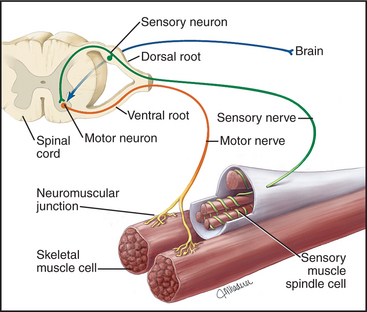
For Nerves:

It covers how neurons (nerve cells) generate electrical impulses, communicate with each other (synaptic transmission), process information, and transmit signals throughout the body to control various functions, from thought and sensation to movement and organ regulation.

For Muscles:

It focuses on how muscle cells (fibers) respond to electrical signals from nerves, leading to contraction (shortening) and the generation of force. This includes the molecular mechanisms of contraction, the regulation of muscle force, and the different types of muscle tissue and their distinct functional characteristics.

Nervous System Excitability

Nervous system excitability is the ability of nerve cells (neurons) to respond to a stimulus by generating and propagating an action potential, a self-propagating electrical impulse.

This property is fundamental to the nervous system's function and depends on the neuron's membrane's selective permeability, ion channels, and pumps. A change in membrane potential can lead to this event, which is essential for transmitting information throughout the body. The physiology of the nervous system involves its main divisions (the Central Nervous System (CNS) and Peripheral Nervous System (PNS)), which use neurons and electrochemical signals to sense stimuli, integrate information, and produce coordinated responses.

Overall Structure & Function of a Motor Neuron (The Command Pathway)

A motor neuron is a specialized nerve cell that transmits electrical signals from the central nervous system (brain and spinal cord) to muscles or glands, thereby initiating movement or secretion. It acts as the "final common pathway" by which the nervous system controls effector organs.
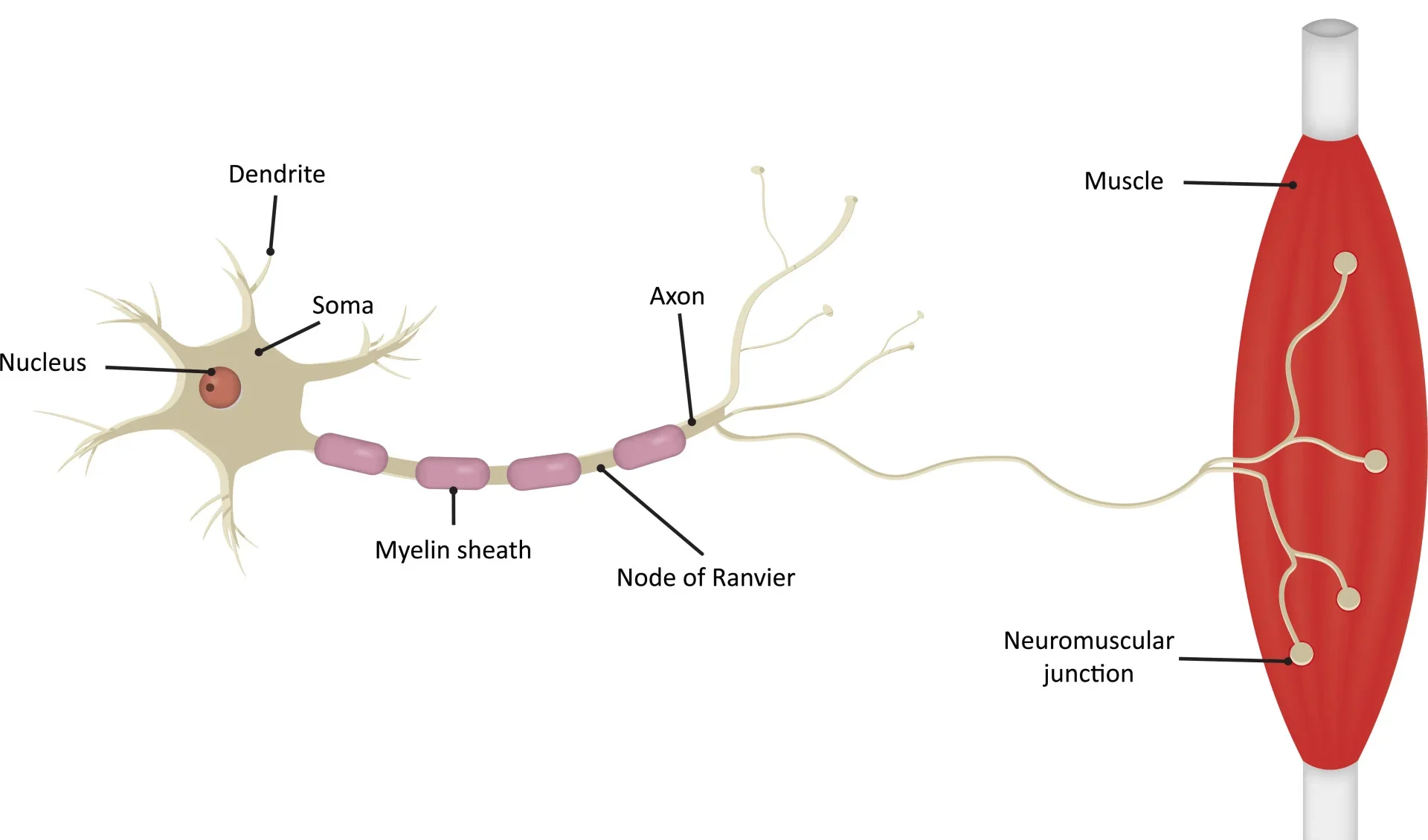
1. Motor Neuron Anatomy: Key Structural Components

Cell Body (Soma/Perikaryon)

The metabolic center of the neuron, containing the nucleus and other organelles. It synthesizes neurotransmitters and proteins and receives synaptic inputs from other neurons.

Dendrites

Branching, tree-like extensions that are the primary receptive (input) regions. They contain ligand-gated ion channels that receive chemical signals and generate graded potentials (EPSPs and IPSPs).

Axon Hillock

A cone-shaped region where the axon originates. This is the critical "trigger zone" with the highest density of voltage-gated Na⁺ channels. It integrates all incoming potentials, and if the sum reaches threshold, an action potential is generated.

Axon

A single, long projection that transmits the action potential (the output signal) away from the cell body. Its length can exceed a meter.

Myelin Sheath

A fatty, insulating layer that surrounds many axons, formed by Schwann cells in the PNS and oligodendrocytes in the CNS. It is crucial for increasing the speed of action potential conduction.

Nodes of Ranvier

Gaps in the myelin sheath that contain a high concentration of voltage-gated Na⁺ and K⁺ channels. The action potential is regenerated at these nodes, "jumping" from one to the next in a process called saltatory conduction.

Axon Terminals (Synaptic Terminals)

The branched ends of the axon that form synapses with other cells. They contain synaptic vesicles filled with neurotransmitters and are specialized for converting the electrical signal (action potential) into a chemical signal (neurotransmitter release).

2. Functional Zones: Relating Structure to Role

We can map these anatomical components to four distinct functional zones, illustrating the flow of information:

Input Zone (Dendrites & Cell Body): Receives and integrates incoming signals as graded potentials (EPSPs & IPSPs).
Integration Zone (Axon Hillock): Sums all graded potentials. If the net depolarization reaches threshold, it triggers an action potential.
Conduction Zone (Axon): Propagates the "all-or-nothing" action potential without loss of strength over long distances, facilitated by saltatory conduction.
Output Zone (Axon Terminals): Converts the electrical action potential into a chemical signal by releasing neurotransmitters.

3. Role in Motor Control: The Final Common Pathway

Motor neurons are often referred to as the "final common pathway" in motor control. This term emphasizes a fundamental principle: all the complex neural computations happening in higher brain centers (e.g., planning and coordination in the cerebral cortex, basal ganglia, and cerebellum) ultimately converge onto these lower motor neurons.

It is only through the firing of a lower motor neuron that a skeletal muscle can be activated and a movement can occur. Regardless of whether a movement is voluntary or reflexive, the command signal ultimately travels down a lower motor neuron to its target muscle fibers. This makes the motor neuron a critical bottleneck and the ultimate determinant of muscle activity and all bodily movements.

Synaptic Transmission (The Communication Bridge Between Neurons)

Synaptic transmission is the fundamental process by which one neuron (the presynaptic neuron) communicates with another neuron (the postsynaptic neuron) or an effector cell. Most synapses in the nervous system are chemical synapses, meaning they utilize chemical messengers called neurotransmitters to bridge the microscopic gap between cells.
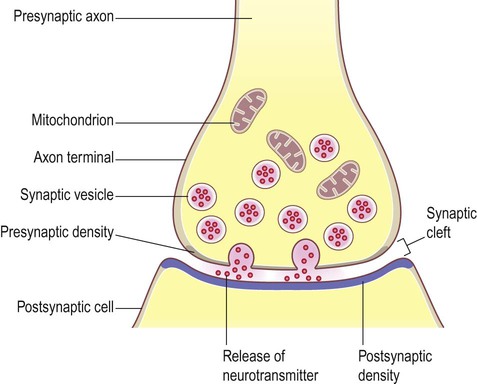
Anatomy of a Chemical Synapse

A chemical synapse consists of three main components:

  1. Presynaptic Terminal (Axon Terminal): The specialized end of the presynaptic axon. It contains synaptic vesicles filled with neurotransmitters, abundant mitochondria for energy, and crucial voltage-gated Ca²⁺ channels.
  2. Synaptic Cleft: The microscopic, fluid-filled space (typically 20-50 nm wide) that separates the presynaptic and postsynaptic membranes.
  3. Postsynaptic Membrane: The specialized region of the receiving cell's membrane, containing a high density of specific neurotransmitter receptors.

Neurotransmitter Synthesis & Storage

Neurotransmitters are synthesized via distinct pathways and then packaged into synaptic vesicles. This packaging protects them from degradation, concentrates them for efficient release, and ensures their availability.

Presynaptic Events: Neurotransmitter Release

This phase converts the electrical signal into a chemical signal:

  1. Action Potential Arrives: An action potential propagates down the axon and depolarizes the presynaptic terminal.
  2. Depolarization Opens Voltage-Gated Ca²⁺ Channels: The change in membrane potential activates and opens these channels.
  3. Ca²⁺ Influx: Due to a steep electrochemical gradient, Ca²⁺ ions rapidly rush into the presynaptic terminal. This influx is the essential trigger for neurotransmitter release.
  4. Ca²⁺ Triggers Vesicle Fusion: The increase in intracellular Ca²⁺ causes synaptic vesicles to fuse with the presynaptic membrane, mediated by SNARE proteins.
  5. Neurotransmitter Release (Exocytosis): As vesicles fuse, neurotransmitters are rapidly expelled into the synaptic cleft.

Postsynaptic Events: Receptor Binding & Ion Channel Opening

Once in the cleft, neurotransmitters diffuse across and bind reversibly to their specific receptors on the postsynaptic membrane, causing a response.

Ligand-Gated Ion Channels (Ionotropic)

The receptor itself is an ion channel. Binding of the neurotransmitter causes an immediate opening, allowing ion flow and a rapid change in the postsynaptic membrane potential. This can generate:

  • Excitatory Postsynaptic Potential (EPSP): Depolarization (e.g., via Na⁺ influx), making the neuron more likely to fire.
  • Inhibitory Postsynaptic Potential (IPSP): Hyperpolarization (e.g., via Cl⁻ influx or K⁺ efflux), making the neuron less likely to fire.

G-Protein Coupled Receptors (Metabotropic)

The receptor activates an intracellular G-protein, which then initiates a slower but more widespread and long-lasting signaling cascade. This can lead to:

  • Direct modulation of nearby ion channels.
  • Production of "second messengers" (e.g., cAMP) that can alter protein synthesis or gene expression.

These events generate graded potentials (EPSPs or IPSPs). If the combined effect of these graded potentials at the axon hillock reaches threshold, a new action potential is triggered in the postsynaptic neuron.

Neurotransmitter Inactivation/Removal: Terminating the Signal

To ensure precise and discrete signaling, the action of neurotransmitters must be swiftly terminated. This happens through several mechanisms:

  • Enzymatic Degradation: Specific enzymes in the synaptic cleft break down the neurotransmitter. The classic example is acetylcholinesterase (AChE) breaking down acetylcholine.
  • Reuptake: Specialized transporter proteins on the presynaptic terminal (or nearby glial cells) actively pump the neurotransmitter back into the cell for recycling. This is the primary mechanism for monoamines like serotonin, dopamine, and norepinephrine.
  • Diffusion: Some neurotransmitters simply diffuse away from the synaptic cleft, where their concentration drops and their effect is diminished.

Generation of a Motor Neuron Action Potential

The motor neuron is constantly bombarded with chemical signals from thousands of other neurons. These signals cause small, localized changes in the membrane potential, which the neuron must integrate to decide whether to fire an "all-or-nothing" action potential.

Synaptic Input: EPSPs and IPSPs

When a presynaptic neuron releases neurotransmitters, they bind to ligand-gated ion channels on the motor neuron, leading to a change in its membrane potential.

Excitatory Postsynaptic Potential (EPSP)

A depolarization of the postsynaptic membrane, making it less negative and more likely to fire. Typically caused by the influx of positive ions, most commonly Na⁺, when an excitatory neurotransmitter (e.g., glutamate) binds.

Inhibitory Postsynaptic Potential (IPSP)

A hyperpolarization or stabilization of the membrane potential, making it more negative and less likely to fire. Typically caused by the influx of negative ions (Cl⁻) or the efflux of positive ions (K⁺) when an inhibitory neurotransmitter (e.g., GABA, glycine) binds.

Spatial and Temporal Summation

A single EPSP is usually too weak to trigger an action potential. Motor neurons integrate thousands of inputs:

  • Spatial Summation: Multiple EPSPs or IPSPs arriving at different locations simultaneously can add together.
  • Temporal Summation: Rapid, successive EPSPs or IPSPs from a single presynaptic neuron can add up over time.

The axon hillock acts as the integrator. If the algebraic sum of all incoming EPSPs and IPSPs reaches the threshold potential (typically around -55 mV), an action potential is generated.
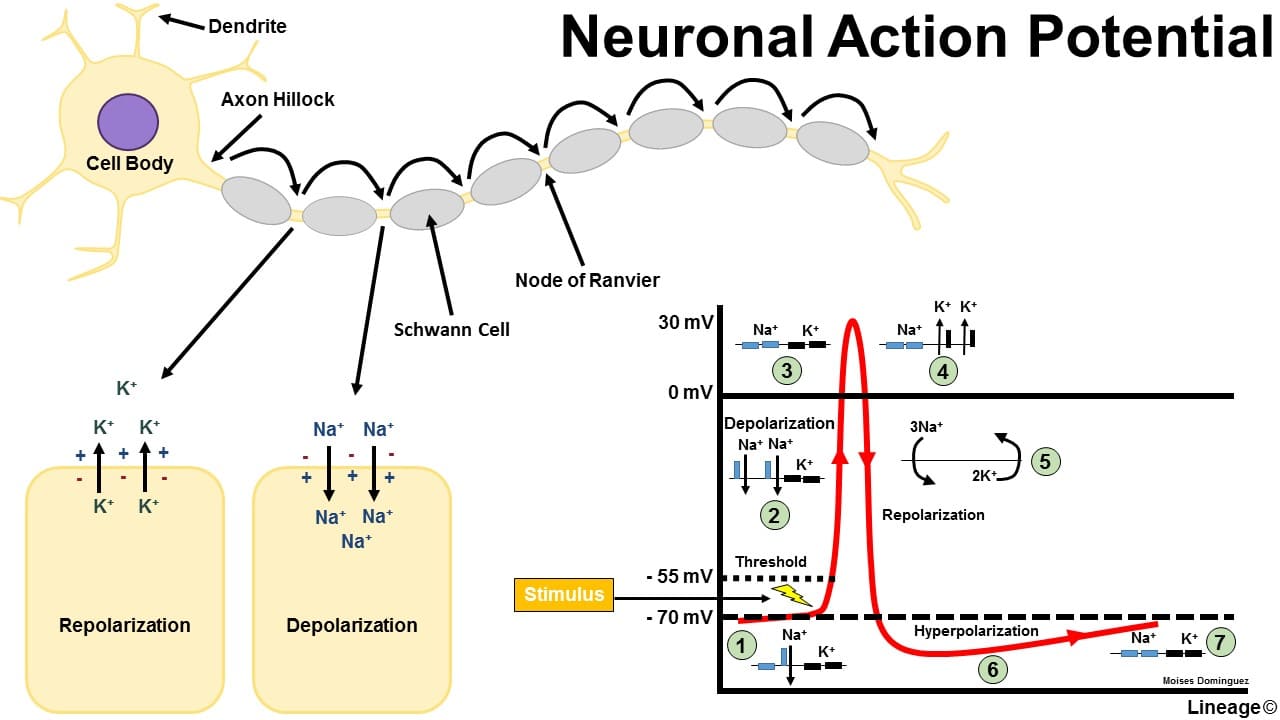
Conduction of the Motor Neuron Action Potential

Once generated at the axon hillock, the action potential propagates along the axon without losing strength.

Action Potential Phases (in a Motor Neuron):

  1. Resting State (-70 mV): The membrane is polarized. All voltage-gated Na⁺ and K⁺ channels are closed. The RMP is maintained by K⁺ leak channels and the Na⁺/K⁺-ATPase pump.
  2. Depolarization to Threshold (-55 mV): The summed EPSPs cause a localized depolarization. If it reaches threshold, the positive feedback loop for Na⁺ channel activation begins.
  3. Rising Phase (Rapid Depolarization to +30mV): At threshold, voltage-gated Na⁺ channels rapidly open. A massive influx of Na⁺ causes a swift and strong depolarization, making the inside of the membrane positive.
  4. Falling Phase (Repolarization): At the peak, voltage-gated Na⁺ channels inactivate (stopping Na⁺ influx), and the slower voltage-gated K⁺ channels fully open. A large efflux of K⁺ rapidly repolarizes the membrane.
  5. Undershoot/Hyperpolarization (below -70 mV): The slow-to-close voltage-gated K⁺ channels cause an excessive efflux of K⁺, making the membrane briefly more negative than the RMP. This phase is critical for the refractory periods:
    • Absolute Refractory Period: During the rising and initial falling phase, no stimulus can generate another action potential because Na⁺ channels are either open or inactivated. This ensures one-way propagation.
    • Relative Refractory Period: During the undershoot phase, a stronger-than-normal stimulus is required to generate another action potential because the membrane is hyperpolarized.
  6. Restoration of Resting Potential: All voltage-gated channels close. The Na⁺/K⁺-ATPase pump works continuously in the background to restore and maintain the long-term ion concentration gradients.

Muscle Physiology: Contraction and Relaxation

Muscle tissue is specialized for contraction, generating force and movement. Here, we'll focus on skeletal muscle.
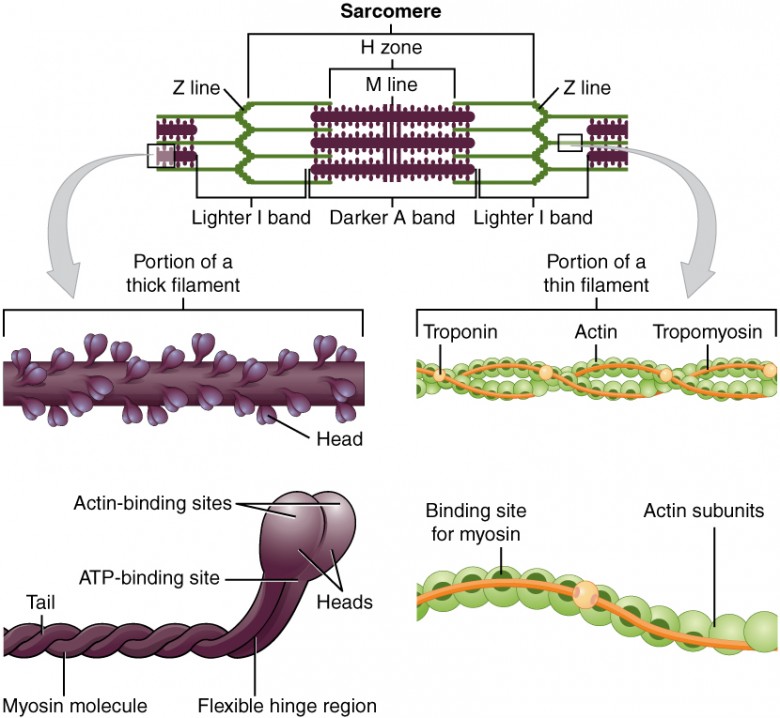
A. Skeletal Muscle Structure

  • Muscle Fiber (Cell): A single, elongated, multinucleated cell.
  • Sarcolemma: The specialized plasma membrane of a muscle fiber, with invaginations called T-tubules.
  • Sarcoplasm: The cytoplasm of a muscle fiber, containing mitochondria, glycogen, myoglobin, and myofibrils.
  • Myofibrils: Long, rod-like contractile organelles composed of repeating sarcomeres.
  • Sarcoplasmic Reticulum (SR): A specialized smooth ER that surrounds each myofibril, storing and releasing Ca²⁺ ions.
  • T-Tubules (Transverse Tubules): Deep invaginations of the sarcolemma that conduct action potentials into the cell's interior. A triad consists of a T-tubule flanked by two terminal cisternae of the SR.

B. The Sarcomere: The Contractile Unit

The sarcomere is the fundamental, repeating contractile unit of a myofibril, extending from one Z-disc to the next.

Filaments:

  • Thick Filaments (Myosin): Composed of myosin protein. Each molecule has a tail and two globular heads. The heads contain an actin-binding site and an ATP-binding site (which also functions as an ATPase).
  • Thin Filaments (Actin): Composed primarily of actin. Also contain two crucial regulatory proteins:
    • Tropomyosin: A rod-shaped protein that covers the myosin-binding sites on actin in a relaxed muscle.
    • Troponin: A complex of three proteins. Troponin C (TnC) is the component that binds Ca²⁺ ions, initiating contraction.

Bands and Zones:

  • A Band: The entire length of the thick filament (dark). Its length remains constant during contraction.
  • I Band: Contains only thin filaments (light). It shortens during contraction.
  • H Zone: The central region of the A band with only thick filaments. It shortens during contraction.
  • M Line: A dark line in the center of the H zone that anchors thick filaments.
  • Z Disc (Z Line): Defines the ends of a sarcomere and anchors the thin filaments.

The Neuromuscular Junction (The Link from Nerve to Muscle)

The neuromuscular junction (NMJ) is the specialized chemical synapse where a motor neuron's axon terminal meets a skeletal muscle fiber.

Anatomy of the NMJ:

  • Presynaptic Terminal: The end of the motor neuron's axon, containing synaptic vesicles filled with acetylcholine (ACh).
  • Synaptic Cleft: The space between the nerve and muscle, containing the enzyme acetylcholinesterase (AChE).
  • Motor End Plate: A specialized region of the sarcolemma with junctional folds packed with acetylcholine receptors (AChRs).

Neurotransmitter & Receptor: Acetylcholine's Role

  • Acetylcholine (ACh): The sole neurotransmitter used to excite skeletal muscle.
  • ACh Receptors (nAChRs): These are ligand-gated ion channels on the motor end plate. When two ACh molecules bind, the channel opens, allowing both Na⁺ and K⁺ to pass through.

End-Plate Potential (EPP): The Muscle's First Electrical Response

This is the muscle's initial, graded electrical response at the motor end plate:
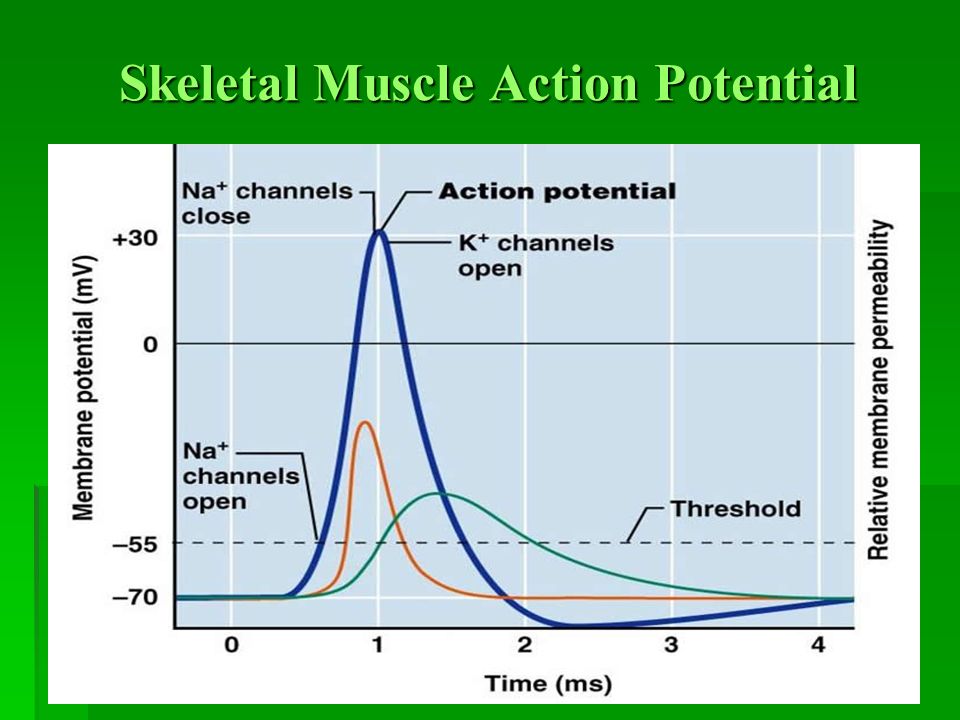
  1. ACh Release: An action potential in the motor neuron triggers the release of ACh into the synaptic cleft.
  2. ACh Binding: ACh diffuses across the cleft and binds to AChRs on the motor end plate.
  3. Channel Opening: The binding of two ACh molecules opens the ion channel.
  4. Ion Movement: Na⁺ ions rapidly rush into the muscle fiber, while a smaller amount of K⁺ ions move out. The net effect is a significant influx of positive charge.
  5. Depolarization (EPP): This net influx of positive ions causes a rapid, large, localized depolarization of the motor end plate, known as the End-Plate Potential (EPP). An EPP is always large enough to trigger an action potential in the adjacent sarcolemma.
  6. ACh Inactivation: ACh is rapidly degraded by acetylcholinesterase (AChE) in the synaptic cleft, terminating the signal and allowing the muscle fiber to repolarize.

The Muscle Action Potential (Electrical Signal within the Muscle Cell)

The muscle action potential is an "all-or-nothing" electrical signal that rapidly spreads across the entire muscle fiber membrane. Its characteristics are very similar to the neuronal action potential, but its purpose is specifically to initiate muscle contraction.

Propagation: Spreading the Signal Deep Within

The muscle action potential propagates in two critical ways:

  1. Along the Sarcolemma: Spreading in both directions along the length of the muscle fiber.
  2. Into the T-tubules: The action potential rapidly dives down into these deep invaginations of the sarcolemma. This is crucial because it brings the electrical signal into very close proximity with the sarcoplasmic reticulum (SR), which stores the Ca²⁺ needed for contraction.

Excitation-Contraction Coupling

This is the physiological process by which an electrical signal (the muscle action potential) is converted into a mechanical event (muscle contraction).

  1. Muscle AP Propagation: The action potential travels along the sarcolemma and down into the T-tubules.
  2. DHPR Activation: The action potential causes a conformational change in voltage-sensitive proteins in the T-tubule membrane called Dihydropyridine Receptors (DHPRs).
  3. Mechanical Linkage to RyRs: The DHPRs are mechanically linked to Ryanodine Receptors (RyRs), which are Ca²⁺ release channels on the sarcoplasmic reticulum (SR).
  4. RyR Opening and Ca²⁺ Release: The change in the DHPRs mechanically pulls open the RyRs, allowing stored Ca²⁺ ions to flood out of the SR and into the sarcoplasm.
  5. Increase in Intracellular Ca²⁺: This rapid increase in sarcoplasmic Ca²⁺ concentration is the immediate trigger for muscle contraction.

The Mechanism of Muscle Contraction (The "Sliding Filament Theory")

The Sliding Filament Theory proposes that muscle shortening occurs by the thick and thin filaments sliding past one another, thereby increasing their overlap.
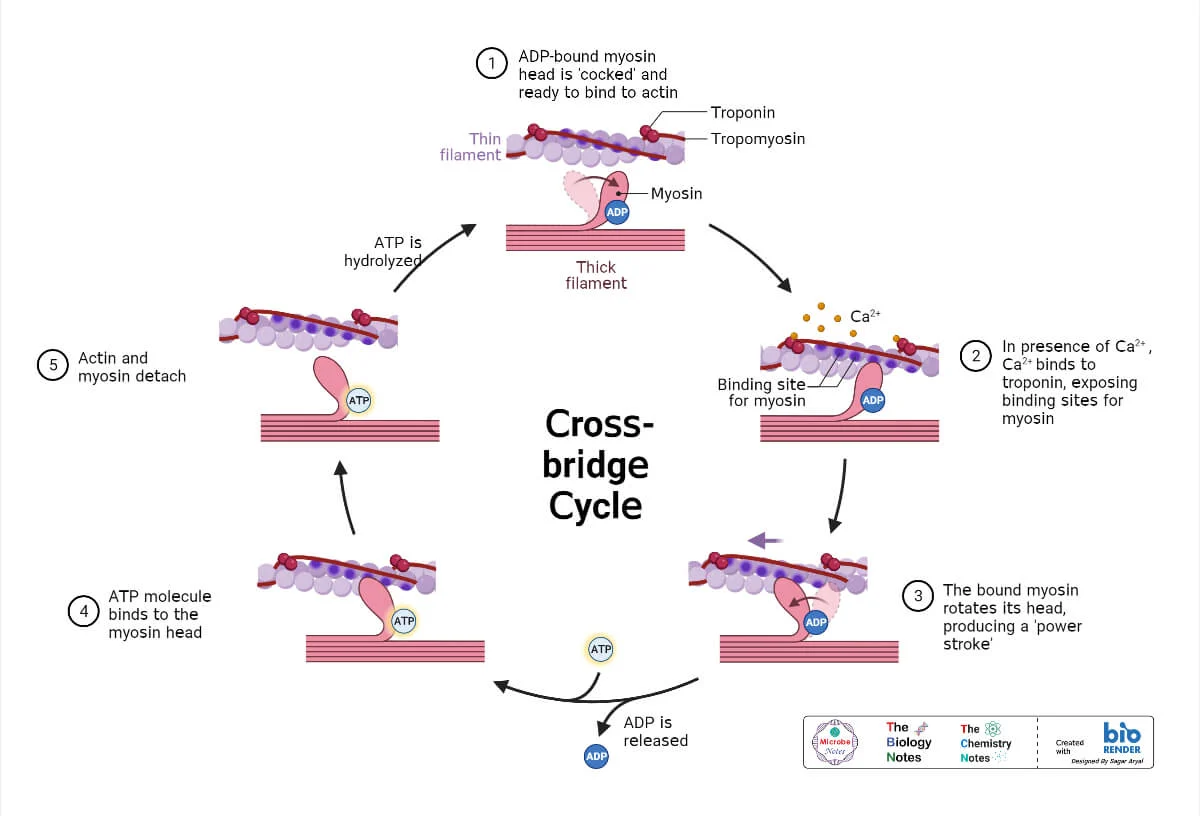
1. Role of Ca²⁺: Unlocking the Binding Sites

  1. Ca²⁺ Binds to Troponin C: Ca²⁺ ions released from the SR bind to the Troponin C subunit on the thin filaments.
  2. Tropomyosin Shifts: This binding causes a shape change in troponin, which in turn tugs on the tropomyosin molecule.
  3. Active Sites Exposed: The movement of tropomyosin physically shifts it away from the myosin-binding sites on the actin molecules, which were previously blocked.

Cross-Bridge Cycle (Molecular Events): The Powerhouse

The cross-bridge cycle is a repetitive series of events that causes the thin filaments to slide over the thick filaments.

    1

    Step 1: Cross-Bridge Formation

    The energized ("cocked") myosin head, which is already holding onto ADP and inorganic phosphate (Pi) from the previous cycle, has a strong chemical attraction (affinity) for the actin filament. This binding can only occur if the myosin-binding sites on the actin are exposed. Once the sites are uncovered by the movement of tropomyosin (triggered by Ca²⁺ binding to troponin), the myosin head immediately forms a strong physical link with the actin. This connection is the "cross-bridge."

    2

    Step 2: The Power Stroke

    The formation of the cross-bridge triggers the release of the inorganic phosphate (Pi) from the myosin head. This release unleashes the stored energy, causing the myosin head to pivot forcefully from its high-energy 90° angle to a low-energy 45° angle. This pivotal movement is the power stroke. Because it is firmly attached, the myosin head drags the entire thin filament a short distance (~10 nm) toward the center of the sarcomere. Immediately after the pivot, the ADP molecule is also released, leaving the myosin head in a low-energy state, still tightly bound to actin.

    3

    Step 3: Cross-Bridge Detachment

    After the power stroke, the myosin head is "stuck" to the actin in a low-energy state (the "rigor" state). The only way for it to let go is for a new molecule of ATP to bind to the ATP-binding site on the myosin head. This binding causes a conformational change that weakens the bond between myosin and actin, reducing their affinity for each other and causing the myosin head to detach. Without a fresh supply of ATP, this detachment cannot occur, which is the molecular basis for the muscle stiffness seen in rigor mortis after death.

    4

    Step 4: Re-cocking of the Myosin Head

    The myosin head, now with ATP bound, immediately acts as an enzyme (myosin ATPase) and hydrolyzes the ATP back into ADP and inorganic phosphate (Pi). The energy released from breaking this ATP bond is captured by the myosin head and used to change its shape, moving it from its low-energy bent position back to its high-energy, upright, "cocked" position. It is now energized and reset, ready to begin the cycle again by binding to another active site further down the actin filament (if Ca²⁺ is still present).

    4. Sarcomere Shortening: The Result of Sliding Filaments

    Repeated cycles of the cross-bridge cycle cause:

    • The thin filaments to slide inward, past the stationary thick filaments.
    • The Z-discs to be pulled closer together, shortening the entire sarcomere.
    • The I bands and H zone to shorten.
    • The A band to remain unchanged in length.

    When thousands of sarcomeres shorten simultaneously, the entire muscle shortens and generates force.

    Muscle Relaxation

    Muscle relaxation is an active, energy-requiring process.
    1. Cessation of Motor Neuron Signal: The motor neuron stops firing, and no more ACh is released.
    2. AChE Activity: Remaining ACh in the synaptic cleft is rapidly broken down by acetylcholinesterase.
    3. Repolarization of Sarcolemma: The muscle fiber action potential ceases.
    4. Ca²⁺ Reuptake into SR: As the T-tubules repolarize, the RyRs on the SR close. Simultaneously, active transport pumps called SERCA pumps use ATP to actively pump Ca²⁺ from the sarcoplasm back into the SR.
    5. Tropomyosin Blocks Active Sites: As sarcoplasmic Ca²⁺ levels fall, Ca²⁺ detaches from Troponin C. Troponin returns to its original shape, allowing tropomyosin to shift back and cover the myosin-binding sites on actin.
    6. Muscle Relaxes: With cross-bridge formation prevented, the muscle fiber passively lengthens or remains at its resting length.

Test Your Knowledge

A quiz covering Nerve and Muscle Physiology.

1. Which of the following is the primary role of the T-tubules in skeletal muscle contraction?

  • Store calcium ions
  • Synthesize ATP for muscle contraction
  • Conduct action potentials deep into the muscle fiber
  • Anchor thin filaments in the sarcomere

Correct (c): T-tubules conduct action potentials from the sarcolemma surface deep into the muscle fiber, ensuring simultaneous activation of all myofibrils.

Incorrect: Ca2+ storage is by the SR, ATP synthesis by mitochondria, and thin filament anchoring by Z-discs.

Analogy: Think of T-tubules as a subway system quickly delivering an important message (action potential) to all neighborhoods (myofibrils) within the muscle city.

2. Which ion's rapid influx into the motor neuron terminal triggers the release of acetylcholine (ACh)?

  • Sodium (Na+)
  • Potassium (K+)
  • Calcium (Ca2+)
  • Chloride (Cl-)

Correct (c): Influx of extracellular Ca2+ into the presynaptic terminal acts as the signal that triggers the fusion of ACh-containing vesicles with the presynaptic membrane.

Analogy: Ca2+ is like the "go-ahead" button for vesicles to release their neurotransmitter payload.

Incorrect: Na+ is for AP depolarization, K+ for repolarization, and Cl- for inhibition.

3. What is the primary function of acetylcholinesterase (AChE) at the neuromuscular junction?

  • To synthesize new acetylcholine molecules
  • To transport acetylcholine back into the presynaptic terminal
  • To break down acetylcholine in the synaptic cleft
  • To bind to acetylcholine receptors and open ion channels

Correct (c): AChE rapidly degrades ACh in the synaptic cleft, terminating the signal and allowing the muscle to relax and prepare for the next impulse.

Analogy: AChE is like a cleanup crew removing the "message" (ACh) from the bulletin board (receptor) promptly.

Incorrect: ACh synthesis and receptor binding are distinct processes; AChE's role is degradation.

4. The End-Plate Potential (EPP) at the neuromuscular junction is primarily caused by the net movement of which ions?

  • Na+ out, K+ in
  • K+ out, Na+ in
  • Ca2+ out, K+ in
  • Na+ in, K+ out

Correct (d): ACh opens non-selective cation channels. More Na+ rushes in than K+ leaves, causing a net influx of positive charge and depolarization (EPP).

Incorrect: The directions of ion movement are wrong or the primary ion is incorrect.

5. What is the direct consequence of Ca2+ binding to Troponin C in skeletal muscle?

  • Myosin heads hydrolyze ATP
  • Tropomyosin moves, exposing actin-binding sites
  • Myosin heads detach from actin
  • The sarcoplasmic reticulum reabsorbs Ca2+

Correct (b): Ca2+ binding to Troponin C causes a conformational change that pulls tropomyosin away from the myosin-binding sites on actin, allowing cross-bridge formation.

Analogy: Ca2+ is like a key that unlocks a protective shield (tropomyosin) covering the active sites.

Incorrect: ATP binding causes detachment; ATP hydrolysis cocks the myosin; Ca2+ reuptake occurs during relaxation.

6. During the power stroke, which event immediately follows the binding of the myosin head to actin?

  • ATP binds to the myosin head
  • Pi (inorganic phosphate) is released from the myosin head
  • The myosin head re-cocks
  • Ca2+ is reabsorbed into the SR

Correct (b): The sequence is: energized myosin (ADP+Pi) binds actin -> Pi is released -> Power stroke (ADP released) -> ATP binds causing detachment.

Incorrect: ATP binding causes detachment, Pi release triggers the power stroke, and Ca2+ reuptake is for relaxation.

7. Which component of the sarcomere remains unchanged in length during muscle contraction?

  • I band
  • H zone
  • A band
  • Sarcomere length

Correct (c): The A band corresponds to the length of the thick filament, which does not shorten; thin filaments slide over it.

Incorrect: I band, H zone, and sarcomere length all shorten during contraction.

8. Which statement about the role of ATP in muscle contraction is TRUE?

  • ATP is directly used to move tropomyosin off actin.
  • ATP binding to myosin causes its detachment from actin.
  • ATP hydrolysis directly powers the power stroke.
  • ATP is only required for relaxation.

Correct (b): A new ATP molecule must bind to the myosin head to reduce its affinity for actin, allowing detachment.

Incorrect: Ca2+ moves tropomyosin; ATP hydrolysis energizes myosin for the power stroke after binding; ATP is crucial for both contraction and relaxation.

9. What is the primary role of voltage-gated Ca2+ channels in the motor neuron terminal?

  • Initiate the action potential in the motor neuron.
  • Cause the repolarization of the motor neuron terminal.
  • Trigger the release of neurotransmitter into the synaptic cleft.
  • Generate the end-plate potential in the muscle fiber.

Correct (c): When the action potential arrives, it opens these channels, allowing Ca2+ influx which signals synaptic vesicles to release ACh.

Incorrect: Action potentials are initiated by Na+ channels; repolarization by K+ channels; EPPs are on the muscle fiber.

10. Blocking Ryanodine Receptors (RyRs) on the SR would directly prevent:

  • Acetylcholine release from the motor neuron.
  • The generation of a muscle action potential.
  • The release of Ca2+ into the sarcoplasm.
  • The reuptake of Ca2+ into the SR during relaxation.

Correct (c): RyRs are the Ca2+ release channels on the SR. Blocking them prevents Ca2+ from escaping the SR into the sarcoplasm, thus halting contraction.

Incorrect: ACh release is presynaptic; muscle APs are on the sarcolemma; Ca2+ reuptake is by SERCA pumps.

11. Why is the action potential in a motor neuron considered "all-or-nothing"?

  • Because it travels only in one direction.
  • Because it either fires at full strength or not at all, once threshold is reached.
  • Because it requires all ion channels to open simultaneously.
  • Because it only occurs at the Nodes of Ranvier.

Correct (b): If the threshold is reached, a full-sized action potential occurs; if not, none occurs. Its amplitude is constant, independent of stimulus strength beyond threshold.

Analogy: It's like flushing a toilet – you either push the handle enough to flush completely, or nothing happens. There's no "half-flush."

12. During muscle relaxation, what happens to Ca2+ in the sarcoplasm?

  • It binds to RyRs, causing them to close.
  • It is actively pumped back into the sarcoplasmic reticulum.
  • It is released from troponin, and then diffuses out of the cell.
  • It remains bound to troponin, keeping active sites exposed.

Correct (b): Relaxation requires active pumping of Ca2+ back into the SR by SERCA pumps, which lowers sarcoplasmic Ca2+ levels.

Incorrect: Ca2+ detaches from troponin when its concentration drops; it doesn't diffuse out of the cell; RyRs are closed by low Ca2+ (indirectly).

13. Which component of the thin filament directly binds to Ca2+ ions to initiate contraction?

  • Actin
  • Tropomyosin
  • Troponin T
  • Troponin C

Correct (d): Troponin C (TnC) is the specific subunit of the troponin complex that binds Ca2+ ions, initiating the conformational change leading to contraction.

Incorrect: Actin has myosin-binding sites; tropomyosin blocks them; TnT binds tropomyosin.

14. What happens to ADP and Pi immediately prior to the power stroke?

  • Both ADP and Pi bind to the myosin head.
  • Both ADP and Pi are released from the myosin head.
  • Pi is released, while ADP remains bound.
  • ADP is released, while Pi remains bound.

Correct (c): After the energized myosin head (with ADP + Pi) binds to actin, Pi is released, triggering the power stroke. ADP is released during the power stroke itself.

15. If a motor neuron's action potential fails to reach the presynaptic terminal, what is the direct consequence?

  • Continuous muscle contraction due to uncontrolled ACh release.
  • Increased sensitivity of the muscle to acetylcholine.
  • No acetylcholine release, and thus no muscle contraction.
  • Enhanced Ca2+ reuptake into the sarcoplasmic reticulum.

Correct (c): The action potential reaching the presynaptic terminal is the critical trigger for Ca2+ influx and subsequent ACh release. Without it, the NMJ process fails.

Incorrect: Without the AP, there's no release, controlled or uncontrolled. Receptor sensitivity isn't directly altered. Ca2+ reuptake is for relaxation, not relevant here.

16. The specialized endoplasmic reticulum that stores and releases Ca2+ ions in a muscle fiber is called the ____________________.

Rationale: This organelle is uniquely adapted for rapid sequestration and release of Ca2+, central to regulating muscle contraction and relaxation.

17. The functional contractile unit of a myofibril, extending from one Z-disc to the next, is the _________.

Rationale: The sarcomere is the fundamental, repeating unit whose shortening causes muscle fiber shortening.

18. The release of _________ from the motor neuron terminal initiates the process at the neuromuscular junction.

Rationale: ACh is the neurotransmitter that carries the signal from the nerve to the muscle, initiating excitation-contraction coupling.

19. During the cross-bridge cycle, the binding of new ATP to myosin causes it to _________ from actin.

Rationale: This is a critical step; without new ATP, the myosin head remains attached to actin, leading to rigor.

20. DHPRs in T-tubules are mechanically linked to _________ on the SR, which act as Ca2+ release channels.

Rationale: This mechanical coupling allows the electrical signal from the T-tubules to directly trigger Ca2+ release from the SR into the sarcoplasm, initiating contraction.
PHYSIOLOGY OF EXCITABLE TISSUES

PHYSIOLOGY OF EXCITABLE TISSUES

Excitability: PHYSIOLOGY OF EXCITABLE TISSUES

Excitability

Excitability: The Ability to Respond and Communicate


Excitability refers to the ability of a cell to respond to a stimulus by generating an electrical signal called an action potential. It can be defined as a physical chemical change that occurs when a stimulus is applied on a tissue. A stimulus is an external agent that produces excitation in a tissue. This electrical signal is then propagated along the cell membrane or transmitted to other cells, leading to a specific physiological response.

The action potential is a transient, rapid, and self-propagating reversal of the electrical potential across the cell membrane. This electrical signal is the medium through which cells rapidly transmit information, either along the length of an individual cell or to other cells via specialized junctions. This property is crucial for rapid communication and coordination within the body, underpinning virtually every complex physiological function, from perception and thought to movement and visceral regulation.
Analogy for Understanding: The Tripwire

Think of an excitable cell like a highly sensitive electrical tripwire or alarm system. The resting state is the armed system waiting for a trigger. The stimulus is the pressure that activates the tripwire. The action potential is the immediate, swift, and uniform "alarm bell" that rings loudly and clearly, sending its message through the system to orchestrate a coordinated response.
2. Excitable Cells

While all living cells exhibit some degree of responsiveness, only a select group possess the highly specialized machinery to generate and propagate rapid electrical signals. These are the "excitable cells."

Neurons (Nerve Cells): The Master Communicators

Expanded Role: Neurons are the fundamental units of the nervous system. Their primary function is the transmission of electrical and chemical signals for sensory input, integration, motor output, cognition, and emotion.

Unique Features: They possess specialized structures like dendrites (to receive signals), a cell body (soma), and a long axon (to transmit signals), often insulated by a myelin sheath to speed conduction.

Muscle Cells: The Effectors of Movement

Muscle cells are specialized for contraction, which generates force and movement. Their excitability is the prerequisite for this mechanical action.

Skeletal Muscle Cells:

Responsible for all voluntary movements (walking, speaking, breathing). When a motor neuron sends an action potential, it triggers a muscle action potential, leading to contraction.

Cardiac Muscle Cells:

Found only in the heart, responsible for the rhythmic and involuntary pumping of blood. They possess autorhythmicity and have distinctively long action potentials for coordinated contractions.

Smooth Muscle Cells:

Mediate involuntary movements in the walls of internal organs like the digestive tract, blood vessels, and urinary bladder. Their excitability is influenced by stretch, local chemicals, and the autonomic nervous system.

Glandular Cells: The Secretory Responders

Role Expansion: Many glandular cells (e.g., in the adrenal medulla, pancreas) exhibit excitability. They can respond to an electrical stimulus from a neuron by generating their own electrical event (depolarization or action potential).

Excitability Link: This electrical event is typically coupled to the release of their secretions (e.g., hormones, digestive enzymes). For example, adrenal medullary cells depolarize in response to a neuronal signal, triggering Ca²⁺ influx and the exocytosis of epinephrine. This ensures precise and rapid control over hormone release.

Membrane Potential

The capacity of these cells to generate electrical signals rests entirely on the idea of membrane potential.

This is the voltage difference across the cell's outer boundary, a stored electrical energy created by an uneven distribution of ions (electrically charged particles) inside the cell (ICF) and outside the cell (ECF).

Resting Membrane Potential (RMP)

When an excitable cell is quiet, it maintains a stable, baseline electrical charge called the Resting Membrane Potential (RMP). In this state, the inside of the cell consistently holds a negative charge relative to the outside (e.g., -70 mV in neurons, -90 mV in skeletal muscle).

Creating and Maintaining the RMP

The RMP is a dynamic state, constantly maintained by an interplay of three factors:
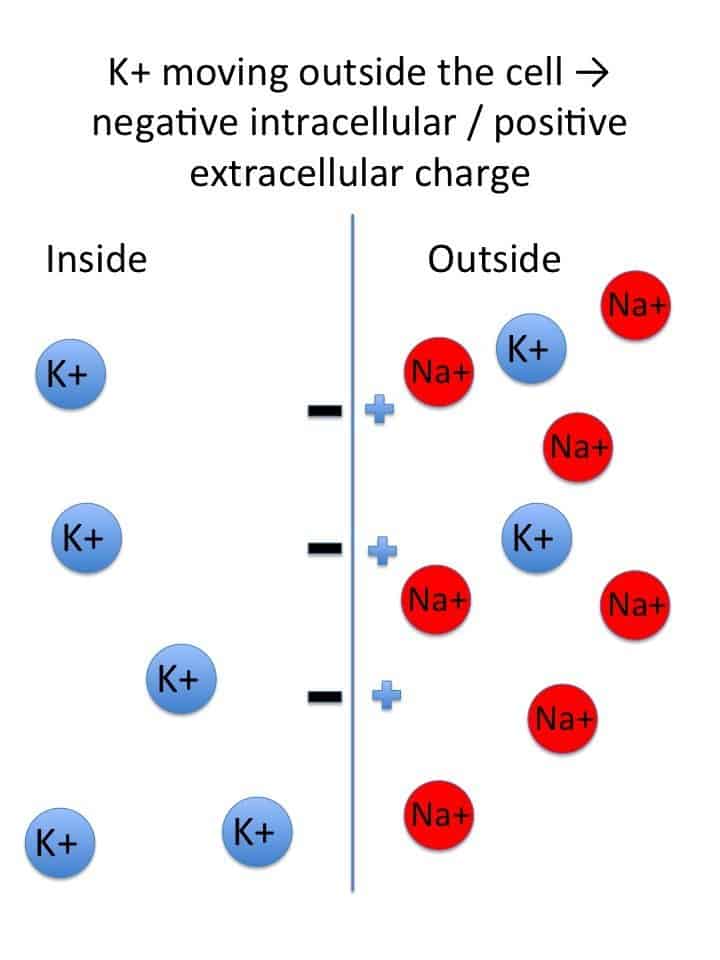
  1. Ion Gradients: The Concentration Divide
    The foundation is the different concentrations of key ions: a high concentration of Na⁺ outside the cell and a high concentration of K⁺ inside the cell.
  2. Selective Permeability: The Leaky Gates
    At rest, the membrane is significantly more permeable to K⁺ than to Na⁺ because there are many more open K⁺ "leak" channels than Na⁺ leak channels.
  3. Sodium-Potassium ATPase (Na⁺/K⁺-ATPase) Pump: The Gradient Upholder
    This active transporter continually pumps 3 Na⁺ ions out for every 2 K⁺ ions it pumps in, directly maintaining the concentration gradients and contributing a small amount to the RMP's negativity (making it an electrogenic pump).

Equilibrium Potential (Nernst Potential)

The equilibrium potential for a specific ion is the membrane voltage at which there is no net movement of that ion across the membrane. At this voltage, the electrical force is perfectly balanced by the chemical (concentration) force. The Nernst Equation calculates this value:

E_ion = (RT / zF) * ln([ion]out / [ion]in)
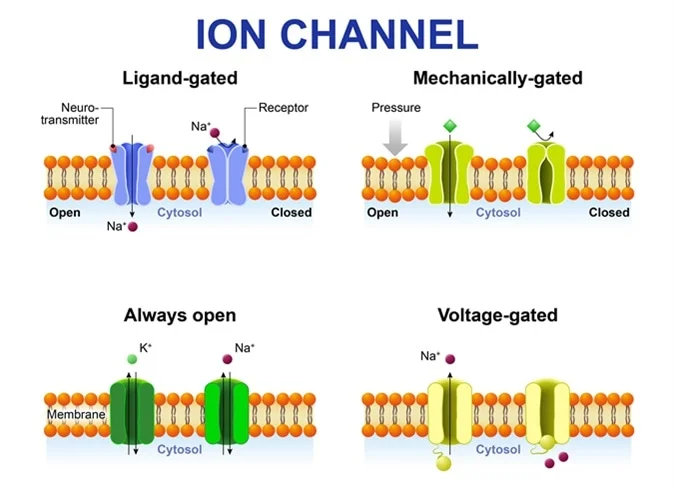
Ion Channels

These are specialized proteins that form pores for specific ions to cross the membrane.

Types Relevant to Excitability:

  • Leak Channels: These channels are always open and are instrumental in establishing the RMP, particularly the K⁺ leak channels.

Gated Channels: The Responsive Switches

These channels open or close only in response to a particular trigger and are essential for generating action potentials.

Voltage-Gated Channels

Open or close in direct response to changes in membrane voltage. They are the key drivers of the action potential.

Ligand-Gated Channels (Chemically Gated)

Open or close when a specific chemical messenger (a ligand), such as a neurotransmitter, binds to them.

Mechanically Gated Channels

Open or close when they are physically deformed or stretched, critical for sensory perception like touch and pressure.

Initiating the Response: Stimulus and Threshold

The Stimulus: A Call to Action

A stimulus is any detectable change (electrical, chemical, or mechanical) in the cell's environment that has the potential to alter its RMP.

  • Depolarization: A shift in membrane voltage where the inside of the cell becomes less negative (e.g., from -70 mV to -50 mV).
  • Hyperpolarization: A shift where the inside of the cell becomes more negative (e.g., from -70 mV to -90 mV).

Threshold: The Point of No Return

Threshold is the crucial voltage level that depolarization must reach for an action potential to fire (typically around -55 mV in neurons). It is an "all-or-none" event: if a stimulus causes a depolarization that reaches threshold, a full action potential fires. If it does not, nothing happens.

The Action Potential

The action potential is the primary electrical signal employed by excitable cells to swiftly transmit information across significant distances. It stands as an "all-or-nothing" phenomenon: once initiated, it proceeds through its entire sequence with consistent strength, never diminishing.
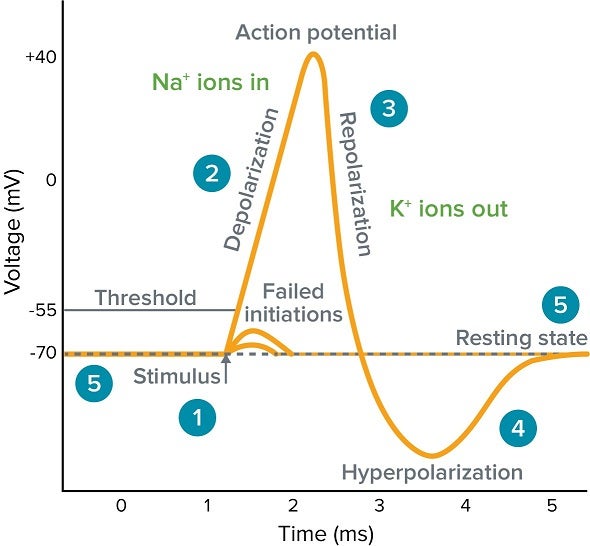
Requirements for an Action Potential:

  • Resting Membrane Potential (RMP): The cell needs a stable, negative baseline electrical charge.
  • Voltage-Gated Ion Channels: These specialized channels respond specifically to changes in the membrane's electrical charge. The key players are:
    • Voltage-Gated Sodium (Na⁺) Channels: Responsible for the rapid depolarization. They have a fast activation gate and a slower inactivation gate.
    • Voltage-Gated Potassium (K⁺) Channels: Responsible for repolarization. They open more slowly in response to depolarization.
  • Threshold Potential: A specific voltage level that must be reached for the action potential to be irrevocably triggered.

Stages of an Action Potential

1. Resting State (e.g., -70 mV)

All voltage-gated Na⁺ and K⁺ channels are closed. The RMP is maintained by K⁺ leak channels and the Na⁺/K⁺ pump.

2. Depolarization to Threshold (to -55 mV)

A local stimulus causes a few voltage-gated Na⁺ channels to open, allowing a small amount of Na⁺ to enter. If enough Na⁺ enters to raise the membrane potential to the threshold level, an action potential is triggered.

3. Rising Phase (Depolarization, to +30 mV)

Once threshold is reached, a vast number of voltage-gated Na⁺ channels open very rapidly. A massive and swift surge of Na⁺ into the cell causes the inside of the membrane to become positive.

4. Repolarization Phase (from +30 mV down)

At the peak, the voltage-gated Na⁺ channels inactivate (their inactivation gates close), stopping Na⁺ influx. Simultaneously, the slower voltage-gated K⁺ channels are now fully open, allowing a significant outflow of K⁺, which rapidly restores the membrane's negative charge.

5. Afterhyperpolarization (Undershoot)

The voltage-gated K⁺ channels close slowly, allowing K⁺ to continue exiting for a brief period. This causes the membrane to become temporarily more negative than the RMP.

6. Return to Rest

The slow K⁺ channels finally close, and the ever-active Na⁺/K⁺ pump helps to re-establish the original ion concentration gradients, returning the membrane to its stable RMP.

Defining Features of Action Potentials

  • All-or-Nothing: If the threshold is crossed, the action potential unfolds completely with the same magnitude. If not, no action potential occurs.
  • Non-Decremental: Action potentials are continuously re-generated along the membrane and do not lose strength as they move.

Refractory Periods

  • Absolute Refractory Period: During the rising and peak phases, when Na⁺ channels are either open or inactivated, no second stimulus, regardless of its intensity, can trigger another action potential. This ensures one-way propagation of the signal.
  • Relative Refractory Period: During the afterhyperpolarization phase, a stimulus that is stronger than normal can provoke another action potential.

Propagation of Action Potentials: Spreading the Message

The electrical shift at one point on the membrane triggers the opening of voltage-gated Na⁺ channels in the immediately adjacent area. This process repeats, moving the signal along the length of the nerve or muscle fiber.

Myelination (in Nerve Cells): Enhancing Speed

Many nerve fibers are insulated by a fatty myelin sheath. Action potentials therefore appear to "jump" from one uninsulated gap (a node of Ranvier) to the next. This rapid "jumping" process is termed saltatory conduction and dramatically increases the signal's speed.
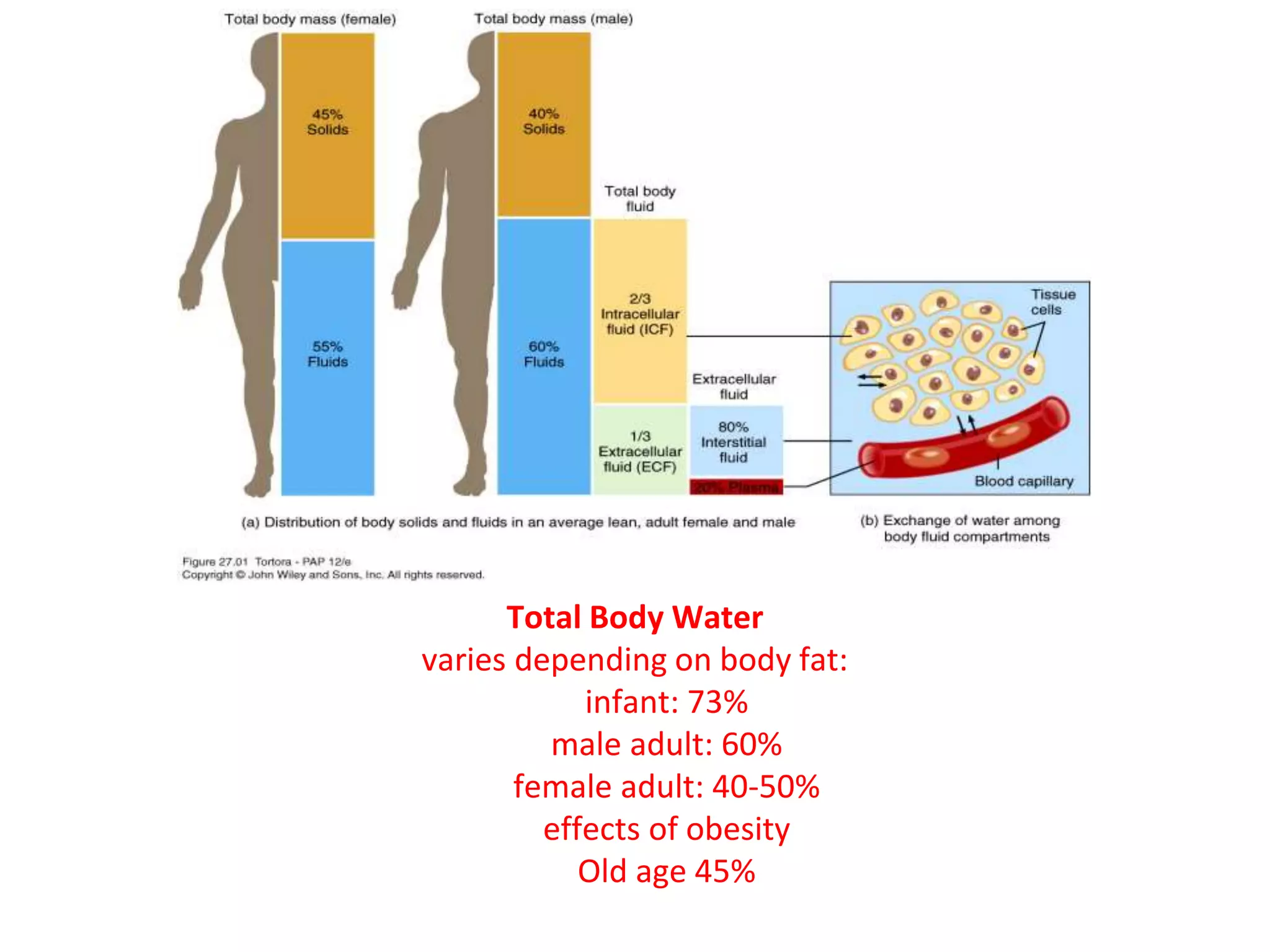
Factors Influencing Conduction Speed:

  • Fiber Diameter: Larger diameter fibers conduct signals more quickly.
  • Myelination: Myelinated fibers transmit signals considerably faster than unmyelinated fibers.

Inhibition of Excitability

Just as cells must generate signals, they also need ways to inhibit them, ensuring precise control and preventing uncontrolled firing.

Hyperpolarization: Driving Further from Threshold

Inhibitory neurotransmitters (like GABA or glycine) open ion channels that either allow Cl⁻ to enter the cell or K⁺ to leave. The outcome is an increase in the negative charge inside the cell (e.g., from -70 mV to -75 mV), making it significantly harder for the cell to reach the threshold and fire an action potential.

Presynaptic Inhibition: Muting the Signal at its Source

An inhibitory neuron releases neurotransmitter (e.g., GABA) directly onto the axon terminal of an excitatory neuron. This reduces the electrical charge of the terminal, so when an action potential arrives, fewer excitatory neurotransmitters are released. This allows for fine-tuning and selective reduction of specific signals.

Pharmacological Inhibition: Manipulating Channels

A vast array of drugs and toxins work by directly interfering with ion channels.

  • Local Anesthetics (e.g., Lidocaine): Block voltage-gated Na⁺ channels, preventing action potentials in pain-sensing nerves.
  • Tetrodotoxin (TTX, from pufferfish): A potent blocker of voltage-gated Na⁺ channels, causing paralysis.
  • Anti-epileptic Drugs: Some work by enhancing GABA's inhibitory effects or stabilizing Na⁺ channels to prevent excessive firing.

Clinical Significance of Excitability

An in-depth comprehension of cellular excitability is absolutely vital for understanding, diagnosing, and creating effective treatments for numerous conditions affecting the nervous system and muscles.

Conditions of the Nervous System and Muscles:

  • Epilepsy: Marked by episodes of abnormal, synchronized, and excessive electrical firing of large groups of neurons in the brain, resulting in seizures.
  • Multiple Sclerosis (MS): An autoimmune disease where the myelin sheath insulating nerve fibers is destroyed. This slows, weakens, or completely blocks action potential propagation, leading to muscle weakness and sensory disturbances.
  • Myasthenia Gravis: An autoimmune disease that destroys acetylcholine receptors at the neuromuscular junction, reducing the ability of nerve signals to excite muscle cells and leading to muscle weakness.
  • Cardiac Arrhythmias: Irregular heart rhythms stemming from abnormalities in the electrical excitability of heart muscle cells, leading to potentially life-threatening disruptions to the heart's pumping action.

Electrolyte Imbalances

The precise balance of ions is paramount for proper excitability.

Hyperkalemia (Elevated K⁺)

High extracellular K⁺ makes the resting membrane potential less negative (closer to threshold). While this might initially increase excitability, prolonged depolarization can inactivate voltage-gated Na⁺ channels, rendering cells inexcitable. This is life-threatening for heart muscle cells and can lead to cardiac arrest.

Hypokalemia (Low K⁺)

Low extracellular K⁺ makes the resting membrane potential more negative (hyperpolarized). This moves the cell further from threshold, making it less excitable and leading to symptoms like muscle weakness and dangerous heart arrhythmias.

Sodium Imbalances (Hypernatremia/Hyponatremia)

Since the influx of Na⁺ is the primary driver of depolarization, imbalances in Na⁺ levels can significantly impair the ability of nerve and muscle cells to generate action potentials.

Calcium Imbalances
  • Hypocalcemia (Low Ca²⁺): Low extracellular calcium paradoxically increases nerve cell excitability by making voltage-gated Na⁺ channels open more easily. This can lead to muscle spasms (tetany).
  • Hypercalcemia (High Ca²⁺): High extracellular calcium stabilizes Na⁺ channels, making them harder to open. This decreases neuronal excitability, potentially leading to muscle weakness and reduced neurological function.

Test Your Knowledge

An Excitability Exam covering core neurophysiology concepts.

1. Which ion is primarily responsible for the rapid depolarization (rising phase) of a typical neuronal action potential?

  • Potassium (K+)
  • Chloride (Cl-)
  • Sodium (Na+)
  • Calcium (Ca2+)

Correct (c): The rapid influx of positively charged Na+ ions through voltage-gated Na+ channels causes the membrane potential to swiftly become positive during the rising phase.

Incorrect: K+ is for repolarization, Cl- for inhibition, and Ca2+ for neurotransmitter release.

Analogy: Think of Na+ as the "gas pedal" for the action potential. Pushing it hard (opening Na+ channels) makes the electrical signal quickly accelerate upwards.

2. The Resting Membrane Potential (RMP) is primarily maintained by which two factors?

  • Voltage-gated Na+ channels and Na+/K+-ATPase pump
  • Leak K+ channels and voltage-gated K+ channels
  • Leak K+ channels and Na+/K+-ATPase pump
  • Ligand-gated channels and voltage-gated Na+ channels

Correct (c): The RMP is established by the Na+/K+-ATPase pump (which creates the gradients) and the high permeability of the membrane to K+ ions through K+ leak channels (allowing K+ to slowly exit).

Incorrect: Voltage-gated and ligand-gated channels are primarily involved in generating signals (action potentials, synaptic potentials), not maintaining the baseline RMP.

3. What event immediately follows the membrane potential reaching threshold?

  • Voltage-gated K+ channels rapidly open.
  • Voltage-gated Na+ channels rapidly open in a positive feedback loop.
  • The Na+/K+-ATPase pump becomes more active.
  • The cell hyperpolarizes due to Cl- influx.

Correct (b): Reaching threshold triggers a massive opening of voltage-gated Na+ channels, leading to a huge Na+ influx and the rapid depolarization. This is a positive feedback loop.

Incorrect (a): K+ channels open slowly and are for repolarization.

Analogy: Reaching threshold is like the first domino falling, triggering a chain reaction where all the other dominoes (voltage-gated Na+ channels) quickly topple over.

4. The absolute refractory period of an action potential is primarily caused by:

  • The slow closing of voltage-gated K+ channels.
  • The inactivation of voltage-gated Na+ channels.
  • The continued activity of the Na+/K+-ATPase pump.
  • The binding of inhibitory neurotransmitters.

Correct (b): During this period, the voltage-gated Na+ channels are in an inactivated state and cannot open again, regardless of stimulus strength, preventing another action potential.

Incorrect (a): Slow closing of K+ channels contributes to the relative refractory period.

Analogy: The inactivation gate of the Na+ channel is like a "do not disturb" sign. Once it's up, no matter how hard you knock, you can't start another action potential until it's taken down.

5. Myelination of an axon primarily serves to:

  • Increase the amplitude of action potentials.
  • Slow down the conduction velocity of action potentials.
  • Prevent the action potential from going backward.
  • Increase the conduction velocity of action potentials.

Correct (d): Myelin acts as an electrical insulator, forcing the action potential to "jump" between nodes of Ranvier (saltatory conduction), which significantly speeds up signal transmission.

Incorrect (a): Action potential amplitude is "all-or-nothing."

Incorrect (c): The refractory period ensures unidirectional propagation.

6. Which condition would make a cell less excitable by hyperpolarizing its RMP?

  • Opening of voltage-gated Na+ channels.
  • Decreased K+ leak channels activity.
  • Increased Cl- influx through ligand-gated channels.
  • Reduced activity of the Na+/K+-ATPase pump.

Correct (c): If negative Cl- ions enter the cell, they make the inside more negative, driving the membrane potential further away from the threshold, thus reducing excitability.

Incorrect (a): Opening Na+ channels causes depolarization, making it more excitable.

7. In the context of action potentials, "all-or-nothing" means:

  • The cell either fires an action potential, or it dies.
  • All ion channels open simultaneously or none do.
  • Once threshold is reached, a full-sized action potential fires, or none fires at all.
  • All parts of the cell depolarize at the exact same time.

Correct (c): If a stimulus is strong enough to reach threshold, a full-sized action potential occurs. If it's below threshold, no action potential occurs. The size of the AP is independent of stimulus strength.

Analogy: It's like flipping a light switch. You either press it hard enough to turn the light completely ON, or it stays OFF. There's no "half-on" setting.

8. Which phase is characterized by K+ outflow and Na+ channel inactivation?

  • Resting state
  • Depolarization to threshold
  • Rising phase
  • Repolarization phase

Correct (d): During repolarization, voltage-gated Na+ channels inactivate (stop Na+ influx), and voltage-gated K+ channels are fully open, allowing K+ to exit the cell, bringing the membrane potential back down.

9. A drug that blocks voltage-gated Na+ channels would primarily affect:

  • Maintaining the resting membrane potential.
  • The ability to generate action potentials.
  • The rate of neurotransmitter release.
  • The speed of K+ efflux during repolarization.

Correct (b): Voltage-gated Na+ channels are essential for the rapid depolarization phase. Blocking them prevents the action potential from initiating and propagating.

Analogy: Blocking Na+ channels is like taking the ignition key out of a car. You can't start the engine (action potential) at all.

10. Which of the following best describes Multiple Sclerosis (MS)?

  • Hyperexcitability of neurons leading to seizures.
  • Impaired action potential conduction due to demyelination.
  • Reduced ability of neurotransmitters to excite muscle cells.
  • Abnormalities in cardiac muscle excitability.

Correct (b): MS is characterized by the destruction of the myelin sheath that insulates axons, which directly disrupts the efficient and rapid propagation of action potentials.

Incorrect (a): This describes epilepsy.

Incorrect (c): This describes Myasthenia Gravis.

11. The Equilibrium Potential for an ion is the membrane potential where:

  • The concentration gradient for that ion is zero.
  • There is no net movement of that ion across the membrane.
  • All channels for that ion are closed.
  • The Na+/K+-ATPase pump stops working for that ion.

Correct (b): At the equilibrium potential, the electrical force pulling the ion is exactly equal and opposite to the chemical (concentration) force pushing it, resulting in no net movement.

12. Presynaptic inhibition reduces an excitatory signal by:

  • Causing the postsynaptic neuron to hyperpolarize.
  • Directly blocking the excitatory neurotransmitter.
  • Reducing neurotransmitter release from the presynaptic terminal.
  • Increasing the reuptake of excitatory neurotransmitter.

Correct (c): Presynaptic inhibition involves an inhibitory neuron acting on the axon terminal of an excitatory neuron, reducing the amount of neurotransmitter released when an action potential arrives.

Incorrect (a): This would be postsynaptic inhibition.

13. A patient with hypokalemia (low extracellular K+) would likely experience:

  • Increased neuronal excitability, leading to seizures.
  • Hyperpolarization of the RMP, leading to muscle weakness.
  • Rapid depolarization of cardiac cells, causing arrhythmias.
  • Enhanced neurotransmitter release due to increased Ca2+ influx.

Correct (b): With less K+ outside, the K+ gradient out of the cell becomes steeper, causing more K+ to leave. This makes the inside more negative (hyperpolarized), moving the RMP further from threshold and making cells less excitable.

14. What is the role of the inactivation gate of the voltage-gated Na+ channel?

  • To open rapidly at threshold to initiate depolarization.
  • To close slowly to ensure prolonged Na+ influx.
  • To close, terminating Na+ influx and causing the refractory period.
  • To allow K+ to exit the cell during repolarization.

Correct (c): The inactivation gate closes a few milliseconds after the activation gate opens, stopping Na+ influx. This is essential for repolarization and prevents immediate re-firing (absolute refractory period).

Incorrect (a): This is the role of the activation gate.

15. Which ion's movement is primarily responsible for the "afterhyperpolarization" (undershoot) phase?

  • Rapid Na+ influx
  • Continued K+ efflux
  • Cl- influx
  • Ca2+ influx

Correct (b): Afterhyperpolarization occurs because voltage-gated K+ channels are slow to close, allowing K+ to continue exiting the cell for a short period, making the membrane temporarily more negative than RMP.

16. The critical electrical level that must be reached for an action potential to be generated is known as the _________ potential.

Rationale: The threshold potential is the specific voltage at which the rapid, regenerative opening of voltage-gated Na+ channels is triggered.

17. Local anesthetics like Lidocaine work by blocking voltage-gated _________ channels.

Rationale: Local anesthetics prevent the crucial influx of Na+ ions required for the rising phase of an action potential, thus blocking pain signals.

18. In Multiple Sclerosis, the loss of the myelin sheath leads to impaired action potential _________.

Rationale: Myelin speeds up and insulates action potentials. Its loss slows down or completely blocks the transmission (conduction) of these signals.

19. The period when a second AP cannot be generated, regardless of stimulus strength, is the _________ refractory period.

Rationale: This period is due to the inactivation of voltage-gated Na+ channels, making them temporarily unresponsive.

20. Neurotransmitters like GABA and glycine can inhibit excitability by causing the influx of _________ ions.

Rationale: When negative chloride (Cl-) ions enter the cell, they make the inside more negative, moving the membrane potential further from threshold.
body-water-compartments-1620

Body Fluids and Compartments

Body Fluids: And Compartments

Body Fluids

To truly appreciate the dynamics of body fluids, we first need to understand where all this fluid is located within the body. Imagine your body as a system of interconnected containers, each holding a specific type of fluid. These "containers" are what we call body fluid compartments.

The human body is largely composed of water, and this water isn't just free-flowing; it's meticulously organized into various functional compartments. This compartmentalization is key to maintaining cellular and systemic homeostasis.

1. Total Body Water (TBW)

TBW refers to all the water contained within the body. It represents a significant proportion of body mass.

Proportion:

Approximately 60% of an adult's body weight is water. This percentage can vary significantly based on several factors:

  • Age: Infants (up to 75-80%), Adults (~60%), and the Elderly (can drop to 45-50%).
  • Sex: Females generally have a slightly lower TBW percentage than males because they typically have a higher percentage of adipose tissue (fat), which contains very little water.
  • Body Fat Content: Individuals with higher body fat percentages will have lower TBW percentages, and vice-versa.

Composition of Water:

TBW is not pure water; it contains numerous dissolved solutes, including electrolytes, proteins, nutrients, gases, and waste products. The total amount of water in an adult human body constitutes about 50-70% of the total body weight. This water is not uniformly distributed but is divided into two primary compartments, which are further subdivided:
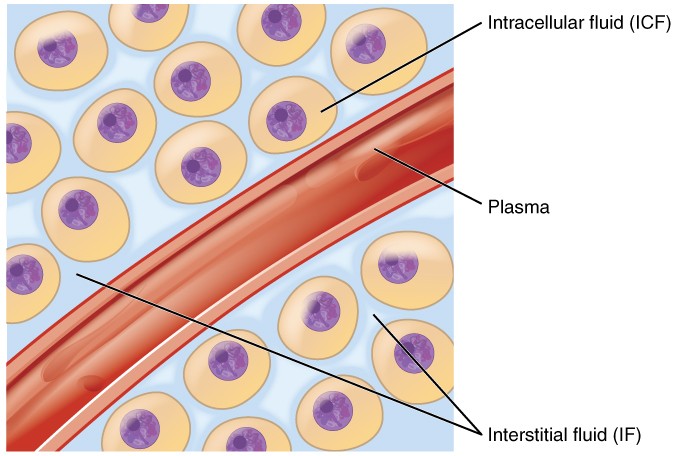
A. Intracellular Fluid (ICF)

Location: The ICF is the fluid found within the cells of the body. It is the immediate environment where the vast majority of cellular metabolic activities take place.

Proportion and Significance: The ICF constitutes the largest single fluid compartment, accounting for approximately two-thirds (2/3) of the Total Body Water (TBW). In an adult male weighing 70 kg, this would be roughly 28 liters (40% of body weight). This large volume underscores its critical role: it directly bathes the cellular machinery, providing the aqueous medium for all intracellular biochemical reactions.
Composition - The Cell's Internal Environment:

  • Major Cations:
    • Potassium (K⁺): The predominant cation in the ICF. Its high concentration is crucial for nerve impulse transmission, muscle contraction, and maintaining cell volume.
    • Magnesium (Mg²⁺): Vital as a cofactor for numerous enzymatic reactions, particularly those involving ATP.
  • Major Anions:
    • Phosphate (PO₄³⁻): A critical component of energy currency (ATP), nucleic acids, and intracellular buffering systems.
    • Proteins: The ICF is rich in large, negatively charged protein molecules that contribute to osmolarity and act as important buffers.
  • Low Concentrations: In stark contrast to the ECF, Sodium (Na⁺) and Chloride (Cl⁻) concentrations are very low within the ICF.

Key Characteristics - Functional Blueprint:

  • Selective Permeability of the Cell Membrane: The plasma membrane is the critical barrier separating the ICF from the ECF, maintaining the distinct chemical composition of the ICF.
  • Metabolic Engine: The ICF houses the cell's entire metabolic machinery – organelles like mitochondria, ribosomes, and the nucleus.
  • Osmotic Equilibrium: Despite vastly different chemical compositions, the total osmotic concentration (osmolarity) of the ICF is normally in dynamic equilibrium with the ECF.

B. Extracellular Fluid (ECF)

Location: The ECF is all the fluid found outside the cells. It acts as the body's internal environment that bathes all cells.

Proportion: The ECF constitutes approximately one-third (1/3) of the TBW, which is roughly 14 liters (20% of body weight) in a 70 kg adult.

Composition - The Body's Transport Medium:

  • Major Cations: Predominantly Sodium (Na⁺), which is the primary determinant of ECF osmolarity and volume.
  • Major Anions: Predominantly Chloride (Cl⁻) and Bicarbonate (HCO₃⁻), a crucial component of the body's buffering system.
  • Other Components: A rich soup of nutrients, gases, hormones, and waste products.

Sub-compartments of ECF:

The ECF is not a monolithic entity; it is further subdivided into several distinct yet interconnected compartments:

i. Interstitial Fluid (ISF)

This is the "tissue fluid," filling the microscopic spaces between the cells. It is the largest component of the ECF, comprising about 80% of ECF volume. Its ionic composition is similar to plasma, but it has a significantly lower protein concentration. The ISF is the critical medium for the exchange of nutrients, gases, and waste between the blood and the cells.

ii. Plasma

This is the fluid component of blood, circulating within the cardiovascular system. It accounts for about 20% of ECF volume. Its defining characteristic is its high concentration of plasma proteins (e.g., albumin). Plasma is the primary transport medium for blood cells, nutrients, hormones, and waste products.

iii. Transcellular Fluid

A small, specialized component of the ECF, representing only 1-2% of body weight. It consists of fluids secreted by specific cells into distinct, epithelial-lined spaces. The composition of these fluids is often unique and tailored to their specific function.

Examples: Cerebrospinal Fluid (CSF), Intraocular Fluid, Synovial Fluid, Serous Fluids (pleural, pericardial), and Gastrointestinal Secretions.
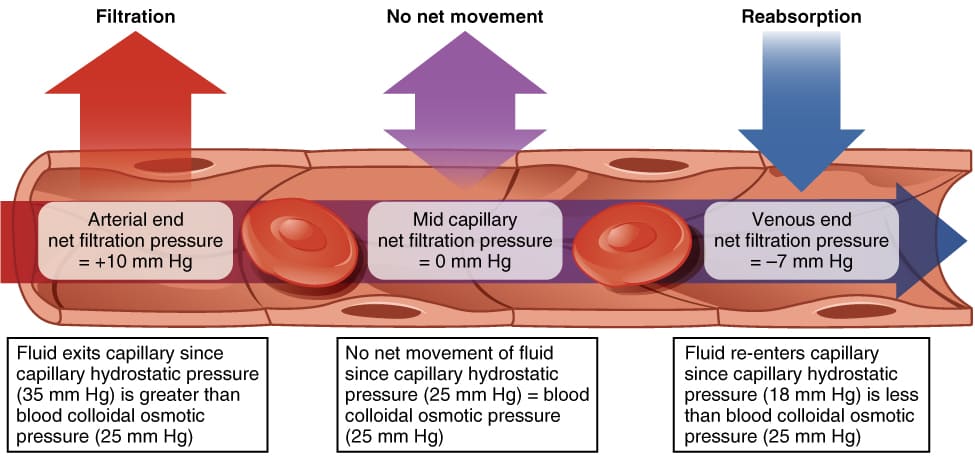
Fluid Movement Between Compartments and Regulatory Mechanisms

The precise movement of water and solutes between the body's fluid compartments is a cornerstone of physiological homeostasis. This dynamic equilibrium is meticulously regulated by physical forces, membrane properties, and complex neurohormonal systems.

A. Fluid Movement Between Plasma and Interstitial Fluid (Across Capillary Walls)

The exchange of fluid, nutrients, gases, and waste products between the blood (plasma) and the cells (via the ISF) occurs primarily across the thin walls of the capillaries. This movement is governed by Starling Forces, which represent the interplay of hydrostatic and oncotic pressures.
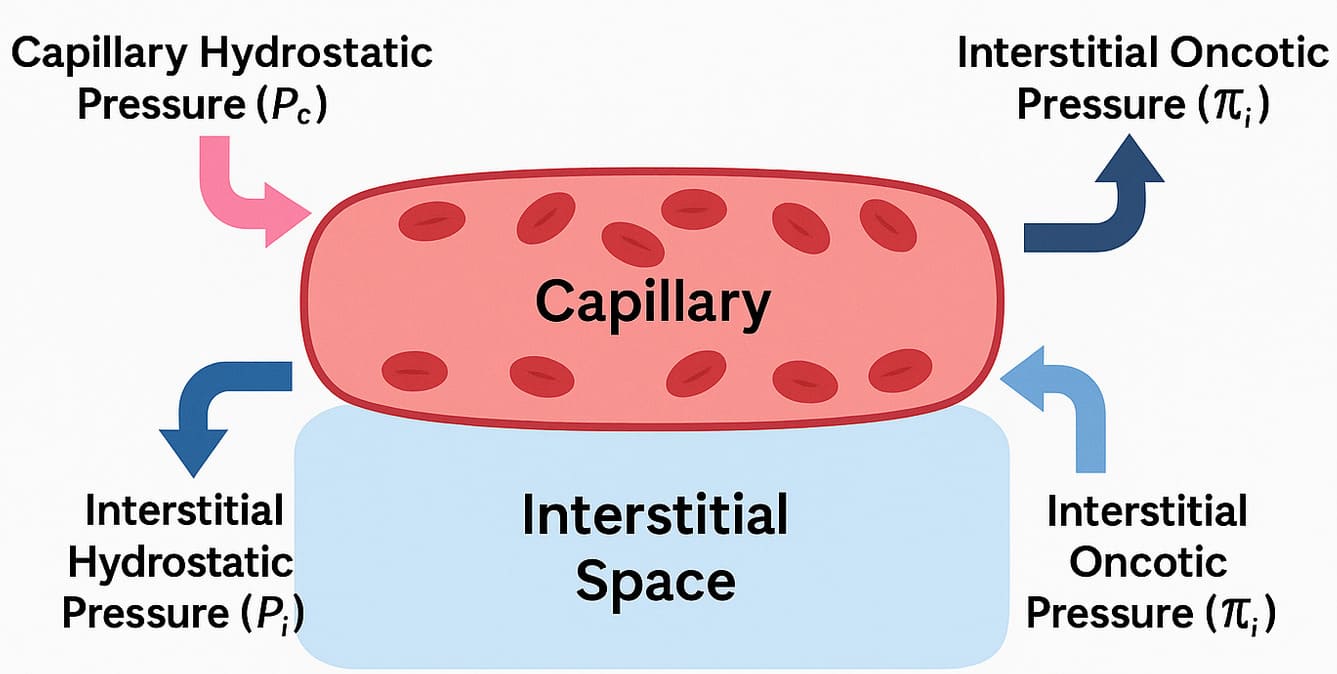

Starling Forces - The Drivers of Capillary Exchange:
Capillary Hydrostatic Pressure (Pc):
  • Definition: This is the pressure exerted by the blood within the capillaries, effectively the "pushing" force of the blood against the capillary wall.
  • Effect: It tends to force fluid out of the capillary and into the interstitial space (filtration).
  • Dynamics: Pc is highest at the arterial end of the capillary (typically around 30-35 mmHg) and progressively drops to a lower value at the venous end (typically around 10-15 mmHg).
Interstitial Fluid Hydrostatic Pressure (Pif):
  • Definition: This is the pressure exerted by the fluid in the interstitial space surrounding the capillary.
  • Effect: It tends to push fluid back into the capillary.
  • Dynamics: Pif is usually very low, often close to zero or even slightly negative.
Capillary Oncotic (Colloid Osmotic) Pressure (πc):
  • Definition: This is the osmotic pressure exerted by the large, non-diffusible proteins (primarily albumin) within the plasma.
  • Effect: It tends to pull fluid into the capillary from the interstitial space (reabsorption).
  • Dynamics: πc remains relatively constant along the length of the capillary (typically around 25-28 mmHg).
Interstitial Fluid Oncotic (Colloid Osmotic) Pressure (πif):
  • Definition: This is the osmotic pressure exerted by the small amount of proteins in the interstitial fluid.
  • Effect: It tends to pull fluid out of the capillary.
  • Dynamics: πif is normally very low (typically 2-8 mmHg).

Net Filtration Pressure (NFP): The Sum of the Forces

The net movement of fluid is determined by the balance of these forces, expressed by the Starling equation: NFP = (Pc - Pif) - (πc - πif)

  • At the arterial end: NFP = (35 - 0) - (26 - 2) = +11 mmHg. A positive NFP indicates net filtration (fluid moves out).
  • At the venous end: NFP = (15 - 0) - (26 - 2) = -9 mmHg. A negative NFP indicates net reabsorption (fluid moves in).

The Lymphatic System:

There is a slight imbalance where filtration slightly exceeds reabsorption. This excess fluid and any leaked proteins are collected by the lymphatic system, which acts as a drainage system, returning this "lymph" to the circulation. This is vital for preventing interstitial edema. Failure of this system results in lymphedema.

Fluid Movement Between ECF and ICF (Across Cell Membranes)

The exchange between the ISF and the ICF is driven primarily by osmosis. The cell membrane is highly permeable to water (largely via aquaporins) but relatively impermeable to most solutes.

Osmolarity vs. Tonicity

Tonicity describes the effect a solution has on cell volume, based on its concentration of non-penetrating solutes.

  • Isotonic ECF: No net movement of water; cell volume remains stable.
  • Hypotonic ECF: Water moves into the cells, causing them to swell (and potentially lyse). This can cause cerebral edema.
  • Hypertonic ECF: Water moves out of the cells, causing them to shrink (crenation). This can also cause severe neurological symptoms.

Active Transport's Essential Role:

While water movement is passive, the maintenance of the osmotic gradients is dependent on active transport. The Na⁺/K⁺ ATPase pump is critical. By constantly pumping 3 Na⁺ out and 2 K⁺ in, it counters the natural tendency of water to enter the cell (due to the high concentration of trapped intracellular proteins), thereby maintaining cell volume and preventing lysis.
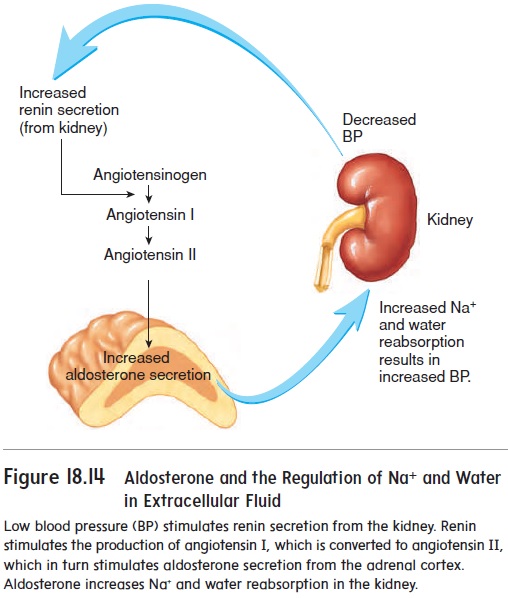
Regulation of Body Fluid Volume and Osmolarity

This is achieved through complex, interconnected neurohormonal feedback systems.

A. Regulation of ECF Volume (primarily Na⁺ balance)

ECF volume is primarily determined by its sodium content, as "where Na⁺ goes, water follows."

  • Renin-Angiotensin-Aldosterone System (RAAS): Activated by low blood pressure/volume. Angiotensin II is a potent vasoconstrictor and stimulates the release of Aldosterone. Aldosterone acts on the kidneys to dramatically increase Na⁺ reabsorption, which in turn leads to water reabsorption, expanding ECF volume.
  • Antidiuretic Hormone (ADH) / Vasopressin: Released in response to increased plasma osmolarity or significantly decreased blood volume. ADH increases water reabsorption in the kidneys by promoting the insertion of aquaporin channels, leading to concentrated urine.
  • Atrial Natriuretic Peptide (ANP) / BNP: Released by the heart in response to high ECF volume/pressure. They are counter-regulatory, promoting Na⁺ and water excretion (natriuresis and diuresis) by the kidneys to reduce volume and pressure.
  • Sympathetic Nervous System: Activation promotes Na⁺ and water retention by reducing renal blood flow and stimulating renin release.

B. Regulation of ECF Osmolarity (primarily water balance)

ECF osmolarity is primarily determined by the concentration of solutes relative to water, and is tightly controlled to stay within 280-300 mOsm/L.

  • ADH (Vasopressin): The primary hormone for osmolarity regulation. Its release is exquisitely sensitive to changes in plasma osmolarity. A small increase in osmolarity strongly stimulates ADH release, leading to water retention to dilute the ECF. A decrease inhibits ADH, leading to water excretion.
  • Thirst Mechanism: The behavioral component. Osmoreceptors in the hypothalamus, stimulated by increased osmolarity, create the conscious sensation of thirst, prompting water intake to dilute the ECF.

Clinical Significance of Fluid Imbalances

Disturbances in fluid regulation can have profound and life-threatening consequences.

  • Hypovolemia (ECF Volume Deficit): Caused by hemorrhage, severe dehydration, or burns. Leads to decreased blood pressure, poor tissue perfusion, and can progress to hypovolemic shock.
  • Hypervolemia (ECF Volume Excess): Caused by heart failure, renal failure, or cirrhosis. Leads to high blood pressure and edema. When in the lungs (pulmonary edema), it impairs gas exchange.
  • Hyponatremia (Low Plasma Na⁺): A disorder of water excess. A hypotonic ECF causes water to shift into cells, leading to cellular swelling, especially in the brain (cerebral edema), which can cause seizures and coma.
  • Hypernatremia (High Plasma Na⁺): A disorder of water deficit. A hypertonic ECF causes water to shift out of cells, leading to cellular shrinkage, especially in the brain, which can also cause seizures and coma.
  • Edema (Excess Interstitial Fluid): Can be caused by increased capillary hydrostatic pressure (e.g., heart failure), decreased plasma oncotic pressure (e.g., liver failure), increased capillary permeability (e.g., inflammation), or impaired lymphatic drainage.

Measurement of Fluid Compartments (Indicator Dilution Method)

The volume of a compartment is calculated as: Volume = Mass of Indicator Injected / Concentration of Indicator in Sample. The key is choosing an indicator that distributes only in the target compartment.
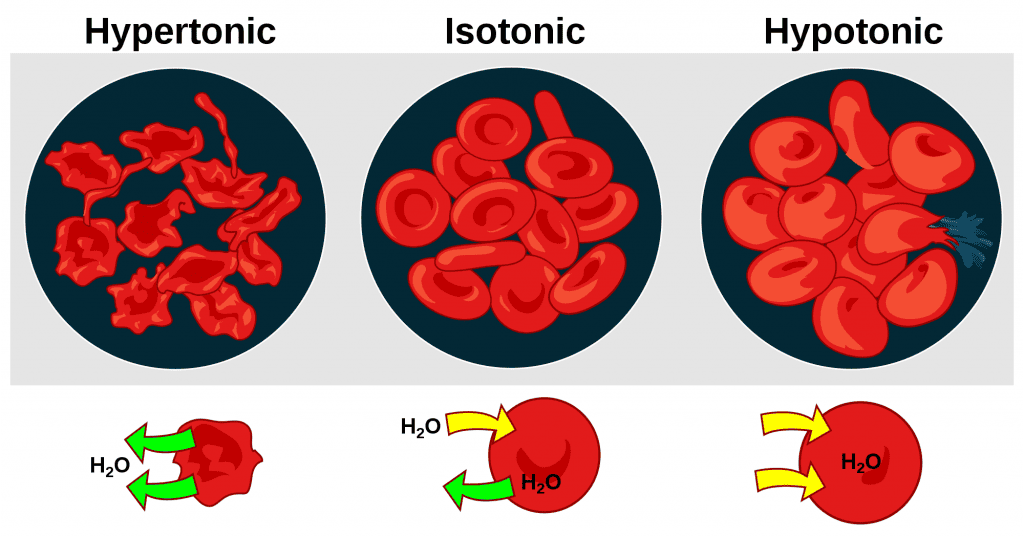
  • Total Body Water (TBW): Measured with heavy water (D₂O) or tritiated water (HTO), which distribute everywhere water does.
  • Extracellular Fluid (ECF): Measured with inulin or mannitol, which cross capillaries but cannot enter cells.
  • Plasma Volume: Measured with Evans blue dye or radioactive albumin, which are large molecules that cannot cross capillaries and remain in the plasma.
  • Interstitial Fluid (ISF) Volume: Calculated indirectly: ISF = ECF - Plasma.
  • Intracellular Fluid (ICF) Volume: Calculated indirectly: ICF = TBW - ECF.

Tonicity, Osmolarity, and Clinical Implications of IV Fluids

The human body is an intricate system highly dependent on the precise balance of water and solutes across its various compartments. Understanding the concepts of osmolarity and tonicity, and their clinical implications, particularly with intravenous (IV) fluid administration, is fundamental to effective medical practice.

1. Osmolarity vs. Tonicity:

These two terms are often used interchangeably, but they possess distinct physiological meanings that are critical when considering fluid shifts across cell membranes.

Osmolarity:

  • Definition: Osmolarity quantifies the total concentration of all solute particles present in a solution, expressed as milliosmoles per liter of solution (mOsm/L).
  • "Effective" vs. "Ineffective" Osmoles:
    • Effective Osmoles (Non-penetrating Solutes): Solutes that cannot readily cross a cell membrane and thus exert an osmotic force. Examples include Na⁺, Cl⁻, HCO₃⁻, and mannitol.
    • Ineffective Osmoles (Penetrating Solutes): Solutes that can readily cross the cell membrane and therefore do not contribute to sustained osmotic gradients. Examples include urea and ethanol.
  • Physiological Reference: Normal plasma osmolarity is tightly regulated between 280-300 mOsm/L.

Tonicity:

  • Definition: Tonicity is a functional term describing the effect a solution has on cell volume, determined solely by the concentration of non-penetrating solutes.
  • Types of Tonicity:
    • Isotonic: A solution with the same concentration of non-penetrating solutes as the cell's cytoplasm. No net water movement occurs, and cell volume remains stable. (e.g., 0.9% Normal Saline, Lactated Ringer's).
    • Hypotonic: A solution with a lower concentration of non-penetrating solutes. Water moves into cells, causing them to swell and potentially lyse. (e.g., 0.45% Saline, D5W after glucose metabolism).
    • Hypertonic: A solution with a higher concentration of non-penetrating solutes. Water moves out of cells, causing them to shrink (crenation). (e.g., 3% Saline, D5NS, Mannitol).

Key Difference (Why it matters):

A solution can be isosmotic but hypotonic. A classic example is 5% Dextrose in Water (D5W). Initially, its osmolarity is ~252 mOsm/L (isosmotic). However, once cells metabolize the glucose, it leaves behind pure water, which is hypotonic to cells, causing water to shift into them. Therefore, tonicity, not just osmolarity, is what truly matters for predicting cell volume changes.

2. Importance of Maintaining Fluid Osmolarity and Tonicity

  • Cellular Function: All cells depend on a stable intracellular volume and extracellular environment.
  • Enzyme Activity: Enzymes are highly sensitive to changes in cell volume, pH, and ion concentrations.
  • Membrane Potential: The electrochemical gradients crucial for nerve and muscle function rely on stable environments.
  • Brain Function: Neurons are exquisitely vulnerable to osmotic shifts. Swelling (cerebral edema in hyponatremia) or shrinking (in hypernatremia) can lead to severe neurological dysfunction, seizures, and death.
  • Circulatory Function: ECF volume, particularly plasma volume, directly impacts blood pressure and tissue perfusion.

3. Effects of External Factors on Fluid Compartments: IV Fluids

Their safe and effective administration requires a deep understanding of their tonicity and how they distribute.

General Principles of IV Fluid Distribution:

  • Initial Introduction: All IV fluids are introduced directly into the plasma.
  • Subsequent Distribution: Depends entirely on the fluid's tonicity.
  • Therapeutic Goal: Isotonic fluids expand ECF volume; hypotonic fluids shift water into cells; hypertonic fluids draw water out of cells.

A. Isotonic Solutions (e.g., 0.9% Normal Saline, Lactated Ringer's)

  • Distribution: They do not cause a significant net shift of water into or out of cells. Therefore, they primarily expand the Extracellular Fluid (ECF) compartment. For every 1L infused, ~250-300 mL remains in the plasma and ~700-750 mL moves into the interstitial fluid.
  • Clinical Uses: Volume resuscitation in hypovolemic shock, severe dehydration, and burns.
  • Hospital Scenario: A hypotensive trauma patient with acute blood loss is given a rapid IV infusion of 1-2 liters of Normal Saline or Lactated Ringer's to rapidly increase circulating blood volume and raise blood pressure.

B. Hypotonic Solutions (e.g., 0.45% Saline, D5W after glucose metabolism)

  • Distribution: Hypotonic solutions cause water to shift from the ECF into the Intracellular Fluid (ICF).
  • Clinical Uses: Treating hypernatremia (cellular dehydration) and providing free water replacement.
  • Hospital Scenario: A patient with severe hypernatremia has their brain cells rehydrated via a slow and controlled infusion of 0.45% Saline or D5W. This must be done slowly to avoid causing cerebral edema.

C. Hypertonic Solutions (e.g., 3% Saline, Mannitol)

  • Distribution: These create a powerful osmotic gradient that draws water out of the ICF and into the ECF, expanding the ECF at the expense of the ICF.
  • Clinical Uses: Treating severe, symptomatic hyponatremia (to pull water out of swollen brain cells) and reducing cerebral edema from conditions like traumatic brain injury.
  • Hospital Scenario: A patient with severe hyponatremia and seizures is given small, controlled boluses of 3% Saline to rapidly reduce brain swelling. Extreme caution is required to avoid Osmotic Demyelination Syndrome (ODS) from too-rapid correction.

4. Effects of Blood Transfusion

Products like packed red blood cells (PRBCs) are considered isotonic. Their distribution primarily expands the intravascular compartment (plasma volume) and directly increases the oxygen-carrying capacity of the blood.

5. Colloids vs. Crystalloids


Crystalloids:

  • Definition: Aqueous solutions of small, water-soluble molecules (e.g., Normal Saline, Lactated Ringer's).
  • Distribution: Can freely cross capillary membranes and distribute throughout the entire ECF.
  • Advantages: Inexpensive and effective for general ECF volume expansion.
  • Disadvantages: A large volume is needed for sustained plasma expansion as much of it moves into the interstitial space, which can cause significant edema.

Colloids:

  • Definition: Solutions containing large molecules (e.g., albumin, starches) that do not readily cross intact capillary membranes.
  • Distribution: Primarily remain within the intravascular compartment (plasma), exerting oncotic pressure that helps retain or pull fluid into the blood vessels.
  • Advantages: More effective at expanding plasma volume per unit infused.
  • Disadvantages: More expensive, potential for allergic reactions, and concerns about kidney injury with some synthetic colloids.

Summary of Fluid Shifts and Clinical Implications

IV Fluid TypeTonicityFinal DistributionEffect on CellsPrimary Clinical Use
IsotonicIsotonicExpands ECF (Plasma + ISF)No changeECF volume expansion (shock, dehydration)
HypotonicHypotonicShifts from ECF to ICFSwellCellular rehydration (hypernatremia)
HypertonicHypertonicShifts from ICF to ECFShrinkReduce cerebral edema, treat severe hyponatremia
ColloidsIsotonicPrimarily remains in PlasmaNo changePlasma volume expansion (severe shock)
Blood ProductsIsotonicPrimarily remains in PlasmaNo changeReplace blood loss, improve O₂ carrying capacity

Solutes, Solvents, and Simple Movement in Body Fluids

At the heart of all physiological processes involving fluids is the interaction between solutes and solvents, and their movement across various compartments.
1. Solutes and Solvents: The Basics

  • Solution: A homogeneous mixture composed of two or more substances.
  • Solvent: The substance that is present in the greatest amount in a solution and does the dissolving.
  • Solute: The substance(s) that are present in a lesser amount in a solution and get dissolved by the solvent.

What is the Solvent of Body Fluid?

The primary and overwhelmingly abundant solvent in all body fluids is WATER (H₂O).

Water's unique properties make it an ideal biological solvent:

  • Polarity: Allows it to dissolve a wide variety of other polar molecules and ions.
  • High Heat Capacity: Helps regulate body temperature.
  • High Heat of Vaporization: Allows for cooling through sweating.

Common Solutes in Body Fluids:

Body fluids are complex solutions containing a vast array of solutes:

  • Electrolytes: Ions that conduct electricity.
    • Cations (positively charged): Sodium (Na⁺), Potassium (K⁺), Calcium (Ca²⁺), Magnesium (Mg²⁺).
    • Anions (negatively charged): Chloride (Cl⁻), Bicarbonate (HCO₃⁻), Phosphate (HPO₄²⁻).
  • Non-electrolytes:
    • Nutrients: Glucose, amino acids, fatty acids, vitamins.
    • Metabolic Wastes: Urea, creatinine, uric acid.
    • Proteins: Albumin, globulins, fibrinogen.
    • Gases: Oxygen (O₂), Carbon Dioxide (CO₂).

2. Simple Movement of Solutes and Solvents

The movement of substances is primarily governed by passive processes that do not require cellular energy (ATP).

A. Movement of Solutes: Diffusion

  • Definition: The net movement of solute particles from an area of higher solute concentration to an area of lower solute concentration (down the concentration gradient).
  • Mechanism: Driven by the inherent random kinetic energy of molecules.
  • Factors Affecting Diffusion Rate: The rate is faster with a larger concentration gradient, higher temperature, smaller molecular size, shorter distance, and larger surface area.
  • Types of Diffusion:
    • Simple Diffusion: Solutes pass directly through the lipid bilayer (e.g., O₂, CO₂, fatty acids).
    • Facilitated Diffusion: Solutes move with the help of membrane proteins (channels or carriers), still following the concentration gradient (e.g., glucose, ions).

B. Movement of Solvents: Osmosis

  • Definition: The net movement of water (the solvent) across a selectively permeable membrane from an area of higher water concentration (lower solute) to an area of lower water concentration (higher solute).
  • Mechanism: Water molecules move down their own concentration gradient.
  • Selectively Permeable Membrane: Crucial for osmosis, as it allows water to pass but restricts most solutes.
  • Osmotic Pressure: The pressure needed to prevent the inward flow of water across a semipermeable membrane. The higher the solute concentration, the higher the osmotic pressure.

Summary of Movement Principles:

  • Solutes move by Diffusion: From high solute concentration to low solute concentration.
  • Water (Solvent) moves by Osmosis: From high water concentration (low solute) to low water concentration (high solute).

These passive movements are essential for:

  • Nutrient delivery and waste removal.
  • Gas exchange in the lungs.
  • Maintaining cell volume and shape.
  • Fluid balance between intracellular and extracellular compartments.

Clinical Scenarios:

Basic Principle: Water follows solutes. Specifically, water moves from an area of lower effective solute concentration (higher water concentration) to an area of higher effective solute concentration (lower water concentration) across a semipermeable membrane.

Scenario 1: Blood Transfusion

  • Product: Whole blood or packed red blood cells.
  • Tonicity: Isotonic.
  • Effect: Primarily increases the plasma volume. No significant shift of fluid between ECF and ICF. Also delivers oxygen-carrying capacity.
  • Clinical Use: To replace blood loss or treat anemia.

Scenario 2: Intravenous (IV) Fluid Administration

1. Isotonic Solutions (e.g., Normal Saline - 0.9% NaCl, Lactated Ringer's - LR)

  • Composition: 0.9% NaCl (NS) contains 154 mEq/L Na⁺ and 154 mEq/L Cl⁻. Lactated Ringer's (LR) contains Na⁺, Cl⁻, K⁺, Ca²⁺, and lactate. Both are effectively isotonic.
  • Distribution: The fluid stays entirely within the ECF compartment, distributing between the plasma (~1/4) and interstitial fluid (~3/4).
  • Clinical Uses: Volume expansion for dehydration, hypovolemic shock, hemorrhage.
  • Hospital Scenario: A hypotensive car accident patient receives a rapid infusion of NS or LR to restore intravascular volume and blood pressure.

2. Hypotonic Solutions (e.g., 0.45% NaCl - Half Normal Saline, D5W - Dextrose 5% in Water)

  • Composition: 0.45% NaCl has half the sodium of NS. D5W is initially isotonic, but the dextrose is rapidly metabolized, leaving free water.
  • Distribution: Water moves from the ECF into the ICF compartment to equalize osmolality, hydrating the cells.
  • Clinical Uses: To treat cellular dehydration (e.g., hypernatremia).
  • Hospital Scenario: A patient with severe hypernatremia is given a slow infusion of Half Normal Saline to allow water to shift into their dehydrated brain cells.

3. Hypertonic Solutions (e.g., 3% NaCl - Hypertonic Saline, D5NS)

  • Composition: 3% NaCl is very hypertonic (1026 mOsm/L). D5NS is initially hypertonic, then becomes isotonic as dextrose is metabolized.
  • Distribution: Water moves out of the ICF and into the ECF compartment, causing cells to shrink.
  • Clinical Uses: To treat severe symptomatic hyponatremia and to reduce cerebral edema.
  • Hospital Scenario: A patient with traumatic brain injury and high intracranial pressure is given a slow infusion of 3% Hypertonic Saline to draw fluid out of the swollen brain cells.

4. Colloids (e.g., Albumin, Dextran, Hetastarch)

  • Composition: Solutions containing large molecules (proteins, large sugars) that do not easily cross capillary membranes.
  • Distribution: Due to their large size, they primarily remain within the intravascular space (plasma), exerting an oncotic pull that draws fluid from the interstitial space into the plasma.
  • Clinical Uses: Rapid plasma volume expansion, especially in severe hypoalbuminemia or burns.
  • Hospital Scenario: A patient with severe burns and plasma volume depletion is given an infusion of Albumin to rapidly restore intravascular volume.

Summary Table of IV Fluid Effects:

IV Fluid TypeEffective TonicityPrimary DistributionEffect on ICF Cells
Isotonic (NS, LR)IsotonicECF only (plasma & ISF)No change
Hypotonic (0.45% NaCl, D5W)HypotonicECF & ICFSwell
Hypertonic (3% NaCl)HypertonicECF (draws from ICF)Shrink
Colloids (Albumin)Effectively Hypertonic (oncotic)Plasma only (draws from ISF)No direct effect

Test Your Knowledge

A quiz on Body Fluids, Osmolarity, Tonicity & IV Solutions.

1. Which of the following best defines osmolarity?

  • The concentration of non-penetrating solutes in a solution.
  • The effect a solution has on cell volume.
  • The total concentration of all solute particles in a solution.
  • The pressure required to stop water movement across a membrane.

Correct (c): Osmolarity measures the sum of all solute particles, both penetrating (ineffective) and non-penetrating (effective), in a given volume of solution.

Incorrect (a, b): This defines tonicity.

Incorrect (d): This describes osmotic pressure.

2. A solution with a lower concentration of non-penetrating solutes than the cell's cytoplasm is described as:

  • Isosmotic
  • Isotonic
  • Hypotonic
  • Hypertonic

Correct (c): Hypotonic solutions have fewer non-penetrating solutes, causing water to move into cells and make them swell.

Incorrect (b): Isotonic solutions have the same concentration, causing no change in cell volume.

Incorrect (d): Hypertonic solutions have a higher concentration, causing cells to shrink.

3. Which solute is generally considered an ineffective osmole in the context of sustained osmotic gradients across cell membranes?

  • Sodium (Na+)
  • Glucose
  • Urea
  • Mannitol

Correct (c): Urea readily crosses most cell membranes, so it does not create a sustained osmotic gradient and is an ineffective osmole.

Incorrect (a): Sodium is the primary effective osmole in the ECF.

Incorrect (d): Mannitol is specifically designed not to cross membranes, making it a potent effective osmole.

4. Normal plasma osmolarity is approximately:

  • 150-200 mOsm/L
  • 280-300 mOsm/L
  • 350-400 mOsm/L
  • 450-500 mOsm/L

Correct (b): This is the tightly regulated normal range for plasma osmolarity in humans.

Incorrect: The other ranges are either too low or too high for a healthy state.

5. When a cell is placed in a hypertonic solution, what will happen to the cell?

  • It will swell and potentially lyse.
  • It will remain stable in volume.
  • It will shrink (crenation).
  • It will undergo active transport of water.

Correct (c): In a hypertonic solution, the ECF has more non-penetrating solutes, pulling water out of the cell via osmosis and causing it to shrink.

Incorrect (a): This happens in a hypotonic solution.

Incorrect (b): This happens in an isotonic solution.

Incorrect (d): Water moves passively by osmosis.

6. A patient with severe hypovolemic shock requires rapid fluid resuscitation. Which IV fluid is most appropriate?

  • 0.45% Saline
  • D5W
  • 3% Saline
  • Lactated Ringer's

Correct (d): Isotonic crystalloids like Lactated Ringer's are first-line for hypovolemic shock because they expand the extracellular fluid volume without causing dangerous fluid shifts.

Incorrect (a, b): These are hypotonic and would shift water into cells, worsening intravascular depletion.

Incorrect (c): This is hypertonic and used for specific conditions like cerebral edema, not routine resuscitation.

7. How does 5% Dextrose in Water (D5W) behave clinically after the glucose is metabolized?

  • It becomes hypertonic.
  • It primarily expands the intravascular compartment.
  • It acts as a hypotonic solution, providing free water.
  • It acts as an isotonic solution long-term.

Correct (c): Once the glucose is metabolized, it leaves behind pure water. This "free water" then moves into cells due to osmosis, effectively acting as a hypotonic solution and rehydrating cells.

8. What is a primary clinical indication for administering a hypertonic saline solution (e.g., 3% NaCl)?

  • Correcting hypernatremia.
  • Treating severe symptomatic hyponatremia with cerebral edema.
  • Routine maintenance fluid.
  • Expanding interstitial fluid volume.

Correct (b): Hypertonic saline is used to rapidly raise ECF sodium and pull water out of swollen brain cells in life-threatening hyponatremia.

Incorrect (a): Hypernatremia is treated with hypotonic solutions.

Incorrect (c): It is a high-risk fluid, not for routine use.

9. What is the main advantage of colloids over crystalloids for plasma volume expansion?

  • Colloids are less expensive.
  • Colloids distribute throughout the entire ECF.
  • Colloids are more effective at expanding plasma volume per unit infused.
  • Colloids are primarily used for cellular rehydration.

Correct (c): Due to their large molecules remaining in the intravascular space and exerting oncotic pressure, colloids expand plasma volume with a smaller amount of fluid compared to crystalloids.

Incorrect (a): Colloids are significantly more expensive.

Incorrect (b): Crystalloids distribute throughout the ECF; colloids largely stay in the plasma.

10. The primary solvent in all human body fluids is:

  • Sodium chloride
  • Plasma proteins
  • Water
  • Glucose

Correct (c): Water is the universal solvent for biological systems, making up the vast majority of all body fluids.

Incorrect: The other options are important solutes, not the solvent.

11. The net movement of solute particles from an area of higher to lower concentration is called:

  • Osmosis
  • Active Transport
  • Diffusion
  • Filtration

Correct (c): Diffusion is the passive movement of solute particles down their concentration gradient.

Incorrect (a): Osmosis is the movement of water (the solvent).

Incorrect (b): Active transport requires energy to move solutes against a gradient.

12. Which type of diffusion requires membrane proteins but not ATP?

  • Simple Diffusion
  • Facilitated Diffusion
  • Active Transport
  • Endocytosis

Correct (b): Facilitated diffusion uses membrane proteins (channels or carriers) to help solutes move down their gradient, without ATP.

Incorrect (a): Simple diffusion does not require proteins.

Incorrect (c): Active transport requires ATP.

13. A patient with severe hypernatremia would most likely benefit from which type of IV fluid?

  • Isotonic crystalloid
  • Hypertonic saline
  • Hypotonic solution
  • Colloid

Correct (c): In hypernatremia, the ECF is hypertonic, causing cells to shrink. A hypotonic solution will dilute the ECF sodium and cause water to move back into the cells, rehydrating them.

14. What is the approximate distribution of 1 liter of an isotonic crystalloid (like Normal Saline) after infusion?

  • All 1L remains in the intravascular space.
  • All 1L shifts into the intracellular fluid.
  • ~250 mL intravascular, ~750 mL interstitial.
  • ~500 mL intravascular, ~500 mL intracellular.

Correct (c): Isotonic crystalloids distribute throughout the entire ECF. Since the ECF is roughly 1/4 plasma and 3/4 interstitial fluid, an infused liter will partition accordingly.

15. Why are brain cells particularly vulnerable to rapid shifts in ECF osmolarity?

  • They produce less ATP than other cells.
  • They are in a rigid skull with limited room for expansion.
  • Their cell membranes are impermeable to water.
  • They only contain ineffective osmoles.

Correct (b): The brain's enclosure within the skull means that significant swelling (from hypotonicity) or shrinking (from hypertonicity) can lead to severe neurological damage.

16. The term describing the effect a solution has on cell volume is _________.

Rationale: This is the direct definition of tonicity, distinguishing it from osmolarity which considers all solutes.

17. In osmosis, water moves toward an area of _________ solute concentration.

Rationale: Water moves down its own concentration gradient, which means it moves from an area of low solute concentration to an area of high solute concentration.

18. _________ are solutions with large molecules that primarily remain within the intravascular compartment.

Rationale: This is the defining characteristic of colloids and how they differ from crystalloids in terms of fluid distribution.

19. The primary cation in the ECF that is a major effective osmole is _________.

Rationale: Sodium (Na+) is the main determinant of ECF osmolarity and tonicity, making it critically important for fluid balance.

20. When a cell is placed in a hypotonic solution, it will _________.

Rationale: A hypotonic solution has fewer non-penetrating solutes than the cell, causing water to move into the cell by osmosis.