Body Fluids and Compartments
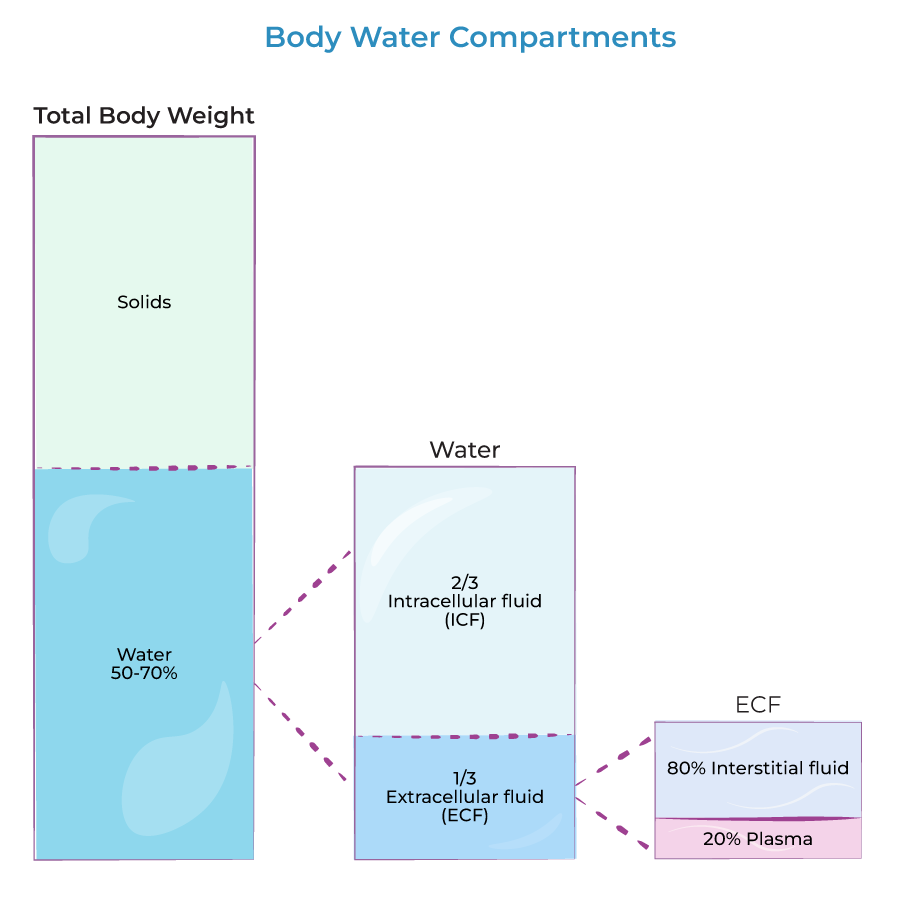
Body Fluids: And Compartments Body Fluids To truly appreciate the dynamics of body fluids, we first need to understand where all this fluid is located within the body. Imagine your body as a system of interconnected containers, each holding a specific type of fluid. These “containers” are what we call body fluid compartments. The human body is largely composed of water, and this water isn’t just free-flowing; it’s meticulously organized into various functional compartments. This compartmentalization is key to maintaining cellular and systemic homeostasis. 1. Total Body Water (TBW) TBW refers to all the water contained within the body. It represents a significant proportion of body mass. Proportion: Approximately 60% of an adult’s body weight is water. This percentage can vary significantly based on several factors: Age: Infants (up to 75-80%), Adults (~60%), and the Elderly (can drop to 45-50%). Sex: Females generally have a slightly lower TBW percentage than males because they typically have a higher percentage of adipose tissue (fat), which contains very little water. Body Fat Content: Individuals with higher body fat percentages will have lower TBW percentages, and vice-versa. Composition of Water: TBW is not pure water; it contains numerous dissolved solutes, including electrolytes, proteins, nutrients, gases, and waste products. The total amount of water in an adult human body constitutes about 50-70% of the total body weight. This water is not uniformly distributed but is divided into two primary compartments, which are further subdivided: A. Intracellular Fluid (ICF) Location: The ICF is the fluid found within the cells of the body. It is the immediate environment where the vast majority of cellular metabolic activities take place. Proportion and Significance: The ICF constitutes the largest single fluid compartment, accounting for approximately two-thirds (2/3) of the Total Body Water (TBW). In an adult male weighing 70 kg, this would be roughly 28 liters (40% of body weight). This large volume underscores its critical role: it directly bathes the cellular machinery, providing the aqueous medium for all intracellular biochemical reactions. Composition – The Cell’s Internal Environment: Major Cations: Potassium (K⁺): The predominant cation in the ICF. Its high concentration is crucial for nerve impulse transmission, muscle contraction, and maintaining cell volume. Magnesium (Mg²⁺): Vital as a cofactor for numerous enzymatic reactions, particularly those involving ATP. Major Anions: Phosphate (PO₄³⁻): A critical component of energy currency (ATP), nucleic acids, and intracellular buffering systems. Proteins: The ICF is rich in large, negatively charged protein molecules that contribute to osmolarity and act as important buffers. Low Concentrations: In stark contrast to the ECF, Sodium (Na⁺) and Chloride (Cl⁻) concentrations are very low within the ICF. Key Characteristics – Functional Blueprint: Selective Permeability of the Cell Membrane: The plasma membrane is the critical barrier separating the ICF from the ECF, maintaining the distinct chemical composition of the ICF. Metabolic Engine: The ICF houses the cell’s entire metabolic machinery – organelles like mitochondria, ribosomes, and the nucleus. Osmotic Equilibrium: Despite vastly different chemical compositions, the total osmotic concentration (osmolarity) of the ICF is normally in dynamic equilibrium with the ECF. B. Extracellular Fluid (ECF) Location: The ECF is all the fluid found outside the cells. It acts as the body’s internal environment that bathes all cells. Proportion: The ECF constitutes approximately one-third (1/3) of the TBW, which is roughly 14 liters (20% of body weight) in a 70 kg adult. Composition – The Body’s Transport Medium: Major Cations: Predominantly Sodium (Na⁺), which is the primary determinant of ECF osmolarity and volume. Major Anions: Predominantly Chloride (Cl⁻) and Bicarbonate (HCO₃⁻), a crucial component of the body’s buffering system. Other Components: A rich soup of nutrients, gases, hormones, and waste products. Sub-compartments of ECF: The ECF is not a monolithic entity; it is further subdivided into several distinct yet interconnected compartments: i. Interstitial Fluid (ISF) This is the “tissue fluid,” filling the microscopic spaces between the cells. It is the largest component of the ECF, comprising about 80% of ECF volume. Its ionic composition is similar to plasma, but it has a significantly lower protein concentration. The ISF is the critical medium for the exchange of nutrients, gases, and waste between the blood and the cells. ii. Plasma This is the fluid component of blood, circulating within the cardiovascular system. It accounts for about 20% of ECF volume. Its defining characteristic is its high concentration of plasma proteins (e.g., albumin). Plasma is the primary transport medium for blood cells, nutrients, hormones, and waste products. iii. Transcellular Fluid A small, specialized component of the ECF, representing only 1-2% of body weight. It consists of fluids secreted by specific cells into distinct, epithelial-lined spaces. The composition of these fluids is often unique and tailored to their specific function. Examples: Cerebrospinal Fluid (CSF), Intraocular Fluid, Synovial Fluid, Serous Fluids (pleural, pericardial), and Gastrointestinal Secretions. Fluid Movement Between Compartments and Regulatory Mechanisms The precise movement of water and solutes between the body’s fluid compartments is a cornerstone of physiological homeostasis. This dynamic equilibrium is meticulously regulated by physical forces, membrane properties, and complex neurohormonal systems. A. Fluid Movement Between Plasma and Interstitial Fluid (Across Capillary Walls) The exchange of fluid, nutrients, gases, and waste products between the blood (plasma) and the cells (via the ISF) occurs primarily across the thin walls of the capillaries. This movement is governed by Starling Forces, which represent the interplay of hydrostatic and oncotic pressures. Starling Forces – The Drivers of Capillary Exchange: Capillary Hydrostatic Pressure (Pc): Definition: This is the pressure exerted by the blood within the capillaries, effectively the “pushing” force of the blood against the capillary wall. Effect: It tends to force fluid out of the capillary and into the interstitial space (filtration). Dynamics: Pc is highest at the arterial end of the capillary (typically around 30-35 mmHg) and progressively drops to a lower value at the venous end (typically around 10-15 mmHg). Interstitial Fluid Hydrostatic Pressure (Pif): Definition: This is the pressure exerted by the fluid in the interstitial space surrounding the capillary. Effect: It tends to push fluid