The-steeplechase-exam-in-Human-Anatomy-practical-1-2048

Anatomy steeplechase questions pdf

Anatomy Steeplechase

Anatomy Steeplechase: Embryology, Histology & Limbs

Anatomy Steeplechase

Embryology, Histology, Upper & Lower Limb

Exam Rules:

  • Be Specific: Don't just identify the bone; identify the landmark.
  • Side Matters: In a real exam, always specify Left/Right.
  • Clinical Correlation: Think about nerve supplies and injuries.
Respiratory Function Tests

Respiratory Function Tests

Respiratory Function Tests

Respiratory Function Tests

Respiratory Function Tests (RFTs), or lung function tests, are painless breathing evaluations measuring how well your lungs take in air, move it in and out, and transfer oxygen to blood, using tools like spirometry (how fast you breathe out) and plethysmography (total lung capacity in a booth) to diagnose breathing issues, monitor lung diseases, and assess lung health before surgery. These tests provide crucial data for managing asthma, COPD, and other respiratory conditions.

Overall Objective: To understand the principles, methodologies, and clinical significance of various tests used to assess pulmonary function, differentiate between obstructive and restrictive lung diseases, and monitor disease progression.

Objective 1: Describe the principles and interpretation of spirometry, including FEV1, FVC, and FEV1/FVC ratio.

Spirometry is the most common and fundamental pulmonary function test. It measures how much air a person can inhale and exhale, and how quickly they can exhale it. It's an indispensable tool for diagnosing and managing a wide range of respiratory conditions.

A. Spirometry Basics

Definition and Purpose

Definition: Spirometry is a simple, non-invasive test that measures the volume and flow of air that can be inhaled and exhaled.

Purpose:
  • Diagnose respiratory diseases (e.g., asthma, COPD).
  • Monitor disease progression and response to treatment.
  • Assess severity of lung impairment.
  • Evaluate disability for legal or insurance purposes.
  • Pre-operative assessment of respiratory risk.

How Spirometry is Performed (Forced Exhalation Maneuver)

  1. The patient takes the deepest breath possible (maximal inspiration) to reach Total Lung Capacity (TLC).
  2. Then, they forcefully and rapidly exhale all the air they can, for as long as they can (at least 6 seconds, or until no more air can be exhaled) into a mouthpiece connected to a spirometer.
  3. It requires good patient cooperation and effort to obtain reliable and reproducible results.

Parameters Measured

Spirometry primarily measures two key volumes, from which a crucial ratio is derived:

Forced Vital Capacity (FVC)

Total Volume Exhaled

Definition: The total volume of air exhaled during a maximal forced expiration, starting from a maximal inspiration.

Represents: Total "usable" air. Reflects overall size/elasticity of lungs and chest wall.

Normal Value: ~4-6 liters (varies by age/height).

FEV1

Volume in 1st Second

Definition: The volume of air exhaled in the first second of the FVC maneuver.

Represents: Speed/ease of expulsion. Indicator of airway patency/resistance.

Normal Value: 75-85% of FVC.

FEV1/FVC Ratio

The Critical Ratio

Definition: Ratio of FEV1 to FVC, expressed as percentage.

Represents: Most important parameter for differentiating obstructive vs. restrictive disease.

Normal Value: ≥ 70-75% (or ratio ≥ 0.70-0.75).

Flow-Volume Loops

Description: A graphical representation generated during spirometry that plots instantaneous expiratory flow rate (y-axis) against lung volume (x-axis).

Normal Loop:

A rapid rise to peak expiratory flow, followed by a linear decrease in flow as lung volume decreases, forming a triangular or "sail-like" shape. Inspiratory limb is a smooth, concave curve.

Obstructive Pattern:

Characterized by a "scooped-out" or concave shape of the expiratory limb, reflecting significant airflow limitation. Peak flow may be reduced.

Restrictive Pattern:

Characterized by a "witch's hat" appearance – smaller loop overall (reduced FVC) but with a relatively normal, preserved flow rate shape (proportional but scaled down).

Fixed Airway Obstruction:

Both inspiratory and expiratory limbs are flattened.

B. Interpretation of Spirometry Results

Interpretation involves comparing measured values to predicted normal values (based on age, sex, height, ethnicity).

Normal

  • Ratio: ≥ 70-75%
  • FEV1: ≥ 80% predicted
  • FVC: ≥ 80% predicted

Suggests healthy lung function.

Obstructive

Example: COPD, Asthma

  • Ratio: < 70-75% (KEY DIAGNOSTIC)
  • FEV1: Reduced (< 80%)
  • FVC: Normal or slightly reduced
  • Loop: "Scooped-out"

Increased resistance makes exhalation difficult.

Restrictive

Example: Fibrosis, Scoliosis

  • Ratio: Normal/Increased (≥ 70%)
  • FEV1: Reduced (< 80%)
  • FVC: Reduced (< 80%)
  • Loop: "Witch's hat" (small)

Reduced compliance/volume; both reduced proportionally.

Severity Grading (e.g., COPD GOLD)

Based on FEV1 % predicted:

  • Mild: ≥ 80%
  • Moderate: 50-79%
  • Severe: 30-49%
  • Very Severe: < 30%

Bronchodilator Reversibility

Purpose: Differentiate Asthma vs. COPD.

Significant Reversibility: Increase in FEV1/FVC of >12% AND >200 mL.

  • Asthma: Typically significant reversibility.
  • COPD: Often less pronounced/consistent; obstruction is largely fixed.

Objective 2: Understand additional lung volumes and capacities measured by methods other than spirometry, particularly Residual Volume (RV) and Total Lung Capacity (TLC).

While spirometry is excellent for measuring dynamic lung function (how much air can be quickly moved), it has limitations. Specifically, it cannot measure volumes of air that cannot be exhaled from the lungs. This necessitates other techniques to determine the complete picture of lung volumes.

A. Limitations of Spirometry

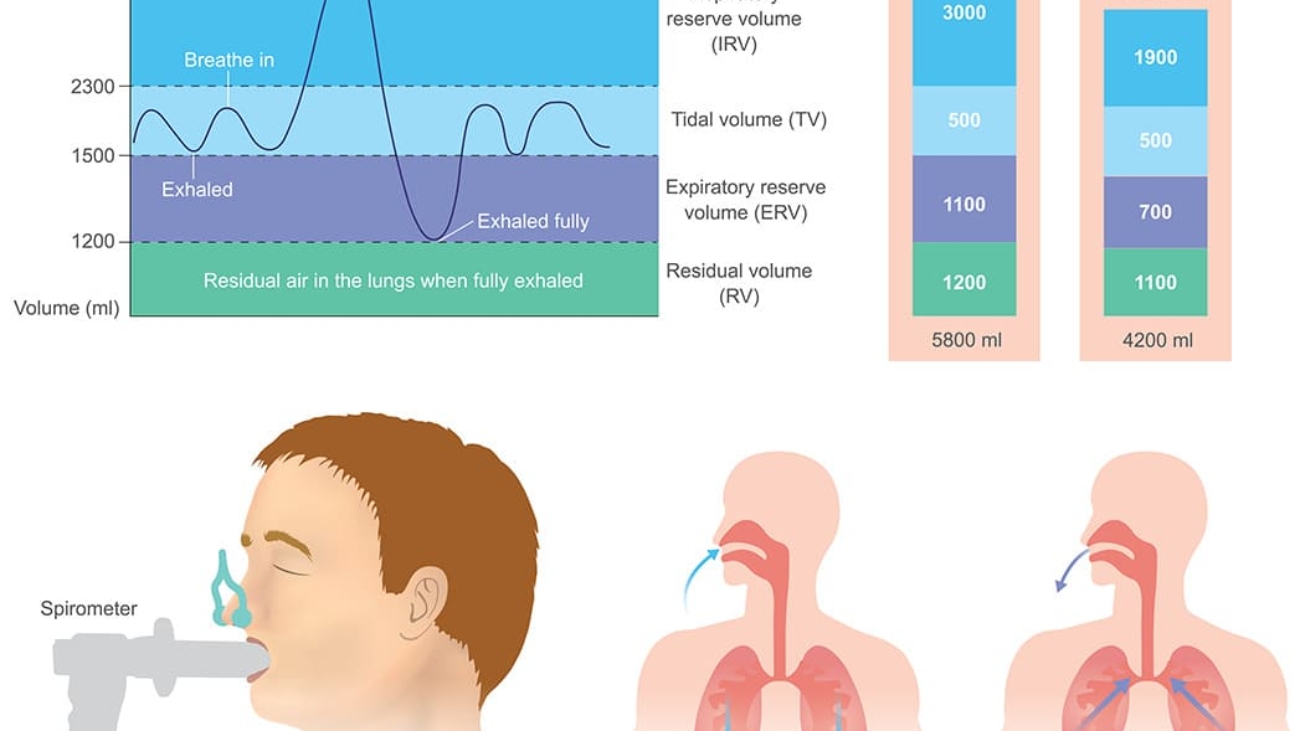
Spirometry directly measures vital capacity (VC or FVC) and its components (IRV, TV, ERV). However, it cannot measure:

Residual Volume (RV):

The volume of air remaining in the lungs after a maximal forced expiration.

Functional Residual Capacity (FRC):

The volume of air remaining in the lungs after a normal tidal expiration (ERV + RV).

Total Lung Capacity (TLC):

The total volume of air in the lungs after a maximal inspiration (VC + RV, or FRC + IC).

These volumes are essential for diagnosing and characterizing certain lung conditions, particularly restrictive lung diseases (where TLC is reduced) and obstructive diseases with air trapping (where RV and TLC might be increased).

B. Methods for Measuring RV, FRC, and TLC

Since RV, FRC, and TLC all include the residual volume, which cannot be exhaled, specialized techniques are required to measure them.

1. Helium Dilution Method

Principle:

Inert gas dilution. If a known quantity of a tracer gas (helium, insoluble in blood) is introduced into a closed system, it distributes throughout the available lung volume until equilibrium is reached. The extent of dilution is used to calculate the unknown volume.

Procedure:
  1. Patient connected to spirometer with known volume/concentration of helium (C1).
  2. Patient breathes normally (tidal breathing) from closed system. Exhales to FRC, then circuit opens.
  3. Helium mixes with air in lungs (FRC volume).
  4. Breathing continues until equilibrium is reached (C2). Usually 5-7 minutes.
  5. Patient performs maximal expiration (ERV) and maximal inspiration (VC).
Calculation:
(Vspirometer * C1) = (Vspirometer + FRC) * C2
FRC = ( (Vspirometer * C1) / C2 ) - Vspirometer

Once FRC is known: TLC = FRC + IC and RV = FRC - ERV.

Limitations:

Assumes free mixing. In severe obstruction/air trapping (e.g., emphysema), trapped air may not equilibrate, leading to underestimation of FRC and TLC.

2. Nitrogen Washout Method

Principle:

Uses inert gas (nitrogen) but measures washout. Lungs are normally ~80% nitrogen. Breathing 100% O2 washes nitrogen out, which is collected.

Procedure:
  1. Patient exhales to FRC.
  2. Breathes 100% oxygen from spirometer.
  3. Exhaled air (containing lung nitrogen) is collected and analyzed.
  4. Continues until exhaled nitrogen drops to < 1.5% (approx 7 mins).
Calculation:
FRC = (Total N2 exhaled) / (Initial alveolar N2 conc, ~0.80)
Limitations:

Similar to helium dilution, tends to underestimate FRC/TLC in severe obstruction due to poorly ventilated trapped air.

3. Body Plethysmography (Body Box)

Principle:

Generally considered the most accurate method. Uses Boyle's Law (P1V1 = P2V2).

Procedure:
  • Patient sits in airtight "body box".
  • Pants against a closed shutter at end of normal expiration (FRC).
  • Chest expansion decreases box volume -> increases box pressure.
  • Simultaneously lung volume increases -> lung pressure decreases.
  • Transducers measure mouth pressure and box pressure changes.
Measurement & Advantages:

Calculates thoracic gas volume (TGV). Unlike dilution methods, it measures all compressible gas within the thorax (including trapped air), making it more accurate for obstructive diseases.

Limitations:

Claustrophobia, equipment cost.

C. Clinical Significance of RV and TLC

Increased RV & TLC

Indicates: Hyperinflation and air trapping.

Clinical Relevance: Hallmark of Obstructive Lung Diseases (Emphysema, Asthma).

  • Emphysema: Loss of elastic recoil = difficult to exhale = increased RV/FRC.
  • Asthma/Bronchitis: Airway narrowing traps air.

RV/TLC Ratio: An increased ratio (>30%) is a strong indicator of air trapping.

Decreased RV & TLC

Indicates: Reduced lung volumes.

Clinical Relevance: Defining characteristic of Restrictive Lung Diseases.

  • Intrinsic: Fibrosis, Sarcoidosis (stiff tissue).
  • Extrinsic: Obesity, Neuromuscular disease, Scoliosis (restricted expansion).

Differentiation: A reduced TLC (<80% predicted) is the definitive criterion for restrictive disease.

Objective 3: Explain the principles and clinical utility of Diffusing Capacity of the Lung for Carbon Monoxide (DLCO/TLCO).

The diffusing capacity of the lung (DLCO), also sometimes referred to as Transfer factor for Carbon Monoxide (TLCO), measures the efficiency of gas exchange across the alveolar-capillary membrane. It assesses the integrity and function of the primary site where oxygen enters the blood and carbon dioxide leaves it.

A. DLCO Basics

Definition:

DLCO is the rate at which carbon monoxide (CO) is absorbed from the alveoli into the pulmonary capillary blood per unit of driving pressure (partial pressure gradient) for CO. Essentially, it quantifies the ability of the lungs to transfer gas from the inhaled air into the red blood cells.

Principle:

Tracer Gas (Carbon Monoxide):

Used because of its very high affinity for hemoglobin (200-250x greater than oxygen). This ensures that almost all CO that diffuses into the blood binds to hemoglobin, maintaining a near-zero partial pressure in plasma. Thus, alveolar partial pressure (PACO) becomes the primary driving force.

Test Gas Mixture:

Inhaled mixture contains low concentration CO (0.3%), an inert tracer gas (helium/methane for measuring alveolar volume), oxygen (21%), and nitrogen.

Measurement:

Calculated by measuring how much CO disappears from the inhaled gas (after correcting for alveolar volume).

Correcting Factors:

  • Hemoglobin Concentration: Since CO binds to Hb, the amount of available Hb directly affects uptake. DLCO is corrected (upwards for anemia, downwards for polycythemia) to reflect normal Hb levels.
  • Alveolar Volume (VA): Total surface area is proportional to lung volume. DLCO/VA (KCO) normalizes diffusing capacity to lung volume, differentiating reduced DLCO due to small lungs vs. actual membrane impairment.

B. Factors Affecting DLCO

The diffusing capacity is determined by properties of the alveolar-capillary membrane and the pulmonary circulation.

1. Surface Area

Increased: Exercise, Polycythemia.

Decreased: Emphysema (destruction of alveolar walls), Pneumonectomy/Lobectomy.

2. Membrane Thickness

Decreased DLCO: Conditions increasing barrier thickness.

  • Pulmonary Fibrosis / ILD.
  • Pulmonary Edema (fluid accumulation).
  • Asbestosis, Sarcoidosis.
3. Hemoglobin Concentration

Decreased DLCO: Anemia (fewer binding sites).

Increased DLCO: Polycythemia (increased RBC mass).

4. Pulmonary Capillary Volume

Decreased: Pulmonary Hypertension, Pulmonary Embolism.

Increased: Congestive Heart Failure, Cardiac Shunts (L to R), Exercise.

C. Interpretation of DLCO Results

Results are compared to predicted values. < 80% predicted is typically considered reduced.

Reduced DLCO

Reduced Surface Area:
  • Emphysema: Key differentiator from asthma.
  • Pneumonectomy.
Increased Thickness:
  • Fibrosis / ILDs: Correlates with severity.
  • Pulmonary Edema.
Reduced Capillary Vol:
  • Pulmonary Hypertension: Early sign.
  • Pulmonary Embolism.
Other:
  • Anemia (uncorrected).
  • Drug toxicity (Amiodarone).

Normal DLCO

  • Asthma: Primarily airway obstruction, membrane intact. (Key vs Emphysema).
  • Chronic Bronchitis: Usually normal unless emphysema present.
  • Neuromuscular / Chest Wall: Membrane unaffected.

Increased DLCO

  • Polycythemia: Increased Hb.
  • Congestive Heart Failure: Increased capillary volume.
  • Pulmonary Hemorrhage: CO binds to RBCs in alveoli.
  • Exercise: Capillary recruitment.

D. Clinical Utility

Differentiating Lung Diseases:
  • Obstructive: Distinguishes Emphysema (Low DLCO) vs. Asthma/Bronchitis (Normal DLCO).
  • Restrictive: Distinguishes ILD (Low DLCO) vs. Neuromuscular/Chest Wall (Normal DLCO).
Other Uses:
  • Severity/Prognosis: Monitors progression in ILD/Emphysema.
  • Early Detection: Drug toxicity may show low DLCO before spirometry changes.
  • Pre-op: Surgical risk assessment.
  • Vascular Disease: Suggests PH or emboli if parenchyma is normal.

Objective 4: Discuss the role of Arterial Blood Gas (ABG) analysis in assessing respiratory and acid-base status.

Arterial Blood Gas (ABG) analysis is a vital diagnostic tool that measures the partial pressures of oxygen (PaO2) and carbon dioxide (PaCO2) in arterial blood, as well as blood pH and bicarbonate (HCO3-) concentration. It provides a real-time snapshot of the patient's oxygenation, ventilation, and acid-base balance.

A. ABG Components

The primary parameters measured or calculated from an ABG sample include:

pH 7.35 - 7.45

Definition: Measure of acidity/alkalinity (H+ concentration).

Significance: Acid-base imbalance. Acidosis (< 7.35), Alkalosis (> 7.45).

PaO2 80 - 100 mmHg

Definition: Pressure of dissolved oxygen in arterial blood.

Significance: Oxygenation status. < 80 mmHg = Hypoxemia.

PaCO2 35 - 45 mmHg

Definition: Pressure of dissolved CO2. Controlled by ventilation.

Significance:
  • > 45 mmHg: Hypoventilation (Resp. Acidosis)
  • < 35 mmHg: Hyperventilation (Resp. Alkalosis)
HCO3- 22 - 26 mEq/L

Definition: Bicarbonate (Metabolic component).

Significance:
  • < 22 mEq/L: Metabolic Acidosis
  • > 26 mEq/L: Metabolic Alkalosis
SaO2 (Saturation): Normal: 95 - 100%. Percentage of hemoglobin binding sites saturated with oxygen.

B. Interpretation of ABG Results

Interpreting ABGs involves a systematic approach to identify the primary acid-base disturbance, assess for compensation, and evaluate oxygenation and ventilation.

1. Acid-Base Disturbances

Step Logic
Step 1: pH Is it acidic (< 7.35), alkaline (> 7.45), or normal?
Step 2: PaCO2 (Resp) Acidosis + High PaCO2 = Respiratory Acidosis
Alkalosis + Low PaCO2 = Respiratory Alkalosis
Step 3: HCO3- (Metabolic) Acidosis + Low HCO3- = Metabolic Acidosis
Alkalosis + High HCO3- = Metabolic Alkalosis

2. Compensation

Respiratory Compensation

Lungs adjust CO2 to correct metabolic issues.

  • Metabolic Acidosis: Hyperventilation (blow off CO2).
  • Metabolic Alkalosis: Hypoventilation (retain CO2).
Metabolic Compensation

Kidneys adjust HCO3- to correct respiratory issues.

  • Resp Acidosis: Retain HCO3-, excrete H+.
  • Resp Alkalosis: Excrete HCO3-, retain H+.

Partial vs. Full: If pH is abnormal but moving towards normal = Partial. If pH is back in range = Full.

3. Oxygenation & Ventilation Status

Hypoxemia Grading (PaO2):
  • Mild: 60-79 mmHg
  • Moderate: 40-59 mmHg
  • Severe: < 40 mmHg
Ventilatory Status:
  • Hypoventilation: PaCO2 > 45 mmHg (Acidosis). e.g., COPD, Opioids.
  • Hyperventilation: PaCO2 < 35 mmHg (Alkalosis). e.g., Anxiety, PE.

C. Clinical Utility

Diagnosing Respiratory Failure

Type I (Hypoxemic)

Oxygenation problem.

  • PaO2: Low
  • PaCO2: Normal/Low
  • Example: Pneumonia, ARDS, Pulmonary Edema.
Type II (Hypercapnic)

Ventilatory problem (CO2 retention).

  • PaO2: Low
  • PaCO2: High
  • Example: COPD exacerbation, Opioid overdose.

Monitoring Critically Ill: Essential for sepsis, DKA, renal failure.

Guiding Therapy: Determines oxygen needs and helps adjust mechanical ventilator settings (rate/tidal volume) to normalize PaCO2.

Objective 5: Briefly mention other specialized respiratory function tests.

Beyond the foundational tests we've discussed, several other specialized pulmonary function tests exist. These tests often target specific clinical questions or provide more nuanced information about lung mechanics, control of breathing, or airway responsiveness.

A. Airway Responsiveness Testing (Bronchial Challenge Tests)

Purpose & Method

Purpose: To identify or confirm airway hyperresponsiveness, a hallmark feature of asthma, even when baseline spirometry is normal.

Method: The patient inhales progressively increasing doses of a bronchoconstricting agent (most commonly methacholine, a cholinergic agonist) or undergoes physical challenges (e.g., exercise, hyperventilation of cold, dry air). Spirometry (FEV1) is measured after each dose.

Interpretation:

A significant drop in FEV1 (typically ≥20%) at a low dose of the provocative agent indicates airway hyperresponsiveness. The dose that causes a 20% drop (PC20) is inversely related to the degree of hyperresponsiveness.

Clinical Utility
  • Diagnosis of asthma when routine tests are inconclusive.
  • Evaluating occupational asthma.
  • Monitoring treatment effectiveness.
Contraindications
  • Severe airflow obstruction (FEV1 < 60-70% predicted).
  • Recent myocardial infarction or stroke.
  • Uncontrolled hypertension.
  • Aortic aneurysm.
  • Pregnancy.

B & C. Exercise Testing

Six-Minute Walk Test (6MWT)

Functional Capacity

Purpose: Submaximal test measuring distance walked in 6 minutes on a flat surface. Assesses integrated cardiorespiratory/musculoskeletal function.

Method: Self-paced walking. SpO2 and heart rate monitored.

Interpretation: Distance (6MWD) compared to predicted. Desaturation is highly significant.

Utility: Prognosis in COPD/ILD/Heart Failure, monitoring rehab, assessing O2 needs.

Cardiopulmonary Exercise Testing (CPET)

Diagnostic / Maximal

Purpose: Comprehensive evaluation of responses to increasing physical demand. Differentiates cardiac vs. pulmonary causes.

Method: Treadmill/Cycle with continuous ECG, BP, SpO2, and exhaled gas analysis (VO2, VCO2).

Interpretation: Analyzes Peak VO2 (VO2max), anaerobic threshold, ventilatory efficiency.

Utility: Unexplained dyspnea, pre-op risk stratification, disability assessment.

D. Inspiratory and Expiratory Muscle Strength (MIP/MEP)

Purpose: To assess the strength of the respiratory muscles.

  • Maximal Inspiratory Pressure (MIP or PImax): Measured at residual volume (RV) by having the patient generate a maximal inspiratory effort against an occluded airway.
  • Maximal Expiratory Pressure (MEP or PEmax): Measured at total lung capacity (TLC) by having the patient generate a maximal expiratory effort against an occluded airway.
Clinical Utility:
  • Diagnosing neuromuscular diseases (ALS, Myasthenia Gravis).
  • Assessing weaning from mechanical ventilation.
  • Evaluating unexplained dyspnea/hypoventilation.

E. Functional Imaging (HRCT & V/Q)

While not "pulmonary function tests" in the classical sense, these provide critical functional information:

High-Resolution CT (HRCT)

Provides detailed anatomical imaging. Used to visualize emphysema, fibrosis, bronchiectasis, and air trapping. Aids in correlating functional deficits (from PFTs) with structural changes.

V/Q Scan

Uses radioactive tracers to assess regional ventilation (air movement) and perfusion (blood flow). Primarily used for diagnosing Pulmonary Embolism (mismatch) and pre-op assessment for lung resections.

These specialized tests, when used judiciously, complement the standard pulmonary function tests to provide a comprehensive evaluation of the respiratory system, leading to more accurate diagnoses and tailored management plans.

Physiology: Respiratory Function Tests Exam
Logo

Respiratory Function Tests Exam

Test your knowledge with these 32 questions.

Control of Respiration (Neural and Chemical Regulation)

Control of Respiration (Neural and Chemical Regulation)

Control of Respiration: Neural and Chemical Regulation

Control of Respiration (Neural and Chemical Regulation)

Respiration is controlled by both the involuntary and voluntary nervous systems. Involuntary control, which governs automatic breathing, is managed by the respiratory centers in the brainstem (medulla oblongata and pons), which respond to blood levels of oxygen, carbon dioxide, and pH. Voluntary control comes from the cerebral cortex and allows you to control your breathing for activities like speaking or holding your breath.

Overall Objective: To understand the neural pathways and chemical factors that regulate the rate and depth of breathing, ensuring appropriate gas exchange to meet metabolic demands and maintain blood gas homeostasis.

Objective 1: Identify and describe the key neural control centers for respiration in the brainstem.

The control of breathing is a complex process involving both voluntary and involuntary mechanisms. The involuntary, rhythmic control of breathing primarily originates in the brainstem, specifically in the medulla oblongata and the pons. These areas contain specialized groups of neurons that generate and modulate the respiratory rhythm.

I. Medullary Respiratory Centers

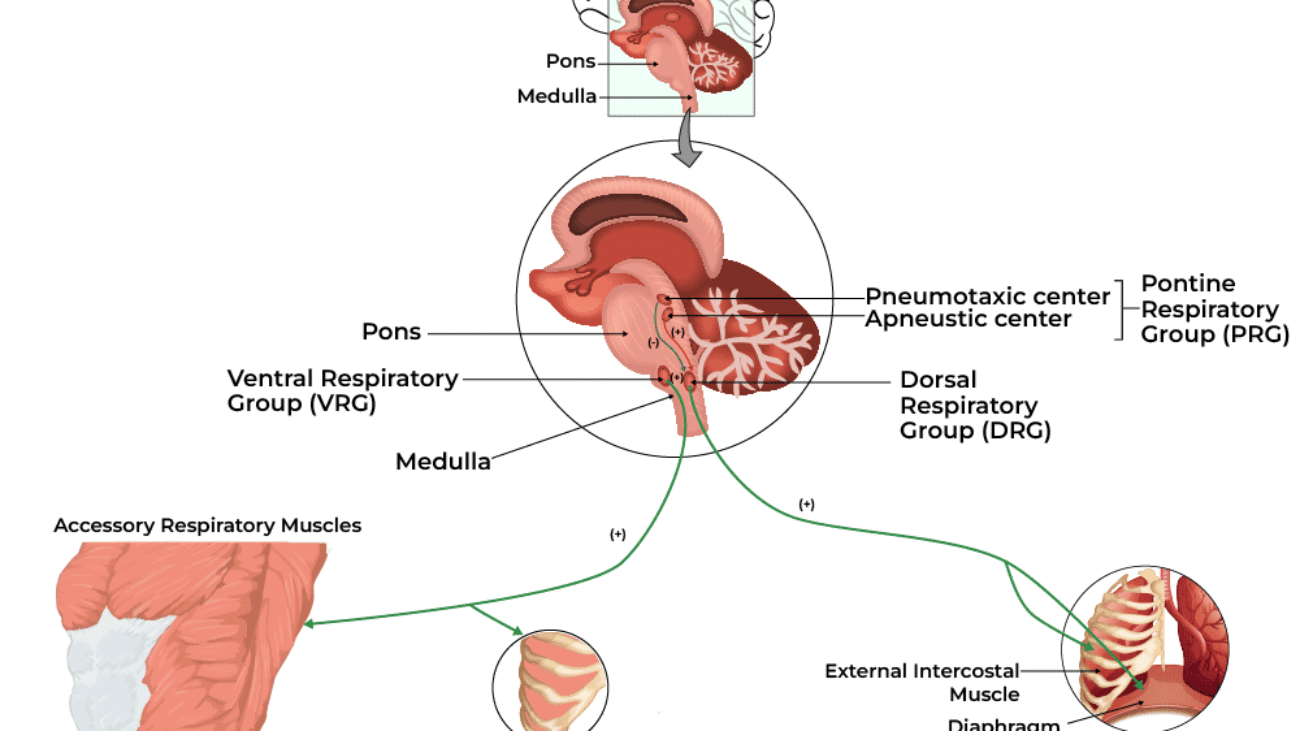
The medulla oblongata houses the most crucial respiratory control centers, responsible for setting the basic rhythm of breathing. These are broadly divided into two main groups: the Dorsal Respiratory Group (DRG) and the Ventral Respiratory Group (VRG).

A. Dorsal Respiratory Group (DRG)

Location:

Located in the posterior portion of the medulla, near the nucleus of the tractus solitarius.

Primary Function:

The DRG is the most fundamental and active group involved in controlling the basic rhythm of breathing, especially during quiet (eupneic) respiration. It primarily controls inspiration.

Neuronal Activity:
  • Contains inspiratory neurons that fire rhythmically.
  • These neurons generate a ramp-like signal: they start weakly and increase in intensity over approximately 2 seconds, then abruptly cease for about 3 seconds, allowing for elastic recoil and exhalation. This gradual increase helps to ensure a smooth, progressive filling of the lungs.
Innervation:
  • Sends efferent (motor) signals via the phrenic nerves to the diaphragm.
  • Sends signals via the intercostal nerves to the external intercostal muscles.
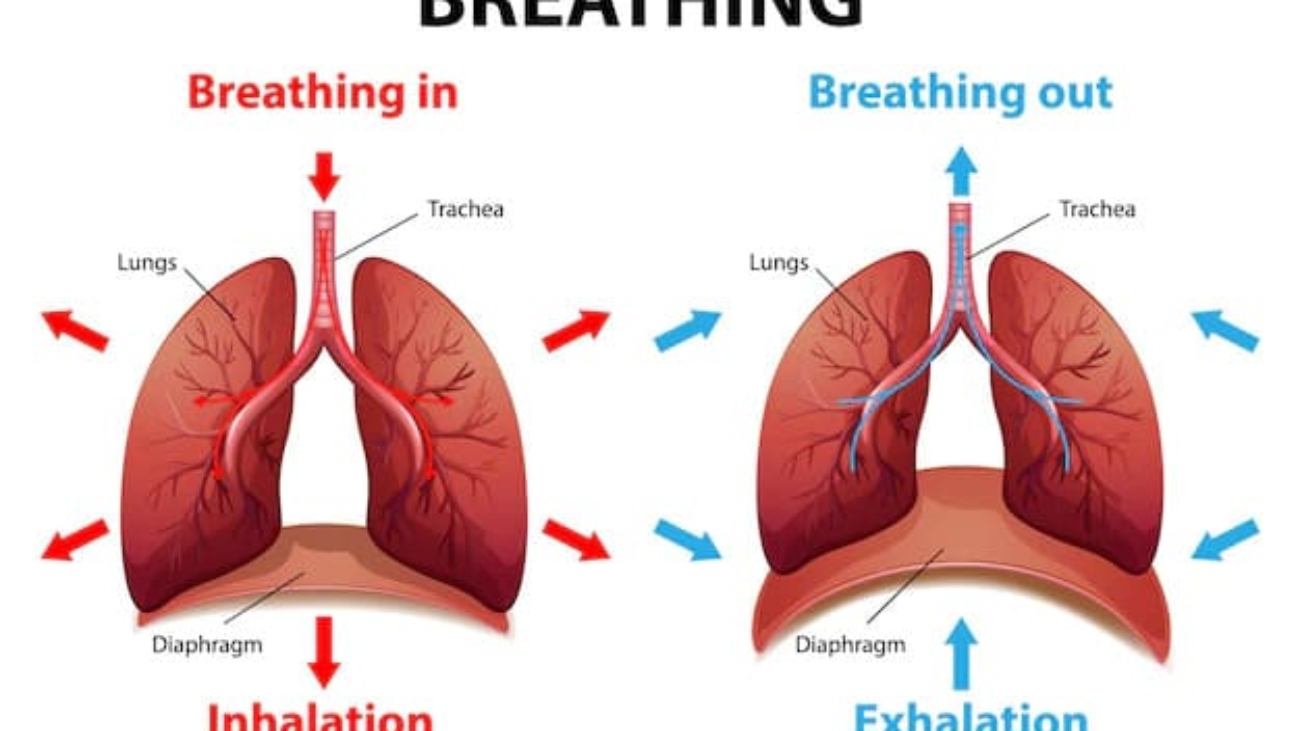
  • Activation of these muscles causes the diaphragm to contract and flatten, and the rib cage to expand, leading to inspiration.
Afferent Input:

Receives sensory input (afferent signals) from:

  • Peripheral chemoreceptors: via glossopharyngeal (CN IX) and vagus (CN X) nerves, detecting changes in PO2, PCO2, and pH.
  • Lung receptors: via vagus (CN X) nerve, detecting stretch and irritation in the lungs and airways.

This sensory input allows the DRG to modify the basic respiratory rhythm in response to physiological demands.

B. Ventral Respiratory Group (VRG)

Location:

Located in the anterior portion of the medulla, extending from the brainstem to the upper spinal cord, including the pre-Bötzinger complex.

Primary Function:

The VRG is largely inactive during quiet breathing. It becomes active and crucial for generating the respiratory rhythm only when there is an increased ventilatory demand, such as during forceful (active) inspiration and expiration.

Neuronal Activity:

Contains both inspiratory and expiratory neurons.

  • Inspiratory neurons: When stimulated (e.g., by intense DRG signals or strong chemoreceptor input), they send signals to accessory muscles of inspiration (e.g., sternocleidomastoid, scalenes).
  • Expiratory neurons: When stimulated, they send signals to the internal intercostals and abdominal muscles, which are primarily active during forceful exhalation.
Rhythm Generation (Pre-Bötzinger Complex):

Current research suggests that a small area within the VRG, known as the pre-Bötzinger complex, is the primary site responsible for generating the basic respiratory rhythm. It acts as the pacemaker for breathing, relaying signals to the DRG.

Innervation:
  • Inspiratory neurons: Innervate accessory muscles of inspiration.
  • Expiratory neurons: Innervate internal intercostal and abdominal muscles (for active expiration).
Role in Forced Breathing:

During exercise or respiratory distress, the DRG activates the VRG. The VRG then significantly increases the strength of both inspiratory and expiratory signals, leading to a deeper and more rapid breathing pattern.

II. Pontine Respiratory Centers (Pontine Respiratory Group - PRG)

The pons contains centers that modify and fine-tune the activity of the medullary respiratory centers, ensuring smooth transitions between inspiration and expiration. These are often collectively referred to as the Pontine Respiratory Group (PRG) and include the Pneumotaxic and Apneustic centers.

A. Pneumotaxic Center

Upper Pons (Nucleus Parabrachialis)

Primary Function: Primarily acts to limit inspiration and fine-tune the respiratory rate. It essentially "switches off" the inspiratory ramp signal from the DRG.

Effect: By shortening the inspiratory phase, it leads to:
  • Decreased tidal volume (shallower breaths).
  • Increased respiratory rate.
Analogy: Think of it as an "off switch" or a "brake" for inspiration. A strong pneumotaxic signal reduces the duration of inspiration.

Clinical Significance: Damage to this center can lead to prolonged inspiration and decreased respiratory rate.

B. Apneustic Center

Lower Pons

Primary Function: Has an excitatory effect on the medullary inspiratory neurons, particularly the DRG. It essentially prolongs inspiration.

Effect: If unopposed by the pneumotaxic center, it would lead to:
  • Prolonged, gasping inspirations followed by brief, insufficient expirations (a breathing pattern called apneusis).

Interaction with Pneumotaxic Center: Normally, the pneumotaxic center overrides the apneustic center, preventing prolonged inspiration and ensuring rhythmic breathing.

Clinical Significance: Damage to the pneumotaxic center or vagal nerves (which also inhibit inspiration) can allow the apneustic center to dominate, leading to apneustic breathing.

Summary of Brainstem Control

  • Medulla (DRG & VRG): Generates the basic rhythm of breathing. DRG for quiet inspiration; VRG for forceful inspiration/expiration and contains the pacemaker (pre-Bötzinger complex).
  • Pons (Pneumotaxic & Apneustic): Modulates the medullary centers. Pneumotaxic center limits inspiration and increases rate; Apneustic center prolongs inspiration.

This intricate interplay of neural centers ensures that breathing is a continuous, rhythmic process that can be finely adjusted to meet the body's changing metabolic demands.

Objective 2: Explain the roles of central chemoreceptors in regulating breathing.

The chemical control of respiration is paramount for maintaining arterial blood gas homeostasis (PCO2, PO2, and pH). Chemoreceptors are specialized sensory receptors that detect changes in the chemical composition of the blood and cerebrospinal fluid (CSF) and send signals to the respiratory centers in the brainstem to adjust ventilation accordingly.

Central chemoreceptors are the most potent and important regulators of ventilation under normal physiological conditions.

I. Location of Central Chemoreceptors

Primary Location: Strategically located in the ventrolateral surface of the medulla oblongata, very close to the DRG and VRG respiratory centers. This proximity allows for a rapid and direct influence on breathing patterns.

II. Primary Stimulus: Changes in Cerebrospinal Fluid (CSF) pH

(Largely driven by arterial PCO2)

Not directly sensitive to blood CO2: Central chemoreceptors are not directly sensitive to changes in arterial PCO2, but rather to the pH of the cerebrospinal fluid (CSF).

The Crucial Link: Arterial PCO2 and CSF pH

1. CO2 freely crosses the Blood-Brain Barrier (BBB):

Unlike H+ and HCO3- ions, CO2 is lipid-soluble and readily diffuses across the blood-brain barrier from the systemic circulation into the CSF.

2. Conversion to Carbonic Acid in CSF:

Once in the CSF, CO2 reacts with water to form carbonic acid (H2CO3), a reaction facilitated by carbonic anhydrase (though less prevalent than in RBCs, it still occurs spontaneously).

CO2 + H2O ↔ H2CO3 ↔ H+ + HCO3-
3. CSF Lacks Significant Buffering Capacity:

The CSF has a very low protein concentration, meaning it has a much weaker buffering capacity compared to blood plasma. Therefore, even small changes in CO2 entering the CSF can cause a significant change in CSF H+ concentration, and thus, a notable change in CSF pH.

4. H+ Stimulates Chemoreceptors:

It is these increased H+ ions (decreased pH) in the CSF that directly stimulate the central chemoreceptors.

Relationship Summary:

Increased arterial PCO2 → Increased CO2 in CSF → Increased H+ in CSF → Decreased CSF pH → Stimulation of central chemoreceptors → Increased ventilation.

Decreased arterial PCO2 → Decreased CO2 in CSF → Decreased H+ in CSF → Increased CSF pH → Inhibition of central chemoreceptors → Decreased ventilation.

III. Mechanism of Action

  • Detection: Central chemoreceptors detect changes in CSF H+ concentration (pH).
  • Signal Transmission: When stimulated, these receptors send excitatory signals directly to the medullary respiratory centers (DRG and VRG).
  • Ventilatory Response: The respiratory centers respond by increasing the rate and depth of breathing (hyperventilation).
  • Restoration of Homeostasis: This increased ventilation leads to a more rapid "blowing off" of CO2 from the blood. As arterial PCO2 decreases, less CO2 diffuses into the CSF, allowing CSF H+ concentration to fall and CSF pH to normalize. This, in turn, reduces the stimulation of the central chemoreceptors, completing the negative feedback loop.

IV. Significance in Long-Term Control of Breathing

Dominant Regulator: Under normal physiological conditions, arterial PCO2 (and thus CSF pH) is the most powerful and closely regulated chemical stimulus for breathing. Even small changes in PCO2 (e.g., a 1-2 mmHg increase) can significantly alter ventilation.

Acute vs. Chronic Changes

Acute Hypercapnia

Central chemoreceptors respond quickly (within seconds to minutes) to acute changes in PCO2, causing a robust increase in ventilation.

Chronic Hypercapnia (e.g., COPD)

If high PCO2 levels persist for several days, the kidneys compensate by retaining bicarbonate ions (HCO3-) in the blood. These HCO3- ions eventually diffuse into the CSF, buffering the excess H+ ions. This "normalizes" the CSF pH, even though arterial PCO2 remains high.

Clinical Relevance: COPD & Oxygen Administration

In such patients, the central chemoreceptors become desensitized or "reset" to the chronically high PCO2. Their primary respiratory drive then shifts from PCO2 to the hypoxic drive (detected by peripheral chemoreceptors).

The Danger: If supplemental oxygen is administered at high concentrations to these patients, their arterial PO2 may increase significantly, which can then depress the hypoxic drive from the peripheral chemoreceptors. Without the strong PCO2 drive (due to desensitization) or the hypoxic drive (due to O2 administration), the patient's respiratory drive can diminish, leading to hypoventilation, further CO2 retention, and potentially respiratory acidosis and coma.

This is why oxygen administration in COPD patients needs to be carefully monitored and typically delivered at lower flow rates.

Insensitivity to Hypoxia: Central chemoreceptors are essentially insensitive to changes in arterial PO2. This role is primarily handled by the peripheral chemoreceptors.

In essence, central chemoreceptors are the body's primary "CO2 sensors," indirectly monitoring arterial CO2 levels by sensing CSF pH, and they are crucial for maintaining CO2 homeostasis.

Objective 3: Explain the roles of peripheral chemoreceptors in regulating breathing.

Peripheral chemoreceptors provide an additional layer of chemical control, primarily acting as the body's emergency sensors for oxygen levels and as a secondary sensor for CO2 and pH.

I. Location of Peripheral Chemoreceptors

These are specialized sensory organs located in specific arteries outside the brain.

Carotid Bodies

Location: Small, highly vascularized structures located bilaterally at the bifurcation of the common carotid arteries (where they split into internal and external carotid arteries).

Innervation: Send afferent (sensory) signals to the medulla oblongata via the glossopharyngeal nerve (CN IX).

Significance: Because they sample blood going to the brain, they are particularly important for ensuring adequate oxygen supply to the brain.

Aortic Bodies

Location: Scattered along the aortic arch.

Innervation: Send afferent signals to the medulla oblongata via the vagus nerve (CN X).

Significance: Monitor the arterial blood that will be distributed to the rest of the body.

II. Primary Stimuli: Severe Decreases in Arterial PO2 (Hypoxia)

Oxygen Sensitivity: Peripheral chemoreceptors are the body's primary and most important sensors for detecting changes in arterial oxygen levels.

The Critical Threshold

They are relatively insensitive to changes in PO2 until arterial PO2 falls below a critical threshold, typically around 60-70 mmHg.

Below this level, their firing rate increases sharply and exponentially. This means they act more as an "emergency" oxygen sensor rather than a fine-tuner of normal PO2.

Why 60-70 mmHg?

This corresponds to the steep part of the oxygen-hemoglobin dissociation curve. Below this point, a small drop in PO2 leads to a significant decrease in hemoglobin saturation and oxygen content, which could rapidly become life-threatening.

Response to Hypoxia: When activated by low PO2, they send strong excitatory signals to the DRG, leading to a significant increase in ventilation (hyperventilation).

III. Secondary Stimuli: Increases in Arterial PCO2 and H+ (Decreased pH)

PCO2 Sensitivity

While central chemoreceptors are the dominant sensors for PCO2, peripheral chemoreceptors also respond to increases in arterial PCO2.

Their response to CO2 is faster but quantitatively less powerful (about 20-30%) than that of the central chemoreceptors. This means they contribute to the overall ventilatory response to hypercapnia, particularly in its initial, acute phase.

pH Sensitivity

Peripheral chemoreceptors are directly sensitive to changes in arterial H+ concentration (pH), independent of PCO2.

This is especially important in metabolic acidosis (e.g., diabetic ketoacidosis), where H+ levels rise without a primary increase in PCO2. In such cases, the peripheral chemoreceptors are crucial for stimulating hyperventilation to "blow off" CO2, thereby attempting to raise blood pH.

IV. Mechanism of Action

  • Detection: Peripheral chemoreceptors monitor the arterial blood for changes in PO2, PCO2, and pH.
  • Signal Transmission: Upon stimulation (e.g., significant drop in PO2, rise in PCO2 or H+), they generate action potentials that are transmitted via the glossopharyngeal (carotid bodies) and vagus (aortic bodies) nerves to the medullary respiratory centers (primarily the DRG).
  • Ventilatory Response: The medullary centers, receiving this input, increase the firing rate of inspiratory neurons, leading to an increased rate and depth of breathing (hyperventilation).
  • Integrated Response: The overall ventilatory response to hypercapnia and acidosis is a combined effect of both central and peripheral chemoreceptor activity.

V. Significance in Immediate, Emergency Responses and Clinical Relevance

Hypoxic Drive & COPD Oxygen Therapy

Hypoxic Drive: As mentioned in our previous discussion on central chemoreceptors, in individuals with chronic hypercapnia (e.g., severe COPD), the central chemoreceptors become desensitized to high PCO2. In these patients, the hypoxic drive (stimulation of peripheral chemoreceptors by low PO2) becomes the primary stimulus for breathing.

Clinical Point Revisited:

If a COPD patient with chronic hypercapnia is given high concentrations of supplemental oxygen, their arterial PO2 rises significantly. This rise in PO2 removes the hypoxic stimulus from the peripheral chemoreceptors, thus diminishing their main remaining drive to breathe.

This can lead to severe hypoventilation, worsening hypercapnia, respiratory acidosis, and potentially coma or death. Therefore, oxygen therapy in these patients must be carefully managed to avoid suppressing their crucial hypoxic drive.

Acute Hypoxemia:

The peripheral chemoreceptors are vital for triggering a rapid ventilatory response to acute hypoxemia (e.g., at high altitude, during suffocation).

Metabolic Acidosis:

They are the sole chemoreceptors to respond to changes in pH that are not caused by changes in PCO2 (i.e., metabolic acidosis), driving the compensatory hyperventilation (Kussmaul breathing) seen in conditions like diabetic ketoacidosis.

In summary, while central chemoreceptors are the primary sensors for CO2 and pH via CSF, peripheral chemoreceptors are indispensable for detecting critically low oxygen levels and for responding to metabolic acid-base disturbances, making them vital for acute and emergency respiratory regulation.

Objective 4: Describe the various lung and airway receptors that influence breathing.

Beyond the central control in the brainstem and chemical feedback from chemoreceptors, a variety of mechanoreceptors and irritant receptors located within the lungs and airways provide sensory input that modifies the breathing pattern. These receptors relay information predominantly via the vagus nerves (CN X) to the medullary respiratory centers.

I. Pulmonary Stretch Receptors (Slowly Adapting Receptors)

  • Location: Found in the smooth muscle of the airways (trachea, bronchi, and bronchioles).
  • Stimulus: Activated by distension or stretching of the lung tissue during inspiration. As the lungs inflate, these receptors fire with increasing frequency.
Reflex: The Hering-Breuer Reflex

Mechanism: When these receptors are significantly stimulated (i.e., during deep inspiration, or in infants even during normal inspiration), they send inhibitory signals to the inspiratory neurons of the DRG.

Effect: This inhibition terminates inspiration and therefore prolongs the expiratory phase. It acts as a protective mechanism to prevent overinflation of the lungs, particularly important in newborns and during exercise in adults. In resting adults, it may not play a major role until tidal volume exceeds approximately 1.5 liters.

Adaptation: They are "slowly adapting" because they continue to fire as long as the stretch is maintained.

II. Irritant Receptors (Rapidly Adapting Receptors)

  • Location: Located in the epithelium of the entire airway, from the trachea to the terminal bronchioles.
  • Stimulus: Activated by a wide variety of noxious stimuli:
    • Mechanical irritants (e.g., dust, foreign particles)
    • Chemical irritants (e.g., smoke, fumes, sulfur dioxide, ammonia)
    • Cold air
    • Inflammatory mediators (e.g., histamine, prostaglandins)
Protective Reflexes:
  • Bronchoconstriction: Narrows the airways, limiting further entry of irritants.
  • Coughing: A forceful expulsion of air to clear the airways.
  • Sneezing: Similar to coughing, but typically for irritants in the nasal passages.
  • Hyperpnea/Shallow Breathing: Increased rate or shallow pattern depending on the irritant.

Adaptation: They are "rapidly adapting" because they respond vigorously to the onset of a stimulus but then quickly decrease their firing rate even if the stimulus persists.

III. J-Receptors (Juxtacapillary Receptors)

  • Location: Located in the alveolar-capillary walls, in the interstitial space between the pulmonary capillaries and the alveoli.
  • Stimulus: Activated by an increase in interstitial fluid volume or pressure (e.g., pulmonary edema, pneumonia, left heart failure) and by chemical agents such as histamine.
Reflexes & Response:
  • Rapid, Shallow Breathing (Tachypnea): Increases the respiratory rate but with reduced tidal volume.
  • Bronchoconstriction (sometimes).
  • Dyspnea: Sensation of shortness of breath. Thought to be a major contributor to the feeling of breathlessness in conditions like pulmonary edema.
Physiological Role: Their precise physiological role is still debated, but they are thought to be important in sensing pathological changes in the lung interstitium.
Receptor Type Function/Reflex
Pulmonary Stretch Prevent overinflation, modulate inspiratory duration (Hering-Breuer).
Irritant Protect airways from noxious stimuli, trigger cough/bronchoconstriction.
J-Receptors Respond to interstitial fluid changes, contribute to dyspnea and rapid shallow breathing.

These receptors act as sophisticated sensors within the respiratory system, providing essential feedback to the brain to adjust ventilation and activate protective reflexes, ensuring both efficient gas exchange and the integrity of the airways.

Objective 5: Identify other factors that influence respiratory control.

Beyond the primary medullary and pontine centers, chemoreceptors, and pulmonary reflexes, several other physiological and psychological factors can exert significant influence over the rate and depth of respiration. These often involve higher brain centers or specialized sensory receptors throughout the body.

I. Voluntary Control (Cerebral Cortex)

Mechanism: The cerebral cortex, particularly the motor cortex, can temporarily override the brainstem's automatic respiratory centers. This allows for conscious control over breathing.

Examples:
  • Holding Breath (diving).
  • Talking, Singing, Playing Wind Instruments.
  • Breath-holding for medical procedures (X-ray).
  • Voluntary Hyperventilation/Hypoventilation.
The "Breaking Point":

This voluntary control is ultimately limited. If CO2 levels rise too high (or O2 levels fall too low) during breath-holding, the involuntary drive from the medullary centers (primarily via central chemoreceptors sensing CO2) will eventually become so strong that it overrides voluntary inhibition, forcing a breath.

II. Hypothalamic Influence (Emotion, Pain, Temperature)

Mechanism: The hypothalamus, a key brain region for regulating homeostatic functions and emotional responses, can influence the respiratory centers.

Emotion:

Strong emotions (e.g., fear, anxiety, anger, excitement) can cause changes in breathing patterns (e.g., gasping, hyperventilation, sighing). Mediated by pathways from the limbic system to the hypothalamus.

Pain:

Sudden severe pain often causes a brief period of apnea followed by rapid, shallow breathing. Prolonged pain typically leads to an increase in respiratory rate.

Temperature:
  • Increased Body Temperature (Fever): Increases respiratory rate (hyperpnea). Mechanism to increase heat loss.
  • Decreased Body Temperature (Hypothermia): Generally decreases respiratory rate and depth.

III. Proprioceptors & V. Muscle Stretch Receptors (Exercise)

Location: Sensory receptors located in muscles, tendons, and joints throughout the body.

Mechanism: The "Anticipatory Response"

When movement begins (e.g., at the start of exercise), these proprioceptors send excitatory signals to the medullary respiratory centers, causing an immediate increase in ventilation. This anticipatory response ensures that ventilation increases before there are significant changes in blood gases or pH due to increased metabolic activity.

Significance: This "neurogenic drive" is a significant contributor to the rapid increase in breathing observed at the onset of exercise.

IV. Baroreceptors (Blood Pressure)

Location: Carotid sinuses and aortic arch.

  • Increased BP: Stimulation inhibits respiratory centers → temporary decrease in rate/depth.
  • Decreased BP: Reduced stimulation excites respiratory centers → increase in rate/depth.

Significance: Plays a role in integrated cardiovascular/respiratory homeostasis, though less powerful than chemoreceptors.

VI. Irritation of Upper Airways

Receptors: Free nerve endings in nose, pharynx, larynx, trachea.

Reflexes: Sneezing, coughing, bronchoconstriction, temporary apnea. Similar to lung irritant receptors but specific to the upper tract.

These diverse influences demonstrate that respiration is not merely an automatic process driven by basic chemical needs, but a highly adaptable system integrated with our emotional state, physical activity, and protective reflexes.

Objective 6: Explain how the body responds to changes in PCO2, PO2, and pH to maintain respiratory homeostasis.

The respiratory system works tirelessly to maintain arterial partial pressures of carbon dioxide (PCO2) and oxygen (PO2), and arterial pH within very narrow physiological limits. This is achieved through a sophisticated negative feedback system involving chemoreceptors and medullary respiratory centers.

I. Response to Hypercapnia (Increased Arterial PCO2)

Definition: Hypercapnia is an abnormally high level of CO2 in the arterial blood (PaCO2 > 45 mmHg). It typically occurs due to hypoventilation (inadequate removal of CO2).

Consequences:
  • Respiratory Acidosis: As CO2 combines with water to form carbonic acid (H2CO3) which then dissociates into H+ and HCO3-, the H+ concentration in the blood increases, causing a drop in pH.
  • Direct effect on tissues: High CO2 can have narcotic effects on the brain at very high levels.

Body's Response:

1. Central Chemoreceptors (Dominant Role):

Increased PaCO2 readily diffuses across the blood-brain barrier into the CSF. In the CSF, CO2 is converted to H+, leading to a decrease in CSF pH. This decreased CSF pH strongly stimulates the central chemoreceptors in the medulla.

2. Peripheral Chemoreceptors (Secondary, Faster Role):

Increased PaCO2 also directly stimulates the peripheral chemoreceptors (carotid and aortic bodies). This response is faster but less powerful than the central chemoreceptor response to CO2.

Physiological Outcome:
  • Overall Effect: Both sets of chemoreceptors send strong excitatory signals to the medullary respiratory centers (DRG and VRG).
  • Ventilatory Outcome: The respiratory centers respond by dramatically increasing the rate and depth of breathing (hyperventilation).
  • Restoration of Homeostasis: This increased ventilation "blows off" excess CO2 from the lungs, reducing PaCO2 back towards normal. As PaCO2 falls, CSF pH rises, and the stimulation of chemoreceptors decreases, completing the negative feedback loop.

Summary: Increased PaCO2 is the most powerful ventilatory stimulus. A rise of just 1-2 mmHg in PaCO2 can double ventilation.

II. Response to Hypoxemia (Decreased Arterial PO2)

Definition: Hypoxemia is an abnormally low level of O2 in the arterial blood (PaO2 < 80 mmHg).

Body's Response:

Peripheral Chemoreceptors (Exclusive Role):
  • Central chemoreceptors are insensitive to changes in PO2.
  • The peripheral chemoreceptors (carotid and aortic bodies) are the only chemoreceptors that directly sense arterial PO2.
  • They become significantly stimulated when PaO2 drops below approximately 60-70 mmHg. Their firing rate increases exponentially below this threshold.
Physiological Outcome:
  • Overall Effect: Stimulated peripheral chemoreceptors send excitatory signals to the medullary respiratory centers.
  • Ventilatory Outcome: The respiratory centers respond by increasing the rate and depth of breathing (hyperventilation).
  • Restoration of Homeostasis: This increased ventilation brings more oxygen into the alveoli, raising PaO2 back towards normal.

Summary: Decreased PaO2 is a potent ventilatory stimulus, but only when it falls significantly below normal levels. It acts primarily as an emergency mechanism.

III. Response to Acidosis/Alkalosis (Changes in Arterial pH)

Definition: Acidosis (pH < 7.35) or alkalosis (pH > 7.45) refers to an imbalance in arterial blood pH.

Metabolic Acidosis

Decreased pH, Normal/Decreased PaCO2

Primary Role: Peripheral chemoreceptors are directly sensitive to increased H+.

Secondary Role: Central chemoreceptors play a delayed, indirect role if acidosis is prolonged.

Outcome: Marked increase in ventilation (hyperventilation), often characterized by deep, rapid breaths known as Kussmaul respiration.

Restoration: "Blowing off" CO2 reduces H+ concentration, raising pH back toward normal.

Metabolic Alkalosis

Increased pH, Normal/Increased PaCO2

Primary Role: Decreased H+ (increased pH) inhibits peripheral chemoreceptors.

Outcome: Decreased ventilation (hypoventilation).

Restoration: Hypoventilation leads to CO2 retention, increasing H+ concentration and lowering pH back toward normal.

Objective 7: Identify and describe common abnormal breathing patterns and their physiological basis.

Understanding normal quiet breathing (eupnea) is essential, but equally important is the ability to recognize and interpret deviations from this pattern.

I. Eupnea (Normal Breathing)

Quiet, effortless, rhythmic breathing (12-20 breaths/min). Generated by medullary centers maintaining homeostasis.

II. Apnea

Cessation of breathing.

  • Voluntary: Breath-holding.
  • Reflexive: Pain, cold shock.
  • Pathological: Sleep apnea, brainstem lesions, opioid overdose.
III. Dyspnea

Subjective sensation of "shortness of breath." Complex sensation involving increased effort, ventilatory demand mismatch, and chemoreceptor stimulation. Common in heart failure, COPD, anxiety.

IV. Tachypnea

Rapid breathing (>20/min). Caused by acidosis, hypoxemia, fever, anxiety, pain.

V. Bradypnea

Slow breathing (<12/min). Caused by CNS depression (opioids), hypothermia, metabolic alkalosis.

VI. Hyperpnea & VII. Kussmaul Respiration

Hyperpnea: Increased depth/rate to meet metabolic demand (exercise, altitude).

Kussmaul: Deep, rapid, labored breathing. Specific compensatory mechanism for severe metabolic acidosis (DKA) to blow off CO2.

VIII. Cheyne-Stokes Respiration

Cyclical pattern: gradual increase in volume/rate, then decrease, then apnea. Repeats.

Mechanism (Unstable Feedback Loop): Heart failure/brain injury → Slow blood flow → Delayed signal to brain → Overshoot (hyperventilation) → Undershoot (apnea) → Cycle repeats.
IX. Biot's (Ataxic)

Irregular shallow breaths followed by irregular apnea. Indicates severe medullary damage (stroke, trauma). Pre-terminal.

X. Apneustic

Prolonged inspiratory pauses, short expirations. Indicates pontine damage disrupting the pneumotaxic center.

Physiology: Control of Respiration Exam
Logo

Control of Respiration Exam

Test your knowledge with these 30 questions.

Gas Exchange and Transport

Gas Exchange and Transport

Gas Exchange &: Transport

Gas Exchange and Transport

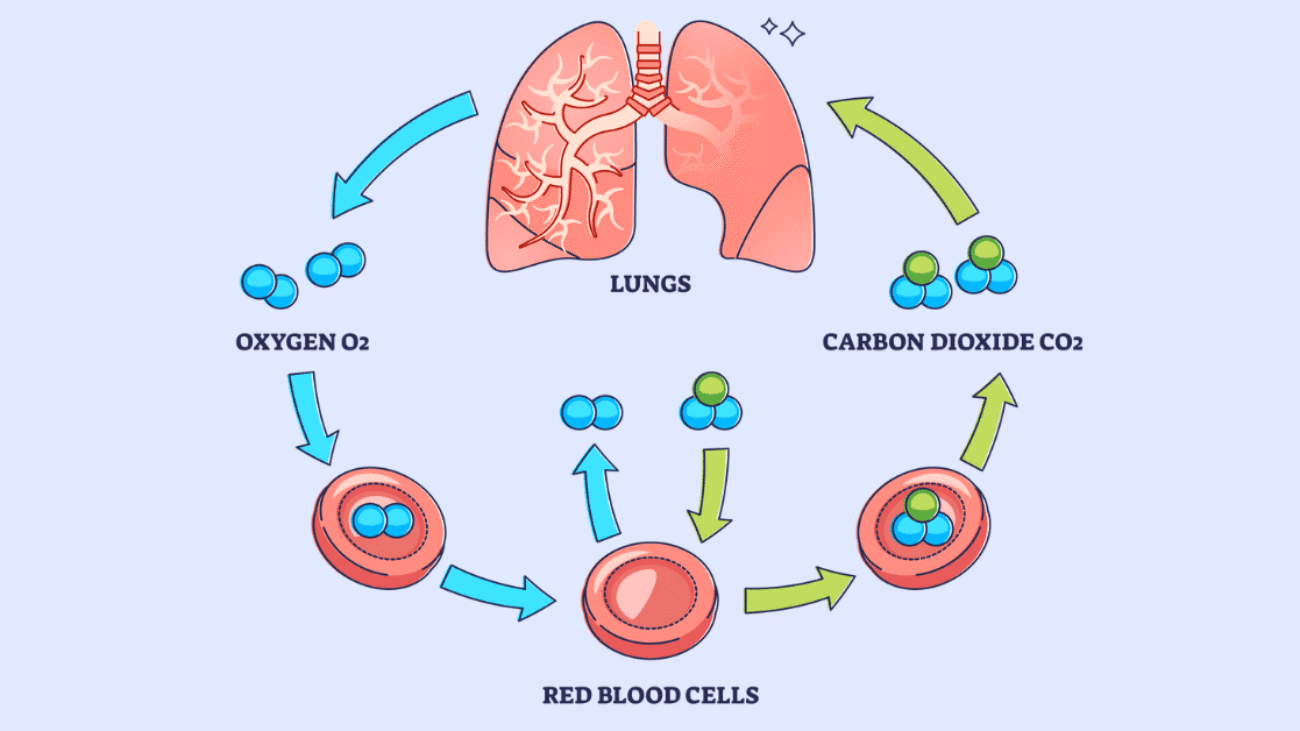
Gas exchange is the process by which oxygen and carbon dioxide move between the lungs and the bloodstream, driven by simple diffusion along partial pressure gradients. This is coupled with the transport of these gases throughout the body via the circulatory system, primarily using hemoglobin in red blood cells. The entire process involves two main stages:

I. External Respiration (in the Lungs)

This is the exchange of gases between the air in the alveoli and the blood in the pulmonary capillaries.

  • Oxygen uptake: Inhaled air has a high partial pressure of oxygen (PO2 ≈ 100 mmHg) in the alveoli, while the deoxygenated blood in the capillaries has a low PO2 ≈ 40 mmHg. This gradient causes oxygen to diffuse rapidly from the alveoli into the blood.
  • Carbon dioxide release: The deoxygenated blood in the capillaries has a higher partial pressure of carbon dioxide (PCO2 ≈ 45 mmHg) compared to the air in the alveoli (PCO2 ≈ 40 mmHg). This causes carbon dioxide to diffuse from the blood into the alveoli to be exhaled.

II. Internal Respiration (in the Tissues)

This is the exchange of gases between the blood in systemic capillaries and the body's tissue cells.

  • Oxygen release: Oxygenated blood arriving at the tissues has a high PO2 ≈ 100 mmHg, while the metabolizing tissue cells have a low PO2 < 40 mmHg due to continuous consumption for cellular respiration. This gradient causes oxygen to dissociate from hemoglobin and diffuse into the cells.
  • Carbon dioxide uptake: Tissue cells produce carbon dioxide as a waste product, resulting in a high PCO2 > 45 mmHg compared to the blood in the capillaries (PCO2 ≈ 40 mmHg). Carbon dioxide diffuses from the cells into the blood.

Objective 1: Describe the partial pressures of oxygen and carbon dioxide in atmospheric air, alveoli, arterial blood, and venous blood.

To understand gas exchange, we first need to grasp the concept of partial pressure.

1. Dalton's Law of Partial Pressures

Dalton's Law states that in a mixture of non-reacting gases, the total pressure exerted is equal to the sum of the partial pressures of the individual gases.

Ptotal = P1 + P2 + P3 + ... Pn

Where Ptotal is the total pressure of the gas mixture and P1, P2, etc. are the partial pressures of each individual gas.

The partial pressure of an individual gas in a mixture is the pressure that gas would exert if it alone occupied the volume. It is directly proportional to its percentage concentration in the mixture.

Partial Pressure of Gas (Px) = % Concentration of Gas x Total Pressure
Example Calculation (Atmospheric Air at Sea Level):

Total Pressure = 760 mmHg. Composition:

  • Nitrogen (N2): ~79%
  • Oxygen (O2): ~21%
  • Carbon Dioxide (CO2): ~0.04%

PO2 = 0.21 x 760 mmHg = ~160 mmHg

2. Partial Pressures in Different Locations

Gases always diffuse down their partial pressure gradients from an area of higher partial pressure to an area of lower partial pressure. This is the driving force for gas exchange.

Let's examine the typical partial pressures of Oxygen (O2) and Carbon Dioxide (CO2) in four key locations:

A. Atmospheric (Inspired) Air (at sea level, dry)

This is the air we breathe in.

PO2 (Atmospheric):
Percentage: ~21%
0.21 x 760 = ~160 mmHg
PCO2 (Atmospheric):
Percentage: ~0.04%
0.0004 x 760 = ~0.3 mmHg
(often rounded to 0 mmHg)

B. Alveolar Air

As atmospheric air enters the lungs, it mixes with the air already present in the dead space and alveoli, and it becomes saturated with water vapor. This significantly alters the partial pressures.

Influencing Factors:
  • Water Vapor: At 37°C, water vapor pressure is 47 mmHg. This dilutes other gases (Effective pressure: 760 - 47 = 713 mmHg).
  • Gas Diffusion: CO2 continuously enters from blood; O2 continuously leaves into blood.
PO2 (Alveolar - PAO2):
~104 mmHg
Lower than atmospheric due to water vapor dilution and O2 diffusion into blood.
PCO2 (Alveolar - PACO2):
~40 mmHg
Higher than atmospheric due to CO2 diffusion from blood.

C. Arterial Blood

This is the blood leaving the pulmonary capillaries (oxygenated blood) and traveling to the systemic tissues.

PO2 (Arterial - PaO2):
~95-100 mmHg
Slightly lower than alveolar PO2 due to physiological shunts (bronchial circulation).
PCO2 (Arterial - PaCO2):
~40 mmHg
Same as alveolar PCO2; high solubility allows rapid equilibration.

D. Venous Blood (Mixed Venous Blood)

This is the blood returning to the lungs from the systemic tissues, carrying metabolic waste products.

PO2 (Mixed Venous - PvO2):
~40 mmHg
Lower than arterial because O2 was delivered to tissues.
PCO2 (Mixed Venous - PvCO2):
~45 mmHg
Higher than arterial because CO2 was picked up from tissues.

Summary of Partial Pressures (Approximate Values at Sea Level)

Location PO2 (mmHg) PCO2 (mmHg)
Atmospheric Air 160 0.3
Alveolar Air 104 40
Arterial Blood 95-100 40
Mixed Venous Blood 40 45

Key Gradients for Gas Exchange

  • O2 gradient for diffusion (Alveoli to Pulmonary Capillaries):
    104 mmHg (alveolar) - 40 mmHg (venous) = 64 mmHg
  • CO2 gradient for diffusion (Pulmonary Capillaries to Alveoli):
    45 mmHg (venous) - 40 mmHg (alveolar) = 5 mmHg

Note: Notice the much larger gradient for O2 compared to CO2. This is important because CO2 is much more soluble than O2, allowing it to diffuse efficiently even with a smaller pressure gradient.

Checkpoint Question:

Why is the partial pressure of oxygen in the alveoli (PAO2) significantly lower than the partial pressure of oxygen in atmospheric air (PO2)?

Objective 2: Explain the principles governing gas exchange across the alveolar-capillary membrane (e.g., Dalton's Law, Henry's Law, Fick's Law of Diffusion).

Gas exchange, both between the alveoli and pulmonary capillaries, and between systemic capillaries and tissues, is driven by fundamental physical laws. We've already touched upon Dalton's Law of Partial Pressures, which establishes the pressure gradient for individual gases. Now let's integrate Henry's Law and Fick's Law of Diffusion to understand how these gases actually move and dissolve.

1. Dalton's Law of Partial Pressures (Recap)

  • Principle: The total pressure exerted by a mixture of gases is the sum of the partial pressures of the individual gases. The partial pressure of a specific gas is proportional to its concentration in the mixture.
  • Relevance to Gas Exchange: This law explains why gases move. Gases diffuse from an area where their partial pressure is higher to an area where it is lower. This partial pressure gradient is the primary driving force for gas exchange.
    • O2: High PO2 in alveoli, low PO2 in venous blood → O2 moves into blood.
    • CO2: High PCO2 in venous blood, low PCO2 in alveoli → CO2 moves into alveoli.

2. Henry's Law

Principle:

When a gas is in contact with a liquid, the amount of gas that dissolves in the liquid is directly proportional to its partial pressure above the liquid, and its solubility coefficient in that liquid, at a given temperature.

  • The higher the partial pressure of a gas above a liquid, the more of that gas will dissolve into the liquid.
  • The higher the solubility of a gas in a specific liquid, the more of that gas will dissolve at a given partial pressure.
Amount of dissolved gas = Px * Solubility Coefficient

Where Px is the partial pressure of the gas.

Relevance to Gas Exchange:

  • Loading and Unloading: Henry's Law explains how O2 and CO2 move between the gaseous phase (alveoli) and the liquid phase (blood plasma) and vice versa.
  • Solubility Differences: It highlights a critical difference between O2 and CO2:

    CO2 is about 20-24 times more soluble in plasma than O2. This is extremely important because even though the partial pressure gradient for CO2 across the alveolar-capillary membrane (typically 5 mmHg) is much smaller than for O2 (typically 64 mmHg), CO2 can still diffuse across the membrane very rapidly and efficiently due to its high solubility. This ensures efficient CO2 elimination despite the small gradient.

3. Fick's Law of Diffusion

Fick's Law quantifies the rate at which a gas diffuses across a membrane.

V gas = (A * D * ΔP) / T
V gas: Rate of gas diffusion.
A (Area): Surface area of the membrane. (Larger area = faster diffusion).
D (Diffusion Coefficient): Depends on solubility/molecular weight. (D ∝ Solubility / √MW).
ΔP (Pressure Gradient): Difference in partial pressure. (Larger gradient = faster diffusion).
T (Thickness): Membrane thickness. (Thicker membrane = slower diffusion).

Relevance to Gas Exchange:

This law combines the key anatomical and physiological factors that determine how effectively gas moves between the alveoli and blood.

  • Surface Area (A): The human lungs have an enormous alveolar surface area (estimated 50-100 m², about the size of a tennis court). Diseases like emphysema reduce this area, impairing diffusion.
  • Diffusion Coefficient (D): As mentioned with Henry's Law, CO2 has a much higher diffusion coefficient than O2 due to its greater solubility, meaning it diffuses much faster than O2 for a given partial pressure gradient.
  • Partial Pressure Gradient (ΔP): This is the driving force from Dalton's Law. Maintaining appropriate partial pressure differences is crucial.
  • Thickness (T): The alveolar-capillary membrane is incredibly thin (0.2-0.6 µm). Diseases like pulmonary fibrosis or pulmonary edema increase this thickness, significantly impairing gas diffusion.

In Summary:

  • Dalton's Law explains the direction and driving force (gradients).
  • Henry's Law explains solubility and dissolving into liquid.
  • Fick's Law describes the rate of diffusion integrating area, thickness, gradients, and solubility.
Checkpoint Question:

Given that the partial pressure gradient for O2 across the alveolar-capillary membrane is much larger (64 mmHg) than for CO2 (5 mmHg), why do O2 and CO2 still diffuse across the membrane at roughly equal rates under normal physiological conditions?

Objective 3: Discuss the factors affecting the efficiency of gas exchange at the alveolar-capillary membrane.

The efficiency of gas exchange across the delicate alveolar-capillary membrane is paramount for maintaining proper blood gas levels. Several interconnected factors, derived directly from the laws we just discussed (especially Fick's Law), determine this efficiency.

1. Partial Pressure Gradients of O2 and CO2

How it affects efficiency: This is the most fundamental driving force (Dalton's Law). The steeper the gradient for a gas, the faster it will diffuse.

  • For O2: PO2 alveoli (~104 mmHg) >> PO2 venous blood (~40 mmHg). Large gradient ensures rapid uptake.
  • For CO2: PCO2 venous blood (~45 mmHg) >> PCO2 alveoli (~40 mmHg). Smaller gradient sufficient due to high solubility.
Factors influencing gradients:
  • Alveolar ventilation: Maintains PAO2 and PACO2. Hypoventilation reduces gradients.
  • Perfusion: Brings deoxygenated blood to maintain gradients.
  • Altitude: Low atmospheric PO2 reduces alveolar PO2 and the gradient.

2. Thickness of the Respiratory Membrane

How it affects efficiency: Per Fick's Law, diffusion is inversely proportional to thickness. A thicker membrane slows down diffusion.

Normal state: Extremely thin (0.2-0.6 µm).

Pathological conditions causing increased thickness:
  • Pulmonary Edema: Fluid accumulation in interstitial space.
  • Pulmonary Fibrosis: Scarring/thickening of tissue.
  • Pneumonia: Inflammatory exudates.

These conditions primarily impair O2 diffusion (less soluble) more than CO2.

3. Surface Area of the Respiratory Membrane

How it affects efficiency: Rate of diffusion is directly proportional to surface area.

Normal state: Immense surface area (50-100 m²).

Pathological conditions causing decreased surface area:
  • Emphysema: Destruction of alveolar walls, merging alveoli.
  • Lung Resection: Surgical removal.
  • Tumors/Atelectasis: Reduced functional area.

4. Ventilation-Perfusion (V/Q) Matching

How it affects efficiency: Requires a close match between ventilation (V) and perfusion (Q).

Ideal V/Q ratio: Around 0.8-1.0.

High V/Q Ratio ("Dead Space")

Ventilation exceeds perfusion (e.g., pulmonary embolism). Ventilated air doesn't exchange gas effectively.

Low V/Q Ratio ("Shunt")

Perfusion exceeds ventilation (e.g., pneumonia, atelectasis). Blood remains poorly oxygenated, reducing arterial PO2.

5. Diffusion Coefficient of Gases

How it affects efficiency: Depends on solubility and molecular weight.

  • CO2 vs. O2: CO2 is ~20-24 times more soluble. Its diffusion coefficient is ~20 times greater than O2.
  • Result: CO2 diffuses much more rapidly despite the smaller gradient.
Clinical Relevance:

When diffusion capacity is impaired (e.g., thick membrane), O2 diffusion is affected much more severely than CO2. A patient may present with hypoxemia (low O2) but a relatively normal PCO2.

Checkpoint Question:

A patient with severe pulmonary edema (fluid in the interstitial space) is likely to experience more significant problems with oxygenation (hypoxemia) than with carbon dioxide elimination (hypercapnia) in the initial stages. Explain why, using the factors discussed above.

Objective 4: Explain the mechanisms of oxygen transport in the blood, including the role of hemoglobin and the oxyhemoglobin dissociation curve.

Once oxygen diffuses from the alveoli into the blood, it needs to be transported efficiently to the metabolically active tissues. Oxygen is transported in two main forms:

1. Oxygen Dissolved in Plasma (Small Amount)

  • Mechanism: A small percentage of oxygen (~1.5%) dissolves directly into the blood plasma.
  • Amount: For every mmHg of PO2, about 0.003 mL of O2 dissolves in 100 mL of blood.
Significance:

While small in quantity (at an arterial PO2 of 100 mmHg, only ~0.3 mL O2/100 mL blood), this fraction is critically important because:

  • It's the only form of oxygen that exerts a partial pressure.
  • It creates the partial pressure gradient for diffusion into the tissues.
  • It serves as the "gateway" for O2 to bind to hemoglobin.

2. Oxygen Bound to Hemoglobin (Major Amount)

Mechanism: The vast majority of oxygen (~98.5%) is transported bound reversibly to the iron atoms within the heme groups of hemoglobin (Hb) inside red blood cells.

Hemoglobin Structure

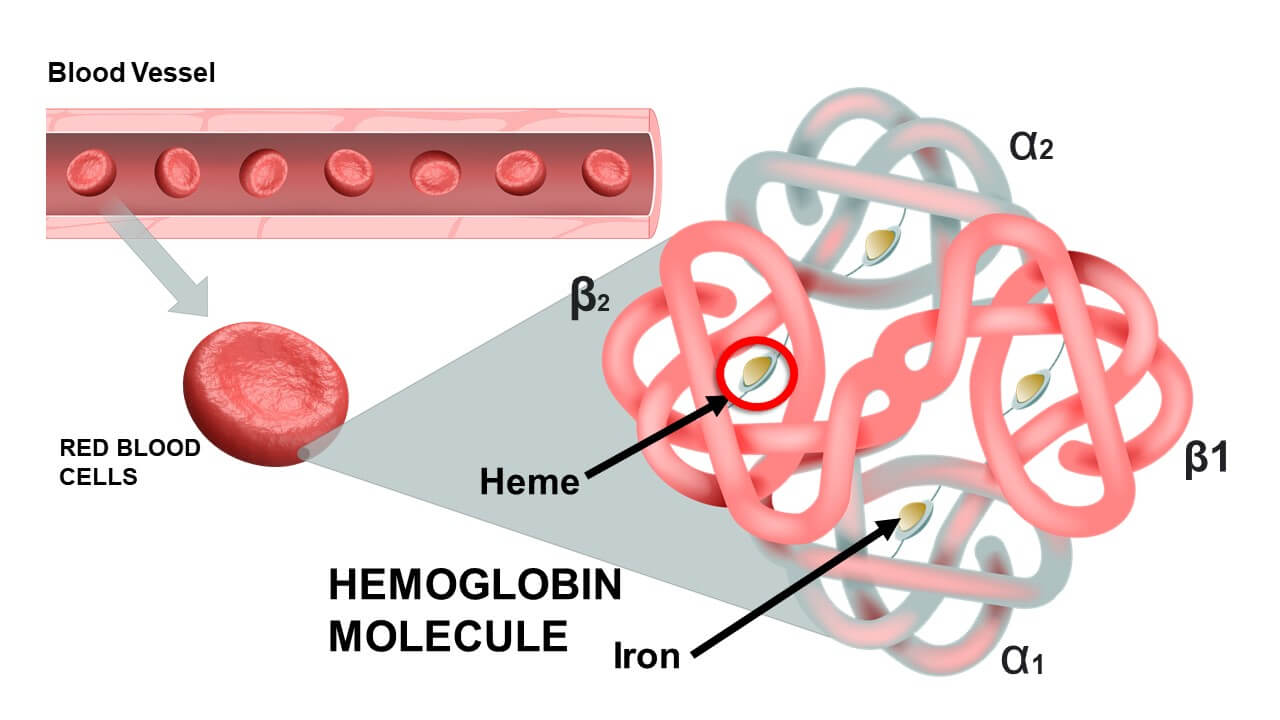
  • Composed of four subunits (2 alpha, 2 beta).
  • Each subunit contains a heme group with an iron atom (Fe2+).
  • Each iron atom binds one O2 molecule (Max 4 O2 per Hb).

Definitions & Capacity

  • Oxyhemoglobin (HbO2): Hb with bound oxygen.
  • Deoxyhemoglobin (HHb): Hb without bound oxygen.
  • Capacity: Each gram of Hb carries ~1.34 mL O2. (Normal 15 g/dL = ~20 mL O2/100 mL blood).

3. The Oxyhemoglobin Dissociation Curve

This S-shaped (sigmoidal) curve represents the relationship between partial pressure of oxygen (PO2) and hemoglobin saturation (%).

Plateau (High PO2 - Lungs)

At Lung PO2 (100 mmHg): Hb is ~97-98% saturated.

Significance: The flat upper part provides a "safety margin." Large drops in PO2 (e.g., to 60 mmHg) result in only small decreases in saturation, ensuring loading.

Steep Slope (Low PO2 - Tissues)

At Tissue PO2 (40 mmHg): Saturation drops to ~75%.

Significance: Small drops in tissue PO2 cause large unloading of O2. Crucial for active tissues (PO2 < 20 mmHg) to receive massive O2 release.

4. Factors Shifting the Curve

Releases O2

Right Shift (Decreased Affinity)

"Bohr Effect" - Favors unloading to tissues.

  • PCO2
  • Acidity (H+) / Low pH
  • Temperature
  • 2,3-BPG
Holds O2

Left Shift (Increased Affinity)

Favors loading in lungs.

  • PCO2
  • Acidity / High pH
  • Temperature
  • 2,3-BPG
  • HbF (Fetal Hemoglobin)
Checkpoint Question:

During intense exercise, a person's muscle tissue produces more CO2 and generates more heat. How do these changes affect the oxyhemoglobin dissociation curve, and what is the physiological advantage of this shift?

Objective 5: Explain the mechanisms of carbon dioxide transport in the blood.

Carbon dioxide (CO2) is a metabolic waste product constantly produced by body cells. It is transported in the blood in three main forms:

Form Percentage
Dissolved in Plasma 7-10%
Carbaminohemoglobin 20-23%
Bicarbonate Ions (HCO3-) 70%

1. Dissolved in Plasma

Creates the PCO2 gradient for diffusion. It is the only form that can diffuse across membranes.

2. Carbaminohemoglobin

CO2 binds to protein (globin), not heme. Favored by deoxygenated Hb (Haldane Effect).

3. As Bicarbonate Ions (HCO3-) (Major Amount)

This is the most significant mechanism (70%) and is crucial for buffering blood pH.

A. Process in Systemic Capillaries (Loading)

  1. CO2 Entry: Diffuses from tissues into RBCs.
  2. Conversion: CO2 + H2O ↔ H2CO3 (Catalyzed by Carbonic Anhydrase).
  3. Dissociation: H2CO3 ↔ H+ + HCO3-.
  4. Buffering: H+ is buffered by hemoglobin (H+ + Hb → HHb).
  5. Chloride Shift: HCO3- diffuses out to plasma; Cl- enters RBC to maintain electrical neutrality.

B. Process in Pulmonary Capillaries (Unloading)

  1. Reversal of Chloride Shift: HCO3- re-enters RBC; Cl- moves out.
  2. Reformation: HCO3- + H+ (released from Hb as O2 binds) → H2CO3.
  3. Conversion: H2CO3 → CO2 + H2O (Catalyzed by CA).
  4. Diffusion: CO2 diffuses into plasma and then into alveoli for exhalation.
The Haldane Effect

Describes the relationship between O2 binding and CO2 transport.

  • Principle: Deoxygenated Hb (systemic) has greater affinity for CO2 and H+. Oxygenated Hb (pulmonary) has reduced affinity.
  • Significance: Enhances CO2 loading in tissues (where Hb is deoxygenated) and CO2 unloading in lungs (where Hb becomes oxygenated).
Checkpoint Question:

A person is experiencing severe metabolic acidosis (excess H+ in the blood). How might the body's mechanisms for CO2 transport respond to help compensate for this acidosis?

Objective 6: Describe the concept of ventilation-perfusion (V/Q) matching and its importance for efficient gas exchange.

For optimal gas exchange, it is not enough to simply ventilate the lungs and perfuse them with blood. The amount of air delivered to the alveoli (ventilation, V) must be appropriately matched with the amount of blood flowing through the pulmonary capillaries (perfusion, Q). This relationship is known as Ventilation-Perfusion (V/Q) Matching.

1. Defining Ventilation (V) and Perfusion (Q)

Ventilation (V)

The volume of fresh air reaching the alveoli per minute.

Normal ≈ 4-5 L/min
Perfusion (Q)

The volume of blood flowing through the pulmonary capillaries per minute (Cardiac Output).

Normal ≈ 5 L/min

2. The Ideal V/Q Ratio

  • Ideal: In a perfectly ideal lung, every alveolus would be perfectly ventilated and perfectly perfused, resulting in a V/Q ratio of 1.0.
  • Healthy/Actual: However, in a healthy lung, the overall V/Q ratio is approximately 0.8 (e.g., 4 L/min ventilation / 5 L/min perfusion). This slight mismatch is normal and due to physiological differences in ventilation and perfusion throughout the lung.

3. Physiological Variations in V/Q Ratio

Due to gravity, both ventilation and perfusion are not uniform throughout the lung, especially in an upright person.

Apex (Top) of Lung

  • Ventilation: Lower than at the base (alveoli are stretched/less compliant).
  • Perfusion: Significantly lower than at the base (harder to flow against gravity).
  • V/Q Ratio: High (> 1.0)
  • Note: Ventilation is relatively better than perfusion. Referred to as having "physiological dead space".

Base (Bottom) of Lung

  • Ventilation: Higher than at the apex (alveoli less stretched/more compliant).
  • Perfusion: Significantly higher than at the apex (gravity assists flow).
  • V/Q Ratio: Low (< 1.0, approx 0.6)
  • Note: Perfusion is relatively better than ventilation. Referred to as having "physiological shunt".

Despite these regional differences, the overall V/Q matching is remarkably efficient in a healthy lung.

4. Consequences of V/Q Mismatch

V/Q mismatch is the most common cause of hypoxemia (low arterial PO2) in many lung diseases.

Low V/Q Ratio (Perfusion > Ventilation)

"Shunt-like" effect

  • Definition: Alveoli are well-perfused but poorly ventilated (e.g., airway obstruction, fluid).
  • Result: Blood passes without picking up O2. "Venous admixture" lowers arterial PO2.
  • Examples: Pneumonia, atelectasis, pulmonary edema, asthma.
  • Effect on Blood Gases: Low PO2, normal/elevated PCO2.

High V/Q Ratio (Ventilation > Perfusion)

"Dead Space-like" effect

  • Definition: Alveoli are well-ventilated but poorly perfused (e.g., reduced blood flow).
  • Result: Ventilated air does not contact enough blood. Increases "physiological dead space".
  • Examples: Pulmonary embolism, emphysema (capillary destruction), low cardiac output.
  • Effect on Blood Gases: Increased PCO2 (if severe), normal PO2 or mild hypoxemia.

5. Body's Compensatory Mechanisms

The body has local regulatory mechanisms to optimize V/Q matching:

Hypoxic Pulmonary Vasoconstriction
  • Mechanism: If an alveolus is poorly ventilated (low PAO2), the pulmonary arterioles supplying it constrict.
  • Purpose: Diverts blood flow away from poorly ventilated areas to better-ventilated areas.
  • Unique to pulmonary circulation; systemic hypoxia causes vasodilation.
Bronchoconstriction (Low PCO2)
  • Mechanism: If an area is poorly perfused (high V/Q), leading to low local PCO2, bronchioles constrict.
  • Purpose: Reduces ventilation to poorly perfused areas, redirecting air to better-perfused areas.

6. Importance of V/Q Matching

  • Efficient Gas Exchange: Ensures O2 is loaded and CO2 is removed effectively.
  • Homeostasis: Critical for maintaining arterial PO2 and PCO2 within limits.
  • Clinical Relevance: Hallmark of many respiratory diseases.

Conclusion of Module 7, Section III

We have now covered the complete journey of oxygen from the atmosphere to the blood, and carbon dioxide from the blood to the atmosphere, detailing the physical laws, anatomical features, and physiological mechanisms that govern this vital process.

Final Review Question:

Consider a patient who has experienced a severe acute asthma attack, leading to widespread bronchoconstriction. How would this primarily affect their V/Q ratio, and what would be the immediate impact on their blood gas levels (PO2 and PCO2)? How would the body attempt to compensate?

How V/Q Ratios are Determined and Why They Vary

The V/Q ratio represents the ratio of alveolar ventilation (A) to pulmonary blood flow (c).

V/Q =
Alveolar Ventilation (L/min)
Pulmonary Blood Flow (L/min)
Formula used to calculate the efficiency of matching air to blood.

1. Overall V/Q Ratio (Typically ~0.8)

Measured Values at Rest:
  • Total Alveolar Ventilation (A): Approximately 4-5 L/min.
    Calculated from minute ventilation (tidal volume x respiratory rate) minus anatomical dead space ventilation.
  • Total Pulmonary Blood Flow (c): Approximately 5 L/min.
    Equal to the cardiac output of the right ventricle.
Calculation:
V/Q = 4 L/min / 5 L/min = 0.8
V/Q = 5 L/min / 5 L/min = 1.0

So, the overall V/Q ratio of 0.8-1.0 is simply a division of the average measured total alveolar ventilation by the average measured total pulmonary blood flow.

2. Regional V/Q Variations (Apex vs. Base)

This is where it gets more complex and is based on experimental observations, primarily due to the effects of gravity in an upright lung.

Perfusion (Q) Gradient

  • Gravity: Significantly affects blood flow. In an upright person, blood tends to pool at the bottom (base).
  • Hydrostatic Pressure: The pressure of the blood column is highest at the base and lowest at the apex. This means pulmonary arterial pressure is highest at the base, leading to greater distension of capillaries and more blood flow.
  • Result: Blood flow (Q) is much higher at the base than at the apex.
    • Apex: Perfusion can be almost zero (Zone 1 of West's Lung Zones).
    • Base: Perfusion is highest (Zone 3).
  • Quantification: Perfusion at the base might be 5-10 times higher than at the apex.

Ventilation (V) Gradient

  • Pleural Pressure: Gravity makes pleural pressure more negative at the apex and less negative (or more positive) at the base.
  • Alveolar Size & Compliance:
    • At Apex: The more negative pressure stretches alveoli more at rest. They are larger but less compliant (stiffer). They are "full" at the start, so they expand less with each breath.
    • At Base: The less negative pressure means alveoli are smaller and less stretched at rest. They are more compliant. They expand more with each breath.
  • Result: Ventilation (V) is higher at the base than at the apex, though the gradient is less steep than for perfusion.
  • Quantification: Ventilation at the base might be 2-3 times higher than at the apex.

3. Calculating Regional V/Q (Conceptual)

The Apex

High Ratio

Since V is relatively low and Q is very low (even lower than V):

Low V
Very Low Q
= High V/Q (> 1.0)
Hypothetical Example:

V_apex = 0.2 L/min
Q_apex = 0.05 L/min
Ratio = 4.0

The Base

Low Ratio

Since V is relatively high and Q is very high (even higher than V):

High V
Very High Q
= Low V/Q (< 1.0)
Hypothetical Example:

V_base = 0.8 L/min
Q_base = 1.2 L/min
Ratio = 0.67

Physiology: Gas Exchange and Transport Quiz
Logo

Gas Exchange and Transport

Test your knowledge with these 30 questions.

Mechanics of Breathing (Pulmonary Ventilation)

Mechanics of Breathing (Pulmonary Ventilation)

Mechanics of Breathing : Pulmonary Ventilation

Mechanics of Breathing (Pulmonary Ventilation)

The mechanics of breathing (pulmonary ventilation) involve creating pressure changes in the thoracic cavity to move air in (inspiration) and out (expiration) of the lungs, driven by muscle contraction and elastic recoil. During inhalation, the diaphragm and intercostal muscles contract, expanding the chest cavity, which lowers pressure, causing air to flow in (Boyle's Law). Exhalation is usually passive, as muscles relax, the cavity shrinks, pressure increases, and air is pushed out, relying on lung elasticity.

Precisely, Pulmonary ventilation, also known as breathing, involves the movement of air into and out of the lungs. Inspiration (inhalation) is an active process primarily driven by muscle contractions, such as the diaphragm.

Objective 1: Identify and define the key pressures involved in the respiratory cycle, and explain the significance of each pressure, particularly the negative intrapleural pressure and positive transpulmonary pressure, in maintaining lung expansion.

To understand how air moves into and out of the lungs, it's crucial to grasp the various pressure gradients that drive this process. These pressures are always described relative to each other and, often, relative to atmospheric pressure.

1. Atmospheric Pressure (Patm)

  • Definition: Atmospheric pressure is the pressure exerted by the column of air surrounding the Earth's surface. It's the "weight" of the air above us.
  • Typical Value: At sea level, Patm is approximately 760 millimeters of mercury (mmHg) or 1 atmosphere (atm). This is equivalent to about 1033 cm H2O.
  • Reference Point: In respiratory physiology, atmospheric pressure is often set as the reference point (0 mmHg or 0 cm H2O). This simplification allows us to discuss other pressures as positive (higher than atmosphere) or negative (lower than atmosphere) values.
  • Significance: Air, like any fluid, moves from an area of higher pressure to an area of lower pressure. Therefore, differences between atmospheric pressure and pressures within the respiratory system are what ultimately drive the bulk flow of air during breathing.

2. Intrapulmonary Pressure (Ppul) / Alveolar Pressure (Palv)

Definition: This is the pressure within the alveoli, the air sacs deep within the lungs where gas exchange occurs. It represents the pressure of the air inside the lungs.

Characteristics and Changes during Breathing:

Between Breaths (End-Expiration or End-Inspiration): At the end of a normal breath, when airflow momentarily ceases, Ppul equilibrates with Patm. Therefore, Ppul = 0 mmHg (relative to atmospheric).

During Inspiration:

For air to flow into the lungs from the atmosphere, Ppul must become lower than Patm.

  • As the thoracic cavity expands (due to muscle contraction), the lung volume increases.
  • According to Boyle's Law (Volume and Pressure are inversely proportional), this increase in volume causes the pressure within the alveoli to drop slightly below atmospheric pressure (e.g., Ppul = -1 to -3 mmHg).
  • This negative pressure gradient (Patm > Ppul) draws air into the lungs.

During Expiration:

For air to flow out of the lungs into the atmosphere, Ppul must become higher than Patm.

  • As the thoracic cavity decreases in volume (due to elastic recoil of the lungs and chest wall), the lung volume decreases.
  • This decrease in volume causes the pressure within the alveoli to rise slightly above atmospheric pressure (e.g., Ppul = +1 to +3 mmHg).
  • This positive pressure gradient (Ppul > Patm) pushes air out of the lungs.

Significance: Ppul is the direct driving force for airflow. Its fluctuations above and below atmospheric pressure determine the direction of air movement.

3. Intrapleural Pressure (Pip)

Definition: This is the pressure within the pleural cavity—the narrow, fluid-filled space between the visceral pleura (lining the lungs) and the parietal pleura (lining the thoracic wall).

Key Characteristic: Always Negative

During normal breathing, Pip is always negative relative to both Patm and Ppul.

  • At rest (between breaths), Pip is typically around -4 mmHg (-5 cm H2O).
  • During inspiration, as the chest expands, it becomes even more negative (e.g., -6 to -8 mmHg).
  • During expiration, it becomes less negative, returning towards -4 mmHg.

Why is Pip always negative?

This is a critical concept and results from two opposing elastic forces:

1. Lungs' Natural Tendency to Recoil

The elastic connective tissue within the lung parenchyma (especially around the alveoli) constantly pulls the lungs inward, trying to collapse them down to their smallest possible size. This creates an outward-pulling force on the visceral pleura.

2. Chest Wall's Natural Tendency to Expand

The thoracic wall (ribs, sternum, diaphragm) has its own natural elasticity, tending to spring outwards, increasing the volume of the thoracic cavity. This creates an inward-pulling force on the parietal pleura.

These two opposing forces pull on the fluid in the pleural cavity, creating a "suction" effect that results in a sub-atmospheric (negative) pressure. The thin layer of pleural fluid, due to its surface tension, also acts as an adhesive, effectively "sticking" the two pleurae together, preventing the lungs from pulling away from the chest wall.

Significance: The persistent negative intrapleural pressure is essential for:

  • Maintaining Lung Expansion: It acts as a "suction" that keeps the lungs inflated and prevents them from collapsing due to their natural elastic recoil. Without this negative pressure, the lungs would collapse (atelectasis).
  • Coupling Lung and Chest Wall Movement: It ensures that as the chest wall expands and contracts, the lungs follow suit, enabling effective changes in lung volume.

Clinical Relevance: If the integrity of the pleural cavity is compromised (e.g., by a puncture wound, ruptured bleb), air can enter the pleural space, causing the Pip to equalize with Patm. This condition is called a pneumothorax, and without the negative Pip, the lung will collapse due to its inherent elastic recoil.

4. Transpulmonary Pressure (Ptp)

  • Definition: Transpulmonary pressure is the pressure difference between the intrapulmonary pressure (Ppul) and the intrapleural pressure (Pip).
    Ptp = Ppul - Pip
  • Key Characteristic: Always Positive: Since Pip is always negative relative to Ppul (and Patm), the transpulmonary pressure is always a positive value during normal breathing.
    For example: If Ppul = 0 mmHg and Pip = -4 mmHg, then Ptp = 0 - (-4) = +4 mmHg.
  • Significance: Transpulmonary pressure represents the distending pressure across the lung wall. It is the pressure that keeps the air spaces of the lungs open and prevents them from collapsing.
    • A greater transpulmonary pressure means the lungs are more stretched and expanded.
    • This pressure gradient is a direct measure of the elastic recoil of the lungs. It is the force that acts to inflate the alveoli and stretch the lung tissue.
  • Relationship to Lung Volume: As the transpulmonary pressure increases, the lung volume increases.
  • Clinical Relevance: Changes in transpulmonary pressure can indicate alterations in lung mechanics or diseases. For instance, in conditions where the lung becomes stiffer (reduced compliance), a higher Ptp might be required to achieve a given lung volume.

Summary of Pressure Relationships during a Respiratory Cycle

Phase Patm (relative) Ppul (relative) Pip (relative) Ptp (Ppul - Pip) Airflow Direction
Start of Insp. 0 0 -4 +4 None
Mid-Inspiration 0 -1 to -3 -6 to -8 +5 to +5 Into lungs
End of Insp. 0 0 -6 to -8 +6 to +8 None
Mid-Expiration 0 +1 to +3 -4 to -6 +5 to +7 Out of lungs
End of Exp. 0 0 -4 +4 None

(Note: Specific numerical values are approximate and can vary with depth of breath and individual physiology.)

Objective 2: Explain the process of inspiration and expiration based on Boyle's Law.

Pulmonary ventilation, or breathing, is fundamentally a mechanical process driven by volume changes in the thoracic cavity, which in turn lead to pressure changes. These pressure changes dictate the flow of air, as governed by Boyle's Law.

Boyle's Law

States: At a constant temperature, the pressure of a gas is inversely proportional to its volume.

P ∝ 1/V

If volume increases, pressure decreases.

If volume decreases, pressure increases.

We apply this fundamental principle to the gas (air) within the lungs to understand inspiration and expiration.

A. Inspiration (Inhalation)

Inspiration is typically an active process involving the contraction of respiratory muscles, which increases the volume of the thoracic cavity.

1. Muscular Contraction

Primary Muscles

  • Diaphragm: This large, dome-shaped muscle located at the floor of the thoracic cavity is the most important muscle for quiet breathing. When it contracts, it flattens and moves inferiorly (downward), increasing the vertical dimension of the thoracic cavity. Its central tendon is pulled down.
  • External Intercostal Muscles: These muscles are located between the ribs. When they contract, they pull the rib cage upwards and outwards. This action, often described as a "pump handle" effect for the sternum and upper ribs, and a "bucket handle" effect for the lower ribs, increases the anteroposterior and lateral dimensions of the thoracic cavity.

Accessory Muscles

(for Forced/Deep Inspiration)

When a greater volume of air is needed (e.g., during exercise, deep breath), additional muscles are recruited:

  • Sternocleidomastoid: Elevates the sternum.
  • Scalenes: Elevate the first two ribs.
  • Pectoralis Minor: Elevates ribs 3-5.

These muscles further increase the thoracic volume.

2. The Sequence of Events

Thoracic Volume Increase:

The combined action of these muscles significantly expands the thoracic cage in all three dimensions (vertical, anteroposterior, lateral).

Lung Volume Increase (due to Transpulmonary Pressure):

As the parietal pleura (lining the thoracic cavity) is pulled outward with the expanding chest wall, it also pulls the visceral pleura (lining the lungs) along with it. This occurs due to the adhesive forces of the pleural fluid and the negative intrapleural pressure (Pip) that we discussed earlier.

This "coupling" effect ensures that the lungs expand as the thoracic cavity expands. The transpulmonary pressure (Ptp), which is the pressure difference across the lung wall (Ppul - Pip), becomes more positive (e.g., from +4 mmHg to +6 or +8 mmHg) as Pip becomes more negative. This increased Ptp effectively distends (stretches) the lung tissue, causing intrapulmonary (alveolar) volume to increase.

Intrapulmonary Pressure Drop (Boyle's Law in Action):

As the volume inside the alveoli increases, the pressure of the air within them (Ppul) decreases in accordance with Boyle's Law.

Ppul drops to approximately -1 to -3 mmHg relative to atmospheric pressure (Patm).

Airflow into Lungs:

A pressure gradient is now established: Patm (0 mmHg) is higher than Ppul (-1 to -3 mmHg).

Air, following this pressure gradient, flows from the atmosphere through the conducting airways into the alveoli until Ppul once again equals Patm, and the pressure gradient disappears. This marks the end of inspiration.

B. Expiration (Exhalation)

Expiration can be either a passive or an active process, depending on the demands.

Quiet Expiration (Passive Process)

  • Muscular Relaxation: The diaphragm and external intercostal muscles simply relax. No muscle contraction is required.
  • Thoracic Volume Decrease:
    • The diaphragm rises superiorly as it relaxes.
    • The rib cage descends due to gravity and the relaxation of the external intercostals.
    • This results in a decrease in the volume of the thoracic cavity.
  • Lung Volume Decrease (Elastic Recoil): The highly elastic lung tissue, which was stretched during inspiration, now recoils passively (like a stretched rubber band returning to its original state). This elastic recoil, combined with the decreased thoracic volume, pulls the visceral pleura inward, causing the intrapulmonary (alveolar) volume to decrease.
    The intrapleural pressure (Pip) becomes less negative (e.g., returns from -6 mmHg to -4 mmHg), and the transpulmonary pressure (Ptp) decreases accordingly.
  • Intrapulmonary Pressure Rise (Boyle's Law in Action): As the volume inside the alveoli decreases, the pressure of the air within them (Ppul) increases in accordance with Boyle's Law.
    Ppul rises to approximately +1 to +3 mmHg relative to atmospheric pressure (Patm).
  • Airflow out of Lungs: A pressure gradient is now established: Ppul (+1 to +3 mmHg) is higher than Patm (0 mmHg). Air flows out of the lungs into the atmosphere until Ppul once again equals Patm, and the pressure gradient disappears. This marks the end of expiration.

Forced Expiration (Active Process)

This occurs during strenuous activity, speaking loudly, coughing, or in certain respiratory diseases.

Muscular Contraction:
  • Internal Intercostal Muscles: Contract to pull the rib cage further downward and inward, forcefully depressing the ribs.
  • Abdominal Muscles (Rectus Abdominis, External and Internal Obliques, Transversus Abdominis): Contract powerfully, pushing the abdominal organs superiorly against the diaphragm. This forces the diaphragm high into the thoracic cavity.

Effect: These actions cause a rapid and significant decrease in thoracic volume, leading to a much sharper and higher increase in Ppul (e.g., +30 mmHg or more) compared to quiet expiration. This creates a steeper pressure gradient, expelling air more quickly and forcefully from the lungs.

Summary of Boyle's Law Application

Process Muscle Action Thoracic Vol. Lung Vol. (due to Ptp) Ppul (Boyle's Law) Pressure Gradient Airflow
Inspiration Diaphragm & Ext. Intercostals contract (active) Increases Increases Decreases (below Patm) Patm > Ppul Into lungs
Expiration Diaphragm & Ext. Intercostals relax (passive) Decreases Decreases (elastic recoil) Increases (above Patm) Ppul > Patm Out of lungs

This detailed explanation illustrates how the coordinated action of muscles, changes in thoracic volume, and the application of Boyle's Law orchestrate the continuous movement of air, ensuring a fresh supply of oxygen and the removal of carbon dioxide.

Objective 3: Define and differentiate between the various lung volumes and capacities, and explain their clinical significance.

To assess lung function and diagnose respiratory conditions, specific measurements of the air that can be inhaled, exhaled, or remains in the lungs are used. These are categorized as lung volumes (single, distinct measurements) and lung capacities (combinations of two or more volumes). The measurement technique for most of these is called spirometry.

A. Lung Volumes

These are the four primary non-overlapping volumes of air in the lungs.

1. Tidal Volume (VT or TV)

  • Definition: The volume of air inhaled or exhaled with each normal, quiet breath. It represents the amount of air exchanged during normal, resting breathing.
  • Typical Value: Approximately 500 mL in an average adult. (This means 500 mL inhaled and 500 mL exhaled per breath.)
  • Clinical Significance: A decreased TV can indicate shallow breathing, often seen in restrictive lung diseases or pain. An increased TV (hyperpnea) can be a response to metabolic acidosis or exercise.

2. Inspiratory Reserve Volume (IRV)

  • Definition: The maximum volume of air that can be forcibly inhaled after a normal tidal inspiration. It's the additional air you can take in beyond a regular breath.
  • Typical Value: Approximately 2100 - 3200 mL (around 3 liters).
  • Clinical Significance: A reduced IRV might indicate a decreased ability to take a deep breath, potentially due to weakened inspiratory muscles, stiff lungs (restrictive disease), or chest wall abnormalities.

3. Expiratory Reserve Volume (ERV)

  • Definition: The maximum volume of air that can be forcibly exhaled after a normal tidal expiration. It's the extra air you can push out after a regular exhale.
  • Typical Value: Approximately 1000 - 1200 mL (around 1 liter).
  • Clinical Significance: A decreased ERV can be observed in conditions that limit diaphragmatic movement (e.g., obesity, ascites) or in obstructive lung diseases where air trapping makes it harder to fully empty the lungs.

4. Residual Volume (RV)

  • Definition: The volume of air remaining in the lungs after a maximal forced expiration. This air cannot be voluntarily exhaled.
  • Typical Value: Approximately 1200 mL (around 1.2 liters).
  • Clinical Significance:
    • Prevents Lung Collapse: RV is crucial because it keeps the alveoli inflated between breaths, ensuring continuous gas exchange and preventing lung collapse (atelectasis).
    • Not Measurable by Spirometry: Because it cannot be exhaled, RV cannot be measured directly by standard spirometry. It must be determined by other methods, such as helium dilution or body plethysmography.
    • Increased RV: A significantly increased RV is a hallmark of obstructive lung diseases (e.g., emphysema, severe asthma). Airway obstruction causes "air trapping," making it difficult to fully exhale, thus leaving more air in the lungs.
    • Decreased RV: Can be seen in some restrictive lung diseases, although it is less consistently affected than other volumes.

B. Lung Capacities

These are combinations of two or more lung volumes, providing a broader picture of lung function.

1. Inspiratory Capacity (IC)

IC = TV + IRV

Definition: The total amount of air that can be inspired after a normal tidal expiration. It's the maximum amount of air you can inhale starting from the end of a normal exhale.

Value: Approx. 2600 - 3700 mL.

Clinical Significance: Decreased IC often indicates restrictive lung disease, limiting the overall ability to take a deep breath.

2. Functional Residual Capacity (FRC)

FRC = ERV + RV

Definition: The volume of air remaining in the lungs after a normal tidal expiration. It represents the "resting" volume of air in the lungs.

Value: Approx. 2200 - 2400 mL.

Clinical Significance:
  • Impact on Gas Exchange: Represents air "available" for gas exchange between breaths. Buffers O2/CO2 levels.
  • Measurement: Cannot be measured by spirometry (includes RV).
  • Increased FRC: Characteristic of obstructive diseases (hyperinflation).
  • Decreased FRC: Observed in restrictive diseases or lung compression.

3. Vital Capacity (VC) / FVC

VC = TV + IRV + ERV

Definition: The maximum volume of air that can be exhaled after a maximal inspiration. It represents the total amount of exchangeable air in the lungs.

Value: Approx. 3800 - 4800 mL.

FVC: Forced Vital Capacity is measured during a forced, rapid exhalation.

Clinical Significance:
  • Decreased VC/FVC: Key indicator of restrictive lung diseases (lungs can't expand). Can also be reduced in severe obstruction due to air trapping.
  • Muscle Strength: Reduced values can reflect respiratory muscle weakness.

4. Total Lung Capacity (TLC)

TLC = VC + RV

Definition: The maximum amount of air the lungs can hold after a maximal inspiration.

Value: Approx. 5000 - 6000 mL.

Clinical Significance:
  • Measurement: Cannot be measured by spirometry (includes RV).
  • Increased TLC: Characteristic of obstructive diseases (emphysema) due to hyperinflation.
  • Decreased TLC: Characteristic of restrictive diseases (fibrosis) due to stiffness.

C. Forced Expiratory Volume (FEV1) & FEV1/FVC Ratio

These are critical dynamic lung function tests, measured during a forced expiration.

1. FEV1 (Forced Expiratory Volume in 1 Second)

Definition: The volume of air that can be forcibly exhaled in the first second of a maximal forced expiration (i.e., blowing out as hard and fast as possible after a maximal inspiration).

Clinical Significance: FEV1 is an excellent indicator of airway obstruction.
Reduced FEV1: Indicates difficulty in rapidly emptying the lungs, which is the hallmark of obstructive lung diseases (e.g., asthma, COPD).

2. FEV1/FVC Ratio

Definition: The ratio of FEV1 to Forced Vital Capacity (FVC), expressed as a percentage.

Calculation: FEV1/FVC (%) = (FEV1 / FVC) x 100

Typical Value: In healthy adults, this ratio is typically 70-80% (i.e., 70-80% of the vital capacity can be exhaled in the first second).

Clinical Significance: Differentiating Lung Diseases

This ratio is extremely important for distinguishing between obstructive and restrictive lung diseases:

Obstructive Diseases

Example: COPD, Asthma, Bronchiectasis

Characterized by increased airway resistance, making it difficult to exhale air rapidly.

Both FEV1 and FVC are often reduced, but FEV1 is disproportionately reduced compared to FVC.

FEV1/FVC ratio is decreased (< 70%).

Example: FEV1 = 1.5 L, FVC = 3.0 L → Ratio 50%.

RV, FRC, and TLC are often increased due to air trapping and hyperinflation.

Restrictive Diseases

Example: Pulmonary Fibrosis, Scoliosis

Characterized by reduced lung compliance (stiff lungs) or reduced chest wall expansion, limiting the total amount of air the lungs can hold.

Both FEV1 and FVC are reduced proportionally, because the total lung volume is smaller, but the airways themselves are usually not obstructed.

FEV1/FVC ratio is normal or increased (> 80%).

Example: FEV1 = 2.0 L, FVC = 2.5 L → Ratio 80%.

All lung volumes/capacities (except RV) are typically decreased.

Objective 4: Analyze the major factors affecting pulmonary ventilation, specifically airway resistance and pulmonary compliance.

The efficiency of pulmonary ventilation—how effectively air flows—is primarily determined by two physical factors: airway resistance and pulmonary compliance. These factors dictate the "work of breathing" and can be significantly altered in respiratory diseases.

A. Airway Resistance

Definition: Airway resistance is the opposition to airflow in the respiratory passageways. It's the friction encountered by air as it moves through the conducting zone (from the nose and mouth down to the alveoli).

Primary Determinant: Airway Diameter (Radius)

The most significant factor influencing airway resistance is the radius of the air passageways.

Poiseuille's Law:

This law, applied to fluid flow through tubes, states that the flow rate is directly proportional to the fourth power of the radius (Flow ∝ r4). Conversely, resistance is inversely proportional to the fourth power of the radius.

Resistance ∝ 1/r4

Implication: A very small change in the radius of an airway has a dramatic effect on resistance. For example, if the radius of an airway is halved, the resistance increases by 16 times (24 = 16)! This makes airway radius a crucial control point for airflow.

Sites of Resistance:

  • Upper Respiratory Tract: The largest amount of resistance during quiet breathing typically occurs in the upper respiratory tract (nose, pharynx, larynx) due to the relatively narrow openings and turbulent flow.
  • Medium-Sized Bronchi: The primary site of regulable resistance. While individual bronchi are wider than bronchioles, their total cross-sectional area is still much smaller than that of the combined bronchioles, leading to significant resistance here.
  • Bronchioles (< 1 mm diameter): Surprisingly, the resistance in the smallest airways (bronchioles) is normally very low. Although individual bronchioles are tiny, their enormous number means their total cross-sectional area becomes vast. This large collective area significantly reduces airflow resistance at the level of the bronchioles, promoting laminar flow.

Clinical Relevance: In diseases like asthma, the bronchioles (and smaller bronchi) become significantly constricted, leading to a massive increase in airway resistance.

Regulation of Airway Diameter (and thus Resistance):

Bronchodilation

Decreases Resistance

  • Sympathetic Nervous System: Activation releases norepinephrine (and circulating epinephrine from adrenal medulla) which acts on β2-adrenergic receptors on airway smooth muscle, causing relaxation and dilation. This is a vital mechanism during exercise to increase airflow.
  • Carbon Dioxide (CO2): Increased alveolar CO2 (local effect) can also cause bronchodilation.

Bronchoconstriction

Increases Resistance

  • Parasympathetic Nervous System: Activation releases acetylcholine, acting on muscarinic receptors, causing contraction of airway smooth muscle.
  • Histamine: Released during allergic reactions/inflammation; potent bronchoconstrictor.
  • Leukotrienes: Potent inflammatory mediators and bronchoconstrictors (important in asthma).
  • Irritants: Dust, smoke, cold air, chemicals trigger reflex constriction.

Clinical Significance of Airway Resistance:

Obstructive Lung Diseases:

Increased airway resistance is the hallmark of diseases like asthma, chronic bronchitis, and emphysema (collectively COPD). Patients with these conditions have difficulty exhaling air, leading to air trapping and hyperinflation of the lungs. The increased resistance makes the work of breathing much harder, particularly during expiration.

B. Pulmonary Compliance

Definition: Pulmonary compliance is a measure of the "stretchiness" or distensibility of the lungs and thoracic wall. It reflects how easily the lungs can be expanded.

Formula: Compliance = ΔVolume / ΔPressure
  • A high compliance means a small change in transpulmonary pressure (ΔPtp) results in a large change in lung volume (ΔV).
  • A low compliance means a large change in transpulmonary pressure is required to achieve a small change in lung volume (i.e., the lungs are "stiff").

Factors Affecting Compliance:

1. Elasticity of Lung Tissue

The amount and health of the elastic connective tissue (elastin and collagen fibers) in the lung parenchyma are crucial.

  • High Elasticity (Stiff Lungs): Conditions like pulmonary fibrosis (scarring) cause the lungs to become stiff and less elastic, decreasing compliance. More effort is needed to inflate them.
  • Low Elasticity (Floppy Lungs): Conditions like emphysema involve the destruction of elastic fibers. This increases compliance (lungs are easy to inflate) but decreases elastic recoil, making it difficult to exhale passively.
2. Surface Tension of Alveolar Fluid

The thin film of fluid lining the alveoli creates surface tension. Water molecules at the air-water interface are more attracted to each other than to the air, creating an inward-directed force that tends to collapse the alveoli and reduce lung volume.

Surfactant (Pulmonary Surfactant)

  • Produced by: Type II alveolar cells (Type II pneumocytes).
  • Composition: A complex mixture of lipids (primarily phospholipids) and proteins.
  • Function: Surfactant intersperses between water molecules in the alveolar fluid, reducing the cohesive forces between them. This lowers the surface tension significantly.

Benefits of Surfactant:

  • Increases Lung Compliance: Makes it easier to inflate the lungs.
  • Prevents Alveolar Collapse: Without surfactant, smaller alveoli would collapse into larger ones due to higher surface tension. (Law of Laplace: P = 2T/r, where T=surface tension, r=radius; smaller radius means higher collapsing pressure if T is constant). Surfactant reduces T more effectively in smaller alveoli, stabilizing them.

Clinical Significance:

  • Infant Respiratory Distress Syndrome (IRDS): Premature infants often have insufficient surfactant production, leading to very low lung compliance, stiff lungs, and widespread alveolar collapse.
  • Adult Respiratory Distress Syndrome (ARDS): Damage to Type II pneumocytes can occur in adults, leading to surfactant dysfunction and similar problems.
Restrictive Lung Diseases:

Decreased compliance (stiff lungs) is the hallmark of restrictive lung diseases (e.g., pulmonary fibrosis, interstitial lung disease, pneumonia, ARDS). Patients find it difficult to inflate their lungs, requiring more muscular effort for inspiration.

Note: While increased compliance sounds good, abnormally high compliance (as in emphysema) is often coupled with a loss of elastic recoil, making passive expiration inefficient.

Relationship Between Resistance, Compliance, and Work of Breathing:

High Resistance

Requires more muscular effort, especially during expiration, to overcome the friction in the airways and move air out.

Low Compliance

Requires more muscular effort, especially during inspiration, to stretch the stiff lungs and expand their volume.

Both increased resistance and decreased compliance increase the "work of breathing," making it harder for the patient to ventilate effectively and efficiently.

Objective 5: Differentiate between different types of dead space and explain their impact on the efficiency of gas exchange.

Not all the air that enters the respiratory system actually participates in gas exchange. Some of it simply fills spaces where no exchange occurs. This "wasted" ventilation is known as dead space. Understanding dead space is crucial for assessing the efficiency of gas exchange.

1. Anatomical Dead Space (Vd(anat))

Definition: This is the volume of air contained within the conducting airways—the parts of the respiratory system where gas exchange does not occur. This includes the nose, pharynx, larynx, trachea, bronchi, and bronchioles, right up to the terminal bronchioles.

Think of it as the volume of the "pipes" that lead to the gas exchange units.

Characteristics:
  • Constant: For a given individual, Vd(anat) is relatively constant and corresponds roughly to 1 mL per pound of ideal body weight. So, for a 150-lb person, it's about 150 mL.
  • Normal Component: It is a normal and unavoidable part of the respiratory system.

Impact on Gas Exchange Efficiency:

Ventilation of Dead Space:

During inspiration, the first air to reach the alveoli is the "stale" air that was left in the anatomical dead space from the previous exhalation.

During exhalation, the last air to leave the lungs is the "fresh" air from the alveoli, but it mixes with the dead space air and remains in the conducting airways, ready to be re-inhaled.

This means that for every breath, a portion of the inhaled air (equal to the anatomical dead space volume) does not reach the alveoli and therefore does not participate in gas exchange.

Measurement: Can be estimated from body weight or measured using Fowler's method (single-breath nitrogen washout).

2. Alveolar Dead Space (Vd(alv))

Definition: This is the volume of air contained within alveoli that are ventilated but are not perfused (or are inadequately perfused) with blood. This means air reaches these alveoli, but there's no blood flow to pick up oxygen or drop off carbon dioxide.

Think of it as alveoli that have air but no functional "delivery truck" (blood supply) to perform the exchange.

Characteristics:

  • Pathological: In healthy individuals, alveolar dead space is negligible or zero. All healthy alveoli are normally perfused.
  • Occurs in Disease: Alveolar dead space primarily arises in disease states where there is a mismatch between ventilation (V) and perfusion (Q) – known as V/Q mismatch.
Examples of V/Q Mismatch:
  • Pulmonary Embolism: A blood clot blocks blood flow to a section of the lung, causing the alveoli in that region to be ventilated but not perfused.
  • Severe Hypotension: Very low blood pressure can lead to inadequate perfusion of some lung areas.
  • Emphysema: Destruction of alveolar walls also destroys the associated capillaries, creating areas of high V/Q ratio and thus increased alveolar dead space.

Impact on Gas Exchange Efficiency:

  • Wasted Ventilation: The air that enters these non-perfused alveoli is effectively "wasted" in terms of gas exchange. It contributes to total ventilation but not to effective alveolar ventilation.
  • Reduced Efficiency: Increases the overall work of breathing without contributing to O2 uptake or CO2 removal.

3. Physiological Dead Space (Vd(phys))

Definition: This is the total volume of non-gas-exchanging air in the respiratory system. It represents the sum of anatomical dead space and alveolar dead space.

Calculation: Vd(phys) = Vd(anat) + Vd(alv)

Characteristics:

  • In Healthy Individuals: Vd(phys) is approximately equal to Vd(anat) because Vd(alv) is negligible.
  • In Disease States: Vd(phys) significantly increases when alveolar dead space becomes substantial.

Impact on Gas Exchange Efficiency

  • Crucial Measure of Efficiency: Physiological dead space is the most accurate indicator of the total amount of wasted ventilation. It represents the volume of air that is breathed in but does not contribute to the body's O2 and CO2 exchange.
  • Calculating Effective Ventilation: To determine how much air truly participates in gas exchange, we must subtract the physiological dead space from the tidal volume. This leads to the concept of Alveolar Ventilation (VA), which is the subject of our next objective.

Measurement: Calculated using the Bohr equation, which compares the partial pressure of CO2 in expired air to that in arterial blood.

Impact on the Efficiency of Gas Exchange

Reduced Alveolar Ventilation

An increase in any form of dead space means that a larger proportion of each tidal volume is "wasted" and does not reach the perfused alveoli. This effectively reduces the alveolar ventilation, which is the actual amount of fresh air reaching the alveoli for gas exchange per minute.

Increased Work of Breathing

To maintain adequate alveolar ventilation when dead space increases, the body must either increase its tidal volume or increase its respiratory rate, or both. This increases the work of breathing.

  • Hypercapnia (High CO2): If alveolar ventilation is insufficient due to increased dead space, the body may not be able to eliminate CO2 effectively, leading to a buildup of CO2 in the blood.
  • Hypoxemia (Low O2): While CO2 is more immediately affected by dead space, severe increases in dead space can also contribute to reduced oxygenation.

The Train Analogy

Imagine a train carrying passengers...

Tidal Volume
All the passengers on the train.
Anatomical Dead Space
The train's empty engine and baggage car – they travel with the train but don't carry passengers.
Alveolar Dead Space
Passenger cars that are traveling but are completely empty – no passengers.
Physiological Dead Space
The sum of empty engine/baggage car and the empty passenger cars.
Effective Alveolar Ventilation
Only the passengers in the occupied cars.
To move the same number of passengers (effective ventilation) if there are more empty cars (increased dead space), you either need a longer train (larger tidal volume) or more frequent train trips (increased respiratory rate).

Objective 6: Calculate and explain the importance of Alveolar Ventilation (VA) as a measure of effective ventilation.

While total pulmonary ventilation tells us how much air moves in and out of the respiratory system, it doesn't reveal how much of that air actually participates in gas exchange. For that, we need to consider Alveolar Ventilation (VA), which is the most critical measure of the effectiveness of breathing.

1. Definition of Alveolar Ventilation (VA)

  • Alveolar ventilation is the volume of fresh air that reaches the alveoli and participates in gas exchange per minute.
  • It is the portion of the inspired tidal volume that is not taken up by dead space and therefore contributes to the exchange of oxygen and carbon dioxide between the blood and the atmosphere.

2. Calculation of Alveolar Ventilation (VA)

Alveolar ventilation is calculated by subtracting the dead space volume from the tidal volume, and then multiplying by the respiratory rate.

Formula

VA = (Tidal Volume - Physiological Dead Space) × Respiratory Rate
VA = (VT - Vd(phys)) × f
VA = Alveolar Ventilation (mL/min or L/min)
VT = Tidal Volume (mL/breath)
Vd(phys) = Physiological Dead Space (mL)
f = Respiratory Rate (breaths/min)
Example Calculation (Typical Healthy Adult):
  • Tidal Volume (VT) = 500 mL/breath
  • Physiological Dead Space (Vd(phys)) = 150 mL
  • Respiratory Rate (f) = 12 breaths/minute

VA = (500 mL - 150 mL) × 12 breaths/min

VA = (350 mL) × 12 breaths/min

VA = 4200 mL/min (or 4.2 L/min)

Contrast with Total Pulmonary Ventilation (Minute Ventilation, VE):

Total pulmonary ventilation is simply the total volume of air moved in and out of the lungs per minute.

VE = Tidal Volume × Respiratory Rate (VE = VT × f)

Using the example above: VE = 500 mL × 12 breaths/min = 6000 mL/min (or 6 L/min).

Notice that a significant portion of the total pulmonary ventilation (6 L/min) is "wasted" on dead space and does not contribute to gas exchange. In this example, 1800 mL/min (150 mL x 12 breaths/min) is dead space ventilation.

3. Importance of Alveolar Ventilation (VA)

VA is the most important determinant of the efficiency of gas exchange for several critical reasons:

1. Directly Affects Arterial PCO2

The primary function of alveolar ventilation is to remove CO2 produced by metabolism. There is an inverse relationship between VA and arterial partial pressure of CO2 (PaCO2).

  • If VA doubles, PaCO2 halves.
  • If VA halves, PaCO2 doubles.
Homeostasis:
Hypoventilation → High PaCO2 (Acidosis)
Hyperventilation → Low PaCO2 (Alkalosis)

2. Affects Alveolar PO2 & Efficiency

Alveolar PO2: VA plays a crucial role in maintaining alveolar partial pressure of oxygen (PAO2). The higher the VA, the higher the PAO2.

Low VA (hypoventilation) is a common cause of hypoxemia.

Efficiency: Only the air that participates in VA actually replenishes O2. Changes in breathing pattern can profoundly affect VA even if total minute ventilation (VE) remains constant.

4. Clinical Implications: Breathing Patterns and VA

Consider two individuals with the same total pulmonary ventilation (VE = 6 L/min) but different breathing patterns:

Efficient

Individual A: Deep, Slow Breathing

  • VT = 1000 mL
  • f = 6 breaths/min
  • Vd(phys) = 150 mL
VA = (1000 - 150) × 6
= 850 × 6
= 5100 mL/min (5.1 L/min)
Inefficient

Individual B: Shallow, Rapid Breathing

  • VT = 200 mL
  • f = 30 breaths/min
  • Vd(phys) = 150 mL
VA = (200 - 150) × 30
= 50 × 30
= 1500 mL/min (1.5 L/min)
Conclusion on Efficiency:

Both individuals have a total minute ventilation of 6 L/min, but Individual A's alveolar ventilation is significantly higher (5.1 L/min vs. 1.5 L/min). This means Individual A is far more efficient at gas exchange because a larger proportion of each breath actually reaches the alveoli.

Why this difference? In shallow, rapid breathing (Individual B), a larger proportion of each small tidal volume is "wasted" filling the dead space, leaving very little to reach the alveoli. This is why patients in respiratory distress often breathe rapidly and shallowly, which is very inefficient and can lead to CO2 retention despite a high respiratory rate.

Objective 7: Explain the physiological basis of pulmonary reflexes (e.g., Hering-Breuer reflex, cough reflex, sneeze reflex) and their roles in regulating ventilation and protecting the airways.

The respiratory system is equipped with several vital reflexes that operate unconsciously to regulate breathing patterns, prevent overinflation of the lungs, and protect the delicate airways from irritants. These reflexes involve sensory receptors, afferent neural pathways, central processing in the brainstem, and efferent pathways to respiratory muscles.

A. Hering-Breuer Reflex (Inflation Reflex)

Physiological Basis

  • Receptors: Stretch receptors located in the smooth muscle of the bronchi and bronchioles (within the visceral pleura).
  • Stimulus: Excessive stretching of the lung tissue during a deep inspiration.
  • Afferent Pathway: Signals are transmitted via large myelinated fibers in the vagus nerves (cranial nerve X) to the medulla oblongata, specifically inhibiting the inspiratory neurons in the dorsal respiratory group (DRG).
  • Efferent Pathway: Inhibition of inspiratory muscles (diaphragm and external intercostals).

Role in Regulating Ventilation:

  • Protective Mechanism: Primarily acts as a protective mechanism to prevent overinflation of the lungs, particularly during forced or deep inspirations.
  • Termination of Inspiration: When the lungs are stretched to a certain point, the reflex terminates inspiration and initiates expiration.
  • Effect in Adults: While significant in infants to help regulate respiratory rhythm, its role in normal, quiet breathing in healthy adults is generally minimal. It only becomes active when tidal volume exceeds approximately 1 liter (i.e., during exercise or deep breaths).

Clinical Significance: Absence or impairment of this reflex could potentially lead to lung injury from excessive stretch in certain clinical settings (e.g., mechanical ventilation), though other protective mechanisms exist.

B. Cough Reflex

Physiological Basis

  • Receptors: Mechanoreceptors and chemoreceptors (irritant receptors) primarily located in the larynx, trachea, and large bronchi. Highly sensitive to mechanical irritation (e.g., foreign particles, mucus) and chemicals.
  • Stimulus: Irritation of the airway mucosa.
  • Afferent Pathway: Signals are transmitted via the vagus nerves (X) and glossopharyngeal nerves (IX) to the cough center in the medulla oblongata.

Effector Sequence:

  1. Deep Inspiration: A deep, rapid inspiration is taken (up to 2.5 liters).
  2. Glottic Closure: The glottis (the opening between the vocal cords) closes tightly, and the vocal cords adduct.
  3. Forced Expiration: Strong contractions of the abdominal and internal intercostal muscles generate immense positive intrathoracic pressure (up to 100 mmHg or more).
  4. Glottic Opening & Expulsion: The glottis suddenly opens, and the compressed air bursts outward at high velocity (up to 100 mph), carrying with it any irritants or mucus.

Role in Protecting Airways:

  • Clears Obstructions: The primary role of the cough reflex is to forcefully expel foreign bodies, excessive mucus, and irritants from the lower respiratory tract (larynx, trachea, bronchi).
  • Defense Mechanism: It is a vital defense mechanism against aspiration and infection.
Clinical Significance: Weakened cough (e.g., neuromuscular disease, anesthesia) increases aspiration risk. Chronic cough can indicate asthma, COPD, or GERD.

C. Sneeze Reflex

Physiological Basis

  • Receptors: Irritant receptors primarily located in the nasal mucosa.
  • Stimulus: Irritation of the nasal passages (e.g., dust, pollen, strong odors, light).
  • Afferent Pathway: Signals are transmitted via the trigeminal nerves (cranial nerve V) to the sneeze center in the medulla oblongata.

Effector Sequence (Upper Airway Adaptation):

  1. Deep Inspiration: A deep breath is taken.
  2. Glottic Closure & Pharyngeal Closure: The glottis closes, and the soft palate and uvula depress, closing off the oropharynx from the mouth (to direct air through the nose).
  3. Forced Expiration: Strong contractions of the respiratory muscles build high intrathoracic pressure.
  4. Glottic Opening & Expulsion: The glottis opens, and air is forcibly expelled primarily through the nasal passages (and often the mouth), clearing the irritant.

Role in Protecting Airways:

  • Clears Nasal Passages: Forcefully expels irritants and particles from the upper respiratory tract (nasal cavity).
  • Defense Mechanism: Prevents irritants from reaching the lower airways.

D. Other Reflexes/Receptors

J-Receptors

(Juxtacapillary Receptors)

Located in alveolar walls close to capillaries. Stimulated by pulmonary congestion (heart failure, edema). Activation leads to rapid, shallow breathing (tachypnea) and dyspnea.

Irritant Receptors

(Rapidly Adapting)

Found in airway epithelium. Stimulated by noxious gases, smoke, cold air, histamine. Cause bronchoconstriction, increased mucus, and rapid shallow breathing.

Proprioceptors

(Muscle/Joint Spindles)

In muscles and joints, particularly during exercise, signal increased movement to the brain, contributing to the initial increase in ventilation.

These reflexes highlight the complex neural control that ensures both the rhythmic, life-sustaining process of breathing and the robust protective mechanisms of the respiratory system.

Physiology: Mechanics of Breathing Exam
Logo

Mechanics of Breathing Exam

Test your knowledge with these 35 questions.

Platelets and Hemostasis

Blood Related Pathophysiology

Blood : Related Physiologies

Physiology of Red Blood Cells

I. Erythropoiesis: The Journey of a Red Blood Cell

Erythropoiesis is the highly regulated process of red blood cell (RBC) production, primarily occurring in the bone marrow in adults. It's a continuous, dynamic process designed to maintain a stable red blood cell mass and oxygen-carrying capacity in the blood.

A. Sites of Erythropoiesis

Embryonic/Fetal Life

  • Yolk Sac (0-3 mo): Initial primitive site.
  • Liver (3-7 mo): Primary peak activity.
  • Spleen (3-6 mo): Contributes lesser extent.
  • Bone Marrow (5 mo+): Gradually takes over.

Adult Life

  • Red Bone Marrow: Exclusive site (Vertebrae, sternum, ribs, pelvis, proximal long bones).
  • Extramedullary: Reversion to Liver/Spleen in severe pathology (e.g., myelofibrosis).

B. Stages of Erythropoiesis

Progresses from Stem Cell to Mature RBC through distinct morphological changes.

1. Pluripotent Hematopoietic Stem Cell (HSC)

"Master cells" capable of self-renewal. Differentiate into Common Myeloid Progenitors (CMPs).

2. Erythroid Progenitors (BFU-E & CFU-E)
  • BFU-E: Primitive, EPO-sensitive but not dependent.
  • CFU-E: Mature, highly sensitive and dependent on EPO for survival.
3. Pronormoblast (Proerythroblast)

First recognizable precursor. Large (20-25 µm), basophilic cytoplasm (ribosomes), prominent nucleoli. Begins globin synthesis.

4. Basophilic Normoblast

Smaller, intensely basophilic cytoplasm. Active hemoglobin synthesis begins.

5. Polychromatophilic Normoblast

Grayish-blue cytoplasm (mix of ribosomes + Hb). Most active stage of Hb synthesis.

6. Orthochromatophilic Normoblast

Smallest nucleated precursor. Dense, pyknotic nucleus. Pink cytoplasm (massive Hb). Nucleus is extruded at this stage.

7. Reticulocyte (Polychromatophilic Erythrocyte)
  • Anucleated, contains residual RNA network (reticulum).
  • Released from marrow to blood.
  • Constitutes 0.5-2.5% of circulating RBCs.
  • Reticulocytosis: Indicates increased production (e.g., response to anemia).
8. Mature Erythrocyte
  • Biconcave disc, anucleated, no organelles.
  • Packed with Hemoglobin for O2 transport.
  • Lifespan: ~120 days.

C. Regulation of Erythropoiesis

1. Erythropoietin (EPO) - The Key Hormone

  • Source: Kidneys (90%), Liver (10%).
  • Stimulus: Renal Hypoxia (Low O2) due to anemia, altitude, lung disease.
  • Action: Binds receptors on progenitors (CFU-E) → Promotes proliferation, survival, Hb synthesis, and early release.

2. Nutritional Requirements

  • Iron: Essential for Heme. Deficiency = Anemia.
  • B12 & Folate: DNA synthesis cofactors. Deficiency = Macrocytic Anemia.
  • Protein/Vitamins: Globin synthesis, C, B6, Copper, Zinc.

3. Hormonal Influences

  • Androgens (Testosterone): Stimulate EPO + direct marrow effect (Higher RBCs in males).
  • Thyroid/Growth Hormone: Stimulatory effects. Hypothyroidism can cause mild anemia.

II. Hemoglobin Synthesis

Hemoglobin (Hb) is the primary protein within red blood cells, responsible for oxygen transport from the lungs to the tissues and carbon dioxide transport from the tissues back to the lungs. It is a complex molecule, and its synthesis is a highly coordinated process.

A. Structure of Hemoglobin

A mature hemoglobin molecule is a tetramer (four subunits). Each subunit has two parts:

1. Heme (Non-Protein)

  • Porphyrin ring structure with a central Iron (Fe2+) atom.
  • Function: Site where oxygen binds reversibly.
  • Capacity: 4 Heme groups per Hb molecule = 4 O2 molecules.

2. Globin (Protein)

  • Four polypeptide chains (typically 2 pairs).
  • Adult Hb: Two alpha (α) + Two beta (β) chains.
  • Each globin chain enfolds a heme group.
  • Specific combination determines Hb type.

B. The Synthesis Process

Occurs primarily in the cytoplasm of developing RBCs (pronormoblasts through reticulocytes).

1. Globin Chain Synthesis

Occurs on ribosomes in the cytoplasm.

  • Alpha (α) chains: Encoded on Chromosome 16.
  • Beta (β), Gamma (γ), Delta (δ), Epsilon (ε): Encoded on Chromosome 11.

2. Heme Synthesis

Multi-step enzymatic pathway occurring in Mitochondria and Cytoplasm.

  • Start: Succinyl CoA + Glycine.
  • Rate-Limiting Step: Formation of delta-aminolevulinic acid (ALA) by ALA synthase.
  • Intermediates: Porphobilinogen → Uroporphyrinogen → Coproporphyrinogen → Protoporphyrin.
  • Final Step: Insertion of Ferrous Iron (Fe2+) into Protoporphyrin IX ring by Ferrochelatase (Heme synthase).

Iron Delivery: Transported by Transferrin, taken up via Transferrin Receptors.

3. Assembly

Heme + Globin rapidly combine.

  • 1 Globin + 1 Heme = Globin-Heme Monomer.
  • 4 Monomers assemble = Final Hemoglobin Tetramer.

C. Types of Normal Hemoglobin & Developmental Changes

Globin chain production changes to adapt to oxygen environments.

1. Embryonic Hemoglobins (First 8-10 weeks)
  • Gower 1 (ζ2ε2): Zeta + Epsilon.
  • Gower 2 (α2ε2): Alpha + Epsilon.
  • Hb Portland (ζ2γ2): Zeta + Gamma.

Very high O2 affinity for extraction from maternal blood.

2. Fetal Hemoglobin (HbF - α2γ2)

Predominant from 10 weeks to birth.

  • Composition: 2 Alpha (α) + 2 Gamma (γ).
  • Function: Higher O2 affinity than adult Hb (HbA). Crucial for O2 transfer across placenta.
  • Post-Birth: Constitutes 60-90% at birth; gradually declines and is replaced by HbA.
3. Adult Hemoglobins
Hemoglobin A (HbA - α2β2):
  • 95-97% of adult Hb.
  • 2 Alpha (α) + 2 Beta (β).
  • Affinity regulated by 2,3-BPG for efficient tissue release.
Hemoglobin A2 (HbA2 - α2δ2):
  • 1.5-3.5% (Minor).
  • 2 Alpha (α) + 2 Delta (δ).
  • Elevated in Beta-thalassemia trait.

D. Regulation of Hemoglobin Synthesis

  • Iron Availability: Most critical. Deficiency impairs heme synthesis → reduced Hb.
  • Globin Chain Balance: Synthesis of alpha/non-alpha chains is tightly balanced. Imbalance (Thalassemias) causes unstable chains/ineffective erythropoiesis.
  • Erythropoietin (EPO): Indirectly stimulates synthesis by promoting precursor proliferation/maturation.

III. Red Blood Cell Metabolism

Unlike most cells in the body, mature red blood cells (erythrocytes) are anucleated and lack mitochondria, endoplasmic reticulum, and other organelles. This means they cannot synthesize proteins or carry out oxidative phosphorylation. Their metabolism is highly specialized and focuses on two main goals:

  • Generating energy (ATP): To maintain membrane integrity, ion gradients (Na+/K+ pump), and cell shape.
  • Protecting hemoglobin from oxidative damage: Hemoglobin is susceptible to oxidation, which impairs function and damages the cell.

A. Energy Production (ATP Generation)

RBCs rely almost exclusively on Anaerobic Glycolysis (Embden-Meyerhof pathway).

1. Embden-Meyerhof Pathway

Converts Glucose → Pyruvate → Lactate.

Yield: Net 2 ATP per glucose.

Key Functions of ATP:
  • Ion Gradients: Powers Na+/K+ ATPase pump (prevents osmotic lysis).
  • Cell Shape: Phosphorylation of cytoskeletal proteins maintains deformability.

2. Rapoport-Luebering Shunt

Offshoot pathway producing 2,3-Bisphosphoglycerate (2,3-BPG).

Significance:
  • Binds deoxyhemoglobin, stabilizing T-state → Promotes O2 release.
  • High BPG: Decreased affinity (Right shift) → Increased delivery.
  • Low BPG: Increased affinity (Left shift) → Decreased delivery.

Cost: Consumes 1 ATP otherwise generated by glycolysis.

B. Protection Against Oxidative Damage

RBCs have antioxidant systems to neutralize Reactive Oxygen Species (ROS) that cause Methemoglobin (Fe3+) or Heinz bodies (denatured Hb).

1. Hexose Monophosphate (HMP) Shunt

Most important pathway.

  • Reduces NADP+ to NADPH.
  • NADPH is the primary reductant required by Glutathione Reductase.
G6PD Deficiency: Lack of Glucose-6-Phosphate Dehydrogenase (rate-limiting enzyme) → Low NADPH → Impaired defense → Hemolytic Anemia under stress.

2. Glutathione System

  • Glutathione Reductase: Uses NADPH to reduce Oxidized Glutathione (GSSG) → Reduced Glutathione (GSH).
  • Glutathione Peroxidase: Uses GSH to neutralize H2O2 into Water.

3. Methemoglobin Reductase Pathway

Uses NADH (from glycolysis) to reduce Methemoglobin (Fe3+) back to functional Hemoglobin (Fe2+).

Vital to maintain O2 capacity.

4. Catalase: Converts H2O2 into water and oxygen.

C. Maintenance of Cell Membrane Integrity

Flexible lipid bilayer supported by cytoskeleton (Spectrin, Ankyrin, Band 3, Band 4.1).

ATP Requirement: Maintains phosphorylation of proteins and ion pumps → Preserves biconcave shape/deformability for capillary navigation.

D. Red Blood Cell Lifespan and Destruction

Lifespan: ~120 days.

1. Senescence (Aging)

  • Decreased ATP (Loss of shape/ion balance).
  • Decreased Antioxidant capacity (Oxidative damage).
  • Increased Membrane Rigidity.
  • Exposure of "eat me" signals.

2. Destruction (Extravascular Hemolysis)

Primary method. Macrophages in Spleen ("Graveyard"), Liver, Bone Marrow remove aged cells.

Breakdown Products

Globin Chains:

Recycled into amino acids.

Heme:
  • Iron (Fe2+): Salvaged. Bound to Transferrin → Marrow (reuse) or Ferritin (storage).
  • Porphyrin Ring: Catabolized to Biliverdin → Unconjugated Bilirubin.
Bilirubin Pathway:
  1. Unconjugated: Insoluble. Binds Albumin → Liver.
  2. Liver: Conjugated with glucuronic acid (UGT1A1) → Soluble. Excreted in Bile.
  3. Intestine: Bacteria convert to Urobilinogen → Stercobilin (Brown Feces) or Urobilin (Yellow Urine).

3. Intravascular Hemolysis

Less common/pathological (e.g., trauma, complement). Releases free Hb into plasma. Binds Haptoglobin.
Note: If Haptoglobin saturated, free Hb filtered by kidneys → Hemoglobinuria.

Classification and Differentiation of Anemia

Anemia is characterized by a decrease in RBC count, hemoglobin, or oxygen-carrying capacity. It is not a diagnosis in itself, but a sign of an underlying condition.

I. Defining Anemia

Definitions

  • Clinical: Reduced O2 capacity → Tissue hypoxia.
  • Laboratory: Decrease in Hb, Hct, or RBC count.

Reference Ranges

  • Men: Hb < 13.5 g/dL; Hct < 40%.
  • Women: Hb < 12.0 g/dL; Hct < 36%.
  • Children: Age-dependent.

II. Clinical Manifestations

Related to reduced oxygen delivery. Depends on severity and rate of onset.

General/Non-Specific:

Fatigue, weakness, pallor (skin/conjunctiva), dyspnea on exertion, dizziness, headache, palpitations/tachycardia.

Severe/Chronic Compensation:

Angina (chest pain), Congestive Heart Failure, Intermittent claudication.

Specific Signs:
  • Jaundice: Hemolytic anemias (bilirubin).
  • Glossitis/Cheilitis: Iron or B12 deficiency.
  • Pica: Iron deficiency (craving ice/dirt).
  • Neurological (Paresthesias): B12 deficiency.
  • Bone Pain: Marrow expansion (severe hemolysis).

III. Classification of Anemia

A. Morphological Classification (Based on MCV)

Initial classification determined by Mean Corpuscular Volume (MCV).

MCV < 80 fL

1. Microcytic Anemia

Pathophysiology: Small cells due to defects in Hb synthesis (heme or globin). Extra divisions to normalize concentration.

Key Causes (T.I.C.S.):
  • Thalassemia: Defective globin.
  • Iron Deficiency (IDA): Most common. Insufficient heme.
  • Chronic Disease (ACD): Iron sequestration.
  • Sideroblastic Anemia: Defective heme (iron in mitochondria).
  • Lead Poisoning: Inhibits heme enzymes.
MCV 80-100 fL

2. Normocytic Anemia

Pathophysiology: Normal size, reduced number. Acute loss, decreased production, or destruction.

Key Causes:
  • Acute Blood Loss.
  • Chronic Disease (ACD) / Renal Disease (Low EPO).
  • Underproduction (Aplastic Anemia, Leukemia).
  • Hemolysis (G6PD, AIHA).
  • Early Iron Deficiency.
  • Pregnancy (Dilutional).
MCV > 100 fL

3. Macrocytic Anemia

Pathophysiology: Large cells due to DNA synthesis defects (impaired division) OR release of large immature reticulocytes.

Key Causes:
  • Megaloblastic (DNA defect): B12 or Folate Deficiency.
  • Non-Megaloblastic: Alcoholism, Liver Disease, Hypothyroidism.
  • Reticulocytosis: Marrow response to hemorrhage/hemolysis.
  • MDS: Myelodysplastic Syndromes.

B. Pathophysiological Classification (Based on Mechanism)

1. Decreased RBC Production

  • Nutritional: Iron, B12, Folate.
  • Marrow Failure: Aplastic Anemia (pancytopenia), Pure Red Cell Aplasia, MDS.
  • Infiltration: Leukemia, Lymphoma, Metastasis.
  • Decreased EPO: Chronic Kidney Disease, Chronic Inflammation (ACD).

2. Increased Destruction (Hemolytic Anemias)

Lifespan < 120 days. Marrow compensates (Reticulocytosis).

Intrinsic (Defect in RBC):
  • Membrane: Spherocytosis.
  • Enzyme: G6PD, Pyruvate Kinase.
  • Hb: Sickle Cell, Thalassemia.
Extrinsic (Outside Factor):
  • Immune: AIHA, Transfusion reaction.
  • Mechanical: MAHA (TTP/HUS/DIC), Valves.
  • Infection/Toxic: Malaria, Drugs.

3. Blood Loss

  • Acute: Trauma, GI bleed. Rapid drop, normal MCV initially. Reticulocytosis follows.
  • Chronic: Ulcers, Menorrhagia. Leads to Iron Deficiency (Microcytic/Hypochromic) over time.

In clinical settings, initial CBC with MCV guides investigation (Iron studies, B12/Folate, Reticulocyte count, etc.).

Common Anemic Conditions: Iron Deficiency Anemia

Iron Deficiency Anemia (IDA) is the most prevalent form of anemia worldwide. It results from insufficient iron to support normal erythropoiesis, leading to microcytic, hypochromic RBCs.

A. Pathophysiology

The body maintains iron balance through regulated absorption (duodenum), transport (transferrin), and storage (ferritin). IDA disrupts this balance via four main mechanisms:

1. Increased Iron Loss (Most Common in Adults)

  • Chronic Blood Loss: GI bleeding (ulcers, cancer, hemorrhoids), Menorrhagia (heavy periods), frequent blood donation.
  • Urinary Tract: Hematuria.
  • Pulmonary: Idiopathic pulmonary hemosiderosis.

2. Inadequate Dietary Intake

Vegetarian/vegan diets without supplementation, poverty, malnourishment.

3. Decreased Absorption

  • Gastrectomy/Bariatric Surgery: Reduced acid (Fe3+ → Fe2+ conversion) and surface area.
  • Celiac Disease: Villi damage.
  • IBD / H. pylori.
  • Drugs: Antacids, PPIs (reduce acidity).

4. Increased Requirements

Pregnancy (fetal growth) and Rapid Growth (infancy/adolescence).

B. Clinical Features

In addition to general anemia symptoms (fatigue, pallor, dyspnea):

Pica

Craving non-nutritive substances (ice, dirt, clay).

Koilonychia

Spoon-shaped concave nails.

Angular Cheilitis

Fissures at corners of mouth.

Glossitis

Smooth, red, painful tongue.

Plummer-Vinson

Dysphagia due to esophageal web (rare).

Restless Legs Syndrome

C. Diagnosis

1. Complete Blood Count (CBC)

  • Low Hb & Hct.
  • Microcytic (MCV < 80 fL) & Hypochromic (MCH < 27 pg).
  • High RDW: Anisocytosis (variation in size) - often elevated early.
  • Platelets: Normal or Reactive Thrombocytosis.

2. Iron Studies (Confirmatory)

Parameter Result in IDA Notes
Serum Ferritin ↓ Decreased Most sensitive/specific for stores. Can be falsely normal in inflammation.
Serum Iron ↓ Decreased Bound to transferrin.
TIBC ↑ Increased Reflects empty transferrin trying to find iron.
Transferrin Sat. ↓ Decreased <15-20%.

3. Other Findings

  • Smear: Microcytic, hypochromic, anisocytosis, poikilocytosis.
  • Reticulocyte Count: Low/Normal (Inadequate response).
  • Erythrocyte Protoporphyrin: Increased.

D. Management

Primary Step: Identify Cause

Paramount. Ignoring cause (e.g., GI bleed) can mask cancer or serious conditions. Mandatory investigation in men/post-menopausal women.

1. Oral Iron
  • Agents: Ferrous sulfate, gluconate, fumarate.
  • Dose: 150-200 mg elemental/day.
  • Duration: 3-6 months post-normalization to fill stores.
  • Tips: Empty stomach with Vit C (OJ). Avoid tea/dairy/antacids.
  • Side Effects: GI upset (nausea, constipation, dark stools).
2. IV Iron

For malabsorption, intolerance, severe loss, or need for rapid increase. Newer forms allow safer single doses.

3. Transfusion

Reserved for severe symptoms, hemodynamic instability, or active bleeding.

Common Anemic Conditions: Megaloblastic Anemias

Megaloblastic anemias are characterized by defective DNA synthesis, leading to impaired cell division (nuclear maturation defect) but continued cytoplasmic growth. This results in abnormally large (macrocytic) RBC precursors and circulating macro-ovalocytes. Primary causes are B12 or Folate deficiency.

A. Vitamin B12 (Cobalamin) Deficiency

1. Pathophysiology

B12 is a coenzyme for two crucial reactions:

  1. Methylmalonyl-CoA → Succinyl-CoA: Vital for myelin synthesis.
    Deficiency = Neurological symptoms.
  2. Homocysteine → Methionine: Regenerates THF from methyl-THF. Essential for DNA synthesis.
    Deficiency = "Folate Trap" (impairs DNA synthesis).
Causes:
  • Pernicious Anemia: Autoimmune destruction of parietal cells (Lack of Intrinsic Factor). Most common in adults.
  • Malabsorption: Gastrectomy (no IF), Pancreatic insufficiency, Crohn's/Resection (no absorption site), Bacterial overgrowth, Fish tapeworm.
  • Dietary: Strict vegans.
  • Drugs: PPIs/H2 Blockers (reduce acid needed to release B12).

2. Clinical Features

General anemia symptoms plus:

Neurological (Unique to B12)

Can occur without anemia.

  • Subacute Combined Degeneration: Loss of vibration/position sense, ataxia, spasticity.
  • Paresthesias (tingling/numbness).
  • Cognitive impairment, depression.
  • Peripheral neuropathy.
Gastrointestinal
  • Glossitis: Beefy red, sore tongue.
  • Anorexia, weight loss, diarrhea.

3. Diagnosis

  • CBC: Macrocytic (MCV > 100-120 fL), High RDW, possible Pancytopenia.
  • Smear: Macro-ovalocytes and Hypersegmented Neutrophils (>5 lobes).
  • Serum B12: Low (< 200 pg/mL).
  • Metabolites (Specific):
    • MMA (Methylmalonic Acid): ↑ Elevated (Specific for B12).
    • Homocysteine: ↑ Elevated.
  • Antibodies: Intrinsic Factor / Parietal Cell Abs (Positive in Pernicious Anemia).

4. Management

  • Parenteral B12 (IM): For Pernicious Anemia/Severe malabsorption. 1000 µg daily (loading) → monthly (life).
  • Oral B12: High doses for dietary deficiency/mild cases.
  • Response: Reticulocyte crisis in 5-7 days. Neuro symptoms may improve but can be permanent.

B. Folate (Folic Acid) Deficiency

1. Pathophysiology

Folate is essential for purine/pyrimidine synthesis (DNA). Crucial for converting deoxyuridylate to deoxythymidylate.

Causes:
  • Inadequate Intake (Most Common): Lack of leafy greens, alcoholism, poverty, cooking (destroys folate).
  • Increased Requirements: Pregnancy (neural tube defects), Hemolysis, Malignancy.
  • Malabsorption: Celiac, Sprue.
  • Drugs: Methotrexate, Trimethoprim, Anticonvulsants.
  • Loss: Dialysis.

2. Clinical Features

  • Similar to B12 (Anemia + GI symptoms).
  • NO Neurological Symptoms. (Key differentiator).

3. Diagnosis

  • CBC/Smear: Identical to B12 (Macrocytic, Hypersegmented Neutrophils).
  • Serum Folate: Low (< 3 ng/mL).
  • RBC Folate: Low (Better indicator of tissue stores).
  • Metabolites (Differentiation):
    • Homocysteine: ↑ Elevated.
    • MMA: Normal (Critical to distinguish from B12).

4. Management

  • Folic Acid: 1 mg/day oral (higher for pregnancy history).
  • Diet: Increase leafy greens.
Critical Warning

Always rule out B12 deficiency before treating with Folate. Giving folate to a B12 deficient patient will fix the anemia ("masks" the problem) but allow irreversible neurological damage to progress.

Common Anemic Conditions: Thalassemia

A. Pathophysiology

Thalassemia results from inherited defects in genes producing alpha (α) or beta (β) globin chains. This imbalance causes:

  • Reduced Hb Production: Anemia.
  • Precipitation: Unpaired excess chains are unstable and precipitate in RBC precursors.
  • Ineffective Erythropoiesis: Precipitates damage precursors in marrow → premature destruction.
  • Hemolysis: Circulating RBCs damaged and destroyed in spleen.
  • Iron Overload: Due to increased absorption and transfusions.
Genetic Basis:
  • Alpha (α) Genes: Chromosome 16. Total of 4 genes (2 per chromosome).
  • Beta (β) Genes: Chromosome 11. Total of 2 genes (1 per chromosome).

B. Types of Thalassemia

1. Alpha (α) Thalassemia

Caused by deletions. Severity depends on number of genes deleted (out of 4).

1 Gene Deletion (α-/αα): Silent Carrier

Asymptomatic. Normal CBC. Detected by genetic testing.

2 Genes Deletion (α-/α- or --/αα): Alpha Thalassemia Trait

Mild microcytic, hypochromic anemia. Asymptomatic. Common in Asian/African populations.

3 Genes Deletion (--/α-): Hemoglobin H Disease

Significant hemolytic anemia. Excess beta chains form Hb H (β4) tetramers. Splenomegaly, bone changes. Transfusions during crises.

4 Genes Deletion (--/--): Hydrops Fetalis

Lethal. No alpha chains. Excess gamma chains form Hb Barts (γ4) (High affinity, no O2 release). Severe fetal edema/heart failure.

2. Beta (β) Thalassemia

Caused by mutations. Severity depends on 2 genes. (β+ = reduced, β0 = absent).

Beta Thalassemia Minor (Trait)

1 Gene Mutation.

  • Asymptomatic or mild microcytic anemia.
  • Confused with IDA (but normal iron).
  • Hallmark: Elevated Hb A2 (> 3.5%).
Beta Thalassemia Intermedia

2 Gene Mutations (often β+/β+).

Symptoms between Minor and Major. May not need regular transfusions but suffers from iron overload/complications.

Beta Thalassemia Major (Cooley's Anemia)

2 Gene Mutations (β0/β0 or β+/β0).

  • Severe, life-threatening hemolytic anemia. Onset in infancy.
  • Transfusion Dependent: Lifelong.
  • Clinical Features: Hepatosplenomegaly, "Chipmunk facies" / "Hair-on-end" skull (marrow expansion), Iron overload (hemochromatosis), Jaundice.
  • Electrophoresis: Markedly elevated Hb F, absent/low Hb A.

C. Clinical Features (Summary)

  • Microcytic, Hypochromic Anemia: Characteristic.
  • Jaundice/Gallstones: Chronic hemolysis.
  • Splenomegaly: RBC destruction/Extramedullary hematopoiesis.
  • Bone Deformities: Marrow expansion.
  • Iron Overload: Major complication.

D. Diagnosis

  • CBC: Microcytic, hypochromic; Elevated RBC count (disproportionate to Hb), Low MCV, Normal RDW.
  • Smear: Target cells, tear drops, basophilic stippling, nucleated RBCs.
  • Iron Studies: Normal/Elevated (Diff. from IDA).
  • Hb Electrophoresis (Key):
    • Alpha: Hb H or Hb Barts bands.
    • Beta: Elevated Hb A2 / Hb F.
  • Genetics: Confirmation/Prenatal.

E. Management

Beta Thalassemia Major
  • Transfusions: Regular.
  • Chelation: (Deferoxamine) Essential to manage iron overload.
  • Splenectomy: For hypersplenism.
  • Stem Cell Transplant (HSCT): Only potential cure.
  • Folic acid supplementation.
Hb H Disease

Occasional transfusions (crises). Folic acid. Avoid Iron.

Traits (Minor)

Genetic counseling. Avoid unnecessary iron.

Platelets and Hemostasis

Platelets and Hemostasis

Platelets &: Hemostasis

Introduction to Hemostasis

Hemostasis is the physiological process that stops bleeding at the site of vascular injury while maintaining normal blood flow elsewhere. It involves interactions between blood vessels, platelets, and coagulation factors. Dysregulation leads to hemorrhage (excessive bleeding) or thrombosis (inappropriate clotting).

Platelets (thrombocytes) are small, anucleated cell fragments that play a central role in primary hemostasis – the initial formation of a platelet plug at the site of injury.

I. Morphology of Platelets

Physical Traits

  • Size/Shape: Tiny (2-4 µm), discoid (lens-shaped) when inactive. Upon activation, they become spherical with pseudopods (finger-like projections) to enhance adhesion.
  • Anucleated: Lack a nucleus; cannot synthesize proteins. Limited lifespan (7-10 days).

Membrane

Rich in glycoproteins (e.g., GP Ib/IX/V, GP Ia/IIa, GP IIb/IIIa) acting as receptors for adhesion molecules (vWF, collagen, fibrinogen).

Cytoplasmic Granules

The cytoplasm contains critical granules and organelle systems.

Alpha-granules

Contain proteins for adhesion/coagulation:

  • Fibrinogen
  • von Willebrand factor (vWF)
  • Platelet factor 4 (PF4)
  • PDGF, P-selectin

Dense (delta) granules

Contain non-protein activators:

  • ADP, ATP
  • Serotonin
  • Calcium

Lysosomes

Contain hydrolytic enzymes for digesting material.

II. Formation of Platelets (Thrombopoiesis)

Occurs in bone marrow, regulated by Thrombopoietin (TPO).

1. Origin:

Hematopoietic Stem Cells (HSCs) → Common Myeloid Progenitor (CMP).

2. Megakaryoblast:

Progenitor undergoes endoreduplication (DNA replication without division), becoming polyploid.

3. Megakaryocyte:

Largest marrow cell (up to 100 µm). Highly lobulated nucleus.

4. Platelet Release:

Megakaryocytes extend proplatelets into sinusoidal capillaries. Blood shear flow fragments these into thousands of platelets (1,000-3,000 per megakaryocyte).

Regulation: TPO (from liver) stimulates megakaryocytes. Platelets bind and degrade TPO. High platelet mass = Low free TPO = Downregulated production (Negative Feedback).

III. Function of Platelets in Hemostasis (Primary Hemostasis)

1. Adhesion

  • Injury exposes subendothelial collagen.
  • Platelets adhere via GP Ib receptor binding to von Willebrand factor (vWF) (bridge between platelet and collagen).
  • Direct binding via GP Ia/IIa also occurs.
  • Result: Anchors platelets to injury site.

2. Activation

Triggered by adhesion, Thrombin, and ADP. Causes shape change (discoid → spherical + pseudopods) and granule release.

Key Molecules Released:
  • ADP: Potent activator, recruits more platelets.
  • Thromboxane A2 (TxA2): Synthesized via COX-1; powerful vasoconstrictor and aggregator.
  • Serotonin: Vasoconstriction.
  • vWF/Fibrinogen: Aid further adhesion/aggregation.

3. Aggregation

  • Activated platelets express GP IIb/IIIa receptor.
  • Fibrinogen acts as a bridge, binding to GP IIb/IIIa on adjacent platelets.
  • Links platelets together to form the primary hemostatic plug.

4. Procoagulant Activity

Activated platelets provide a negatively charged phospholipid surface (phosphatidylserine). This surface concentrates coagulation factors (Tenase/Prothrombinase complexes), accelerating Thrombin generation to convert fibrinogen to fibrin, stabilizing the plug.

Summary of Platelet Function

When a vessel is damaged, platelets:

  1. Adhere to exposed matrix.
  2. Activate (shape change + release substances).
  3. Aggregate to form primary plug.
  4. Provide surface for Secondary Hemostasis (Coagulation Cascade).

Steps and Components of the Coagulation Cascade

While primary hemostasis (platelet plug formation) provides an initial, temporary seal at the site of vascular injury, it is not strong enough to withstand arterial pressure or provide long-term protection. Secondary hemostasis reinforces the platelet plug with a meshwork of fibrin, a strong, insoluble protein. This process is known as blood coagulation or the coagulation cascade, and it involves a series of enzymatic reactions involving plasma proteins called coagulation factors.

I. Overview

The coagulation cascade is traditionally described as having two main pathways that converge on a common pathway. However, a more modern and physiologically relevant view is the cell-based model. We will present both models for a comprehensive understanding.

II. Traditional Model: Intrinsic, Extrinsic, and Common Pathways

This model helps to understand individual factors and their interactions, especially in laboratory testing.

1. Extrinsic Pathway (Initiation)

Initiated when blood is exposed to Tissue Factor (TF), expressed by subendothelial cells (fibroblasts, smooth muscle) upon injury.

Step 1: TF binds to circulating Factor VII (VIIa) → Forms TF-VIIa complex.

Step 2: TF-VIIa complex activates Factor X to Xa and Factor IX to IXa.

Rapid pathway; primarily responsible for initiation.

2. Intrinsic Pathway (Amplification)

Activated by contact of Factor XII with negatively charged surfaces (collagen, platelets) or by XIIa itself.

Step 1: Factor XII → XIIa.

Step 2: XIIa activates Factor XI → XIa.

Step 3: XIa activates Factor IX → IXa.

Step 4: IXa + Factor VIIIa (activated by thrombin) → Tenase Complex (IXa/VIIIa).

The Tenase complex activates Factor X → Xa.

Slower pathway; significant contribution to amplification.

3. Common Pathway

Both pathways converge at the activation of Factor X.

Step 1: Activated Factor X (Xa) + Factor Va (cofactor activated by thrombin) → Prothrombinase Complex (Xa/Va).
Assembles on activated platelet surfaces.
Step 2: Prothrombinase converts Prothrombin (Factor II)Thrombin (Factor IIa).
Central event of the cascade.
Step 3: Roles of Thrombin:
  • Converts Fibrinogen (I)Fibrin monomers.
  • Activates Factor XIII → XIIIa.
  • Activates cofactors V and VIII.
  • Activates Factor XI (feedback amplification).
  • Activates platelets (positive feedback).
Step 4: Fibrin monomers spontaneously polymerize → Unstable clot.
Step 5: Factor XIIIa (transglutaminase) cross-links fibrin monomers → Stable, insoluble fibrin mesh.

III. Cell-Based Model of Coagulation

This model emphasizes the role of cellular surfaces (TF-bearing cells and activated platelets) and occurs in three overlapping phases.

1. Initiation Phase (on TF-bearing cells)

  • Vascular injury exposes TF on subendothelial cells.
  • TF binds VIIa → TF-VIIa.
  • TF-VIIa activates small amounts of X to Xa and IX to IXa.
  • Xa + Va generates a small "Thrombin Spurt". Crucial for activating platelets/cofactors.

2. Amplification Phase (on Activated Platelets)

  • The initial thrombin activates platelets (shape change, exposure of phosphatidylserine).
  • Thrombin activates cofactors V, VIII, and Factor XI.
  • Activated platelets provide negatively charged phospholipid surface.
  • Factor IXa binds VIIIa on platelet surface → Tenase Complex.
  • Tenase efficiently converts large amounts of X → Xa.

3. Propagation Phase (on Activated Platelets)

  • Large amounts of Xa + Va assemble on platelet surface → Prothrombinase Complex.
  • Converts massive amounts of prothrombin → thrombin. Result: "Thrombin Burst".
  • Thrombin burst rapidly converts fibrinogen to fibrin, activates XIIIa (cross-linking), and further activates platelets → Robust, stable clot.

IV. Key Coagulation Factors & Components

Plasma proteins, mostly synthesized in the liver.

Vitamin K-Dependent Factors:

Factors II, VII, IX, X, Protein C, Protein S. Require Vitamin K for synthesis in liver.

Fibrinogen Group:

Factors I (Fibrinogen), V, VIII, XIII. Consumed during coagulation.

Contact Group:

Factors XII, XI, PK, HMWK. Intrinsic pathway initiation.

V. Role of Calcium (Ca2+):

Essential cofactors for activation/function of several factors, particularly for assembly of Tenase/Prothrombinase complexes on phospholipid surfaces.

VI. Goal of Secondary Hemostasis:

Generate a stable, cross-linked fibrin mesh that traps RBCs/cellular elements, providing mechanical strength to the platelet plug and forming a definitive blood clot.

Regulation of Clotting and Fibrinolysis

Hemostasis is a delicate balance. While rapid clot formation is vital to stop bleeding, uncontrolled or excessive clotting can lead to thrombosis, blocking blood vessels and causing severe damage (e.g., heart attack, stroke). Therefore, the body has sophisticated mechanisms to regulate the coagulation cascade and dissolve clots once they are no longer needed.

I. Regulation of Coagulation (Anticoagulation Systems)

These systems work to limit the size and propagation of the clot to the site of injury, preventing it from spreading unnecessarily.

1. Antithrombin (AT)

Mechanism: Major plasma protein that inactivates several factors, particularly Thrombin (IIa), Xa, and lesser amounts of IXa, XIa, and XIIa.

Action: Forms a stable, irreversible complex with these serine proteases, rendering them inactive.

Enhancement by Heparan Sulfate/Heparin: Activity is accelerated (1,000-fold+) when binding to negatively charged polysaccharides like heparan sulfate (natural on endothelium) or heparin (drug). This induces a conformational change exposing the active site.

2. Protein C System

Components: Thrombomodulin, Protein C, and Protein S.

Activation:
  • Thrombin binds to Thrombomodulin (receptor on healthy endothelium).
  • This complex activates Protein C into Activated Protein C (APC).
Action of APC:
  • APC + cofactor Protein S inactivates cofactors Va and VIIIa (via cleavage).
  • Shuts down prothrombinase and tenase complexes, stopping thrombin generation.

Clinical Relevance: Deficiency in Protein C or S increases thrombosis risk.

3. Tissue Factor Pathway Inhibitor (TFPI)

Mechanism: Directly inhibits the initial step of the extrinsic pathway.

Action: Binds and inactivates Factor Xa. The TFPI-Xa complex then binds and inactivates the TF-VIIa complex.

Result: "Turns off" the tissue factor pathway, limiting the initial thrombin burst.

4. Dilution of Factors

Flowing blood dilutes activated factors, washing them away from the injury site preventing expansion.

5. Hepatic Clearance

Liver clears activated factors and inhibitors from circulation to maintain balance.

II. Clot Dissolution (Fibrinolysis)

Once repair occurs, the stable fibrin clot must be removed (fibrinolysis) to restore flow.

Key Enzyme: Plasmin

  • Mechanism: Serine protease that cleaves fibrin and fibrinogen, breaking the meshwork.
  • Formation: Circulates as inactive Plasminogen.
  • Activation: Converted to Plasmin by Plasminogen Activators.

Plasminogen Activators

Tissue Plasminogen Activator (t-PA)
  • Released from damaged endothelium.
  • High affinity for fibrin.
  • Binds fibrin within clot → activates plasminogen locally.
Urokinase Plasminogen Activator (u-PA)
  • Found in tissues/fluids (urine).
  • Converts plasminogen to plasmin.
  • Role in local fibrinolysis and tissue remodeling.

Inhibitors of Fibrinolysis

Ensures clot doesn't dissolve prematurely.

  • Plasminogen Activator Inhibitor-1 (PAI-1): Inhibits t-PA and u-PA (reduces plasmin generation).
  • Alpha-2-antiplasmin (α2AP): Primary inhibitor of free plasmin in circulation. Prevents systemic fibrinogen breakdown.
  • TAFI (Thrombin Activatable Fibrinolysis Inhibitor): Activated by thrombin. Removes lysine residues from fibrin, making it resistant to plasmin. Links coagulation to fibrinolysis regulation.

Products of Fibrinolysis

Breakdown produces soluble Fibrin Degradation Products (FDPs).

D-Dimer: Specific FDP formed when cross-linked fibrin (by XIIIa) is degraded.
Clinical Significance: Elevated levels indicate recent/ongoing clot formation and breakdown.

Summary of Regulation and Fibrinolysis

  • Anticoagulation systems (AT, Protein C, TFPI) prevent expansion beyond injury.
  • Fibrinolysis (Plasminogen/Plasmin via t-PA/u-PA) ensures timely removal.
  • The balance is crucial for vascular patency and preventing bleeding/thrombosis.

Laboratory Tests and Disorders of Hemostasis

Laboratory tests distinguish between bleeding and clotting disorders, identify specific deficiencies, and guide therapy. They are generally categorized by the phase of hemostasis they assess.

I. Tests of Primary Hemostasis (Platelet Function)

Evaluate platelet number, adhesion, and aggregation.

1. Platelet Count

Normal: 150k - 450k/µL
Thrombocytopenia (<150k)

Bleeding (petechiae, purpura). Causes: Marrow failure, ITP/TTP, splenomegaly.

Thrombocytosis (>450k)

Risk of thrombosis or paradoxical bleeding (dysfunction).

Platelet Function Analyzer (PFA-100)

Screening test simulating vessel injury. Detects vWD, aspirin use, intrinsic defects.

Platelet Aggregometry

Definitive test. Measures response to agonists (ADP, collagen, ristocetin). Diagnoses vWD, Bernard-Soulier.

Note: Bleeding Time is largely historical and replaced by PFA-100.

II. Tests of Secondary Hemostasis (Coagulation Cascade)

Prothrombin Time (PT) & INR

Extrinsic/Common

Normal PT: 10-14 sec. | Normal INR: 0.8-1.2

Prolonged in: Deficiency of VII, X, V, II, Fibrinogen. Liver disease, Vit K deficiency, Warfarin therapy.

INR Use: Standardizes PT for monitoring Warfarin (Target usually 2.0-3.0).

Activated Partial Thromboplastin Time (aPTT)

Intrinsic/Common

Normal Range: 25-35 sec.

Prolonged in: Deficiency of XII, XI, IX, VIII, X, V, II. Heparin therapy, Hemophilia A/B, Lupus anticoagulant.

Use: Monitoring Heparin therapy.

Thrombin Time (TT)

Measures Fibrinogen → Fibrin conversion. Prolonged by low fibrinogen, heparin, FDPs.

Fibrinogen Level

Normal: 200-400 mg/dL. Low in DIC/Liver disease. High in inflammation.

III. Tests of Fibrinolysis (D-Dimer)

D-Dimer

Specific degradation product of cross-linked fibrin.

Clinical Significance:
  • Elevated: Indicates clot formation/breakdown. Screening for DIC, PE, DVT.
  • Negative: High negative predictive value to rule out DVT/PE in low-risk patients.

Common Disorders of Hemostasis

I. Primary Hemostasis Disorders (Platelet/Vessel)

Symptoms: Mucocutaneous bleeding (petechiae, epistaxis).

1. Thrombocytopenia
  • Decreased Production: Marrow suppression, leukemia, B12/folate deficiency.
  • Increased Destruction: ITP (Autoimmune), TTP/HUS (Microangiopathic).
  • Sequestration: Splenomegaly.
2. Platelet Function Disorders
  • Inherited: Glanzmann's (GP IIb/IIIa), Bernard-Soulier (GP Ib).
  • Acquired: Aspirin/NSAIDs, Uremia.
3. Von Willebrand Disease (vWD)

Most common inherited bleeding disorder. Deficiency/defect in vWF (platelet adhesion + Factor VIII carrier).

Lab Findings: Normal Platelet Count, Prolonged Bleeding Time, Prolonged aPTT (low FVIII), Abnormal Ristocetin Aggregation.

II. Secondary Hemostasis Disorders (Coagulation Factors)

Symptoms: Deep tissue bleeding (hemarthroses, hematomas).

Hemophilia A (VIII) & B (IX)

X-linked recessive. Deep bleeding.

Labs: Prolonged aPTT, Normal PT.

Vitamin K Deficiency

Affects II, VII, IX, X. Diet/Malabsorption/Warfarin.

Labs: Prolonged PT (sensitive) & aPTT.

Liver Disease

Reduced synthesis of factors. Bleeding + Thrombosis risk.

Labs: Prolonged PT/aPTT, Low Platelets.

DIC (Disseminated Intravascular Coagulation)

Widespread activation (sepsis/trauma) → Consumption of factors → Bleeding + Clotting.

Labs: ↓ Platelets, ↑ PT/aPTT, ↓ Fibrinogen, ↑ D-Dimer.

III. Thrombotic Disorders (Thrombophilia)

Inherited Thrombophilias
  • Factor V Leiden: Resistance to APC (Most common).
  • Prothrombin Gene Mutation: High prothrombin.
  • Deficiencies: Antithrombin, Protein C, Protein S.
Acquired Thrombophilias
  • Antiphospholipid Syndrome (APS): Autoimmune. Paradoxical prolonged aPTT.
  • Others: Malignancy, Pregnancy, Immobilization, HIT (Heparin-Induced).
Biochemistry: Platelets and Hemostasis Quiz
Logo

Platelets and Hemostasis

Test your knowledge with these 25 questions.

White Blood Cells (Leukocytes) Physiology

White Blood Cells (Leukocytes) Physiology

White blood Cell: Physiology

White Blood Cells (Leukocytes)

White blood cells (WBCs), also known as leukocytes, are a diverse group of immune cells that circulate in the blood and lymphatic system. Unlike red blood cells, they are complete cells, possessing a nucleus and other organelles, and their primary function is to defend the body against infection and disease. They are generally much less numerous than RBCs.

Leukocytes are broadly classified into two main categories based on the presence or absence of visible granules in their cytoplasm when stained with Romanowsky stains (like Wright's or Giemsa):

I. Granulocytes

These cells have prominent cytoplasmic granules that contain various enzymes and antimicrobial substances. They also have lobed nuclei.

1. Neutrophils

Polymorphonuclear Leukocytes - PMNs

Morphology

  • Nucleus: Multi-lobed nucleus (usually 2-5 lobes) connected by thin strands of chromatin. Lobes increase with age.
  • Cytoplasm: Fine, pale lilac or pinkish-tan granules; typically very faint.
  • Size: 10-14 µm.

Key Features

  • Abundance: Most numerous (50-70%).
  • Key Characteristic: "First responders" against bacteria.
Primary Function:
  • Phagocytosis: Rapid responders to bacterial/fungal infections. First to arrive at inflammation.
  • Destroy Pathogens: Granules contain lysosomal enzymes, defensins, and antimicrobial agents.
  • Formation of Pus: Dead neutrophils + debris + bacteria form pus.

2. Eosinophils

Morphology

  • Nucleus: Bi-lobed nucleus, resembling eyeglasses or headphones.
  • Cytoplasm: Large, coarse, distinct red-orange granules.
  • Size: 12-17 µm.

Key Features

  • Abundance: Relatively uncommon (1-4%).
  • Key Characteristic: Associated with parasites and allergies.
Primary Function:
  • Parasitic Infections: Effective against multicellular parasites (worms) via toxic granule release.
  • Allergic Reactions: Modulate responses by releasing antihistamines. Accumulate in asthma/hay fever.

3. Basophils

Morphology

  • Nucleus: Bi-lobed/S-shaped, often obscured by granules.
  • Cytoplasm: Large, coarse, distinct dark blue-purple granules containing histamine and heparin.
  • Size: 10-14 µm.

Key Features

  • Abundance: Rarest WBC (0.5-1%).
  • Key Characteristic: Severe allergic reactions, histamine release.
Primary Function:
  • Allergic/Inflammatory Responses: Release histamine (vasodilator) and heparin (anticoagulant).
  • Similar to Mast Cells: Share functional similarities but are distinct cells.

II. Agranulocytes

These cells have few or no visible granules in their cytoplasm. Their nuclei are typically non-lobed or kidney-shaped.

1. Lymphocytes

Morphology

  • Nucleus: Large, round, densely stained; occupies most of the cell.
  • Cytoplasm: Scant, light blue rim; few/no granules.
  • Size: Variable; small (7-9 µm) most common.

Key Features

  • Abundance: Second most numerous (20-40%).
  • Key Characteristic: Immune "memory" and specific defense.
Primary Function (Specific Immunity):
  • T Lymphocytes (T cells): Cell-mediated immunity (attack virus-infected/cancer cells).
  • B Lymphocytes (B cells): Humoral immunity (produce antibodies). Differentiate into plasma cells.
  • NK Cells: Rapid response to infected/tumor cells (Innate immunity).

2. Monocytes

Morphology

  • Nucleus: Large, kidney or horse-shoe shaped; lighter stain.
  • Cytoplasm: Abundant, pale gray-blue ("ground-glass").
  • Size: Largest WBC (14-20 µm).

Key Features

  • Abundance: 2-8%.
  • Key Characteristic: Precursors to macrophages, "big eaters."
Primary Function:
  • Macrophages: Circulate briefly then migrate to tissues to differentiate into macrophages.
  • Phagocytosis: Engulf bacteria, debris, old RBCs ("clean-up crew").
  • Antigen Presentation: Present antigens to lymphocytes.
  • Chronic Inflammation: Crucial role.

Summary Table of WBC Types

WBC Type Granules (Staining) Nucleus Morphology Abundance Primary Function
Neutrophil Fine, pale lilac 2-5 lobes, polymorphous 50-70% Phagocytosis of bacteria/fungi (first responders)
Eosinophil Large, red-orange Bi-lobed 1-4% Allergic reactions, parasitic infections
Basophil Large, dark blue-purple Bi-lobed, often obscured 0.5-1% Allergic reactions (histamine), inflammation
Lymphocyte None/scant Large, round, dense 20-40% Specific immunity (T/B cells), memory
Monocyte None/fine dust-like Kidney-shaped, horse-shoe 2-8% Phagocytosis (macrophages), antigen presentation

Process of Leukopoiesis

Leukopoiesis is the process of white blood cell (WBC) production, occurring primarily in the red bone marrow. Unlike erythropoiesis, which is mainly stimulated by erythropoietin, leukopoiesis involves a broader array of growth factors called colony-stimulating factors (CSFs) and interleukins (ILs) that guide the differentiation of hematopoietic stem cells into the various leukocyte lineages.

I. Hematopoietic Stem Cells (HSCs) and Lineage Commitment

All blood cells originate from pluripotent Hematopoietic Stem Cells (HSCs) in the red bone marrow. These HSCs differentiate into two major progenitor cell lines:

Common Myeloid Progenitor (CMP)

Gives rise to granulocytes (neutrophils, eosinophils, basophils), monocytes, red blood cells, and platelets.

Common Lymphoid Progenitor (CLP)

Gives rise to lymphocytes (T cells, B cells, NK cells).

II. Myelopoiesis (Granulocytes & Monocytes)

This is the pathway from the CMP to mature granulocytes and monocytes.

Pathway: Common Myeloid Progenitor (CMP) → Granulocyte-Monocyte Progenitor (GMP) (A bipotential progenitor).

A. Granulocyte Development (Neutrophil, Eosinophil, Basophil)

1. Myeloblast:

First morphologically recognizable precursor. Large cell, prominent nucleus, fine chromatin, basophilic cytoplasm, no granules.

2. Promyelocyte:

Larger than myeloblast. Prominent primary (azurophilic) granules (dark purple).

3. Myelocyte:

Beginning of specific granule synthesis (neutrophilic, eosinophilic, or basophilic). Nucleus becomes more kidney-shaped. Last stage capable of mitosis.

4. Metamyelocyte:

Nucleus indented (kidney-bean shaped). No longer capable of mitosis.

5. Band Cell (Stab Cell):

Nucleus elongated and curved (Band or "C" shape), not fully segmented. Released in infection ("left shift").

6. Mature Granulocyte:

Nucleus segmented (multi-lobed for neutrophils, bi-lobed for eosinophils/basophils).

B. Monocyte Development

  • Monoblast: Precursor, similar to myeloblast but committed to monocytic lineage.
  • Promonocyte: Large cell with indented nucleus, somewhat basophilic cytoplasm.
  • Monocyte: Mature cell released into bloodstream. Circulates briefly before migrating to tissues to become a macrophage or dendritic cell.

III. Lymphopoiesis (Lymphocytes)

Pathway from Common Lymphoid Progenitor (CLP) to mature lymphocytes.

Stages:

  1. Lymphoblast: First recognizable precursor. Large nucleus, scant cytoplasm.
  2. Prolymphocyte: Slightly smaller, less prominent nucleolus.
  3. Lymphocyte: Mature cells released into circulation.

Maturation Sites:

  • B Lymphocytes: Mature in Bone Marrow → migrate to lymph nodes/spleen.
  • T Lymphocytes: Migrate from marrow to Thymus to mature and undergo selection.
  • NK Cells: Mature in marrow and secondary lymphoid organs.

IV. Regulation: Colony-Stimulating Factors (CSFs) and Interleukins (ILs)

Leukopoiesis is tightly regulated by a complex network of signaling molecules (glycoproteins) acting as growth factors.

Colony-Stimulating Factors

GM-CSF (Granulocyte-Macrophage CSF): Stimulates production of granulocytes and monocytes/macrophages from myeloid progenitors.

G-CSF (Granulocyte CSF): Primarily stimulates production and maturation of neutrophils.
Clinical: Used to boost neutrophil counts in neutropenic patients.

M-CSF (Macrophage CSF): Promotes differentiation of monocytes into macrophages.

Interleukins (ILs) & Others

IL-3: Multilineage CSF; stimulates growth of various hematopoietic stem cells (myeloid & lymphoid).

IL-5: Crucial for growth, differentiation, and activation of eosinophils.

IL-7: Essential for development of B and T lymphocytes.

IL-6: Involved in immune responses; stimulates HSCs.

Stem Cell Factor (SCF / c-kit ligand): Important for survival and proliferation of early HSCs.

Summary of Leukopoiesis

  • Originates from HSCs in red bone marrow.
  • Differentiates into CMP (Myeloid) and CLP (Lymphoid).
  • Myeloid Lineage: Produces granulocytes and monocytes (regulated by GM-CSF, G-CSF, M-CSF, ILs).
  • Lymphoid Lineage: Produces lymphocytes (regulated by IL-7).
  • Mature T cells undergo further maturation in the thymus.

Common Disorders Associated with White Blood Cells

Disorders involving white blood cells can range from simple numerical changes (too many or too few) to malignant transformations of the cells themselves. These conditions often have significant impacts on the body's immune function and overall health.

I. Quantitative Disorders (Changes in Number)

These involve an abnormal increase or decrease in the total number of WBCs, or specific types of WBCs, in the peripheral blood.

1. Leukocytosis

Definition: An increase in the total white blood cell count above the normal range (>11,000 WBCs/µL).

Causes

  • Infection: Most common (bacterial, viral, fungal, parasitic).
  • Inflammation: Non-infectious (autoimmune, burns).
  • Stress: Physical/emotional (cortisol mobilizes WBCs).
  • Medications: Steroids, G-CSF.
  • Leukemia: Malignant proliferation.

Specific Types

  • Neutrophilia: Bacterial infections, inflammation.
  • Lymphocytosis: Viral infections (Mono), chronic infections.
  • Eosinophilia: Parasites, allergies, skin conditions.
  • Basophilia: Rare, myeloproliferative disorders.
  • Monocytosis: Chronic infections (TB), autoimmune, recovery phase.

2. Leukopenia

Definition: A decrease in the total white blood cell count below the normal range (<4,000 WBCs/µL).

Causes

  • Marrow Suppression: Chemo, radiation, drugs, aplastic anemia, viral (HIV).
  • Autoimmune: Lupus (SLE), Rheumatoid Arthritis.
  • Splenic Sequestration: Enlarged spleen traps WBCs.
  • Overwhelming Infection: Used up faster than produced (sepsis).

Specific Types

  • Neutropenia: High susceptibility to bacterial/fungal infection. Most clinically significant.
  • Lymphopenia: Immunodeficiency (HIV/AIDS), steroids, radiation.

II. Qualitative Disorders (Function/Morphology)

Abnormalities in structure or function, even if numbers are normal.

Pelger-Huët Anomaly:

Inherited condition where neutrophils have hyposegmented (bilobed/unlobed) nuclei, but function is usually normal.

Chédiak-Higashi Syndrome:

Rare genetic disorder with giant, abnormal granules in phagocytes/lymphocytes. Impaired phagocytosis → increased infections.

Chronic Granulomatous Disease (CGD):

Phagocytes cannot produce reactive oxygen species (e.g., superoxide) effectively, impairing killing of certain bacteria/fungi.

III. Malignant Disorders (Cancers of WBCs)

Uncontrolled proliferation of abnormal WBCs or precursors.

1. Leukemia

Definition: Cancers originating in bone marrow/lymphoid tissues characterized by uncontrolled proliferation of abnormal, immature WBCs (blasts) that accumulate in marrow and spill into blood.

Classification:

  • Acute vs. Chronic:
    • Acute: Rapid onset, highly immature cells (blasts). (AML, ALL).
    • Chronic: Slower onset, more mature abnormal cells. (CML, CLL).
  • Myeloid vs. Lymphoid:
    • Myeloid: Granulocytes, monocytes, RBCs, platelets.
    • Lymphoid: Lymphocytes.

Symptoms: Marrow failure (anemia, bleeding, infection) and organ infiltration (lymphadenopathy, splenomegaly).

2. Lymphoma

Definition: Cancers originating in the lymphatic system (nodes, spleen, thymus). Typically forms solid tumors rather than circulating widely initially.

Main Types:

  • Hodgkin Lymphoma (HL): Presence of Reed-Sternberg cells. Orderly spread.
  • Non-Hodgkin Lymphoma (NHL): Diverse group (B, T, or NK cells). More common, varied spread.

Symptoms: Painless lymphadenopathy, "B symptoms" (fever, night sweats, weight loss), fatigue, pruritus.

3. Multiple Myeloma

Definition: Cancer of plasma cells (differentiated B cells) proliferating in bone marrow.

Key Features: Production of large amounts of abnormal antibodies (M-protein), bone lesions (pain/fractures), hypercalcemia, kidney failure, anemia.

Clinical Significance of a Differential White Blood Cell Count

A complete blood count (CBC) with differential is a routine blood test that provides valuable information about the different types of white blood cells (WBCs) present in a patient's blood. It not only gives the total WBC count but also the percentage and absolute number of each of the five main types of leukocytes. This "differential" count is a powerful diagnostic tool, as specific patterns of changes in WBC populations can indicate various underlying conditions.

I. How a Differential WBC Count is Performed

1. Automated Counters

Modern hematology analyzers quickly count and classify thousands of cells based on their size, granularity, and nuclear complexity using light scattering and electrical impedance.

2. Manual Differential

If the automated count is abnormal, or if there is a concern for atypical cells, a technologist examines a stained blood smear under a microscope to visually identify abnormal morphologies.

II. Clinical Significance of Changes in Specific WBC Types

Understanding normal ranges and causes of increases (–philia/-cytosis) and decreases (–penia) is critical.

50-70%

1. Neutrophils

ANC: 2,500-7,000/µL

Neutrophilia (Increased)
  • Significance: Strong indicator of acute bacterial infections. Also seen in inflammation (appendicitis), tissue necrosis (MI), physical stress, corticosteroids.
  • "Left Shift": Presence of increased immature neutrophils (bands, metamyelocytes). Indicates marrow is rapidly releasing cells to fight severe infection.
Neutropenia (Decreased)
  • Significance: Increases susceptibility to severe bacterial/fungal infections.
  • Causes: Marrow suppression (chemo/radiation), viral infections (flu, HIV), aplastic anemia, autoimmune.
20-40%

2. Lymphocytes

ALC: 1,000-4,000/µL

Lymphocytosis (Increased)
  • Significance: Often associated with viral infections (Mono, hepatitis). Also chronic bacterial (TB) and lymphoid leukemia.
  • Atypical Lymphocytes: Large, irregular cells seen in viral infections.
Lymphopenia (Decreased)
  • Significance: Indicates impaired immune function.
  • Causes: Immunodeficiency (HIV/AIDS), steroids, radiation, stress, autoimmune.
2-8%

3. Monocytes

AMC: 100-800/µL

Monocytosis (Increased)

Significance: Suggests chronic inflammation or chronic infection (TB, endocarditis, fungal). Seen in recovery phase of acute infection. Indicates effort to clear debris.

1-4%

4. Eosinophils

AEC: 50-400/µL

Eosinophilia

Significance: Highly indicative of allergic reactions (asthma/hay fever) and parasitic infections (worms).

0.5-1%

5. Basophils

ABC: 20-100/µL

Basophilia

Significance: Rare. Seen in allergic reactions and myeloproliferative disorders (CML).

III. Interpreting the Differential in Clinical Context

A single abnormal value is rarely diagnostic on its own. It must be interpreted with symptoms, medical history, other CBC parameters, trends, and lab tests.

Examples of Differential Interpretation:

  • High Total WBC + Neutrophilia + Left Shift:
    Likely acute bacterial infection.
  • Normal/High WBC + Lymphocytosis + Atypical Lymphocytes:
    Suggests acute viral infection (e.g., infectious mononucleosis).
  • Elevated Eosinophils + Rash/Itching:
    Points towards allergy or parasitic infection.
  • High Total WBC + Significant Immature Blasts:
    Suggests leukemia.
  • Neutropenia + Fever:
    Medical emergency due to high risk of severe infection.

The differential white blood cell count is an indispensable tool in clinical medicine, guiding clinicians towards appropriate diagnostic workups and treatment strategies.

Biochemistry: White Blood Cells Quiz
Logo

White Blood Cells Quiz

Test your knowledge with these 30 questions.

Red Blood Cells (Erythrocytes) Physiology

Red Blood Cells (Erythrocytes) Physiology

Red blood Cell: Physiology

Red Blood Cells (Erythrocytes)

Red blood cells (RBCs), also known as erythrocytes, are arguably the most crucial component of blood in terms of overall physiological function. Their primary role is to transport oxygen from the lungs to the body's tissues and to transport carbon dioxide from the tissues back to the lungs. To efficiently carry out this vital function, RBCs possess a unique and highly specialized structure.

I. Structure of Red Blood Cells

1. Biconcave Disc Shape

Description: Mature RBCs are flexible, anucleated (lacking a nucleus), and lack most other organelles. Their most distinctive feature is their biconcave disc shape – a flattened disc with depressed centers on both sides.

Functional Significance:

  • Increased Surface Area to Volume Ratio: Maximizes the surface area available for gas exchange (O2 and CO2). A spherical cell would have a much smaller surface area.
  • Flexibility and Deformability: The biconcave shape and flexible membrane (maintained by a spectrin protein network) allow RBCs to bend and squeeze through narrow capillaries (3-4 µm) despite being 7.5 µm wide. Essential for circulation.
  • Rouleaux Formation: Allows RBCs to stack like coins in single file to pass through narrow vessels without jamming.

2. Anucleated & Lack of Organelles

Description: Unlike most cells, mature RBCs extrude their nucleus and lose their mitochondria, endoplasmic reticulum, and Golgi apparatus during maturation.

Functional Significance:

  • Maximized Hemoglobin Content: Frees up space to be packed almost entirely with hemoglobin. Approx. 97% of the non-water content is hemoglobin.
  • No Oxygen Consumption: Lacking mitochondria, RBCs do not consume the O2 they transport. They generate ATP primarily through anaerobic glycolysis.
  • Limited Lifespan: Lack of protein synthesis machinery limits lifespan to approx. 100-120 days.

3. Plasma Membrane

Description: A phospholipid bilayer highly specialized with a dense network of cytoskeletal proteins (spectrin, ankyrin, band 3) on its inner surface.

Functional Significance:

  • Maintain Shape and Flexibility: The spectrin-actin cytoskeleton provides structural integrity to withstand shear stress.
  • Antigen Presentation: Displays glycoproteins and glycolipids (e.g., ABO and Rh antigens) important for blood typing.

II. Function of Red Blood Cells


1. Oxygen Transport

Mechanism: This is the primary function. Hemoglobin (Hb) binds reversibly to oxygen. Each Hb molecule binds up to four O2 molecules.

  • Lungs: High O2 concentration → O2 loads onto Hb → Oxyhemoglobin (HbO2) (bright red).
  • Tissues: Low O2 concentration → O2 unloads → diffuses into tissues.

Efficiency: High Hb concentration + large surface area = highly efficient transport.

2. Carbon Dioxide Transport

RBCs transport CO2 (waste product) via three methods:

Bicarbonate Buffer System (~70%)

Enzyme Carbonic Anhydrase converts CO2 + H2O → H2CO3 → H+ + HCO3-.
HCO3- moves to plasma (chloride shift) and acts as a buffer.

Carbaminohemoglobin (~20-23%)

CO2 binds directly to the globin protein (not heme iron).
Forms HbCO2.

Dissolved in Plasma (~7-10%)

Small amount of CO2 is simply dissolved in the fluid.

3. pH Regulation (Buffering)

Mechanism: Hemoglobin acts as a buffer. When CO2 is converted to H+ and HCO3-, the free H+ ions are buffered by deoxyhemoglobin. This prevents significant drops in intracellular pH.

Summary of Specializations

  • Biconcave Shape: Surface area & flexibility.
  • Anucleated: Max space for Hb, no O2 consumption.
  • Packed with Hb: Gas transport vehicle.
  • Carbonic Anhydrase: Facilitates CO2 transport & pH regulation.
  • Flexible Membrane: Passage through capillaries.

Structure and Function of Hemoglobin

Hemoglobin (Hb) is the specialized protein within RBCs responsible for oxygen transport. It is a globular protein with a complex quaternary structure.

I. Structure of Hemoglobin

  • 1. Four Polypeptide Chains (Globins):

    Adult Hb (HbA) consists of two alpha (α) and two beta (β) chains.

  • 2. Heme Groups:

    Each globin chain has a non-protein heme group. One Hb molecule = 4 heme groups.

    The Heme Group Detail:
    • Consists of a porphyrin ring with a central Iron Ion (Fe2+).
    • Fe2+ (Ferrous): The critical site for O2 binding. Must be ferrous state; Ferric (Fe3+) state (methemoglobin) cannot bind oxygen.
    • Capacity: One Hb molecule can bind up to 4 O2 molecules.

II. Function of Hemoglobin

A. Oxygen Transport (Primary)

  • Oxygenation (Lungs): High PO2 → O2 binds to Fe2+Oxyhemoglobin (bright red).
  • Deoxygenation (Tissues): Low PO2 → O2 released → Deoxyhemoglobin (dark red).
  • Cooperative Binding: Binding of the first O2 changes the shape, increasing affinity for the next three. Release of one decreases affinity for the rest. This creates the sigmoidal oxygen-hemoglobin dissociation curve.

B. Carbon Dioxide Transport (Secondary)

  • Carbaminohemoglobin: ~23% of CO2 binds to amino groups of globin chains. Reversible based on PCO2.
  • Role in Bicarbonate System (Haldane Effect): Deoxyhemoglobin binds H+ ions (produced during bicarbonate formation). Deoxyhemoglobin has higher H+ affinity, preventing pH drop and facilitating CO2 uptake.

C. Buffering Blood pH

Deoxyhemoglobin acts as a buffer for H+ ions, helping maintain blood pH within the 7.35-7.45 range.

III. Types of Hemoglobin

HbA (Adult)

Structure: 2 Alpha (α), 2 Beta (β).

Prevalence: 95-98% of adult Hb.

HbA2 (Minor)

Structure: 2 Alpha (α), 2 Delta (δ).

Prevalence: 1.5-3.5%.

HbF (Fetal)

Structure: 2 Alpha (α), 2 Gamma (γ).

Function: Higher O2 affinity allows fetus to extract oxygen from maternal blood.

Clinical Relevance: Genetic defects in globin chains lead to hemoglobinopathies like Sickle Cell Anemia (beta chain mutation) and Thalassemias.

Structure and Function of Hemoglobin

Hemoglobin (Hb) is the specialized protein found within red blood cells responsible for their ability to transport oxygen and, to a lesser extent, carbon dioxide. It is a remarkable molecule whose structure is perfectly adapted for its vital role in gas exchange.

I. Structure of Hemoglobin

Hemoglobin is a globular protein with a complex quaternary protein structure.

1. Four Polypeptide Chains (Globins)

A single hemoglobin molecule is composed of four protein subunits, or globin chains.

  • In adults, the most common type (HbA) consists of two alpha (α) chains and two beta (β) chains.
  • Each globin chain has a specific amino acid sequence and a characteristic folded structure.

2. Heme Groups

Each of the four globin chains is associated with a non-protein, iron-containing prosthetic group called a heme group.
(Therefore: 1 Hemoglobin molecule = 4 Heme groups).

The Heme Group Detail:

  • Porphyrin Ring: A large organic molecule structure.
  • Iron Ion (Fe2+): A central ferrous iron ion is chelated within the ring.
    Critical Function: This Fe2+ is the binding site for oxygen. Each iron can bind one O2 molecule.
  • Reversible Binding: The bond is weak and reversible.
    Important: Iron must be in the Ferrous (Fe2+) state. If oxidized to Ferric (Fe3+), it forms methemoglobin and cannot bind oxygen.

II. Function of Hemoglobin


1. Oxygen Transport (Primary Function)

Oxygenation (Lungs)

In the lungs (High PO2):

  • Oxygen diffuses into RBCs.
  • Binds to Fe2+ in heme.
  • Forms Oxyhemoglobin (HbO2).
  • Appearance: Bright Red.

Deoxygenation (Tissues)

In tissues (Low PO2):

  • Oxygen bond breaks.
  • Oxygen diffuses into tissue cells.
  • Becomes Deoxyhemoglobin (HHb) (or reduced hemoglobin).
  • Appearance: Darker, dull red.

Concept: Cooperative Binding

Hemoglobin exhibits a unique phenomenon where the binding of oxygen facilitates further binding.

  1. When the first O2 molecule binds to one heme group, it causes a conformational (shape) change in the entire hemoglobin molecule.
  2. This change increases the affinity of the remaining three heme groups for oxygen.
  3. Conversely, when one O2 is released, it decreases the affinity of the others, facilitating further release.

Result: The characteristic S-shaped (sigmoidal) oxygen-hemoglobin dissociation curve, allowing for highly efficient loading in lungs and unloading in tissues.

2. Carbon Dioxide Transport (Secondary Function)

Hemoglobin aids in CO2 transport via two mechanisms:

  • Carbaminohemoglobin (HbCO2):
    About 20-23% of blood CO2 binds directly to the amino groups of the globin chains (NOT the heme iron). This is reversible based on PCO2 levels.
  • Role in Bicarbonate System (Haldane Effect):
    While Hb doesn't transport bicarbonate directly, it buffers the Hydrogen ions (H+) produced during the conversion of CO2 to bicarbonate. Deoxyhemoglobin binds these H+ ions, preventing a pH drop and facilitating more CO2 uptake.

3. Buffering Blood pH

Role of Deoxyhemoglobin: It acts as a stronger buffer for H+ ions than oxyhemoglobin. By binding H+ generated from carbonic acid, hemoglobin helps maintain blood pH within the narrow physiological range (7.35-7.45).

III. Types of Hemoglobin

Types vary based on the composition of their globin chains.

Hemoglobin A (HbA)

Structure:
2 Alpha (α) + 2 Beta (β) chains (α2β2).

Prevalence:
Most common adult type (95-98%).

Hemoglobin A2 (HbA2)

Structure:
2 Alpha (α) + 2 Delta (δ) chains (α2δ2).

Prevalence:
Minor adult type (1.5-3.5%).

Hemoglobin F (HbF)

Structure:
2 Alpha (α) + 2 Gamma (γ) chains (α2γ2).

Prevalence:
Primary fetal hemoglobin.

Has higher O2 affinity than HbA to extract oxygen from mom.

Clinical Relevance

Genetic defects affecting globin chains can lead to hemoglobinopathies, such as Sickle Cell Anemia (mutation in beta chain) and Thalassemias (reduced synthesis of alpha or beta chains), which severely impair oxygen transport.

Metabolic Pathways of Red Blood Cells

Mature red blood cells are unique among human cells due to their lack of a nucleus, mitochondria, and other organelles. This distinct cellular composition dictates a highly specialized and simplified metabolic machinery, primarily focused on maintaining cell integrity and the functionality of hemoglobin.
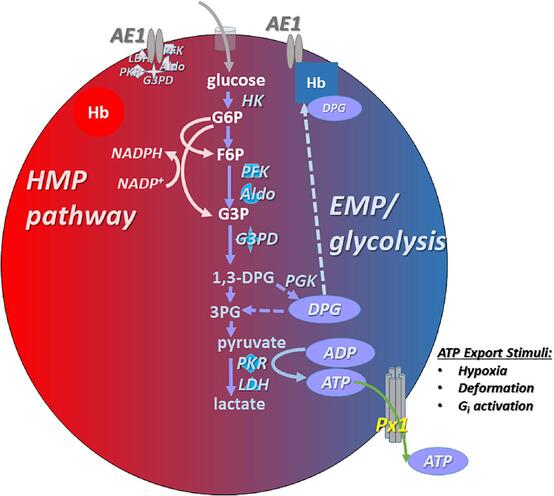
I. Lack of Mitochondria and Aerobic Respiration

Consequence: Since RBCs lack mitochondria, they cannot perform oxidative phosphorylation, the highly efficient process of ATP generation that uses oxygen.

Significance: This is a crucial adaptation. If RBCs used the oxygen they transport for their own energy needs, it would significantly reduce the efficiency of oxygen delivery to the tissues.

II. Primary Energy Production: Anaerobic Glycolysis

Pathway: Glycolysis is the sole pathway for ATP production in mature RBCs. This process breaks down glucose (obtained from the plasma) into pyruvate, ultimately producing a net gain of 2 ATP molecules per molecule of glucose.

End Product: Pyruvate is then converted to lactate (lactic acid) because, in the absence of mitochondria and an electron transport chain, pyruvate cannot enter the Krebs cycle or oxidative phosphorylation. Lactate is released into the plasma and can be taken up by the liver for gluconeogenesis (Cori cycle).

Functional Significance of ATP:

Maintenance of Ion Gradients: ATP powers the Na+/K+-ATPase pump, which actively transports sodium out of the cell and potassium into the cell. This maintains the osmotic balance and prevents the cell from swelling and bursting (hemolysis).

Maintenance of Biconcave Shape: ATP is required to maintain the spectrin-actin cytoskeleton, which supports the biconcave shape and deformability of the RBC.

Other Metabolic Reactions: ATP is also needed for various other minor metabolic reactions and the phosphorylation of certain substrates.

III. The Pentose Phosphate Pathway (Hexose Monophosphate Shunt - HMP Shunt)

Purpose: This pathway, while not producing ATP, is absolutely critical for protecting the red blood cell from oxidative damage.

Key Product: The HMP shunt generates NADPH (Nicotinamide Adenine Dinucleotide Phosphate, reduced form).

Mechanism of Protection:

  • Role of NADPH: NADPH is essential for reducing oxidized glutathione (GSSG) back to its reduced form (GSH) via the enzyme glutathione reductase.
  • Glutathione (GSH): Reduced glutathione is a potent antioxidant within the RBC.
  • Glutathione Peroxidase: GSH is then used by the enzyme glutathione peroxidase to neutralize harmful reactive oxygen species (ROS), such as hydrogen peroxide (H2O2), by converting them into water.

Significance: Without a functioning HMP shunt and sufficient NADPH, RBCs are highly susceptible to oxidative stress (e.g., from certain drugs, infections, or environmental toxins). Oxidative damage can lead to:

  • Denaturation of Hemoglobin: Formation of Heinz bodies (precipitated hemoglobin) which can damage the cell membrane.
  • Membrane Damage: Leads to increased membrane rigidity and fragility.
  • Premature Hemolysis: Oxidatively damaged RBCs are prematurely destroyed, leading to hemolytic anemia.

Clinical Relevance: Genetic deficiencies in enzymes of the HMP shunt, such as Glucose-6-Phosphate Dehydrogenase (G6PD) deficiency, are common and can lead to severe hemolytic anemia when individuals are exposed to oxidative stressors (e.g., fava beans, certain antimalarial drugs, sulfonamides, or infections).

IV. The Rapoport-Luebering Shunt (2,3-Bisphosphoglycerate Pathway)

Purpose: This side branch of glycolysis is unique to RBCs and does not produce ATP. Instead, it produces 2,3-Bisphosphoglycerate (2,3-BPG or 2,3-DPG).

Role of 2,3-BPG: 2,3-BPG binds to deoxyhemoglobin (Hb without O2), causing a conformational change that decreases hemoglobin's affinity for oxygen.

Significance:

  • Oxygen Release in Tissues: Higher levels of 2,3-BPG promote the release of oxygen from hemoglobin to the tissues, which is particularly important at high altitudes or in conditions of hypoxia.
  • Inverse Relationship with Oxygen Affinity: The higher the concentration of 2,3-BPG, the more readily hemoglobin releases oxygen (i.e., decreased oxygen affinity). Conversely, lower 2,3-BPG levels increase oxygen affinity (e.g., in stored blood, which has low 2,3-BPG, making it less effective at oxygen delivery until its 2,3-BPG levels are restored).
  • Fetal Hemoglobin (HbF): HbF has a lower affinity for 2,3-BPG than adult hemoglobin (HbA). This means HbF has a higher affinity for oxygen, allowing the fetus to effectively extract oxygen from the mother's blood (which has HbA and higher 2,3-BPG levels).

V. Methemoglobin Reductase Pathway (NADH-dependent)

Purpose: This pathway is critical for maintaining the iron in hemoglobin in its functional ferrous (Fe2+) state.

Key Enzyme: Methemoglobin reductase (also known as diaphorase I) uses NADH (generated from glycolysis) to reduce ferric iron (Fe3+) back to ferrous iron (Fe2+).

Significance: Oxidizing agents can convert the ferrous iron (Fe2+) in hemoglobin to ferric iron (Fe3+), forming methemoglobin. Methemoglobin cannot bind oxygen, thus reducing the oxygen-carrying capacity of the blood. This pathway continuously works to reverse this process.

Clinical Relevance: Deficiency in methemoglobin reductase or excessive exposure to oxidizing agents can lead to methemoglobinemia, where a significant portion of hemoglobin is in the Fe3+ state, resulting in a bluish discoloration of the skin (cyanosis) and impaired oxygen delivery.

Summary of RBC Metabolic Pathways and Their Functions:

  • Anaerobic Glycolysis: Produces ATP for ion pumps and membrane integrity.
  • Pentose Phosphate Pathway (HMP Shunt): Produces NADPH to protect against oxidative damage via glutathione.
  • Rapoport-Luebering Shunt: Produces 2,3-BPG to regulate oxygen affinity of hemoglobin.
  • Methemoglobin Reductase Pathway: Maintains hemoglobin iron in the ferrous (Fe2+) state for oxygen binding.
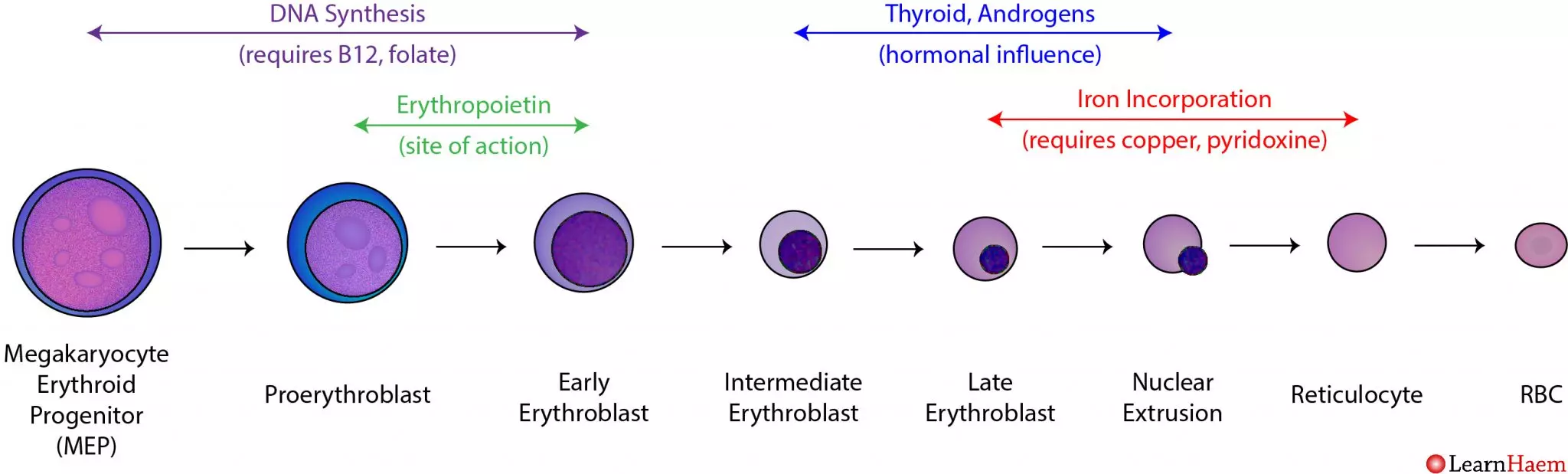
Erythropoiesis and the Destruction of Red Blood Cells

The life cycle of a red blood cell is a carefully orchestrated process, from its formation in the bone marrow to its eventual destruction after about 120 days. This continuous turnover ensures a constant supply of functional RBCs for oxygen transport.

I. Erythropoiesis (Red Blood Cell Production)

Erythropoiesis is the specific term for the formation of red blood cells. It is a tightly regulated process that occurs primarily in the red bone marrow of adults.

Stimulus

The primary stimulus for erythropoiesis is hypoxia (insufficient oxygen delivery to the tissues).

  • Kidney as Sensor: The kidneys act as the main sensors of blood oxygen levels. When renal cells detect hypoxia, they release the hormone erythropoietin (EPO).
  • Other Factors: Other factors that can stimulate EPO release include significant blood loss, high altitude, and intense exercise.

Role of Erythropoietin (EPO)

  • Target Cells: EPO circulates in the blood and travels to the red bone marrow, where it acts on hematopoietic stem cells (HSCs) that have committed to the erythroid lineage.
  • Effects: EPO stimulates:
    • Increased rate of cell division: Accelerates the proliferation of erythrocyte progenitor cells.
    • Accelerated maturation: Speeds up the differentiation process through various developmental stages.
    • Increased hemoglobin synthesis: Promotes the production of hemoglobin within the developing cells.
    • Premature release of reticulocytes: In times of severe demand, the bone marrow may release reticulocytes slightly earlier than usual.

Stages of Erythropoiesis (from Hematopoietic Stem Cell to Mature RBC)

1. Hematopoietic Stem Cell (HSC):

The ultimate precursor, found in red bone marrow.

2. Myeloid Stem Cell (Common Myeloid Progenitor - CMP):

HSC differentiates into a CMP, which can give rise to various myeloid cells, including red blood cells.

3. Proerythroblast (Pronormoblast):

The first committed cell in the erythroid lineage. It is large, basophilic (stains blue due to ribosomes), and actively synthesizes proteins for future divisions.

4. Basophilic Erythroblast:

Divides rapidly, accumulating ribosomes for future hemoglobin synthesis.

5. Polychromatic Erythroblast:

Hemoglobin synthesis begins, leading to a mixed blue-pink (polychromatic) staining pattern. Cell division continues.

6. Orthochromatic Erythroblast (Normoblast):

Hemoglobin accumulation is nearly complete, and the cytoplasm is predominantly pink (eosinophilic). The nucleus becomes dense and pyknotic (condensed) and is then ejected from the cell. This is the last nucleated stage.

7. Reticulocyte:

Anucleated but still contains residual ribosomal RNA (mRNA and ribosomes), which gives it a fine, reticular (net-like) appearance with special stains. Reticulocytes are released from the bone marrow into the peripheral blood. They mature into erythrocytes within 1-2 days. The reticulocyte count is a good indicator of the rate of effective erythropoiesis.

8. Mature Erythrocyte (Red Blood Cell):

After losing its residual RNA, the reticulocyte becomes a fully functional, biconcave disc, packed with hemoglobin.

Nutritional Requirements for Erythropoiesis

  • Iron: Essential for hemoglobin synthesis (part of the heme group). Iron is absorbed from the diet, transported by transferrin, and stored as ferritin in the liver, spleen, and bone marrow.
  • Vitamin B12 (Cobalamin) and Folate (Folic Acid): Crucial for DNA synthesis, particularly for the rapid cell division of erythrocyte precursors. Deficiencies lead to impaired DNA synthesis and maturation defects, resulting in large, immature red blood cells (megaloblastic anemia).
  • Amino Acids: Required for the synthesis of the globin protein chains.
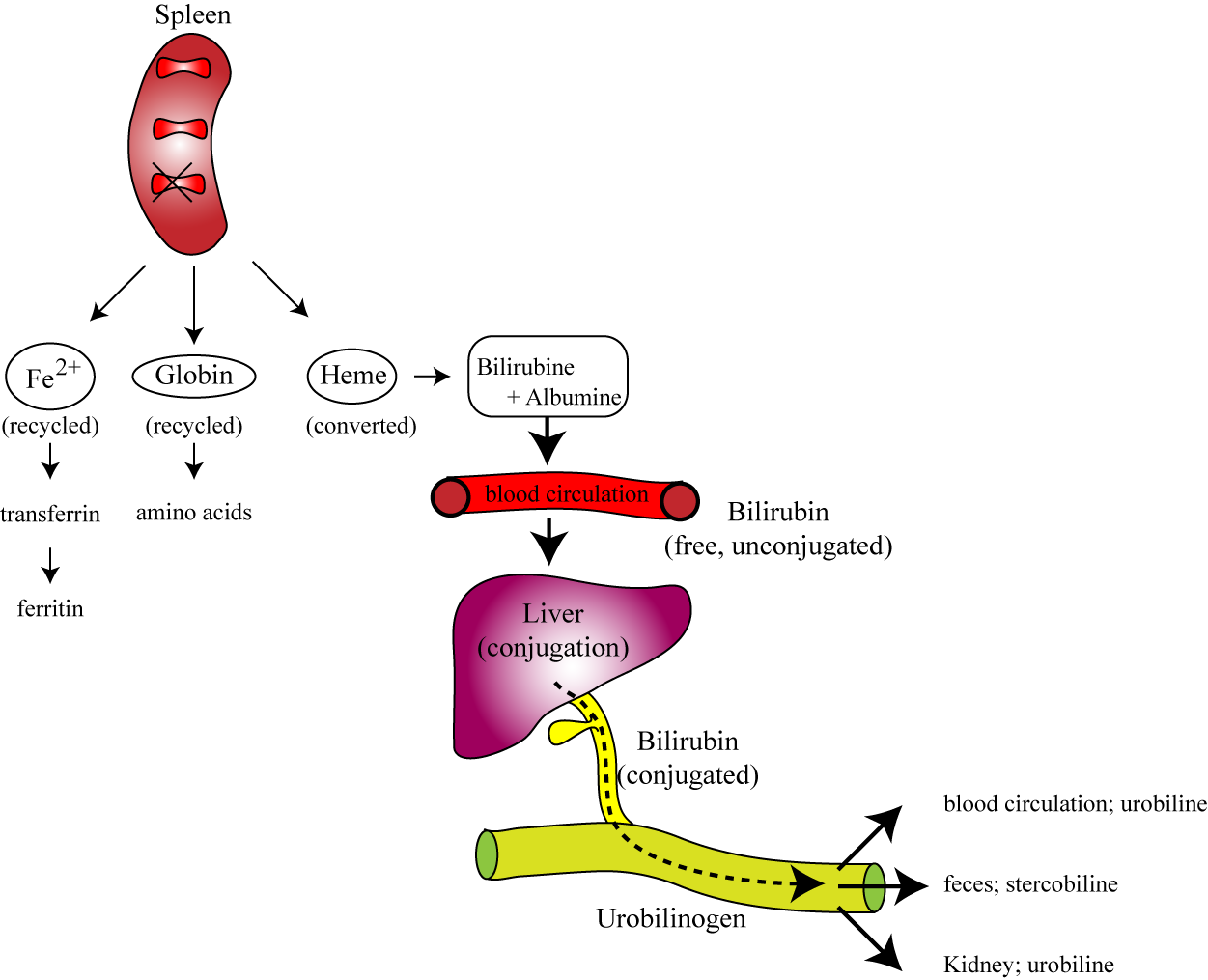
II. Destruction of Red Blood Cells

Mature RBCs have a lifespan of approximately 100-120 days. Due to their lack of a nucleus and organelles, they cannot repair themselves. Over time, their membranes become rigid and fragile, and their enzymatic activity declines.

Phagocytosis by Macrophages

Location: Senescent (aged) or damaged RBCs are primarily removed from circulation by specialized macrophages (phagocytes) in the:

  • Spleen ("red blood cell graveyard"): The spleen's narrow capillaries (sinusoids) act as a filter, trapping old, inflexible RBCs.
  • Liver: Also contains macrophages (Kupffer cells) that participate in RBC breakdown.
  • Bone Marrow: Macrophages here also recycle old RBCs.

Breakdown of Hemoglobin

Once phagocytosed, the red blood cell is broken down, and its components are recycled:

1. Globin Chains

The protein globin chains are catabolized into their constituent amino acids. These amino acids are then returned to the amino acid pool in the blood and can be reused for synthesizing new proteins, including new globin chains for erythropoiesis.

2. Heme Group

The heme group is separated from globin and further broken down:

A. Iron (Fe): The iron is salvaged. It binds to a transport protein called transferrin and is transported back to the bone marrow to be reused for new hemoglobin synthesis, or it is stored as ferritin or hemosiderin in the liver and spleen.

B. Porphyrin Ring (without Iron): The porphyrin ring is degraded into a yellowish pigment called biliverdin, which is then quickly reduced to bilirubin.

  • Unconjugated (Indirect) Bilirubin: Bilirubin is insoluble in water, so it binds to albumin in the blood and is transported to the liver.
  • Conjugated (Direct) Bilirubin: In the liver, bilirubin is conjugated (made water-soluble) with glucuronic acid.
  • Excretion: Conjugated bilirubin is then excreted by the liver into the bile, which passes into the small intestine.
  • Urobilinogen & Stercobilin: In the intestine, bacteria metabolize bilirubin into urobilinogen. Some urobilinogen is reabsorbed and excreted in urine (giving urine its yellow color), but most is oxidized to stercobilin, which gives feces its characteristic brown color.

Jaundice: An accumulation of bilirubin in the blood (hyperbilirubinemia), often due to excessive RBC destruction (hemolytic anemia) or liver dysfunction (impaired bilirubin processing/excretion), leads to a yellowing of the skin and sclera of the eyes, a condition known as jaundice.

Summary of Erythrocyte Life Cycle:

  • Birth (Erythropoiesis): Stimulated by EPO (from kidneys) in response to hypoxia. Occurs in red bone marrow. Involves a series of developmental stages from HSC to reticulocyte to mature erythrocyte. Requires iron, B12, and folate.
  • Circulation: Mature RBCs circulate for ~120 days, transporting O2 and CO2.
  • Death (Destruction): Aged RBCs become rigid and are phagocytosed by macrophages, primarily in the spleen, liver, and bone marrow.
  • Recycling: Hemoglobin components are broken down: globin to amino acids, iron salvaged, and heme converted to bilirubin for excretion.
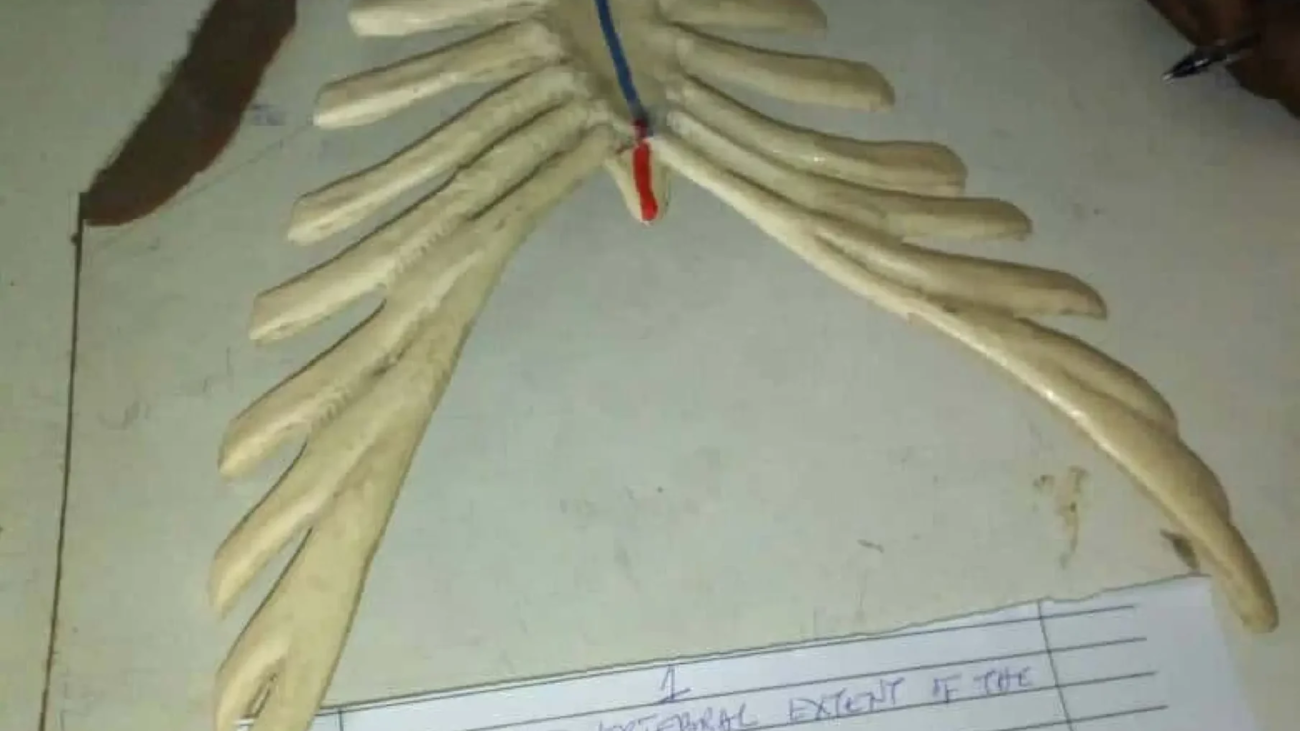
Biochemistry: Red Blood Cells Quiz
Logo

Red Blood Cells Quiz

Test your knowledge with these 35 questions.

Blood Physiology Introduction (1)

Blood Physiology: Introduction

Blood Physiology: Introduction

Introduction to Blood


Blood is often described as a unique connective tissue, though it differs significantly from other connective tissues like bone or cartilage. Its uniqueness stems from its cellular components being suspended in a liquid extracellular matrix (plasma) rather than being anchored to solid fibers. This fluidity is crucial for its transport functions.

It is the only fluid tissue in the body, continuously circulating within the closed system of the cardiovascular system (heart, blood vessels). It is a complex, viscous fluid that accounts for approximately 8% of total body weight in an average adult (e.g., about 5-6 liters in males, 4-5 liters in females).

Origin: All blood cells originate from hematopoietic stem cells in the red bone marrow.

Why is it essential for life?

  • Blood serves as the body's primary transport and communication medium, ensuring that all cells receive necessary resources and waste products are efficiently removed. Without its continuous circulation, cells would rapidly cease to function due to lack of oxygen and nutrients, and the accumulation of toxic metabolic byproducts.
  • It acts as a dynamic internal environment, constantly adapting to the body's changing needs and maintaining homeostasis (the stable internal conditions required for survival).

Overview of Major Roles of Blood


1. Distribution/Transportation

Blood acts as the delivery system for the body:

  • Respiratory Gases:
    • Carries oxygen from the lungs (where it's loaded onto hemoglobin in red blood cells) to all body tissues and cells for cellular respiration.
    • Transports carbon dioxide, a waste product of cellular respiration, from body cells back to the lungs for exhalation (dissolved in plasma, bound to hemoglobin, or as bicarbonate ions).
  • Nutrients: Delivers absorbed nutrients (e.g., monosaccharides like glucose, amino acids, fatty acids, glycerol, vitamins, minerals) from the digestive tract to the liver first, and then to all body cells for energy, growth, and repair.
  • Hormones: Acts as the "circulatory highway" for endocrine hormones, transporting them from their sites of production (endocrine glands) to their specific target organs or cells throughout the body, regulating diverse physiological processes.
  • Metabolic Wastes: Collects and transports metabolic waste products, such as urea (from protein metabolism) and uric acid (from nucleic acid metabolism) to the kidneys for excretion in urine, and lactic acid (from anaerobic respiration) to the liver for conversion.

2. Regulation

Blood plays a pivotal role in maintaining the stability of the interstitial fluid (homeostasis):

  • Body Temperature: Blood possesses a high heat capacity due to its water content. It absorbs heat generated by metabolically active tissues (e.g., muscles) and distributes it throughout the body. By regulating blood flow to the skin, it can either dissipate excess heat (vasodilation) or conserve heat (vasoconstriction) to maintain a stable core body temperature.
  • pH Levels: Crucial for maintaining the extremely narrow and vital physiological pH range of 7.35-7.45. It achieves this through various buffer systems present in plasma proteins and within red blood cells (e.g., bicarbonate buffer system, phosphate buffer system, protein buffer system). These buffers can accept or donate hydrogen ions to resist drastic changes in acidity or alkalinity.
  • Fluid Volume and Blood Pressure: Blood plasma proteins, particularly albumin, exert significant osmotic pressure (colloid osmotic pressure). This pressure draws water from the interstitial fluid back into the capillaries, maintaining proper fluid volume within the circulatory system and helping to prevent edema (swelling of tissues). Maintaining adequate blood volume is directly linked to maintaining sufficient blood pressure for tissue perfusion.
  • Electrolyte Balance: Transports various electrolytes (Na+, K+, Ca2+, Cl-, HCO3-) which are vital for nerve impulse transmission, muscle contraction, and fluid balance.

3. Protection

Blood provides defense mechanisms against blood loss and foreign invaders:

  • Prevention of Blood Loss (Hemostasis): Initiates a rapid and efficient series of events when a blood vessel is damaged. This process, called hemostasis, involves the aggregation of platelets (thrombocytes) and the activation of clotting factors (plasma proteins) to form a fibrin clot, sealing the injured vessel and preventing excessive hemorrhage.
  • Prevention of Infection:
    • Leukocytes (White Blood Cells): Are the mobile units of the immune system. They identify and destroy pathogens (bacteria, viruses, fungi, parasites) and remove damaged or abnormal cells (e.g., cancer cells, dead cells). Different types of leukocytes have specialized roles in this defense.
    • Antibodies: Specific proteins (immunoglobulins) produced by certain lymphocytes that target and neutralize specific pathogens or toxins.
    • Complement Proteins: A group of plasma proteins that, when activated, can lyse microorganisms, enhance phagocytosis, and contribute to inflammation.

Physical Characteristics

Appearance & Texture

Color:
  • Oxygen-rich blood: (typically arterial) is a bright, scarlet red. This vibrant color is due to hemoglobin picking up oxygen in the lungs (oxyhemoglobin).
  • Oxygen-poor blood: (typically venous) is a darker, duller red, sometimes described as brick-red or maroon. This is because hemoglobin has released its oxygen (deoxyhemoglobin). Note: Venous blood is never blue, despite how veins appear through the skin.
Viscosity (Thickness):

Blood is about 5 times more viscous (thicker/stickier) than water, primarily due to RBCs and plasma proteins.

Clinical Significance: Increased viscosity (e.g., polycythemia, severe dehydration) increases resistance to flow, straining the heart. Decreased viscosity (e.g., severe anemia) can lead to turbulent flow.

Properties

pH Level:

Slightly alkaline (basic), maintained tightly between 7.35 and 7.45.

Clinical Significance:
  • pH < 7.35 = Acidosis
  • pH > 7.45 = Alkalosis
Both disrupt enzyme function and can be fatal.
Temperature:

Circulates at ~38°C (100.4°F), slightly higher than body temperature, to absorb and distribute metabolic heat.

Taste/Odor:

Metallic taste (iron content) and faint characteristic odor.

Volume: The average adult has approximately 5-6 liters (1.5 gallons), constituting 7-8% of total body weight.
Clinical Significance: Significant deviations (hemorrhage, fluid overload) severely compromise tissue perfusion.

Composition of Blood: The Two Major Components

When a sample of blood is collected and centrifuged (spun at high speed), its components separate into distinct layers due to differences in density. This separation reveals two main components:

Plasma
55%
RBCs
45%
Buffy Coat

1. Plasma (Liquid Matrix)

Constitutes ~55% of total volume.

  • Least dense component; forms top, yellowish-straw colored layer.
  • A sticky, non-living fluid matrix.
  • (Detailed composition covered in Objective 1.3)

2. Formed Elements (Cellular)

Constitutes ~45% of total volume (Hematocrit).

Normal Hematocrit: Males 42-52%, Females 37-47%.

  • Erythrocytes (RBCs):
    Most numerous (99.9%). Dense red mass at the bottom. Responsible for O2 transport.
  • The "Buffy Coat" (Top of formed elements):
    Thin, whitish layer between plasma and RBCs containing:
    • Leukocytes (WBCs): Critical for immune defense.
    • Thrombocytes (Platelets): Fragments involved in clotting.

Composition and Functions of Blood Plasma

Plasma is the non-living fluid matrix of blood, accounting for approximately 55% of total blood volume. It is a complex mixture, predominantly water, with a vast array of dissolved solutes, many of which are vital for maintaining homeostasis.

Composition of Blood Plasma

1. Water (approx. 90% by weight)

This is the major component of plasma, serving as the solvent for all other plasma constituents.

Function:

  • Acts as the medium for dissolving and suspending solutes.
  • Excellent heat absorber and distributor, contributing to thermoregulation.
  • Provides the fluidity necessary for blood circulation.

2. Plasma Proteins (approx. 8% by weight)

These are the most abundant solutes in plasma by weight and are almost entirely produced by the liver (with the exception of gamma globulins/antibodies). They are not taken up by cells to be used as metabolic fuels or nutrients (unlike other plasma solutes), but rather remain in the blood.

Key Functions (collectively): Contribute to osmotic pressure, act as buffers, transport substances, and play roles in blood clotting and immunity.

60%

Albumin

Most abundant plasma protein.

Main contributor to plasma osmotic pressure: It acts like a sponge, drawing water from the interstitial fluid into the bloodstream, thereby maintaining blood volume and blood pressure.

Important buffer: Helps to maintain blood pH.

Carrier protein: Transports various substances in the blood, including certain hormones (e.g., thyroid hormones, steroid hormones), fatty acids, and some drugs.

36%

Globulins

A diverse group of proteins.

Alpha (α) and Beta (β) Globulins:
  • Transport proteins that bind to and transport lipids (forming lipoproteins), metal ions (e.g., transferrin for iron), and fat-soluble vitamins.
  • Some are involved in immune responses.
Gamma (γ) Globulins:
  • Also known as antibodies or immunoglobulins.
  • Produced by plasma cells (derived from B lymphocytes), not the liver.
  • Function: Critical components of the immune system, recognizing and attacking pathogens.
4%

Fibrinogen

A large plasma protein produced by the liver.

Function: Key component of the blood clotting cascade. It is converted into fibrin, which forms the meshwork of a blood clot.

Other Plasma Proteins: Includes enzymes, complement proteins (involved in immunity), and various regulatory proteins.

Other Solutes

3. Nutrients (approx. 1%)

Substances absorbed from the digestive tract and transported to body cells.

Examples: Glucose (blood sugar), amino acids, fatty acids, glycerol, vitamins, cholesterol.

4. Electrolytes (Ions - approx. 1%)

Inorganic salts, primarily Na+, Cl-, K+, Ca2+, Mg2+, HCO3-, HPO42-, and SO42-.

Most abundant plasma solutes by number.

  • Maintain plasma osmotic pressure.
  • Crucial for buffering blood pH.
  • Essential for nerve impulse transmission, muscle contraction, and enzyme activity.
  • Electrolyte balance is vital for body fluid distribution.

5. Gases

Dissolved O2, CO2, and N2.

Function: Transport of respiratory gases. (Note: Most are transported by RBCs, but a small amount dissolves in plasma).

6. Hormones

Steroid and protein-based hormones transported to target cells to regulate physiology.

7. Waste Products

Byproducts of metabolism transported to kidneys/lungs/liver.

Examples: Urea, uric acid, creatinine, ammonium salts.

Functions of Blood Plasma (Summary)

  • Transport: Serves as the primary medium for transporting nutrients, gases, hormones, metabolic wastes, and drugs throughout the body.
  • Regulation:
    • Osmotic Pressure & Fluid Balance: Plasma proteins, especially albumin, maintain the body's fluid volume and osmotic pressure.
    • pH Balance: Plasma proteins and bicarbonate ions act as buffers.
    • Temperature Regulation: Water content helps distribute and dissipate heat.
  • Protection: Contains antibodies and complement proteins for immunity, and clotting factors (like fibrinogen) to prevent blood loss.

Haematopoiesis: Formation of Blood Cells

Haematopoiesis (Gr. haima = blood; poiesis = to make) is the process of generating all of the cellular components of blood from hematopoietic stem cells (HSCs).

This includes the formation of:

  • Erythropoiesis: Production of Erythrocytes (red blood cells).
  • Leukopoiesis: Production of Leukocytes (white blood cells).
  • Thrombopoiesis: Production of Thrombocytes (platelets).

Significance

1. Maintenance of Blood Cell Homeostasis:
Blood cells have finite lifespans (e.g., RBCs ~120 days, platelets ~10 days, neutrophils ~hours to days). Hematopoiesis ensures that old or damaged cells are constantly replaced by new ones, maintaining stable numbers of each cell type.

2. Response to Physiological Demands:
The rate of hematopoiesis can be dramatically increased in response to specific physiological needs, such as:

  • Anemia: Increased erythropoiesis to compensate for low red blood cell count or oxygen-carrying capacity.
  • Infection: Increased leukopoiesis (especially granulopoiesis) to combat pathogens.
  • Hemorrhage: Increased production of red blood cells and platelets to replace lost blood volume and ensure clotting.

3. Repair and Regeneration: Provides the cells necessary for tissue repair, immune surveillance, and defense against injury and disease.

4. Adaptation: Allows the body to adapt to changes in environmental conditions (e.g., higher altitude, requiring more RBCs).

Sites of Hematopoiesis

1. Embryonic Hematopoiesis

  • Yolk Sac: Begins very early in embryonic development (around 3rd week of gestation). Primitive red blood cells are formed here.
  • Aorta-Gonad-Mesonephros (AGM) region: A crucial site for the emergence and expansion of definitive HSCs.
  • Liver: Becomes the primary hematopoietic organ during the second trimester of fetal development.
  • Spleen: Also contributes significantly to hematopoiesis during fetal life.

2. Fetal Hematopoiesis

  • Liver and Spleen: Are the dominant sites from the second trimester until near birth.
  • Bone Marrow: Begins to take over as the primary site during the late fetal period.

3. Adult Hematopoiesis

Red Bone Marrow:

After birth and throughout adulthood, red bone marrow is the sole site of normal hematopoiesis.

  • Location: Found primarily in the axial skeleton (skull, vertebrae, ribs, sternum), pelvic girdle, and the epiphyses (ends) of the humerus and femur.
  • Composition: Composed of a vascular compartment and a hematopoietic compartment, including hematopoietic stem cells, progenitor cells, developing blood cells, and a stroma (supportive tissue including reticular cells, adipocytes, macrophages).

Yellow Bone Marrow:

In adults, much of the red bone marrow is replaced by yellow bone marrow (composed mainly of fat cells), which is generally quiescent in hematopoiesis but can convert back to red marrow in cases of extreme demand (e.g., severe hemorrhage).

Extramedullary Hematopoiesis: In certain pathological conditions (e.g., severe bone marrow failure, chronic myeloproliferative disorders), the liver and spleen can reactivate their fetal hematopoietic capacity, leading to blood cell production outside the bone marrow.

Role of Hematopoietic Stem Cells (HSCs)

At the pinnacle of the hematopoietic system are the Hematopoietic Stem Cells (HSCs), the remarkable cells responsible for generating all mature blood cells. Understanding HSCs is fundamental to comprehending blood cell formation.

Characteristics of HSCs

1. Pluripotency (Multipotency)

HSCs are pluripotent (more accurately, multipotent). They have the unique ability to differentiate into all types of blood cells (RBCs, WBCs, Platelets). They cannot, however, differentiate into cells of other tissues (like neurons), which is why they are not considered totipotent.

2. Self-Renewal

HSCs undergo asymmetric cell division: one daughter cell remains an undifferentiated stem cell (replenishing the pool) and the other commits to differentiation. This ensures a lifelong supply. Without this, the stem cell pool would eventually deplete.

3. Quiescence

Most HSCs in the marrow exist in a relatively quiescent (resting) state, dividing infrequently to protect from DNA damage and exhaustion. However, they can be rapidly activated in response to stress (infection, hemorrhage).

4. Rare Population

HSCs are an extremely rare population of cells within the bone marrow, estimated to be less than 0.01% of all bone marrow cells.

Differentiation Pathways: The "Hematopoietic Tree"

HSCs don't directly differentiate into mature blood cells. Instead, they undergo a series of commitment steps, forming progenitor cells that have more restricted differentiation potential.

Commitment to Lineage

Upon commitment, an HSC differentiates into one of two major progenitor cell types:

Common Myeloid Progenitor (CMP)

Gives rise to most cells involved in innate immunity and oxygen transport.

  • Erythrocytes (RBCs): via Erythropoiesis.
  • Megakaryocytes: leading to Platelets via Thrombopoiesis.
  • Granulocytes: Neutrophils, Eosinophils, Basophils.
  • Monocytes: Mature into macrophages in tissues.
  • (Some also include mast cells from this lineage).
Common Lymphoid Progenitor (CLP)

Gives rise to cells primarily involved in adaptive immunity.

  • B Lymphocytes: Mature into plasma cells and produce antibodies.
  • T Lymphocytes: Involved in cell-mediated immunity.
  • Natural Killer (NK) cells: Important components of innate immunity.

Significance of HSCs

  • Lifelong Blood Production: Crucial for maintaining the continuous supply of all blood cell types throughout an individual's life.
  • Therapeutic Potential: HSCs are the basis for bone marrow transplantation (more accurately, hematopoietic stem cell transplantation), a life-saving procedure used to treat various blood cancers (leukemias, lymphomas), bone marrow failure syndromes (aplastic anemia), and certain genetic disorders.

Regulation and Differentiation in Hematopoiesis

Hematopoiesis is a tightly regulated process, ensuring that the production of each blood cell type matches the body's physiological demands. This regulation is primarily orchestrated by a diverse array of signaling molecules, collectively known as hematopoietic growth factors and cytokines.

Hematopoietic Growth Factors and Cytokines

What are they? These are secreted protein or glycoprotein signaling molecules that act as messengers between cells.

Mechanism: They bind to specific receptors on target cells (HSCs, progenitor cells, and developing blood cells), triggering intracellular signaling pathways that influence cell survival, proliferation, differentiation, and maturation.

Modes of Action:
  • Autocrine: Affecting the cell that produced them.
  • Paracrine: Affecting nearby cells.
  • Endocrine: Affecting distant cells via the bloodstream.

Key Regulatory Molecules

Erythropoietin (EPO)

Producer: Kidneys (90%), liver (10%).

Target: Erythroid progenitor cells (CFU-E, proerythroblasts).

Function: Stimulates erythropoiesis. Promotes proliferation/differentiation of precursors and prevents apoptosis.

Regulation Loop: Hypoxia (low O2) → kidney releases EPO → increased RBC production → increased O2 transport → reduced EPO release.

Clinical: Used to treat anemia (e.g., in chronic kidney disease, chemotherapy).

Thrombopoietin (TPO)

Producer: Liver (main), kidneys, bone marrow stromal cells.

Target: Megakaryocytes and progenitors.

Function: Stimulates thrombopoiesis. Promotes maturation of megakaryocytes and platelet formation.

Regulation: Liver produces TPO constantly. Platelets internalize/clear TPO. Low platelets = less clearance = high TPO levels = more production.

Clinical: Being developed for thrombocytopenia.

Colony-Stimulating Factors (CSFs)

Glycoproteins named for their ability to form "colonies" in vitro.

  • Granulocyte-CSF (G-CSF):
    Produced by macrophages/endothelial cells. Target: Myeloblasts.
    Stimulates neutrophil production and function. Clinical: Filgrastim used for neutropenia.
  • Macrophage-CSF (M-CSF):
    Produced by monocytes/fibroblasts. Target: Monocyte progenitors.
    Promotes monocyte proliferation and macrophage function.
  • Granulocyte-Macrophage-CSF (GM-CSF):
    Produced by T cells/macrophages. Target: Granulocyte & Monocyte progenitors.
    Stimulates production of both lineages and dendritic cell maturation.

Interleukins (ILs)

Cytokines with pleiotropic effects, often acting synergistically.

  • IL-3 (Multi-CSF):
    Produced by T cells. Targets early multipotent progenitors (HSCs, CMPs, CLPs). Stimulates nearly all lineages.
  • IL-6:
    Produced by macrophages/T cells. Supports multipotent progenitors; involved in immune/acute phase response.
  • IL-7:
    Produced by stromal cells. Crucial for B and T lymphocyte development.

Stem Cell Factor (SCF) / c-kit Ligand

A crucial "master switch" factor produced by marrow stromal cells. It promotes survival, proliferation, and differentiation of very early stem/progenitor cells, working synergistically with many other factors.

The Bone Marrow Microenvironment (Niche): These factors act within a complex niche of stromal cells and extracellular matrix, which provides essential support and regulates HSC self-renewal vs. differentiation.

General Differentiation Pathways

Starting from the HSC, blood cells undergo commitment, proliferation, and maturation guided by the factors above.

I. Erythropoiesis (Red Blood Cell Formation)

Purpose: Produce O2-carrying RBCs.
Stimulus: Hypoxia → EPO.

1. Hematopoietic Stem Cell (HSC)Common Myeloid Progenitor (CMP).

2. Proerythroblast: First committed cell. Large nucleus, basophilic cytoplasm (ribosome synthesis).

3. Basophilic Erythroblast: Intense blue cytoplasm. Hemoglobin synthesis begins.

4. Polychromatic Erythroblast: Grayish-blue cytoplasm (mix of ribosomes/hemoglobin). Rapid division.

5. Orthochromatic Erythroblast (Normoblast): Pink/red cytoplasm (high hemoglobin). Nucleus condenses and is ejected.

6. Reticulocyte: Anucleated immature RBC containing residual ribosomal RNA. Released into bloodstream.

7. Mature Erythrocyte: After 1-2 days in circulation, reticulum is lost. Biconcave disc.

Key Points: Takes 15-17 days. Requires Iron, B12, Folate. Characterized by decreasing size and nuclear extrusion.

II. Leukopoiesis (White Blood Cell Formation)

Purpose: Immune defense.
Stimulus: Infection/Inflammation → CSFs/Interleukins.

A. Myeloid Lineage (from CMP)

Granulopoiesis (Neutrophils, Eosinophils, Basophils)

  • Myeloblast: First committed cell.
  • Promyelocyte: Large granules appear.
  • Myelocyte: Specific granules appear.
  • Metamyelocyte: Nucleus indents (kidney shape).
  • Band (Stab) Cell: Nucleus C or U-shaped. (Immature, seen in "left shift").
  • Mature Granulocyte: Segmented nucleus.

Monopoiesis

  • MonoblastPromonocyte.
  • Monocyte: Large, kidney-shaped nucleus. Circulates briefly.
  • Macrophage: Differentiated monocyte in tissues.

B. Lymphoid Lineage (from CLP)

  • LymphoblastProlymphocyte.
  • Mature Lymphocytes:
    • B Lymphocytes: Mature in bone marrow.
    • T Lymphocytes: Mature in thymus.
    • NK Cells: Mature in marrow/spleen/thymus.

Note: T cells undergo critical maturation in the thymus.

III. Thrombopoiesis (Platelet Formation)

Purpose: Hemostasis.
Stimulus: TPO.

1. HSCCMPMegakaryoblast.

2. Endomitosis: DNA replication without cell division.

3. Megakaryocyte: Massive cell (up to 100µm), multi-lobed polyploid nucleus. Resides near sinusoids.

4. Platelet Formation: Megakaryocyte extends proplatelets into sinusoids, which fragment into thousands of platelets.

Key Points: One megakaryocyte = thousands of platelets. Platelet lifespan = 8-10 days.
Biochemistry: Blood Physiology Introduction Quiz
Logo

Blood Physiology: Introduction

Test your knowledge with these 40 questions.