
Principles of Antimicrobial Therapy, Classification and Drug Resistance
On this page
Overview
Basic terminology
Scroll the table sideways on a smaller screen.
| Term | Meaning | Exam notes |
|---|---|---|
| Antimicrobial | Any agent acting against micro-organisms | Umbrella term: antibacterial, antiviral, antifungal, antiparasitic |
| Antibiotic | Antimicrobial originally derived from a living organism (fungus/bacterium) | Now used loosely for antibacterials generally |
| Chemotherapeutic agent | Synthetic antimicrobial (sulphonamides, quinolones) | Contrast with true antibiotics |
| Bactericidal | Kills bacteria directly | Beta-lactams, aminoglycosides, quinolones, vancomycin; preferred in severe infection/immunocompromise |
| Bacteriostatic | Inhibits growth; host immunity clears | Macrolides, tetracyclines, sulphonamides, chloramphenicol; avoid in severe infection |
| Narrow spectrum | Acts on limited groups of organisms | Penicillin V, cloxacillin, nitrofurantoin — preferred: less flora disruption, less resistance selection |
| Broad spectrum | Acts on many Gram-positive and Gram-negative organisms | Tetracyclines, cephalosporins, carbapenems — reserve; drive resistance and C. difficile |
| Selective toxicity | Drug harms microbe, not host | The founding principle: exploit bacterial structures humans lack (cell wall, 70S ribosome, folate pathway) |
| Minimum inhibitory concentration (MIC) | Lowest concentration that prevents visible growth | Basis of "sensitive / intermediate / resistant" on C&S reports |
Empirical versus definitive therapy
Empirical therapy is started before the organism is known, guided by the most likely pathogens for that syndrome at that site and severity, local resistance patterns, patient factors (allergies, pregnancy, renal function, immune status) and guideline recommendations (Uganda Clinical Guidelines). Definitive therapy follows laboratory identification and sensitivity testing — the drug should then be narrowed (de-escalated) to the cheapest effective agent.
Prophylaxis is a third use: single-dose or short-course cover before clean-contaminated surgery (e.g., cefazolin), rheumatic-fever secondary prophylaxis (benzathine penicillin) or HIV opportunistic-infection prophylaxis (cotrimoxazole) — different logic from treatment, and a frequent exam trap.
The four cellular targets
Almost all antibacterials attack one of four structures that human cells lack or differ in. Memorising the map below organises the whole classification:
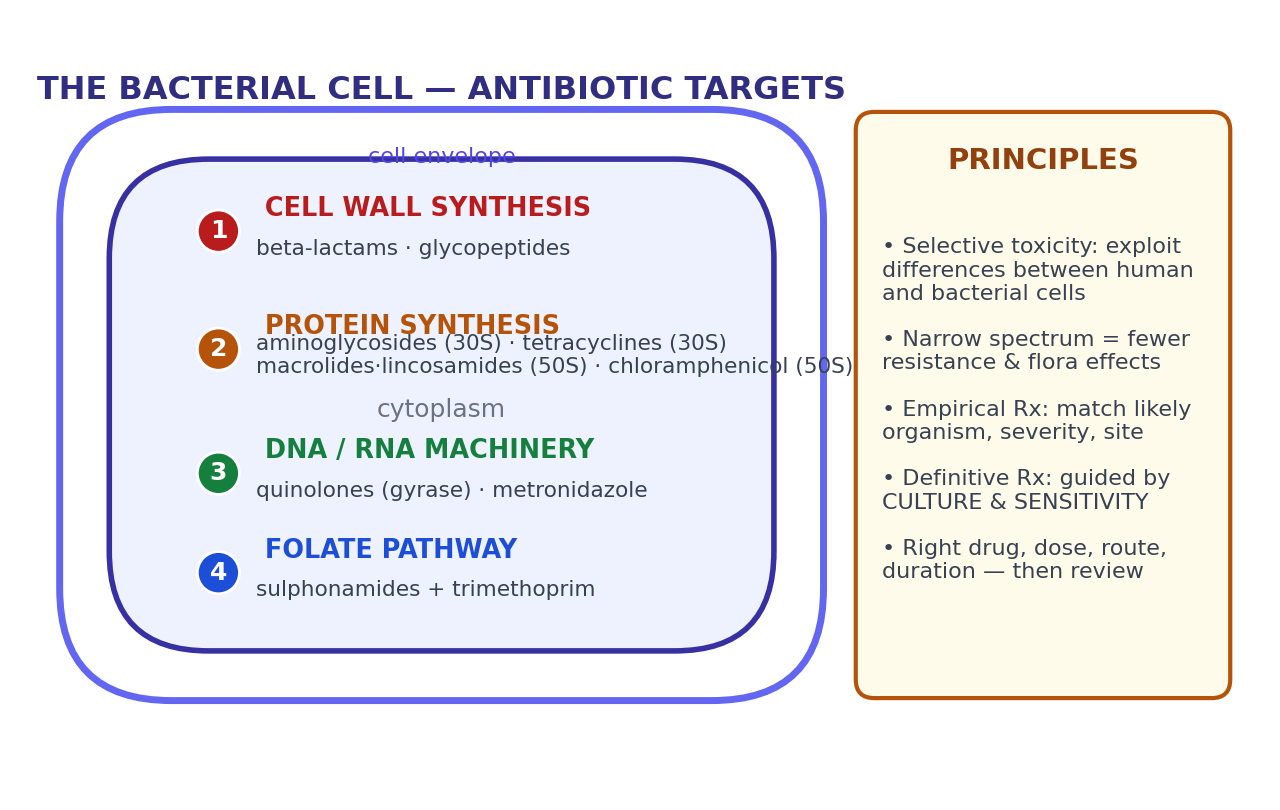
- Cell wall synthesis — beta-lactams (penicillins, cephalosporins, carbapenems) and glycopeptides; humans have no cell wall, hence low toxicity.
- Protein synthesis (70S ribosome) — 30S: aminoglycosides, tetracyclines; 50S: macrolides, lincosamides, chloramphenicol, oxazolidinones. Human ribosomes are 80S, so the effect is selectively toxic.
- DNA / RNA machinery — quinolones (DNA gyrase, topoisomerase IV), metronidazole (DNA strand breakage in anaerobes), rifamycins (RNA polymerase).
- Folate pathway — sulphonamides (dihydropteroate synthetase) and trimethoprim (dihydrofolate reductase); humans take folate from food, so the block is selective.
Classification of antibacterial agents
Scroll the table sideways on a smaller screen.
| Target | Class | Prototype | Main uses |
|---|---|---|---|
| Cell wall | Beta-lactams: penicillins | Benzylpenicillin, amoxicillin, cloxacillin, co-amoxiclav | Streptococci, syphilis, otitis, pneumonia, skin infection |
| Beta-lactams: cephalosporins / carbapenems | Cefalexin, ceftriaxone, meropenem | Stepwise by generation; reserve carbapenems | |
| Protein synthesis | 30S inhibitors | Gentamicin (aminoglycoside), doxycycline (tetracycline) | Gram-negative sepsis; atypicals, rickettsiae, STIs |
| 50S inhibitors | Erythromycin/azithromycin, clindamycin, chloramphenicol | Atypicals, penicillin allergy alternatives, anaerobes, meningitis (chloramphenicol) | |
| DNA machinery | Quinolones; metronidazole; rifamycins | Ciprofloxacin, metronidazole, rifampicin | Dysentery/typhoid; anaerobes and protozoa; TB (combination) |
| Folate pathway | Sulphonamides + trimethoprim | Cotrimoxazole (co-trimoxazole) | UTI, dysentery, PCP treatment/prophylaxis, HIV prophylaxis |
How antimicrobial resistance develops
Antimicrobial resistance (AMR) occurs when a micro-organism survives exposure to a drug that would normally kill it or inhibit it. Resistance is either intrinsic (a natural property — e.g., E. coli is intrinsically resistant to vancomycin because the drug cannot cross its outer membrane) or acquired (new genetic capability). Acquired resistance spreads by mutation and by horizontal gene transfer — conjugation (plasmids), transduction (bacteriophages) and transformation (naked DNA).
Scroll the table sideways on a smaller screen.
| Mechanism | How it works | Classic examples |
|---|---|---|
| 1. Enzymatic inactivation / modification | Bacterium produces an enzyme that destroys or modifies the drug | Beta-lactamases (penicillinase in S. aureus, extended-spectrum ESBLs in Enterobacterales), aminoglycoside-modifying enzymes, chloramphenicol acetyltransferase |
| 2. Target-site modification | Binding site altered so the drug no longer attaches | Altered penicillin-binding proteins (PBPs) in MRSA and penicillin-resistant pneumococcus; mutated gyrase in fluoroquinolone resistance; ribosomal methylation (erm genes) causing macrolide–lincosamide–streptogramin B (MLS) resistance |
| 3. Reduced permeability | Porin channels lost or narrowed; drug cannot enter | Pseudomonas porin loss → carbapenem resistance; reduced tetracycline uptake |
| 4. Efflux pumps & bypass | Pumps eject the drug; or a resistant metabolic pathway bypasses the block | Tetracycline efflux pumps; trimethoprim bypass via plasmid-encoded DHFR; MRSA also acquires a new PBP (PBP2a) |
WHO AWaRe classification
The WHO groups antibiotics into three stewardship categories (AWaRe book, updated 2023) so that consumption can be monitored and Access agents protected:
Scroll the table sideways on a smaller screen.
| Group | Principle | Examples |
|---|---|---|
| Access | First/second choice for common infections; narrow spectrum, low cost, low resistance potential — should be ≥60% of all antibiotic use | Amoxicillin, ampicillin, benzathine penicillin, cloxacillin, cefalexin/cefazolin, gentamicin, amikacin, doxycycline, cotrimoxazole, trimethoprim, metronidazole, nitrofurantoin, chloramphenicol (WHO 2021 list) |
| Watch | Higher resistance potential; broader spectrum; use only for limited, specific indications and monitor carefully | Ceftriaxone and other 2nd/3rd-generation cephalosporins, ciprofloxacin, azithromycin, clarithromycin, erythromycin, vancomycin, piperacillin–tazobactam, clindamycin (UK-adapted) |
| Reserve | Last resort for confirmed/suspected multidrug-resistant infection; specialist-guided | Colistin/polymyxin B, linezolid, meropenem and other carbapenems, ceftazidime–avibactam, tigecycline, fosfomycin IV |
Ugandan data: point-prevalence surveys across nine regional referral hospitals (2020–2023) found Access agents at 47.7% of antibiotic use against the WHO target of ≥60%, with Watch agents at 44.4% — a clear national stewardship gap, and a classic viva question on applying AWaRe locally.
Stewardship principles for the prescriber
- Treat infection, not colonisation or viral illness — most coughs, colds and diarrhoeas are viral.
- Use Access agents first when they cover the likely pathogens.
- Dose adequately and for the right duration — underdosing selects resistance; excessively long courses do too.
- Take cultures before antibiotics when this will not delay emergency therapy.
- Narrow (de-escalate) when sensitivities return; stop if infection is excluded.
- Document indication and review date on every chart.
- Know your level: the EMHSLU restricts Watch/Reserve agents by facility level.
Clinical scenarios
Scenario 1 — Choosing empirically at HC III
A 4-year-old has fever, ear pain and a bulging tympanic membrane — acute otitis media. There is no indication for a Watch cephalosporin or quinolone: the UCG and AWaRe book first choice is amoxicillin (Access), dosed by weight, for 5–7 days, with review if not improving at 48–72 hours. The same syndrome logic (syndrome → likely organism → Access drug) applies to pharyngitis, sinusitis, uncomplicated pneumonia and skin infection.
Scenario 2 — Reading a C&S report
A wound swab grows Klebsiella pneumoniae reported "sensitive to gentamicin, amikacin; resistant to amoxicillin, co-amoxiclav, ceftriaxone (ESBL producer)". Interpretation: the ESBL enzyme (mechanism 1 — enzymatic inactivation) has disabled every penicillin and third-generation cephalosporin; the aminoglycosides still work and carbapenems would be Reserve back-up. The correct action is to narrow from empirical ceftriaxone to gentamicin (per local susceptibility patterns and renal function), exactly the de-escalation the two-phase rule demands.
Key points
References
- WHO AWaRe (Access, Watch, Reserve) Antibiotic Book, 2022; 2023 classification update (Library reference.)
- WHO Model List of Essential Medicines, antibiotics chapter (Library reference.)
- Katzung's Basic & Clinical Pharmacology — chemotherapy section (Library reference.)
- Goodman & Gilman's The Pharmacological Basis of Therapeutics (Library reference.)
- Uganda Clinical Guidelines 2023; EMHSLU 2023 (Library reference.)
- Namutebi et al., AWaRe evaluation of point-prevalence surveys, Uganda RRHs 2020–2023 (Library reference.)
Further reading
For deeper study, compare this lesson with current guidance and standard references from recognised medical and pharmaceutical organisations.
- WHO: The AWaRe Antibiotic Book
- Uganda MoH Knowledge Management Portal (UCG 2023 & EMHSLU 2023)
- WHO: Antimicrobial resistance
- DCM Year One Semester Two curriculum
For education only. Apply current Uganda Clinical Guidelines, the EMHSLU 2023 and facility antimicrobial-stewardship protocols in clinical practice.