
Prescription Writing, Essential Medicines and Rational Use of Medicines
On this page
Overview
The prescription: parts and abbreviations
A prescription is the legal, written instruction from a prescriber to a dispenser. It must stand alone: another professional reading it — possibly weeks later, possibly in another facility — must be able to supply exactly what was intended.
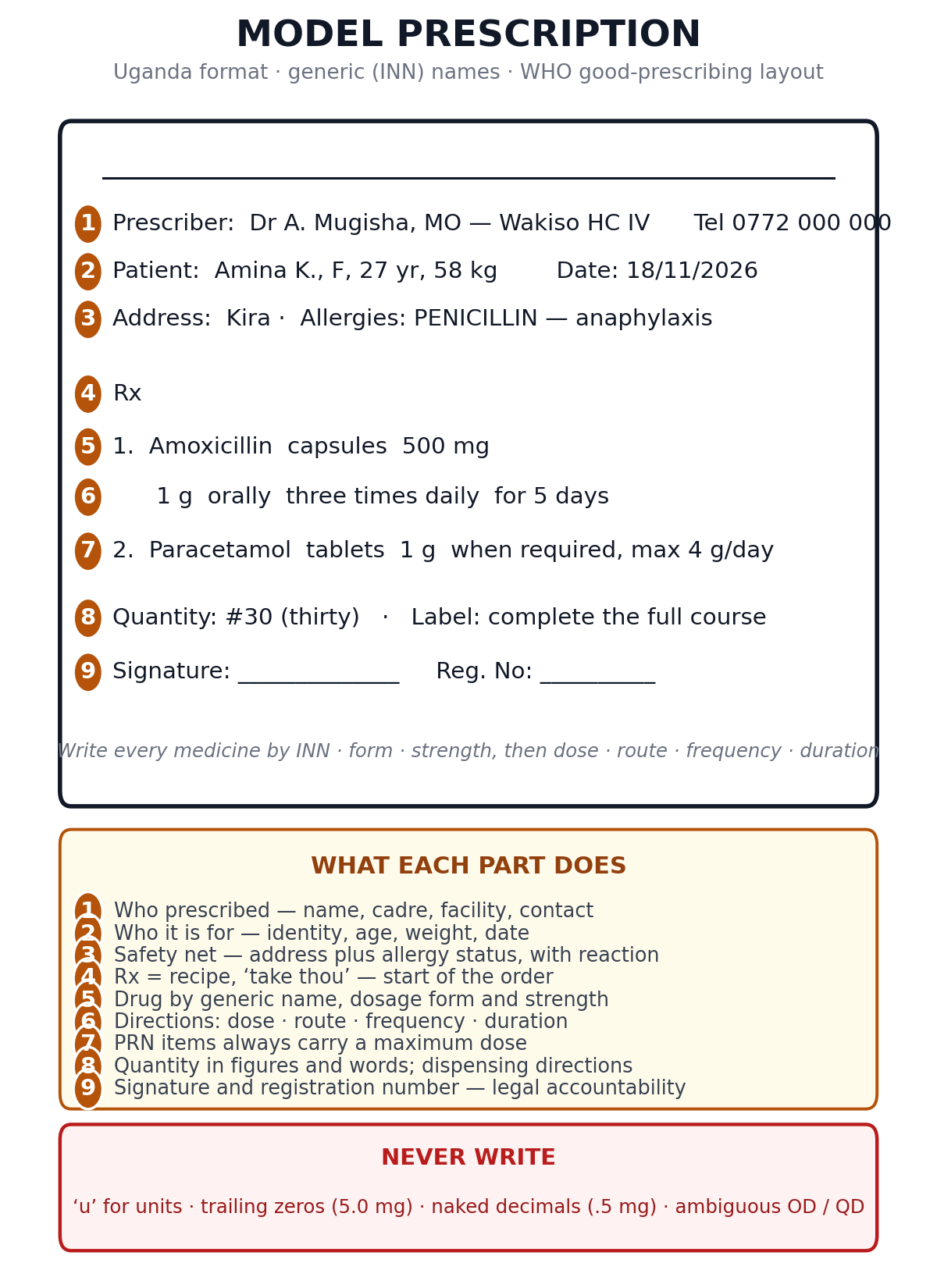
The essential parts: prescriber details (name, cadre, facility, signature, registration number), patient details (name, age, weight where relevant, allergy status), date, the Rx symbol, each medicine written with INN + dosage form + strength, then dose, route, frequency and duration, quantity to dispense (in figures and words for controlled items), directions to the dispenser, and counselling notes to the patient.
Scroll the table sideways on a smaller screen.
| Abbreviation | Latin root | Meaning |
|---|---|---|
| OD / OM | omne die / omne mane | Once daily / every morning |
| BD (BID) | bis in die | Twice daily |
| TDS (TID) | ter in die | Three times daily |
| QDS (QID) | quater in die | Four times daily |
| PRN | pro re nata | When required (always add a maximum) |
| stat | statim | Immediately, give at once |
| ON | omne nocte | Every night |
| AC / PC | ante cibum / post cibum | Before food / after food |
WHO Guide to Good Prescribing: six steps
The WHO Guide to Good Prescribing (de Vries et al., 1994) remains the standard framework for rational therapeutic decisions:
- Define the patient's problem — a working diagnosis, severity and any dangers.
- Specify the therapeutic objective — what exactly should change, and by when (cure, control, relief, prevention).
- Verify the suitability of your P-drug for this patient — first choose your standard P(ersonal)-drug for the problem in general (step 3a: effective, safe, suitable, affordable), then check it for this particular patient (step 3b: contraindications, interactions, pregnancy, organ function, ability to pay and adhere).
- Start the treatment — write a correct, complete prescription.
- Give information, instructions and warnings — what the drug is for, how to take it, what to expect, what to watch for, when to return.
- Monitor (and stop?) the treatment — define the review point and the criteria for stopping, switching or referring.
The essential medicines concept
In 1977 the WHO published the first Model List of Essential Medicines. The underlying concept: essential medicines are those that satisfy the priority health care needs of a population. They should be available at all times, in adequate amounts, in appropriate dosage forms, with assured quality and at a price individuals and the health system can afford.
The concept is powerful because it is selective: no country can buy everything, so the national list concentrates resources on medicines that are evidence-based, cost-effective and relevant to the national disease burden. Selection criteria include disease prevalence, proven efficacy and safety, comparative cost-effectiveness, and stability in the local supply chain.
Concept, concept of essential supplies: the Ugandan list extends the concept beyond medicines to include health supplies (gloves, syringes, catheters, sutures) and laboratory supplies (reagents, slides) — because a medicine without its syringe or diagnostic test is of limited use.
Uganda's Essential Medicines List (EMHSLU 2023)
The Essential Medicines and Health Supplies List of Uganda (EMHSLU 2023) is the national selection document, aligned with the Uganda Clinical Guidelines. Key facts to know:
- It lists 784 medicines plus 738 health supplies and 1,350 laboratory supplies, in four sections (A–D).
- Every item carries a level of use (LOU) — the lowest facility level allowed to prescribe and dispense it. The item is also available at every level above it.
- Every item carries a VEN classification: Vital (life-saving, must never run out), Essential, or Necessary.
Scroll the table sideways on a smaller screen.
| Code | Facility level | Highest expected cadre |
|---|---|---|
| HC1 | Village health centre / community | VHT / CHEW |
| HC2 | Health centre II | Enrolled comprehensive nurse |
| HC3 | Health centre III | Clinical officer |
| HC4 | Health centre IV | Medical officer |
| H | General hospital | Specialist care available |
| RR | Regional referral hospital | Regional specialists |
| NR | National referral hospital | Tertiary/national specialists |
Rational use of medicines
The WHO definition (agreed at Nairobi, 1985): rational use requires that patients receive medications appropriate to their clinical needs, in doses that meet their individual requirements, for an adequate period of time, and at the lowest cost to them and their community.
Irrational use is any departure from this — and it is common. The classic patterns to recognise (and never reproduce):
- Polypharmacy — too many medicines per patient, multiplying interactions and non-adherence.
- Overuse of antibiotics — for viral infections, or without diagnosis, driving antimicrobial resistance.
- Overuse of injections — when oral forms are equally effective; injections cost more and carry infection risk.
- Failure to prescribe per guidelines — brand-name, non-EML prescribing; wrong doses and durations.
- Inappropriate self-medication — including sharing antibiotics and buying prescription-only medicines without assessment.
- Underuse — the reverse failure: not prescribing effective therapy (e.g., no ORS/zinc for childhood diarrhoea, no antihypertensive control), often from unavailability.
WHO/INRUD core drug-use indicators
To make "rational" measurable, the WHO and the International Network for Rational Use of Drugs (INRUD) published core drug-use indicators in 1993, in three groups: prescribing, patient-care and facility indicators. They are the standard audit tool — expect them in research-methods and pharmacovigilance questions.
Scroll the table sideways on a smaller screen.
| Group | Indicator | WHO reference value |
|---|---|---|
| Prescribing | Average number of medicines per encounter | 1.6–1.8 |
| Medicines prescribed by generic name | 100% | |
| Encounters with an antibiotic prescribed | 20–26.8% | |
| Encounters with an injection prescribed | 13.4–24.1% | |
| Medicines prescribed from the EML / formulary | 100% | |
| Patient care | Average consultation time / dispensing time | ≥10 min / ≥3 min |
| Medicines actually dispensed; adequately labelled | 100% / 100% | |
| Patients with correct knowledge of their doses | 100% | |
| Facility | Availability of EML/formulary and clinical guidelines | Present and current |
| Availability of a set of key medicines | 100% |
Improving rational use
WHO's core components for improving medicine use at country level:
- A mandated national multi-disciplinary body (national Medicines and Therapeutics Committee / DTC) to coordinate policies.
- Clinical treatment guidelines (Uganda Clinical Guidelines) based on the EML.
- The essential medicines list on which procurement and insurance are based.
- Drug and Therapeutics Committees (DTCs) in hospitals and districts.
- Problem-based undergraduate training in pharmacotherapy (the WHO Guide to Good Prescribing approach).
- Continuing in-service education and supervision, with audit and feedback.
- Independent drug information — unbiased sources, not promotion.
- Public education about medicines and self-care limits.
- Avoid perverse financial incentives (prescribers should not profit from sales).
- Adequate government spending and sustainable financing for essential medicines.
- Supply systems that ensure continuous availability (NMS procurement per level).
- Monitoring through the drug-use indicators above.
Clinical scenarios
Scenario 1 — Auditing an outpatient register (worked calculation)
You audit 10 prescriptions from an HC III: together they contain 28 medicines; 14 medicines were written by brand name; 6 encounters included an antibiotic; 2 included an injection; 8 of the 28 medicines appear on the EMHSLU. Applying the WHO indicators:
- Average medicines per encounter = 28 ÷ 10 = 2.8 (reference 1.6–1.8 → polypharmacy).
- Generic prescribing = 14 ÷ 28 = 50% (reference 100% → brand-name problem).
- Antibiotic encounters = 6 ÷ 10 = 60% (reference 20–26.8% → major overuse).
- Injection encounters = 2 ÷ 10 = 20% (within reference, but check indications).
- EML adherence = 8 ÷ 28 ≈ 29% (reference 100% → procurement and prescribing failure).
Every indicator fails the same way — this facility needs a DTC audit with feedback, generic-prescribing enforcement, and review against the Uganda Clinical Guidelines, not blame of individual prescribers.
Scenario 2 — Writing it properly
A 27-year-old, 58 kg woman with confirmed penicillin allergy (anaphylaxis) has bacterial pharyngitis requiring antibiotics. Applying the six steps: problem — bacterial pharyngitis, no danger signs; objective — eradicate infection, relieve pain, prevent complications; P-drug check — the guideline P-drug (amoxicillin) is unsuitable because of the anaphylaxis history, so verify suitability fails and you select the EML alternative (e.g., a macrolide per UCG); write a complete generic prescription with allergy status recorded; counsel on completion of the course; set review at 48–72 hours if worsening. The six steps caught the one patient for whom the "usual" drug would have been dangerous.
Key points
References
- de Vries TPGM et al. WHO Guide to Good Prescribing (WHO/DAP/94.11) (Library reference.)
- WHO. Promoting rational use of medicines: core components. WHO/EDM/2002.3 (Library reference.)
- WHO/INRUD. How to investigate drug use in health facilities (1993) (Library reference.)
- Ministry of Health Uganda. Essential Medicines and Health Supplies List of Uganda 2023 (EMHSLU) (Library reference.)
- Ministry of Health Uganda. Uganda Clinical Guidelines 2023 (Library reference.)
Further reading
For deeper study, compare this lesson with current guidance and standard references from recognised medical and pharmaceutical organisations.
- Uganda MoH Knowledge Management Portal (UCG 2023 & EMHSLU 2023 PDFs)
- WHO: medicines selection and essential medicines
- WHO IRIS repository (Guide to Good Prescribing; rational-use core components)
- DCM Year One Semester Two curriculum
For education only. Apply current Uganda Clinical Guidelines, the EMHSLU 2023 and your facility's protocols in clinical practice; prescribing law and cadre scopes are regulated by Uganda's professional councils.