
Drug Formulations and Dosage Forms
On this page
Overview
Key definitions
- Active pharmaceutical ingredient (API) — the chemical substance that produces the pharmacological effect.
- Excipients — the inactive components of a preparation (lactose filler, gelatin shell, syrup base, preservative, coating) that give the product its bulk, stability, taste or release characteristics.
- Formulation — the complete recipe: the API plus chosen excipients, made by a defined process.
- Dosage form (galenical) — the physical presentation of the formulation: tablet, capsule, syrup, injection, ointment and so on. Named after Galen, the ancient physician whose herbal preparations were medicine's first standardised formulations.
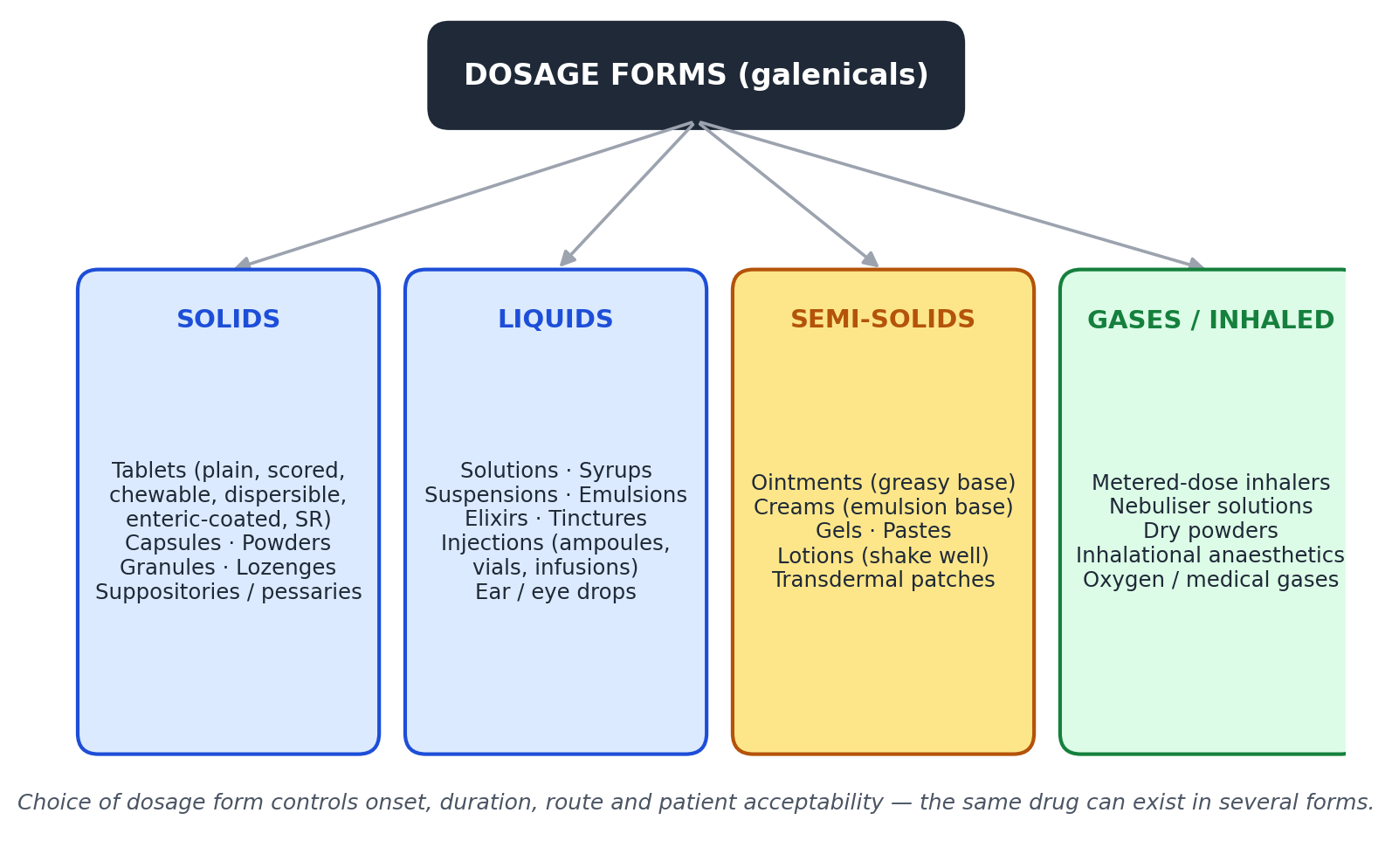
Solid dosage forms
Solids are the most stable, cheapest and most convenient family. Tablets are the workhorse, but the many tablet types behave very differently:
Scroll the table sideways on a smaller screen.
| Form | Description | Clinical notes / examples |
|---|---|---|
| Plain / scored tablet | Compressed powder; scored lines allow halving | Cheapest; only scored tablets should be broken |
| Chewable tablet | Meant to be chewed before swallowing | Antacid tablets; paediatric formulations |
| Dispersible tablet | Dissolved in water before drinking | Paediatric paracetamol, ORS companions, some antibiotics |
| Effervescent tablet | Releases CO₂ when dropped in water | Fast, palatable dissolution; potassium supplements |
| Enteric-coated tablet | Coating that resists stomach acid and dissolves in the intestine | Never crush — protects the drug from acid (omeprazole) or the stomach from the drug (aspirin); crushing destroys the protection |
| Sustained/modified-release (SR/MR) tablet | Matrix or coating releases drug slowly over hours | Never crush — crushing dumps the full dose at once (overdose); e.g., nifedipine SR |
| Sublingual / buccal tablet | Placed under the tongue or against the cheek | Bypasses first-pass metabolism for rapid absorption: GTN for angina, buprenorphine, misoprostol |
| Capsule | Gelatin (or cellulose) shell containing powder or granules | Masks taste; contents can sometimes be sprinkled on food if swallowing is impossible (check first) |
| Powders & granules | Loose or sacheted dry API | ORS sachets, gripe water powders, some antibiotics for reconstitution |
| Lozenge / pastille | Hard sweet base dissolved in the mouth | Local throat action: dequalinium, nystatin pastilles |
| Suppository / pessary | Solid base (cocoa butter, glycerin) that melts at body temperature, given rectally or vaginally | Route when vomiting or unconscious: diazepam, artesunate; vaginal pessaries for candidiasis (clotrimazole) |
Liquid dosage forms
Liquids are essential for infants, patients who cannot swallow tablets, and when doses must be titrated precisely. The critical distinction is solution versus suspension:
Scroll the table sideways on a smaller screen.
| Form | Description | Examples / notes |
|---|---|---|
| Solution | Drug fully dissolved in a solvent (usually water) | PVC-free chloramphenicol drops; the dose is uniform throughout — no shaking needed |
| Syrup | Concentrated sugar solution with dissolved drug | Paediatric paracetamol syrup, cough syrups; sugar content matters in diabetics |
| Suspension | Solid particles dispersed in liquid — not dissolved | Amoxicillin, zinc, antacid suspensions; shake well before every dose or early doses are weak and late doses overdose |
| Emulsion | Two immiscible liquids forced into a mixture (oil in water) | Castor oil, some vitamin A/D preparations; separate on standing |
| Elixir / tincture | Alcohol-based solutions (historical) | Alcohol content restricts use in children and liver disease |
| Injection | Sterile solution or powder in ampoule (single-use) or vial (multi-dose) | Fastest, most reliable route; highest risk — asepsis, correct diluent, anaphylaxis readiness; IM, IV, SC routes |
| Ear / eye / nasal drops | Sterile or clean solutions for local application | Eye drops must be sterile; never touch the dropper to the eye; discard opened chloramphenicol eye drops |
Semi-solid dosage forms
Semi-solids deliver drugs through the skin or mucous membranes. The base determines the clinical behaviour — examiners love the ointment-versus-cream distinction:
Scroll the table sideways on a smaller screen.
| Form | Base | Clinical behaviour |
|---|---|---|
| Ointment | Greasy (petroleum jelly, lanolin) | Occlusive — traps moisture, prolongs drug contact; best for dry, scaly lesions; messy, does not wash off |
| Cream | Emulsion of oil in water (or vice versa) | Non-greasy, rubs in and washes off; best for moist, weeping lesions and intertriginous areas |
| Gel | Water-based with a gelling agent | Cooling, dries quickly; good for acne and hairy areas |
| Paste | Very thick ointment with high powder content | Stays in place; protective barrier pastes for nappy rash |
| Lotion | Liquid suspension, often needs shaking | Spreads over large or hairy areas; cooling as it evaporates |
| Transdermal patch | Adhesive matrix releasing drug steadily | Steady blood levels for days (HRT, nicotine, fentanyl); apply to intact skin, rotate sites, avoid heat sources |
Inhaled and gaseous forms
- Metered-dose inhaler (MDI) — pressurised aerosol; each actuation delivers a fixed dose directly to the airways (salbutamol, beclomethasone). Requires coordination or a spacer in children.
- Dry-powder inhaler (DPI) — breath-actuated powder; no coordination needed but requires adequate inspiratory flow.
- Nebuliser solution — drug in saline nebulised to a mist for 5–10 minutes; used in severe asthma and when the patient cannot use an MDI.
- Inhalational anaesthetics and medical gases — isoflurane, oxygen, nitrous oxide; delivered by calibrated vaporisers or flowmeters.
Choosing a dosage form
The right form is chosen from four questions — patient, disease, drug and setting:
Scroll the table sideways on a smaller screen.
| Factor | Question | Practical consequence |
|---|---|---|
| Patient | Can they swallow? How old? Conscious? | Syrup/suspension or suppository for infants and the unconscious; dispersible tablets where water is available |
| Disease | Where must the drug act, and how fast? | Sublingual GTN for instant angina relief; topical antifungal for skin; IV for emergencies |
| Drug | Is it acid-labile? First-pass metabolised? Short half-life? | Enteric coat for acid-labile drugs; sublingual/injection to skip the liver; SR matrix for short half-life |
| Setting | Cold chain? Water supply? Training? | Prefilled auto-disable syringes in outreach; ORS over IV fluids where feasible |
Special handling instructions
- Do not crush enteric-coated or sustained-release tablets — check before crushing anything for a patient with dysphagia.
- Shake suspensions before every dose; refrigerate reconstituted antibiotic suspensions and discard after the labelled period (usually 7–14 days).
- Sublingual technique: place under the tongue, do not swallow or eat until dissolved; GTN tablets are light- and moisture-sensitive — keep in the original glass bottle.
- Suppositories: moisten with water, insert past the anal sphincter, ask the patient to lie for 15 minutes; refrigerating hardens them for easier handling.
- Insulin: in-use vials/penfill may stay at room temperature; stock in the 2–8 °C compartment of a fridge — never freeze, never leave in direct sun.
- Eye drops: sterile technique, no dropper contact, separate bottles per infected eye in trachoma campaigns.
- Transdermal patches: apply to intact, hairless skin, rotate sites, fold used patches adhesive-side-in for disposal — residual fentanyl can poison a child who finds it.
Clinical scenarios
Scenario 1 — The crushed slow-release tablet
An 82-year-old with dysphagia is prescribed nifedipine sustained-release 60 mg daily. A well-meaning nurse crushes the tablet into the ward porridge "so she can swallow it". Two hours later the patient is hypotensive and dizzy — the modified-release matrix was destroyed, releasing the full 24-hour dose at once. The correct options were a liquid formulation, a dispersible alternative, or a different drug class that comes in a suitable form. Lesson: formulation is part of the dose.
Scenario 2 — Why is the malaria syrup not working?
A 3-year-old returns on day 3 of "artemether-lumefantrine syrup" with persistent fever. Reviewing the bottle, the caregiver has been pouring the clear top liquid without shaking. Every dose was under-dosed — the active drug had settled at the bottom, where it remains. You demonstrate vigorous shaking, mark the bottle "SHAKE FIRST" in the local language, and the child improves on the properly shaken course. Lesson: "shake well before use" belongs in your counselling, not just on the label.
Key points
References
- Ansel's Pharmaceutical Dosage Forms and Drug Delivery Systems (Library reference.)
- Rang & Dale's Pharmacology — routes and formulations chapters (Library reference.)
- British National Formulary (BNF) — dosage form guidance (Library reference.)
- Uganda Clinical Guidelines 2023, Ministry of Health (Library reference.)
Further reading
For deeper study, compare this lesson with current guidance and standard references from recognised medical and pharmaceutical organisations.
- British National Formulary
- World Health Organization
- Uganda Ministry of Health Knowledge Management Portal
- Related note: Routes of Administration
- DCM Year One Semester Two curriculum
For education only. Apply current Uganda Clinical Guidelines and local protocols in clinical practice; always check a product's own label before crushing, splitting, diluting or storing any medicine.