
Gram-Positive Bacteria: Staphylococci, Streptococci, Bacillus and Clostridium
On this page
Overview
First-line laboratory identification
The bedside logic for gram-positive cocci: morphology (clusters vs chains) → catalase (splits staph from strep) → coagulase (splits aureus from the rest) → haemolysis and sensitivity discs (sort the streptococci).
Scroll the table sideways on a smaller screen.
| Step / test | Positive | Negative | Meaning |
|---|---|---|---|
| Microscopy (arrangement) | Grape-like clusters | Chains / pairs | Clusters → Staphylococcus; chains → Streptococcus/Enterococcus |
| Catalase (H₂O₂ → bubbles) | Staphylococcus spp., Bacillus, Listeria | Streptococcus, Enterococcus | The single most-used first test for gram-positive cocci |
| Coagulase (clots plasma) | S. aureus (also clumping factor) | Other staphylococci (epidermidis, saprophyticus) | Confirms the principal pathogen |
| Bacitracin sensitivity | S. pyogenes (Group A) | Other β-haemolytic streps | Sorts Group A from Groups B/C |
| Optochin sensitivity & bile solubility | S. pneumoniae (alpha-haemolytic) | Viridans streptococci | The two alpha-haemolytics that matter |
| Novobiocin sensitivity | S. epidermidis | S. saprophyticus (resistant) | Sorts the coagulase-negative staphylococci |
| Lancefield grouping | Cell-wall carbohydrate antigens A, B, C…, e.g. A = pyogenes, B = agalactiae, D = enterococci (originally strep) | Serological classification of β-haemolytic streps | |
Staphylococci
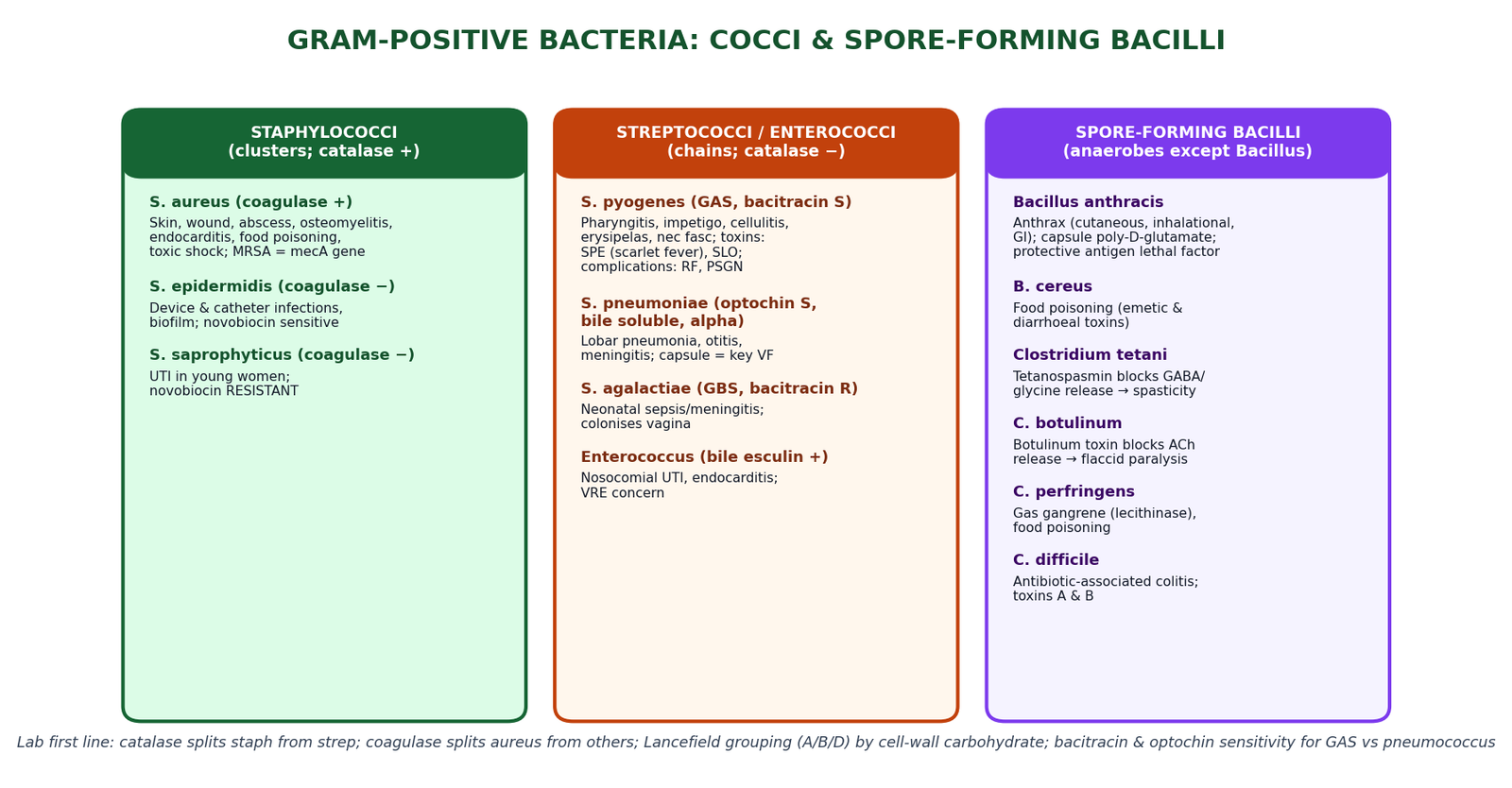
S. aureus ("golden") is catalase-positive, coagulase-positive, often β-haemolytic, and colonises the nares of ~30% of people. Its weaponry: protein A (binds IgG Fc, blocking opsonisation), capsule, haemolysins (α-toxin), Panton-Valentine leukocidin (necrotic skin and severe pneumonia), exfoliative toxins (scalded skin), enterotoxins (food poisoning) and TSST-1 (toxic shock — tampon-associated or any focal infection).
- Diseases: boils and abscesses, wound and surgical-site infection, osteomyelitis, septic arthritis, endocarditis (acute, destructive), pneumonia (post-influenza, necrotising), bacteraemia/sepsis, scalded skin syndrome, food poisoning, toxic shock.
- MRSA: methicillin resistance via the mecA gene, which encodes an altered penicillin-binding protein (PBP2a) with low affinity for β-lactams — so most of the penicillin/cephalosporin family fails. Detected by cefoxitin disc or mecA PCR; treated with cloxacillin if sensitive, or vancomycin/teicoplanin (and in Uganda often clindamycin or co-trimoxazole per susceptibility) if resistant. Hospital infection-control: hand hygiene, screening, decolonisation in selected cases.
- Coagulase-negative staphylococci: S. epidermidis — skin commensal and the classic cause of catheter and prosthesis infection through biofilm (novobiocin sensitive); S. saprophyticus — UTI in sexually active young women (novobiocin resistant). Treat only when genuinely implicated — blood-culture contamination with skin flora is a daily trap.
Streptococci and enterococci
Chains of catalase-negative cocci, sorted by haemolysis and Lancefield carbohydrate:
Scroll the table sideways on a smaller screen.
| Species | Group / haemolysis | Signature diseases | Key facts |
|---|---|---|---|
| S. pyogenes (Group A) | A; β-haemolytic; bacitracin sensitive | Pharyngitis, impetigo, cellulitis, erysipelas, scarlet fever (erythrogenic/SPE toxins), necrotising fasciitis, puerperal sepsis | M protein = anti-phagocytic virulence factor and type-specific antibody target; ASO/anti-DNase B titres document infection; post-streptococcal sequelae: acute rheumatic fever (2–3 wk after pharyngitis) and post-streptococcal glomerulonephritis (after skin/throat infection); penicillin remains exquisitely effective — treat pharyngitis to prevent rheumatic fever |
| S. agalactiae (Group B) | B; β-haemolytic; bacitracin resistant | Neonatal sepsis, pneumonia and meningitis; puerperal infection | Colonises the adult vagina/rectum (~20%); screen in pregnancy; intrapartum penicillin protects the newborn |
| S. pneumoniae | α-haemolytic ("green"); optochin sensitive; bile soluble; lancet-shaped diplococci | Lobar pneumonia, otitis media, sinusitis, meningitis (adults), bacteraemic sepsis (HIV, asplenia) | Polysaccharide capsule is THE virulence factor; >90 serotypes (vaccine covers commonest); α-haemolysis is partial (H₂O₂) — not toxin-mediated; penicillin resistance via altered PBPs exists — check local data |
| Viridans group streptococci | α-haemolytic; optochin resistant | Dental caries; subacute infective endocarditis after dental procedures on damaged valves | Mouth flora; prophylactic antibiotics cover dental work in high-risk patients |
| Enterococcus faecalis/faecium | Lancefield D (historically); γ/α variable | Nosocomial UTI, intra-abdominal infection, endocarditis, bacteraemia | Bile-esculin positive, grow in 6.5% NaCl; intrinsically resistant to many drugs — vancomycin-resistant enterococci (VRE) are a global concern |
Bacillus species
- Bacillus anthracis — large gram-positive rods in chains, boxcar-shaped, non-haemolytic, non-motile; capsule of poly-D-glutamic acid (not polysaccharide) and a two-part toxin (protective antigen delivering lethal factor and oedema factor). Disease by portal: cutaneous anthrax (painless eschar with oedema — most common naturally), inhalational (wool-sorter's disease; mediastinal widening; often fatal), GI (undercooked meat). Diagnosis: PCR/culture (notify public health — a bioterrorism consideration); prevention in livestock-endemic areas: animal vaccination; human vaccine for risk groups.
- B. cereus — food poisoning with two syndromes: emetic (rice and starchy foods; cereulide toxin; rapid vomiting like S. aureus) and diarrhoeal (meats, vegetables; enterotoxins; watery diarrhoea like C. perfringens); also eye and wound infection in trauma.
Clostridium: the anaerobic toxin masters
Gram-positive spore-forming obligate anaerobes of soil and gut. Their diseases are almost all toxin-defined — the table to memorise:
Scroll the table sideways on a smaller screen.
| Organism | Disease | Toxin & mechanism | Clinical signature |
|---|---|---|---|
| C. tetani | Tetanus | Tetanospasmin: retrograde transport to CNS, blocks glycine and GABA release from inhibitory interneurons (and Renshaw cells) | Spastic paralysis: trismus (lockjaw), risus sardonicus, opisthotonus, spasms with preserved consciousness; neonatal tetanus via the umbilicus |
| C. botulinum | Botulism | Botulinum toxin: blocks presynaptic acetylcholine release at the NMJ (and autonomic synapses) | Flaccid, descending paralysis: diplopia, ptosis, dysphagia, weakness with clear sensorium; from canned food, wounds, or infant gut colonisation |
| C. perfringens | Gas gangrene (myonecrosis); food poisoning | Alpha-toxin (lecithinase) degrades membranes → myonecrosis with gas; enterotoxin in food poisoning | Crepitus, bronze skin, sweet odour, shock; "dinner-bell" diarrhoea 8–24 h after reheated meat |
| C. difficile | Antibiotic-associated colitis | Toxins A (enterotoxin) and B (cytotoxin) disrupt the colonic cytoskeleton | Watery diarrhoea ± blood during/after antibiotics (clindamycin, fluoroquinolones, broad-spectrum β-lactams); pseudomembranes on colonoscopy; treat with oral vancomycin or fidaxomicin, stop the culprit antibiotic |
The tetanus vs botulism contrast is a favourite: same toxin family acting at the same synapse from opposite directions — tetanospasmin blocks inhibitory release (everything fires: spastic), botulinum blocks excitatory ACh release (nothing fires: flaccid). Both prevented by toxoid vaccines where available (tetanus) or careful food hygiene (botulism).
Clinical scenarios
Scenario 1 — The breast abscess on the postnatal ward
A breastfeeding mother has a hot, fluctuant breast lump with fever. Aspirated pus grows gram-positive cocci in clusters, catalase and coagulase positive — S. aureus. You drain the abscess (source control is essential — antibiotics alone cannot penetrate pus), send pus for culture and sensitivity, and start flucloxacillin while awaiting results, switching per the antibiogram. You ask about MRSA risk factors (recent admission, prior antibiotics); if she had risk factors or the ward has MRSA circulating, you would add MRSA cover from the start. Breastfeeding continues from the unaffected side after drainage.
Scenario 2 — The sore throat that mattered
A 9-year-old has fever, tender anterior cervical nodes and exudative tonsillitis, no cough — Centor criteria strongly suggest Group A strep. You take a rapid antigen test (or send culture), start oral penicillin V for 10 days, and explain to the mother that finishing the course matters even when the child feels better: the goal is not only curing the throat but preventing rheumatic fever weeks later. You record that this child, if untreated and unlucky, joins the cohort of young Ugandans developing mitral stenosis in their twenties.
Scenario 3 — Lockjaw after a thorn prick
A farmer presents with trismus, painful generalised spasms and a grimacing expression, three weeks after a thorn injury he barely remembers — no wound care, vaccination history unknown. You diagnose tetanus: give human tetanus immunoglobulin to neutralise circulating toxin, metronidazole (or penicillin) to stop further production, aggressive wound toilet, and supportive care in a quiet, darkened area (spasm triggers include light and noise) with airway protection and benzodiazepines for spasms. Crucially, tetanospasmin already bound to neurons cannot be neutralised — recovery is slow and depends on new synapse formation. Afterwards you vaccinate: disease does not confer immunity.
Key points
References
- Medical Microbiology (Baron, ed.), NCBI Bookshelf — Staphylococci and Streptococci chapters (Library reference.)
- Jawetz, Melnick & Adelberg's Medical Microbiology — gram-positive cocci and spore-forming bacilli (Library reference.)
- CDC clinical care resources: MRSA, Group A Streptococcus, tetanus, botulism (Library reference.)
- Uganda Clinical Guidelines 2023 — wound care, pharyngitis, tetanus prophylaxis (Library reference.)
Further reading
For deeper study, compare this lesson with current guidance and standard references from recognised medical and scientific organisations.
- NCBI Bookshelf — Staphylococcus chapter
- CDC — MRSA and Group A Strep clinical resources
- OpenStax Microbiology (free textbook)
- Clinical Medicine Year 1, Semester 2 curriculum
For education only. Antibiotic choice follows culture results and the Uganda Clinical Guidelines; suspected anthrax or botulism require immediate public-health notification.