
Drugs for Ectoparasitic Infestations: Lice, Scabies, Fleas, Tungiasis and Myiasis
On this page
Overview
Pediculosis (head and body lice)
Head lice (Pediculus humanus capitis) infest the scalp, glue eggs (nits) to hair shafts within 1 cm of the scalp, and spread by head-to-head contact — schools, homes, salons. Diagnosis is by finding live lice with a fine nit comb on wet hair; itching is the usual symptom and secondary impetigo the usual complication.
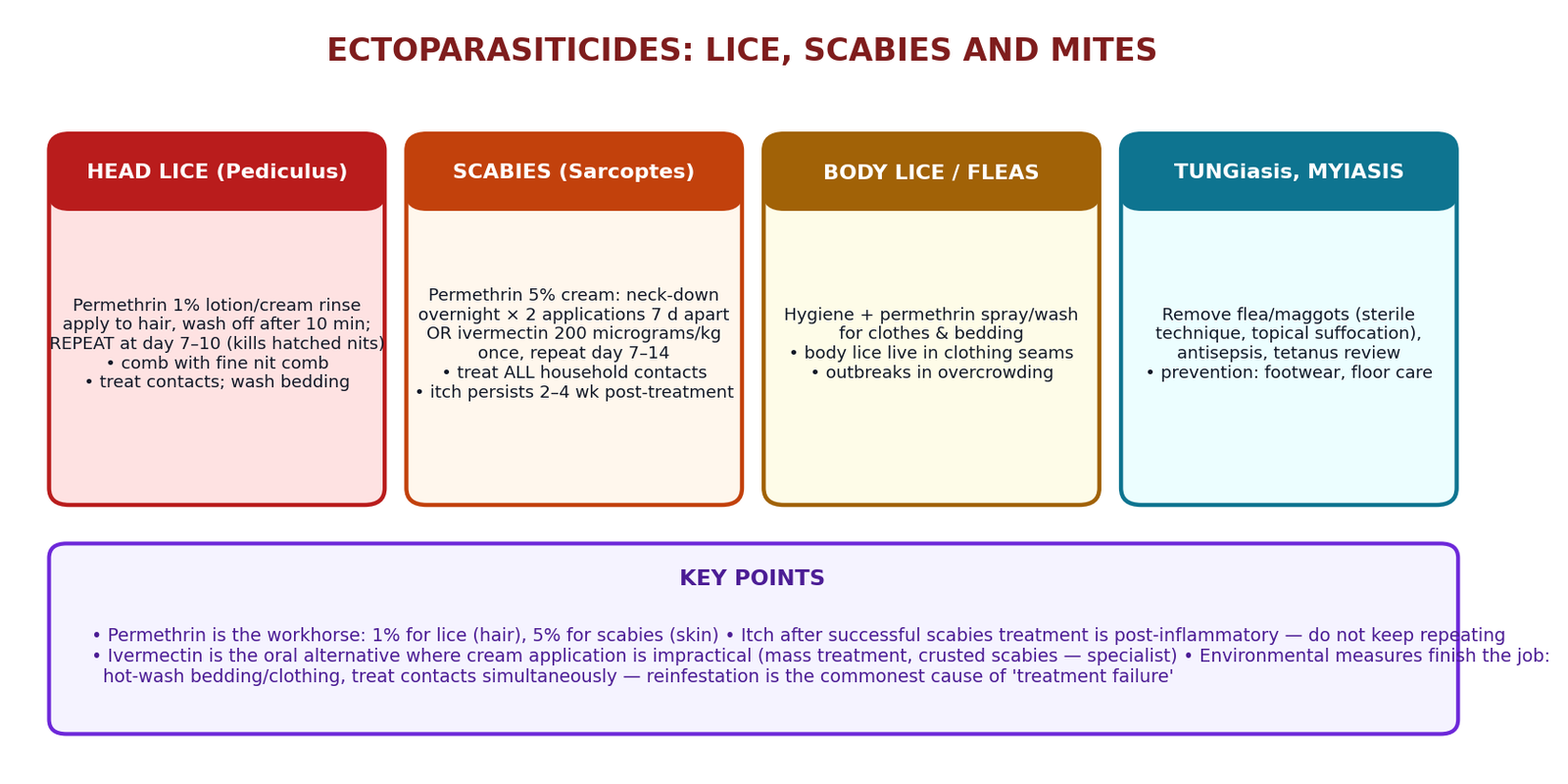
- Permethrin 1% lotion/cream rinse: apply to washed, towel-dried hair and scalp, leave 10 minutes, rinse; repeat at day 7–10 to kill lice hatched from surviving eggs (ovicidal activity is incomplete). Comb out nits with a fine-toothed comb — the step families skip and the reason "lice keep coming back."
- Treat household contacts simultaneously if infested; wash bedding, hats and combs in hot water or seal in plastic bags for 2 weeks.
- Resistance to permethrin exists in some regions; second-line options include oral ivermectin (200 micrograms/kg, repeat day 7–10) or malathion 0.5% where available.
Body lice (P. humanus corporis) live and lay eggs in clothing seams, not on the body — they signal overcrowding and poor clothing hygiene, and they transmit epidemic typhus, trench fever and relapsing fever (Borrelia). Treatment is hygiene plus permethrin spray or hot-washing of clothing and bedding; the body itself needs little medicine unless secondary infection requires antiseptics or antibiotics.
Scabies
The Sarcoptes scabiei mite burrows into the stratum corneum, laying 2–3 eggs daily; the burrows, vesicles and intense nocturnal itch (worse at night — a classic history point) appear 3–6 weeks after first infestation (immediate in reinfestation). Sites: finger webs, wrists, axillae, waistline, genitalia, buttocks, soles in infants.
- Permethrin 5% cream: apply to the whole body from the neck down (include skin folds, under nails, genital area; in infants include scalp and face avoiding eyes), leave overnight (8–12 h), wash off; repeat at day 7. Everyone in the household is treated on the same night.
- Oral ivermectin 200 micrograms/kg, repeated day 7–14, is the practical choice for mass treatment (schools, institutions), crusted scabies, or failed topical therapy — note it is not under 15 kg / 5 years or in pregnancy.
- The itch outlives the mite: post-scabietic dermatitis persists 2–4 weeks after successful killing — a reassure-and-symptom-treat moment (emollients, oral antihistamines, mild topical steroid if eczematous). Do not keep repeating acaricides for persisting itch alone.
- Crusted (Norwegian) scabies — hyperkeratotic plaques teeming with millions of mites in the immunosuppressed — is highly contagious and needs combined oral ivermectin + topical permethrin, repeated, with specialist/infection-control input.
- Secondary bacterial infection (impetigo, abscess, post-streptococcal glomerulonephritis) may need antibiotics — in endemic settings scabies-driven skin infection is a major driver of renal disease in children.
Fleas, tungiasis and myiasis
Scroll the table sideways on a smaller screen.
| Infestation | Source / picture | Treatment |
|---|---|---|
| Tungiasis (jiggers, Tunga penetrans) | The female jigger flea burrows into the skin — classically toes, soles, periungual areas in bare-footed children in infested homes; a white nodule with a central dark dot, pain, walking difficulty, secondary infection, tetanus risk | Remove the flea with sterile technique (sterile needle/surgical excision), disinfect, review tetanus immunisation; topical suffocation agents (e.g. dimethicone-based) can be used; treat secondary infection; environmental control — floor treatment (dusting powder), footwear, hygiene is the lasting fix |
| Myiasis (maggots) | Fly larvae in wounds or body cavities; common in neglected wounds, poor hygiene, fly-plagued settings | Manual removal after petroleum/suffocation, wound toilet and antisepsis, dressings, tetanus review; prevention = wound care and fly control |
| Other flea bites | Papular urticaria in clusters on legs; pets and dusty floors as sources | Symptomatic (antihistamines, topical steroids); treat pets and environment |
The agents in detail
Scroll the table sideways on a smaller screen.
| Drug | Dose / application | Indications | Adverse effects & cautions |
|---|---|---|---|
| Permethrin 1% lotion/cream rinse | Scalp application, 10 min contact, rinse; repeat day 7–10; comb nits | Head lice | Mild scalp irritation, itching (transient); avoid eyes; safe in pregnancy and young children (≥2 months) — the first-line choice |
| Permethrin 5% cream | Whole body neck-down overnight ×2 applications 7 days apart (include folds, nails, genitals; infants: scalp/face avoiding eyes) | Scabies | Burning/stinging (transient, worse with excoriation); apply after a cool (not hot) bath; treat all contacts the same night |
| Ivermectin oral | 200 micrograms/kg; repeat day 7–14 (lice, scabies); crusted scabies: repeated dosing per protocol (e.g. days 1, 2, 8, 9, 15) | Scabies (institutions, crusted, failed topical), head lice alternative, strongyloidiasis and onchocerciasis (overlap with anti-helminthic uses) | Avoid in pregnancy and <15 kg/<5 y; Mazzotti-type reactions when microfilariae are present; take on empty stomach |
| Malathion 0.5% (where available) | 8–12 h application, repeat day 7 | Head/body lice second line (resistance) | Flammable (no hair dryers/open flames), odour; less used as permethrin dominates |
| Benzyl benzoate 25% lotion | Apply neck-down × 2–3 days (irritant — common in older protocols) | Scabies alternative where permethrin unavailable | Skin irritation/burning common; avoid in infants |
Treatment failure: why infestations "resist"
Clinical scenarios
Scenario 1 — The schoolgirl sent home twice
An 8-year-old is sent home from school with head lice again two weeks after treatment. You ask what was done: lotion applied once, mother says "it smelled so strong it must have worked." You explain the lifecycle: permethrin kills lice but not all eggs — the repeat application at day 7–10 is not optional. You demonstrate the nit comb technique, treat her two siblings the same evening, and give the mother a written schedule: treat, comb daily, repeat day 7–10, hot-wash bedding and hair accessories. You also correct the school myth: lice prefer clean hair — this is about contact and technique, not hygiene failure.
Scenario 2 — Itch that "never clears"
A 30-year-old man has used three bottles of permethrin cream in a month "because the scabies keeps coming back." Examination shows no burrows and no fresh vesicles — only excoriated, eczematous skin with post-inflammatory pigmentation. This is post-scabietic dermatitis: the mite is dead, the itch is immune memory, and the cure is emollients, an oral antihistamine at night, a mild topical steroid for the eczema, and stopping the acaricide. You ask about the household: his brother had scabies and was treated the same night — which is why the patient did not actually relapse. Counselling on the 2–4-week itch tail prevents overtreatment, steroid side-effects, and wasted money.
Scenario 3 — Jigger-infested toes in a boarding school
A dormitory outbreak of tungiasis: several boys with painful periungual nodules and limping. You organise removal sessions with sterile technique, disinfect the lesions, screen the worst cases for tetanus immunisation and secondary bacterial infection (one needs flucloxacillin for a paronychia), and — critically — treat the environment: floor dusting with the appropriate powder, daily sweeping, footwear for all pupils, and health education on the flea–pig–dusty-floor cycle. You report to the school health committee: drugs alone never fix jiggers; environment plus footwear does.
Key points
References
- Uganda Clinical Guidelines 2023 — skin and parasitic infestation chapters (Library reference.)
- Katzung's Basic & Clinical Pharmacology — dermatologic and anti-parasitic pharmacology (Library reference.)
- WHO recommendations on the treatment of scabies and pediculosis (Library reference.)
- CDC DPDx — Pediculus, Sarcoptes, Tunga penetrans identification pages (Library reference.)
- WHO Model List of Essential Medicines: ectoparasiticides (Library reference.)
Further reading
For deeper study, compare this lesson with current guidance and standard references from recognised medical and pharmaceutical organisations.
- WHO Model List of Essential Medicines 2023
- Uganda MoH Knowledge Management Portal (UCG 2023)
- CDC DPDx parasite identification library
- WHO Control of Neglected Tropical Diseases
- DCM Year One Semester Two curriculum
For education only. Product choice follows the Uganda Clinical Guidelines and local availability; crusted scabies and institutional outbreaks need public-health and specialist support.