
Anti-Helminthic Agents: Albendazole, Mebendazole, Ivermectin, Praziquantel and Triclabendazole
On this page
Overview
Classification: nematodes, cestodes, trematodes
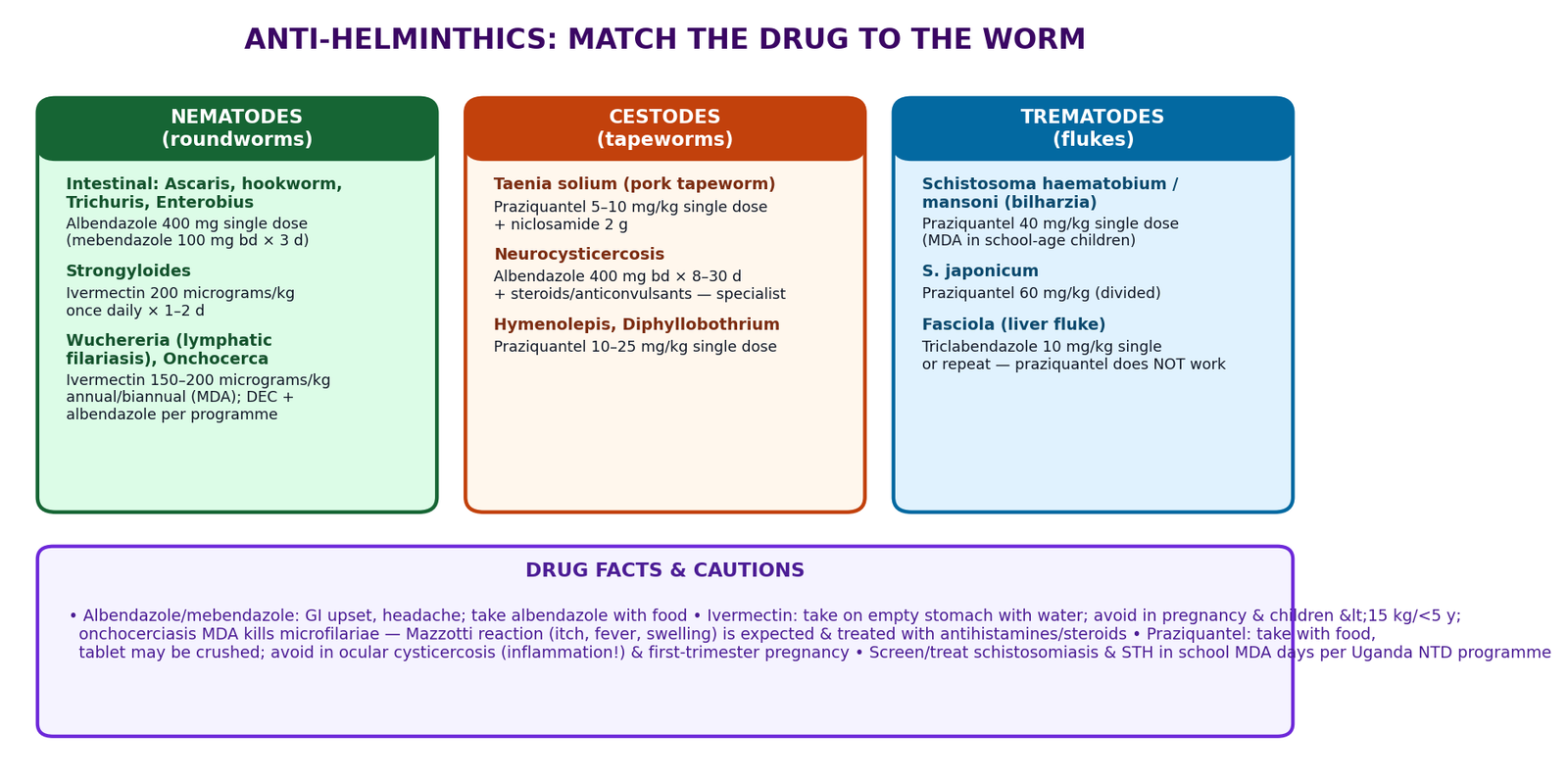
- Nematodes (roundworms) — intestinal (Ascaris, hookworm, Trichuris, Enterobius), tissue (Strongyloides, filariae, Onchocerca). Cell-wall chemistry again guides therapy: the benzimidazoles and ivermectin act on parasite microtubules and nervous-system receptors absent from humans.
- Cestodes (tapeworms) — intestinal Taenia and Hymenolepis, versus the larval tissue form (cysticercosis), which behaves completely differently and needs albendazole plus steroids.
- Trematodes (flukes) — Schistosoma (bilharzia) and Fasciola. Praziquantel covers schistosomes but is useless against Fasciola — triclabendazole is the drug for liver fluke.
Nematodes and the benzimidazoles
Albendazole and mebendazole bind β-tubulin, selectively inhibiting microtubule assembly in worms and blocking glucose uptake — the parasite starves. They are broad, safe, single-dose agents for intestinal nematodes, and high-dose prolonged albendazole is the backbone of tissue-cestode therapy.
Scroll the table sideways on a smaller screen.
| Drug | Dose (adult / child) | Indications | Adverse effects & cautions |
|---|---|---|---|
| Albendazole | Intestinal STH: 400 mg single dose (≥2 y); hookworm/Trichuris may repeat at 2 weeks. Neurocysticercosis: 400 mg bd × 8–30 days with steroids. Hydatid disease: 400 mg bd × 28-day cycles (specialist). Take with food (fat ↑ systemic absorption for tissue phases) | Soil-transmitted helminths; strongyloidiasis alternative; Giardia alternative; neurocysticercosis; hydatid disease; cutaneous larva migrans | GI upset, headache, dizziness; transient LFT rise and leucopenia on prolonged high-dose courses (monitor LFTs/FBC in tissue-phase use); teratogenic in animals — avoid in pregnancy and first-trimester exposure |
| Mebendazole | 100 mg twice daily × 3 days (STH); or 500 mg single dose where available; pinworm (Enterobius): repeat in 2 weeks and treat household | Same intestinal spectrum as albendazole; poor tissue penetration so not for cysticercosis | As albendazole, milder at single doses; rare agranulocytosis with prolonged use |
Intestinal nematodes in practice: Ascaris and hookworm respond to single-dose albendazole; Trichuris (whipworm) responds less reliably — a 3-day course or repeat dosing improves cure; Enterobius (pinworm) causes perianal itch and needs whole-household treatment plus a repeat dose at 2 weeks because eggs survive in the environment. Hookworm deserves respect beyond the gut: chronic blood loss drives the iron-deficiency anaemia of schoolchildren — deworming plus iron works better than either alone.
Strongyloides and ivermectin
Strongyloides stercoralis is unique among helminths: it can multiply inside the host (autoinfection), persisting for decades after leaving an endemic area — and exploding into hyperinfection syndrome with sepsis from enteric bacteria when cell-mediated immunity falls (steroids, HTLV-1, transplant, chemotherapy). This is why every patient from an endemic area should be considered for screening before immunosuppression.
Ivermectin binds parasite-specific glutamate-gated chloride channels → paralysis of the worm's pharynx; mammalian CNS is protected by the blood–brain barrier (but toxicity occurs with massive overdose or in compromised barriers). Strongyloidiasis: ivermectin 200 micrograms/kg daily × 1–2 days (albendazole is the alternative). In onchocerciasis (river blindness) and lymphatic filariasis, ivermectin is given as annual or biannual mass drug administration (150–200 micrograms/kg) — killing microfilariae prevents blindness and interrupts transmission. Filariasis programmes may combine DEC (diethylcarbamazine) + albendazole + ivermectin per national protocol.
The Mazzotti reaction: after ivermectin in onchocerciasis, dying microfilariae release antigens → itching, fever, rash, swelling, occasionally hypotension. It is expected, usually self-limiting, treated with antihistamines/steroids, and actually confirms the drug is working. Counsel patients before mass campaigns to prevent panic and dropout.
Cestodes and praziquantel
Praziquantel increases calcium permeability of the worm tegument → spastic paralysis and tegumental damage that exposes the parasite to host attack. It is the drug for all schistosome species and intestinal tapeworms, well absorbed, and safe enough for mass campaigns — but it has three exam traps:
- No effect on Fasciola (the fluke is a different family) — use triclabendazole 10 mg/kg (single dose, repeat if needed).
- Cysticercosis warning: killing larvae within the CNS provokes inflammation → new seizures and raised intracranial pressure. Neurocysticercosis is therefore treated with albendazole 400 mg bd × 8–30 days PLUS corticosteroids (and anticonvulsants) under specialist supervision; ocular cysticercosis is an absolute contraindication to drug therapy (surgery) because inflammation destroys the eye.
- First-trimester pregnancy and hypersensitivity to the drug are the main exclusions.
Scroll the table sideways on a smaller screen.
| Drug | Dose | Indications | Adverse effects & cautions |
|---|---|---|---|
| Praziquantel | S. haematobium & S. mansoni: 40 mg/kg single dose (MDA in school-age children); S. japonicum: 60 mg/kg divided; intestinal tapeworms (Taenia solium/saginata): 5–10 mg/kg single dose; Hymenolepis, Diphyllobothrium: 10–25 mg/kg single dose; niclosamide 2 g is an alternative luminal agent | All schistosomiasis (bilharzia); intestinal cestodes | Dizziness, drowsiness, headache, GI upset (take with food, tablets may be crushed); avoid in ocular cysticercosis and 1st-trimester pregnancy; transient abdominal pain as worms die |
| Triclabendazole | 10 mg/kg single dose, repeat after 12–24 h if needed (Fasciola) | Fasciola hepatica/gigantica (liver fluke, from watercress/aquatic plants); paragonimiasis | Generally well tolerated; biliary colic as flukes die |
| Niclosamide | 2 g single dose (chewed) for intestinal tapeworms; not absorbed — no tissue activity | Intestinal Taenia, Hymenolepis (alternative to praziquantel) | Minimal (non-absorbed); mild GI upset |
Schistosomiasis clinical reminder: S. haematobium → terminal haematuria in school-age boys around lakeshore communities (plus chronic bladder disease, obstructive uropathy and squamous-cell carcinoma of the bladder years later); S. mansoni → hepatosplenic disease with periportal fibrosis (the classic "pipe-stem" fibrosis), portal hypertension and variceal bleeding in heavy chronic infection. Diagnose by urine sediment (haematobium) or Kato-Katz stool smear (mansoni); treat and map contacts — praziquantel MDA days at school are a pillar of the Uganda NTD programme.
Trematodes: schistosomiasis and Fasciola
Bilharzia is acquired by skin penetration by cercariae released from freshwater snails — fishing, bathing, washing in lakes and rivers is the exposure. Katayama fever (acute serum-sickness-like illness 2–8 weeks after exposure) precedes established infection. Chronic disease is a volume problem: years of egg deposition drives the fibrosis of bladder or liver.
Management: praziquantel 40 mg/kg single dose for both urinary and intestinal species (cure is high in light infection; heavy infection may need repetition), plus public-health measures — safe water, latrine use, snail control, and school-based MDA. Praziquantel is safe in pregnancy after the first trimester per WHO and is given to schoolchildren without individual stool testing in MDA campaigns.
Mass drug administration and the Uganda NTD programme
Uganda runs integrated MDA against soil-transmitted helminths, schistosomiasis, onchocerciasis and lymphatic filariasis: school-based albendazole (± praziquantel by prevalence) and community-directed ivermectin distribution. Clinicians meet these drugs as single doses dispensed by community drug distributors — your roles are to verify eligibility (age, weight, pregnancy), manage the reactions (Mazzotti, GI upset), document exclusions (pregnant women, infants, the sick), and follow up the missed: children absent on MDA day, and adults with persistent symptoms despite campaigns. Know also preventive chemotherapy targets by 2030 (WHO NTD road map) that frame national planning.
Safety, cautions and counselling
Scroll the table sideways on a smaller screen.
| Drug | Pregnancy | Children | Give with | Watch for |
|---|---|---|---|---|
| Albendazole / mebendazole | Avoid (teratogenic signal) — MDA excludes pregnant women | Albendazole from 12–24 months per programme; mebendazole ≥1 y | Food (helps absorption & tolerance) | LFTs/FBC on prolonged courses; GI upset |
| Ivermectin | Avoid | Not under 15 kg or <5 y | Empty stomach, water | Mazzotti reaction; rare encephalopathy with heavy Loa loa |
| Praziquantel | Avoid 1st trimester; acceptable thereafter per WHO | Used in school MDA | Food; crush tablets | Dizziness/drowsiness (no driving); avoid in ocular cysticercosis |
| Triclabendazole | Specialist decision | Specialist decision | Food | Biliary colic as flukes die |
Clinical scenarios
Scenario 1 — Terminal haematuria at the lakeshore
A 12-year-old boy from a fishing village on Lake Albert has painless blood at the end of urination for 3 months. Urine microscopy shows S. haematobium ova with terminal spines. You treat with praziquantel 40 mg/kg as a single observed dose, counsel the family on avoiding bare-water contact and safe water for washing, and refer for a school MDA check because his untreated classmates are the reservoir. You explain that untreated infection can scar the bladder and ureters years later — the reason campaigns exist.
Scenario 2 — New seizures in an adult with a normal childhood
A 28-year-old with new-onset focal seizures has a CT showing multiple calcified and enhancing cystic brain lesions. Cysticercosis serology is positive; he admits to eating pork from uninspected slaughter. This is neurocysticercosis — never praziquantel alone: you admit him, start albendazole 400 mg bd × 14 days with dexamethasone and anticonvulsants, and monitor for the inflammatory flare (headache, worsening seizures) that the steroids are there to prevent. You counsel the household on hand hygiene, latrine use and thoroughly cooking pork — the same tapeworm cycle feeds both intestinal taeniasis and these brain cysts.
Scenario 3 — The immunosuppressed patient with a lifelong worm
A 60-year-old with polymyalgia is about to start high-dose prednisolone. He grew up in an onchocerciasis-endemic district and last took ivermectin "years ago." Before immunosuppression you screen for Strongyloides (serology — stool microscopy misses chronic infection) and find it positive. You treat with ivermectin 200 micrograms/kg daily × 2 days before the steroids, explaining the risk you have just averted: Strongyloides hyperinfection under immunosuppression — worms migrating through the gut wall carrying enteric bacteria, a frequently fatal sepsis picture. Two days of treatment now is the cheapest life-saving medicine of his year.
Key points
References
- WHO Guideline on Preventive Chemotherapy for the Control of Soil-Transmitted Helminth Infections and Schistosomiasis (Library reference.)
- WHO recommendations for onchocerciasis (river blindness) and lymphatic filariasis MDA (Library reference.)
- Uganda Ministry of Health Neglected Tropical Disease programme guidance; Uganda Clinical Guidelines 2023 (Library reference.)
- Katzung's Basic & Clinical Pharmacology — chemotherapy of helminthic infections chapter (Library reference.)
- Goodman & Gilman's The Pharmacological Basis of Therapeutics (Library reference.)
- WHO NTD road map 2021–2030 (Library reference.)
Further reading
For deeper study, compare this lesson with current guidance and standard references from recognised medical and pharmaceutical organisations.
- WHO Control of Neglected Tropical Diseases
- WHO Model List of Essential Medicines 2023
- Uganda MoH Knowledge Management Portal (UCG 2023)
- CDC DPDx parasite identification library
- DCM Year One Semester Two curriculum
For education only. Mass drug administration follows national NTD protocols; individual treatment follows the Uganda Clinical Guidelines and specialist advice for tissue-phase disease.