
Antigens, Immunogens, and Immunoglobulins
On this page 8 sections
Core Immunological Concepts
| Feature | Antigen | Immunogen |
|---|---|---|
| Primary Capability | Binds to specific immune products (antibodies or TCRs) | Actively induces an adaptive immune response |
| Relationship | All immunogens are antigens | Not all antigens are immunogenic (some require carrier proteins) |
Immunoglobulins: Basic Architecture and Chains
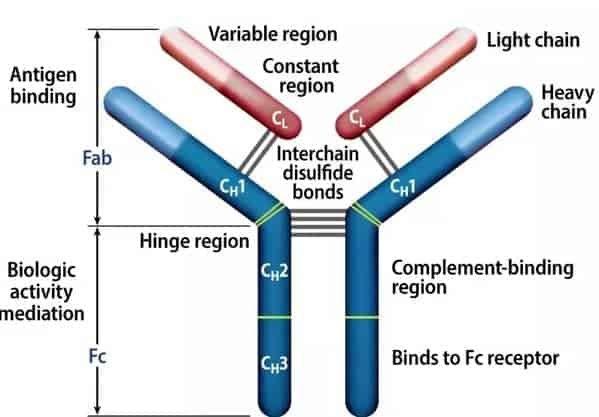
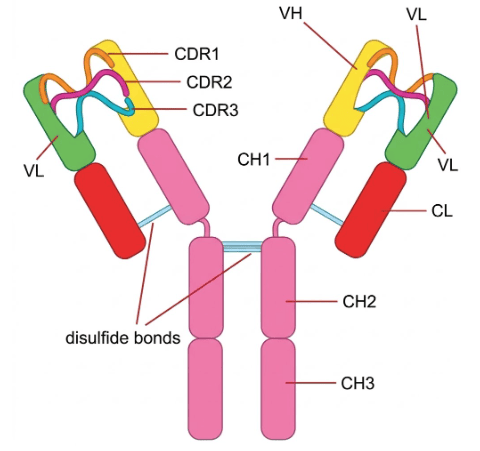
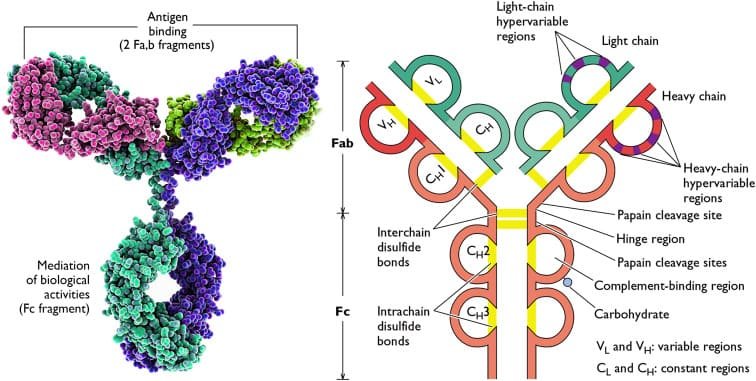
The standard basic immunoglobulin unit consists of four polypeptide chains configured in a characteristic Y-shaped monomeric layout. This structure includes two identical heavy (H) chains and two identical light (L) chains. Sturdy covalent disulfide bridges join these chains together, stabilizing the overall four-chain complex.
Heavy and Light Chain Characteristics
Antibody classes are defined by distinct heavy chains, whereas light chains are shared across classes.
| Chain Category | Isotypes / Types | Molecular Characteristics | Key Structural Features |
|---|---|---|---|
| Heavy (H) Chains | γ (gamma), α (alpha), μ (mu), δ (delta), ε (epsilon) | Defines the five distinct Ig classes: IgG, IgA, IgM, IgD, and IgE | Variable length; contains one variable domain (VH) and 3 to 4 constant domains (CH) |
| Light (L) Chains | κ (kappa) and λ (lambda) | Molecular mass of approximately 23,000 Daltons | An individual antibody contains exclusively κ or λ chains, never a mixture of both |
Domains and Functional Regions
Both heavy and light chains fold into distinct three-dimensional repeating segments known as domains:
- Light Chain Domains: Contains exactly one variable domain (VL) and one constant domain (CL).
- Heavy Chain Domains: Contains one variable domain (VH) paired with either three or four constant domains:
- IgG, IgA, and IgD: Possess three constant domains (CH1, CH2, CH3) along with an accessible hinge region.
- IgM and IgE: Lack an ordinary hinge; instead, they contain an extra constant domain (CH4).
Enzymatic Cleavage: Structure-Function Relationships
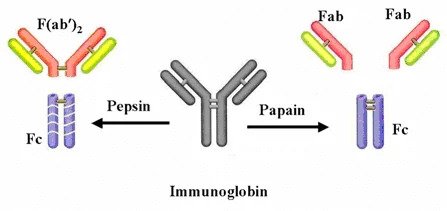
Exposing immunoglobulin monomers to proteolytic enzymes cleaves the polypeptide chains at specific sites, separating antigen-binding capacity from effector function.
| Enzyme | Cleavage Location | Resulting Fragments | Valency & Biological Activity |
|---|---|---|---|
| Papain | Above the hinge region disulfide bonds | Two Fab fragments and one Fc fragment |
Fab (Fragment antigen-binding): Univalent (valence = 1); retains antigen-binding specificity defined by VH and VL, but cannot cross-link antigens to precipitate them. Fc (Fragment crystallizable): No antigen-binding capacity; crystallizes in solution and mediates effector tasks (complement fixation, Fc receptor binding). |
| Pepsin | Below the hinge region disulfide bonds | One F(ab′)2 fragment and degraded Fc subfragments |
F(ab′)2: Bivalent (valence = 2); two Fab units remain connected by disulfide bridges, allowing both antigen binding and lattice formation (agglutination/precipitation). Fc: Digested into multiple small peptide remnants; loses crystallizability and effector mechanisms. |
The Five Mammalian Immunoglobulin Classes
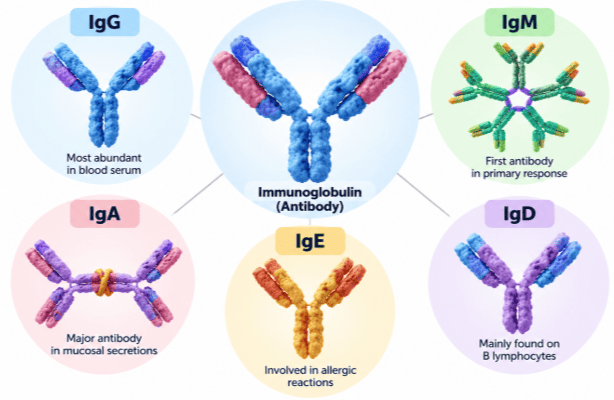
Immunoglobulin G (IgG)
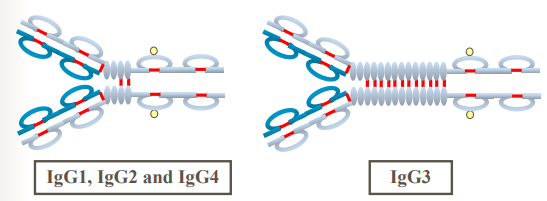
- Structural Form: Exists as a 7S monomer. Composed of four major subclasses: IgG1, IgG2, IgG3, and IgG4. While IgG1, IgG2, and IgG4 share similar hinge arrangements, IgG3 contains an extended hinge made of multiple repeated segments and interchain disulfide links.
- Serum and Tissue Distribution: The most abundant immunoglobulin in circulating serum and the primary antibody found in extravascular spaces.
- Transplacental Passage: The only immunoglobulin class that crosses the human placenta, providing crucial passive immunity to protect the developing fetus and neonate.
- Effector Mechanisms:
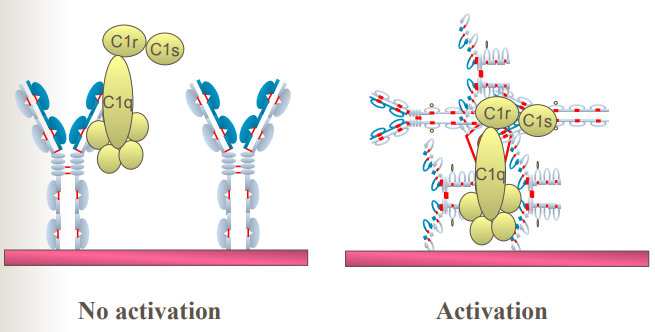
- Complement Activation: Readily fixes and activates classical complement pathways (especially IgG3 and IgG1).
- Opsonization: Binds Fcγ receptors on phagocytic cells (macrophages and neutrophils), facilitating the ingestion and destruction of coated pathogens.
- ADCC (Antibody-Dependent Cell-Mediated Cytotoxicity): Binds to Natural Killer (NK) cells, triggering targeted lysis of infected or abnormal host cells.
- Staphylococcal Protein A (SPA) Binding: Reacts strongly with Protein A found on Staphylococcus aureus cell walls.
Immunoglobulin M (IgM)
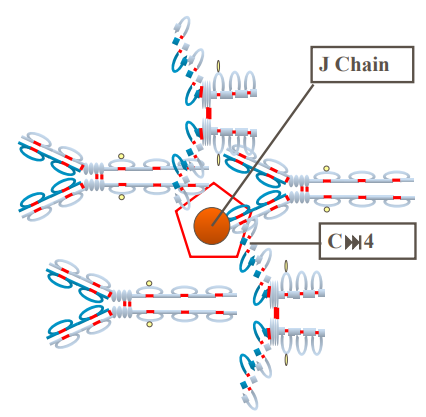
- Structural Form: Secreted primarily as a large 19S pentamer built from five basic H2L2 units connected by a specialized J chain (joining chain). Heavy chains lack a classic hinge and instead contain an extra constant domain (CH4). It also includes an extended tail piece.
- Serum Abundance: Represents the third most prevalent antibody class in circulating serum.
- Developmental & Primary Response Role: The very first immunoglobulin synthesized by the developing fetus and the earliest class produced by newly differentiated B cells during a primary immune response.
- Agglutination & Lysis Efficiency: Because of its high valence (10 theoretical antigen-binding sites, typically 5 functional sites due to steric hindrance), it is the most efficient antibody for pathogen agglutination and classical complement fixation.
- Cellular Roles: Can bind to specific Fc receptors and functions on naïve B-cell surfaces as a monomeric antigen-recognition receptor.
The B-Cell Antigen Receptor Complex (BCR)
On the surface of mature, non-activated B lymphocytes, antibodies operate as the primary antigen recognition system.
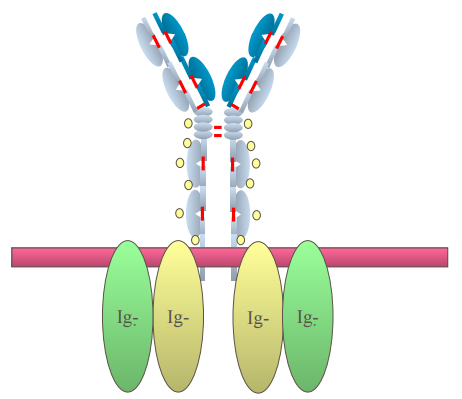
- Membrane-Bound Immunoglobulins: Naïve mature B cells express monomeric IgM and IgD anchored within the plasma membrane via hydrophobic transmembrane sequences.
- Signaling Invariant Heterodimers: Because membrane-bound antibody tails are too short to send intracellular signals, they pair with invariant signaling proteins called Ig-α (CD79a) and Ig-β (CD79b). These accessory proteins contain Immunoreceptor Tyrosine-based Activation Motifs (ITAMs) that transmit activation signals into the cell when an antigen binds.
Immunoglobulin A (IgA)
- Structural Forms:
- Serum IgA: Circulates primarily as an individual monomer. It is the second most abundant antibody class in serum.
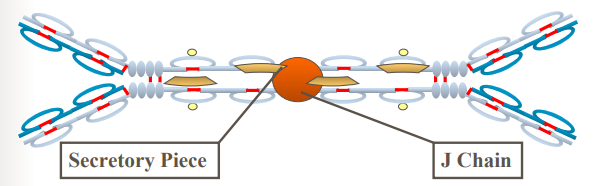
- Secretory IgA (sIgA): Found in external secretions as an 11S dimer. This complex contains two H2L2 monomers linked by a J chain and protected by a polypeptide wrap called the Secretory Component (SC or Secretory Piece, SP).
- Secretion Locations: The predominant antibody in mucosal fluids, including saliva, tears, breast milk, colostrum, respiratory secretions, intestinal fluids, and urogenital tract secretions.
- Effector Functions: Blocks pathogens and toxins from attaching to mucosal surfaces. It does not activate the classical complement cascade unless artificially clustered in high concentrations, but it can bind to specific Fcα receptors on select immune cells.
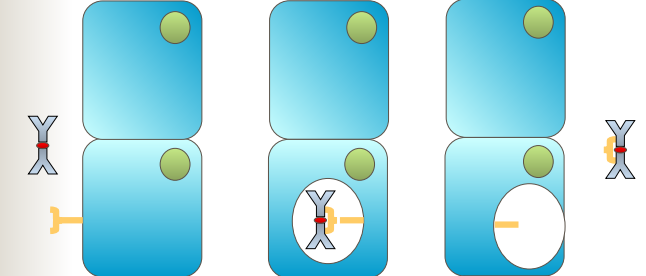
- Role of the Secretory Component: Synthesized by mucosal epithelial cells (derived from the polymeric immunoglobulin receptor, pIgR). The secretory component helps transport dimeric IgA across epithelial layers and protects it from being broken down by proteolytic enzymes in the gastrointestinal tract.
Immunoglobulin D (IgD)
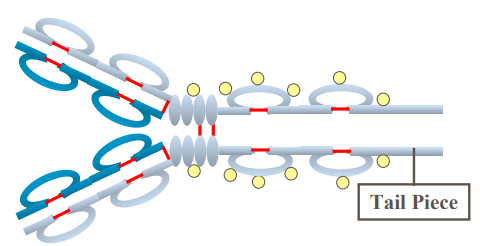
- Structural Form: Exists as a flexible monomer containing an extended hinge and a carboxy-terminal tail piece.
- Serum Concentration: Found in very low amounts in circulation (the fourth highest serum Ig, but accounts for less than 1% of total serum antibodies).
- Primary Biological Role: Acts primarily as a membrane-bound antigen receptor on mature, naïve B cells (co-expressed alongside membrane IgM). It helps signal B-cell activation and differentiation.
- Effector Limitations: Does not bind or activate complement proteins and has no established classical effector role in circulating serum.
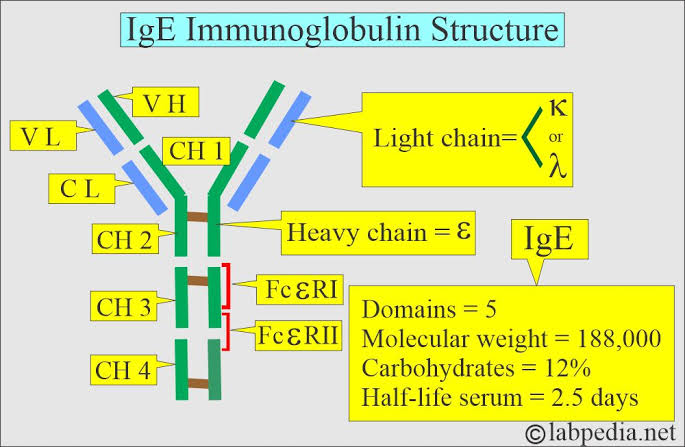
Immunoglobulin E (IgE)
- Structural Form: Exists as a monomer. Like IgM, its heavy chains lack an ordinary hinge and contain an extra constant domain (CH4).
- Serum Abundance: The least common immunoglobulin in circulating serum, present only in trace concentrations under normal conditions.
- High-Affinity Receptor Binding: Binds extremely tightly via its Fc region to high-affinity FcεRI receptors on tissue mast cells and circulating basophils. This binding occurs spontaneously in the resting state, without requiring prior antigen contact.
- Clinical Roles:
- Type I Hypersensitivity Reactions: When specific allergens cross-link IgE molecules already bound to mast cells or basophils, these cells instantly degranulate, releasing histamine, leukotrienes, and heparin. This drives acute allergic symptoms and systemic anaphylaxis.
- Defense Against Parasitic Worms: Coats helminths and recruits eosinophils via their Fcε receptors. This activates the eosinophils to release major basic protein and other enzymes, destroying the parasite's outer surface.
- Complement Inactivity: Does not fix or activate classical complement components.
Comprehensive Comparison of Immunoglobulin Classes
| Property | IgG | IgM | IgA | IgD | IgE |
|---|---|---|---|---|---|
| Heavy Chain | γ (gamma) | μ (mu) | α (alpha) | δ (delta) | ε (epsilon) |
| Basic Configuration | Monomer (7S) | Pentamer (19S) with J chain | Monomer (serum) / Dimer (11S, secretions) with J chain and SP | Monomer | Monomer |
| Heavy Chain Constant Domains | 3 (CH1, CH2, CH3) | 4 (has extra CH4) | 3 (CH1, CH2, CH3) | 3 (CH1, CH2, CH3) | 4 (has extra CH4) |
| Serum Abundance Ranking | 1st (most abundant) | 3rd | 2nd | 4th | 5th (least abundant) |
| Placental Transfer | Yes (only class) | No | No | No | No |
| Classical Complement Fixation | Yes (IgG3 > IgG1 > IgG2; IgG4 does not) | Yes (most potent) | No (only when aggregated) | No | No |
| Primary Biological Function | Long-term systemic immunity, opsonization, ADCC, toxin neutralization | Primary immune response, rapid agglutination, early B-cell receptor | Mucosal protection, prevents pathogen attachment in secretions | Antigen receptor on mature naïve B lymphocytes | Type I hypersensitivity, allergic reactions, defense against parasites |
Primary Biological Functions of Immunoglobulins
Antibodies protect the host through five major defensive mechanisms:
Further Reading
These resources provide reliable background reading on antigens, antibodies, immunoglobulin structure, and immune function.