
Introduction to Medical Microbiology: Branches, Normal Flora, Virulence and Pathogenicity
On this page
Overview
Scope and branches of microbiology
Microbiology is the study of microorganisms — organisms too small to see with the naked eye. Medical microbiology applies this to human health and disease.
Scroll the table sideways on a smaller screen.
| Branch | Studies | Clinical examples |
|---|---|---|
| Bacteriology | Bacteria: prokaryotes with peptidoglycan cell walls | TB, typhoid, meningitis, wound sepsis |
| Virology | Viruses: obligate intracellular particles with DNA or RNA cores | HIV, hepatitis, Ebola, influenza, COVID-19 |
| Mycology | Fungi: eukaryotes with chitin cell walls and ergosterol membranes | Candida thrush, cryptococcal meningitis, ringworm |
| Parasitology | Protozoa and helminths | Malaria, amoebiasis, schistosomiasis, intestinal worms |
| Immunology | Host defence: innate and adaptive immunity | Vaccination, hypersensitivity, HIV immunosuppression |
| Microbial genetics & molecular biology | DNA, plasmids, resistance genes, virulence genes | MRSA (mecA), ESBL, GeneXpert resistance detection |
Normal flora vs pathogens
The human body carries roughly as many bacterial cells as human cells. Normal (commensal) flora colonise the skin, mouth, gut and vagina and usually help us: they occupy ecological niches that exclude pathogens, produce vitamins (gut flora make vitamin K and some B vitamins), and prime the immune system. Flora becomes dangerous when it is displaced from its home site — gut E. coli entering the urinary tract causes UTI; skin staphylococci entering a wound cause abscesses; oral flora entering the bloodstream during dental extraction can seed damaged heart valves.
- Sterile sites (no normal flora): blood, CSF, deep tissues, bladder, lower lung.
- Colonised sites: skin, nasopharynx, oropharynx, colon, vagina, anterior urethra.
- The same species can be commensal in one site and pathogen in another — the site decides the significance of a culture, which is why cultures must be interpreted clinically, never in isolation.
Core terminology: pathogenicity, virulence, infection
Scroll the table sideways on a smaller screen.
| Term | Definition | Example |
|---|---|---|
| Pathogenicity | The ability of a micro-organism to cause disease (qualitative — yes or no) | M. tuberculosis is pathogenic; E. coli in the colon usually is not |
| Virulence | The degree of pathogenicity (quantitative — how severe) | S. pyogenes (flesh-eating necrotising fasciitis) is more virulent than S. epidermidis |
| Virulence factor | A microbial product/structure that enables disease: toxins, capsules, adhesins, enzymes, secretion systems | Cholera toxin; pneumococcal capsule |
| Primary (obligate) pathogen | Causes disease in a healthy host | M. tuberculosis, S. pyogenes |
| Opportunistic pathogen | Causes disease only when host defences are breached | Candida albicans thrush in antibiotics/steroids; Pseudomonas in burns |
| Infection | Multiplication of a microbe in/on the host with tissue invasion or reaction | Contrast colonisation (presence + multiplication without disease) |
| Infestation / contamination | Contamination = transient presence without multiplication; infestation usually refers to parasites on the surface | Skin briefly touched by S. aureus = contamination |
| Communicable disease | Spreads directly or indirectly between hosts | TB, measles; vs non-communicable (tetanus — from environment, not person-to-person) |
| Latrogenic / nosocomial | Hospital-acquired infection (iatrogenic = caused by medical treatment) | Catheter sepsis, C. difficile after antibiotics |
| Zoonosis | Infection transmitted from animals to humans | Brucellosis, leptospirosis, rabies, anthrax |
Stages of infectious disease
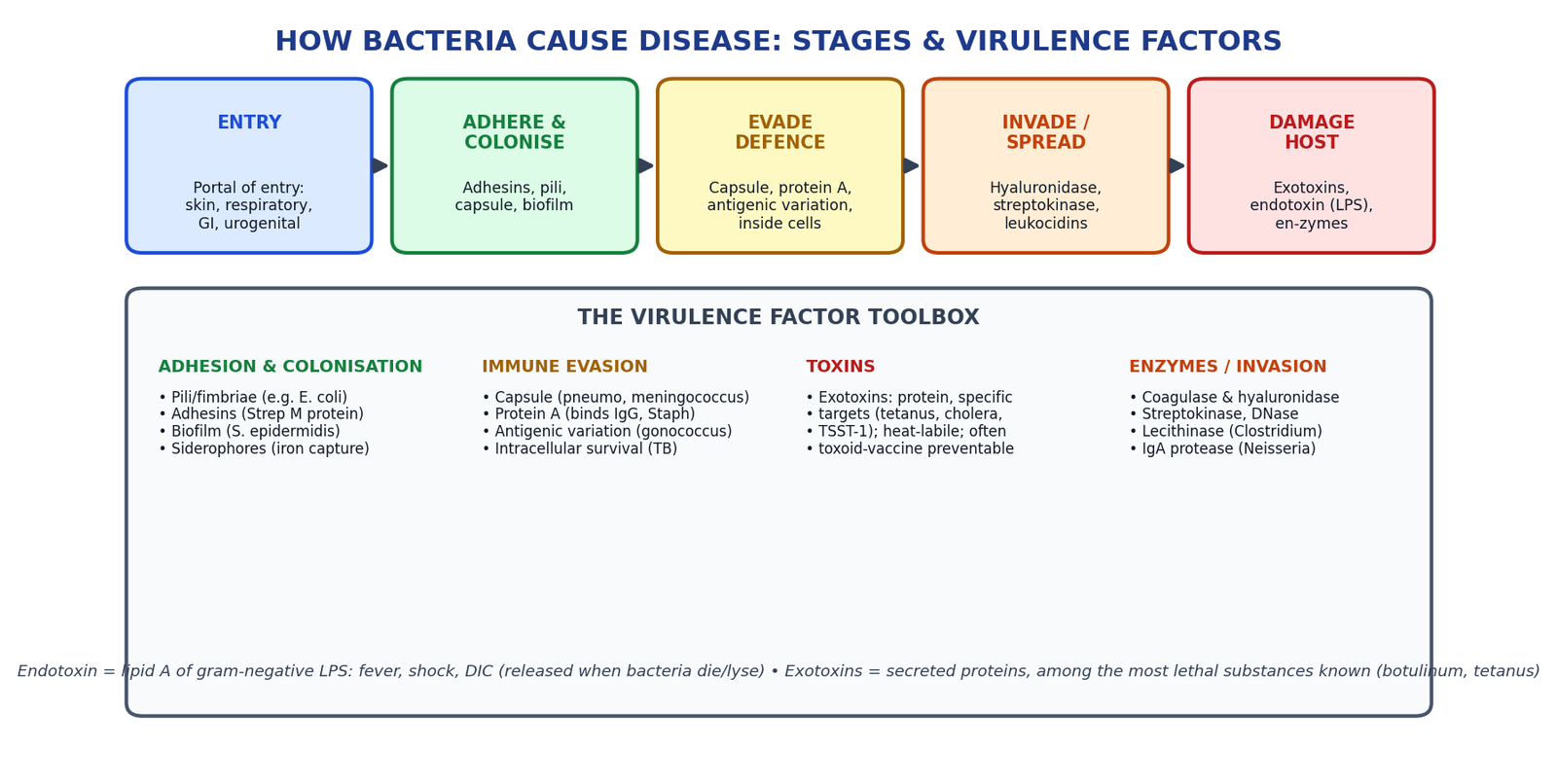
The classic time course of an acute infection: incubation period (entry to first symptoms; microbes multiplying) → prodrome (non-specific symptoms) → acute (invasive) phase (peak symptoms, maximal shedding) → convalescence (recovery) or death. Variants worth naming: chronic infection (TB — symptoms for months), latent infection (dormant, non-replicating but viable — TB granuloma, herpes viruses), and the carrier state (asymptomatic shedding — typhoid Mary, hepatitis B).
Virulence factors in detail
Scroll the table sideways on a smaller screen.
| Category | Mechanism | Examples |
|---|---|---|
| Adhesins & pili | Bind specific receptors so the organism is not flushed away | Type 1 fimbriae of E. coli; M protein of S. pyogenes; gonococcal pili |
| Capsule | Anti-phagocytic; the single most important virulence factor of several killers | S. pneumoniae (90+ serotypes — basis of vaccine), N. meningitidis, Bacillus anthracis (poly-D-glutamate) |
| Exotoxins | Secreted proteins with specific targets; among the most poisonous substances known; many are neutralised by antibodies/toxoids | Tetanus & botulinum toxins, cholera toxin, diphtheria toxin, TSST-1, exfoliatin, anthrax lethal toxin |
| Endotoxin (LPS) | Lipid A of gram-negative outer membrane; released on lysis → macrophage activation, fever, shock, DIC | Septic shock in gram-negative sepsis; meningococcaemia |
| Invasive enzymes | Dissolve barriers and spread through tissue | Hyaluronidase ("spreading factor"), streptokinase (lyses clots), DNase, coagulase, lecithinase (alpha-toxin of C. perfringens) |
| Immune evasion | Hide from or disable host defences | Protein A of S. aureus (binds IgG Fc backwards), antigenic variation of gonococcus, intracellular survival of M. tuberculosis and Salmonella |
| Siderophores | Scavenge iron, which the host deliberately withholds (lactoferrin, transferrin) | Enterobactin of E. coli |
| Biofilm | Community in a protective matrix; shields from antibiotics and phagocytes | S. epidermidis on catheters, dental plaque, Pseudomonas in CF lungs |
Epidemiological vocabulary every student needs
- Reservoir — where the organism normally lives (humans for TB; rodents/cattle for leptospirosis; water for cholera). Distinguish source (immediate origin of infection).
- Vector — living carrier (mosquito for malaria; tick for Lyme; tsetse for sleeping sickness) vs vehicle (inanimate: water, food, fomites).
- Modes of transmission: contact (direct/indirect), droplet, airborne, faecal–oral, vertical (mother→child), vector-borne, iatrogenic.
- Incidence (new cases over time) vs prevalence (all existing cases at a point in time).
- Endemic / epidemic / pandemic — constant presence / sudden excess / worldwide spread.
- Case fatality rate — deaths among diagnosed cases (severity measure); herd immunity — indirect protection when transmission is blocked by immune majority.
Clinical scenarios
Scenario 1 — The "culture" that means nothing
A 70-year-old man has a urine culture reported as "E. coli 10⁴ CFU/mL." The house officer wants to start ciprofloxacin. You ask about symptoms: none — no dysuria, no fever, and the sample was taken because "we screen all admissions." The anterior urethra is a colonised site, so low-count growth without symptoms is colonisation, not infection; treating it breeds resistance and causes side-effects. You decline antibiotics, and you use the moment to teach the ward: a laboratory result is only as good as the clinical question that ordered it.
Scenario 2 — Why one germ, many diseases?
A student asks why S. aureus caused a breast abscess in one patient, food poisoning in a second and toxic shock in a third — "isn't it the same bacteria?" You explain virulence factor expression: the abscess came from local tissue invasion plus enzymes; the food poisoning from pre-formed heat-stable enterotoxin eaten in contaminated food (the patient ate the poison, so symptoms start within hours and fever is absent); the toxic shock from TSST-1, a superantigen that cross-links T-cell receptors and MHC simultaneously, causing massive cytokine release. Same species, different weapons, different syndromes.
Scenario 3 — Explaining the tetanus vaccine to a sceptical father
A father refuses tetanus toxoid for his wounded son "because tetanus comes from the soil, not from people, so it's not contagious." You agree it is not person-to-person — C. tetani is an environmental, non-communicable pathogen — but that is exactly the point: herd immunity cannot protect his son, only his own antibodies can. The toxoid is an inactivated exotoxin, chosen precisely because exotoxins are strongly antigenic; antibodies against the toxoid neutralise the real toxin before it reaches neurons. He consents.
Key points
References
- Medical Microbiology (Baron, ed.), NCBI Bookshelf — Bacterial Pathogenesis chapter (Library reference.)
- Jawetz, Melnick & Adelberg's Medical Microbiology (Library reference.)
- Mims' Pathogenesis of Infectious Disease (Library reference.)
- Prescott's Microbiology — microbial growth and ecology chapters (Library reference.)
- OpenStax Microbiology — mechanisms of microbial pathogenicity chapter (Library reference.)
Further reading
For deeper study, compare this lesson with current guidance and standard references from recognised medical and scientific organisations.
- NCBI Bookshelf — Bacterial Pathogenesis: General Concepts
- OpenStax Microbiology (free textbook)
- CDC — infectious disease resources
- Clinical Medicine Year 1, Semester 2 curriculum
For education only. Diagnosis and treatment of infections follow the Uganda Clinical Guidelines and local laboratory protocols.