
Antifungal Agents: Polyenes, Azoles, Echinocandins and Others
On this page
Overview
Fungal cell targets
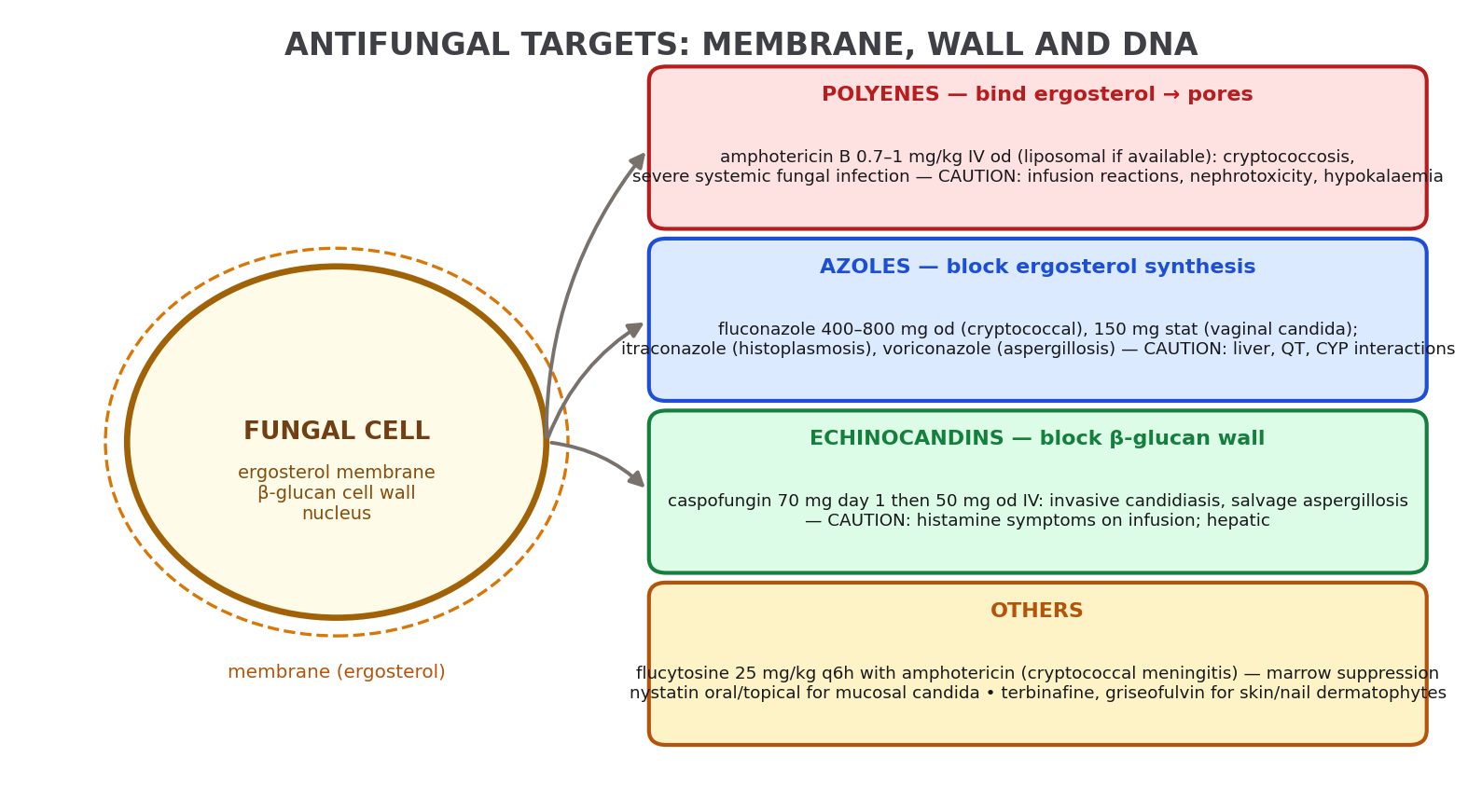
Memorise the map: ergosterol (the fungal equivalent of cholesterol) is attacked by the polyenes (bind it, punch pores) and the azoles (block its synthesis); the β-glucan cell wall is attacked by echinocandins; and flucytosine blocks DNA synthesis after conversion inside the fungal cell. Dermatophyte drugs (terbinafine, griseofulvin) also target ergosterol synthesis, but act at the skin/nails where systemic toxicity is minimal.
Polyenes: amphotericin B and nystatin
Amphotericin B binds ergosterol and forms membrane pores — leakage of ions kills the fungus. It is the broadest antifungal and the backbone of cryptococcal meningitis and severe systemic mycoses, but its toxicity demands respect.
Scroll the table sideways on a smaller screen.
| Drug / formulation | Dose | Indications | Adverse effects | Monitoring / counselling |
|---|---|---|---|---|
| Amphotericin B deoxycholate (conventional) | 0.7–1 mg/kg IV once daily (per national cryptococcal guideline; often 1 mg/kg for cryptococcosis), infused over 2–4 h | Cryptococcal meningitis induction (with flucytosine where available), severe histoplasmosis/coccidioidomycosis, mucormycosis, invasive aspergillosis (lipid forms), systemic candidiasis | Infusion reactions (fever, rigors, hypotension — premedicate with paracetamol ± hydrocortisone/antihistamine per protocol), dose-limiting nephrotoxicity (renal dose-adjust), hypokalaemia and hypomagnesaemia (aggressive replacement), anaemia, phlebitis | Daily creatinine, K⁺/Mg²⁺, FBC; hydrate before infusion; report rigors, reduced urine output, muscle weakness (low K⁺); test dose where protocol requires |
| Liposomal amphotericin B | 3–5 mg/kg IV once daily | Same indications where the cost is covered (programme-dependent); less nephrotoxic | Same class but markedly less nephrotoxicity/infusion reactions | As above; preferred in renal impairment and prolonged courses |
| Nystatin (not absorbed orally/topically) | Oral candida: 500,000–1,000,000 units (1–2 mL) 6-hourly, "swish and swallow"; topical cream for skin candida | Oral and oesophageal candidiasis (mild), cutaneous candida | GI upset (oral); local irritation (topical) | Swish, gargle and swallow; continue denture hygiene; if oesophageal symptoms persist → fluconazole |
Azoles: fluconazole and relatives
Azoles inhibit 14α-demethylase (a CYP enzyme in the ergosterol pathway) → membrane defects. They are mostly fungistatic against yeasts and share CYP-mediated interactions and hepatotoxicity.
Scroll the table sideways on a smaller screen.
| Drug | Dose (usual) | Spectrum / indications | Adverse effects & interactions | Cautions |
|---|---|---|---|---|
| Fluconazole | Cryptococcal consolidation: 400–800 mg od; oesophageal candida: 200–400 mg od; vaginal candida: 150 mg single dose; prophylaxis in selected HIV patients: 100–200 mg od | Candida (oral, oesophageal, vaginal, invasive), Cryptococcus (consolidation/maintenance after amphotericin induction), coccidioidomycosis; NOT moulds (no aspergillus, no mucor) and unreliable vs C. krusei (intrinsic resistance), C. glabrata (dose-dependent resistance) | Hepatotoxicity (check LFTs on prolonged courses), QT prolongation, headache, GI; CYP2C9/3A4 inhibition — ↑ warfarin effect, ↑ phenytoin, ↑ sulfonylureas (hypoglycaemia), ↑ statins | Pregnancy (high-dose teratogenic signal — avoid single high doses in 1st trimester), renal dose-adjust |
| Itraconazole | 200 mg 12-hourly oral (capsules with food / solution fasting) | Histoplasmosis, sporotrichosis, blastomycosis, chronic aspergillosis; dermatophytes (nails) | Hepatotoxicity, negative inotropy (heart failure caution), neuropathy; strong CYP3A4 inhibitor | Avoid in heart failure; capsule absorption needs gastric acid (separate antacids/PPIs) |
| Voriconazole | Loading 6 mg/kg 12-hourly ×2, then 4 mg/kg 12-hourly IV, or 200 mg 12-hourly oral | Invasive aspergillosis (first line), serious Candida infections, Fusarium, Scedosporium | Visual disturbances (photopsia, 30%), hepatotoxicity, hallucinations, skin photosensitivity (long-term), QT prolongation; CYP2C19 polymorphism → therapeutic drug monitoring used; many interactions (levels ↑ by ritonavir — major ART interaction) | TDM where available; avoid strong sunlight (phototoxicity); dose-adjust in renal impairment (IV vehicle accumulates) |
| Posaconazole / isavuconazole | Suspension/tablet per protocol | Mucormycosis salvage, prophylaxis in neutropenia/transplant | Hepatotoxicity, QT, interactions | Specialist/tertiary use |
Echinocandins: caspofungin
Echinocandins inhibit β-1,3-glucan synthase, blocking cell-wall construction — fungicidal against Candida including fluconazole-resistant species (C. glabrata, C. krusei). Given IV only (poor oral absorption), they penetrate poorly into CSF and urine.
Scroll the table sideways on a smaller screen.
| Item | Details |
|---|---|
| Dose | 70 mg IV on day 1 (loading), then 50 mg IV once daily; no renal adjustment; hepatic dose-adjust in moderate–severe liver disease |
| Indications | Invasive candidiasis (candidaemia, deep-seated infection), empirical therapy in febrile neutropenia, salvage Aspergillus (combination) |
| Adverse effects | Histamine-type infusion reactions (flushing, pruritus — slow the infusion), hepatotoxicity (rising LFTs — monitor), hypokalaemia; generally well tolerated |
| Interactions / cautions | Not for meningitis/UTI (poor CSF/urine penetration); monitor LFTs with hepatotoxic co-medication; reduces tacrolimus/ciclosporin clearance |
Flucytosine and dermatophyte agents
Scroll the table sideways on a smaller screen.
| Drug | Dose | Indications | Adverse effects & cautions |
|---|---|---|---|
| Flucytosine (5-FC) | 25 mg/kg 6-hourly oral/IV, in combination with amphotericin B for cryptococcal meningitis induction (per national guideline; where available replaces/augments fluconazole during week 1–2) | Cryptococcal meningitis, chromomycosis, severe candidiasis (combination only) | Marrow suppression (leucopenia, thrombocytopenia — monitor FBC), hepatotoxicity, diarrhoea/colitis, rapid resistance if used alone (never monotherapy) |
| Terbinafine | 250 mg once daily oral (6 weeks fingernail, 12–16 weeks toenail); 1% cream for skin tinea | Dermatophyte onychomycosis and extensive tinea capitis/corporis | Taste disturbance/loss (reversible), hepatotoxicity (rare — check LFTs on long courses), rash; cream: local irritation |
| Griseofulvin | 500 mg–1 g daily oral (microsize) with fatty food (child 10–20 mg/kg/day), 6–8 weeks (capitis up to 8–12) | Tinea capitis (especially in children), tinea corporis | Headache, GI, photosensitivity, teratogenic — avoid in pregnancy and for men 6 months before conception; reduces warfarin and OCP efficacy |
Choosing, monitoring and stewardship
Scroll the table sideways on a smaller screen.
| Situation | First-line approach | Monitor |
|---|---|---|
| Oral thrush (HIV) | Nystatin "swish and swallow" → fluconazole if oesophageal/persistent | ART adherence (immune recovery prevents recurrence) |
| Systemic candidiasis (candidaemia) | Echinocandin first line (fluconazole if stable and susceptible) | LFTs, blood cultures to clearance, remove infected lines |
| Cryptococcal meningitis | Amphotericin B + flucytosine ×≥7 d induction (per national guideline), then fluconazole consolidation (800→400 mg) and maintenance | Creatinine, K⁺/Mg²⁺, FBC; repeat LP for pressure management; ART deferred 4–6 weeks (IRIS risk) |
| Invasive aspergillosis | Voriconazole (tertiary/specialist) | LFTs, TDM, vision, interactions (esp. ritonavir-boosted ART) |
| Tinea capitis/onychomycosis | Terbinafine or griseofulvin oral; topical azole/terbinafine for limited corporis | LFTs on long courses; pregnancy exclusion (griseofulvin) |
Clinical scenarios
Scenario 1 — Cryptococcal meningitis in AIDS
A 34-year-old with newly diagnosed HIV (CD4 24) has 2 weeks of headache, fever and confusion; India-ink stain positive, CSF pressure very high. You start amphotericin B 1 mg/kg IV daily + flucytosine 25 mg/kg q6h induction per the national guideline, with aggressive management of raised intracranial pressure (repeated therapeutic lumbar punctures). You monitor creatinine and potassium daily — by day 4 the creatinine is rising and K⁺ is 2.9: expected amphotericin toxicity — hydrate, replace K⁺/Mg²⁺ vigorously, and continue (the alternative is fatal disease). ART is deferred 4–6 weeks to reduce IRIS mortality. After ≥1–2 weeks induction he steps down to high-dose fluconazole consolidation/maintenance.
Scenario 2 — Recurrent thrush on the ward round
A patient on chemotherapy has oral white plaques that scrape off leaving bleeding points — Candida oesophagitis. You start fluconazole 200–400 mg daily (nystatin cannot reach the oesophagus reliably), check for risk factors (antibiotics, steroids, neutropenia), review his antibiotic list, and send blood cultures because candidaemia can accompany oesophageal disease in neutropenic patients. If he were neutropenic and unstable, an echinocandin would be the safer empiric choice (resistance coverage, no renal adjustment).
Scenario 3 — The schoolgirl with a scaly scalp
A 7-year-old has a scaly alopecic patch with broken hairs and posterior cervical lymphadenopathy — tinea capitis (kerion risk). Topicals won't penetrate hair follicles: you prescribe griseofulvin 10–20 mg/kg/day with fatty food for 8 weeks (terbinafine is an alternative), counsel the mother on not sharing combs/hats, screen close contacts, and review at 4 weeks. You check LFTs only if the course extends or symptoms suggest. The mother is pregnant — griseofulvin is teratogenic, so no handling of the child's medication by her without gloves is needed at normal exposure, but the counselling point stands for any female patient of childbearing age.
Key points
References
- WHO Guidelines for Diagnosing, Preventing and Treating Cryptococcal Disease among People Living with HIV (Library reference.)
- Uganda National HIV cryptococcal screening and treatment guidance; Uganda Clinical Guidelines 2023 (Library reference.)
- Katzung's Basic & Clinical Pharmacology — antifungal agents chapter (Library reference.)
- Goodman & Gilman's The Pharmacological Basis of Therapeutics (Library reference.)
- WHO Model List of Essential Medicines: antifungal agents (Library reference.)
Further reading
For deeper study, compare this lesson with current guidance and standard references from recognised medical and pharmaceutical organisations.
- WHO: Guidelines for Cryptococcal Disease among People Living with HIV
- WHO Model List of Essential Medicines 2023
- Uganda MoH Knowledge Management Portal (UCG 2023)
- DCM Year One Semester Two curriculum
For education only. Systemic antifungals are toxic and programme-regulated — always follow the current Uganda Clinical Guidelines, national HIV/TB programmes and specialist protocols in practice.