
Antimalarial Agents: ACTs, Artesunate, Quinine, Primaquine and Prevention
On this page
Overview
The parasite life-cycle as a drug target
Antimalarials are classified by which stage of the Plasmodium life-cycle they kill:
- Tissue (exo-erythrocytic) schizonticides — kill liver-stage hypnozoites of P. vivax/P. ovale; example: primaquine. This is "radical cure" (prevents relapse).
- Blood (erythrocytic) schizonticides — kill the asexual red-cell stages that cause symptoms and severe disease; examples: artemisinins, quinine, chloroquine, lumefantrine, SP. This is what "treatment" means day-to-day.
- Gametocytocides — kill sexual stages that infect mosquitoes; example: primaquine (single low dose with ACT), artemisinins partially.
- Sporonticides / transmission-blocking — prevent mosquito-stage development; SP and primaquine contribute.
- Causal (true) prophylaxis — prevent liver-stage establishment in non-immune travellers; examples: atovaquone-proguanil, doxycycline (not routinely used in endemic Uganda).
P. falciparum — the dominant species in Uganda — has no persistent liver hypnozoite stage, so radical cure is not needed; treatment targets blood stages only. P. vivax and P. ovale can hide in the liver and relapse months later, which is why a primaquine "anti-relapse" course exists.
Classification by mechanism
Scroll the table sideways on a smaller screen.
| Class / drugs | Mechanism of action | Stage targeted | Key point |
|---|---|---|---|
| Artemisinins: artemether, artesunate, dihydroartemisinin | Activated by haem-iron inside the parasite → free radicals that alkylate and damage parasite proteins/membranes | All asexual blood stages; early gametocytes | Fastest parasite killers known (clear parasitaemia in hours); short half-life → never used as monotherapy |
| Aryl amino alcohols / quinolines: quinine, lumefantrine, mefloquine, chloroquine (4-aminoquinoline) | Accumulate in the acidic food vacuole → inhibit haem detoxification (haem polymerisation to haemozoin), poisoning the parasite with its own haem | Asexual blood schizonts (mainly) | Longer half-lives "mop up" after artemisinins; chloroquine resistance is widespread in P. falciparum in East Africa |
| Antifolates: sulfadoxine-pyrimethamine (SP), proguanil, dapsone | Inhibit dihydropteroate synthase (sulfadoxine) and dihydrofolate reductase (pyrimethamine) sequentially → block folate and DNA synthesis | Asexual blood schizonts | Now reserved for IPTp in pregnancy and intermittent preventive therapy in infants (resistance prevents first-line curative use) |
| 8-Aminoquinolines: primaquine, tafenoquine | Oxidative stress to parasite mitochondria; exact mechanism still debated | Liver hypnozoites (radical cure) + gametocytes | Causes haemolysis in G6PD deficiency — test before the 14-day anti-relapse course; the single transmission-blocking dose needs no test |
| Naphthoquinone: atovaquone (+ proguanil) | Inhibits mitochondrial electron transport at cytochrome bc1 | Hepatic and blood stages (causal + suppressive) | Traveller prophylaxis and second-line therapy; take with food (fat ↑ absorption) |
| Antibiotics with antimalarial activity: doxycycline, clindamycin | Inhibit parasite protein synthesis (apoplast) | Asexual blood schizonts (slow) | Only in combination (e.g. quinine + doxycycline second line) |
Artemether-lumefantrine and other ACTs
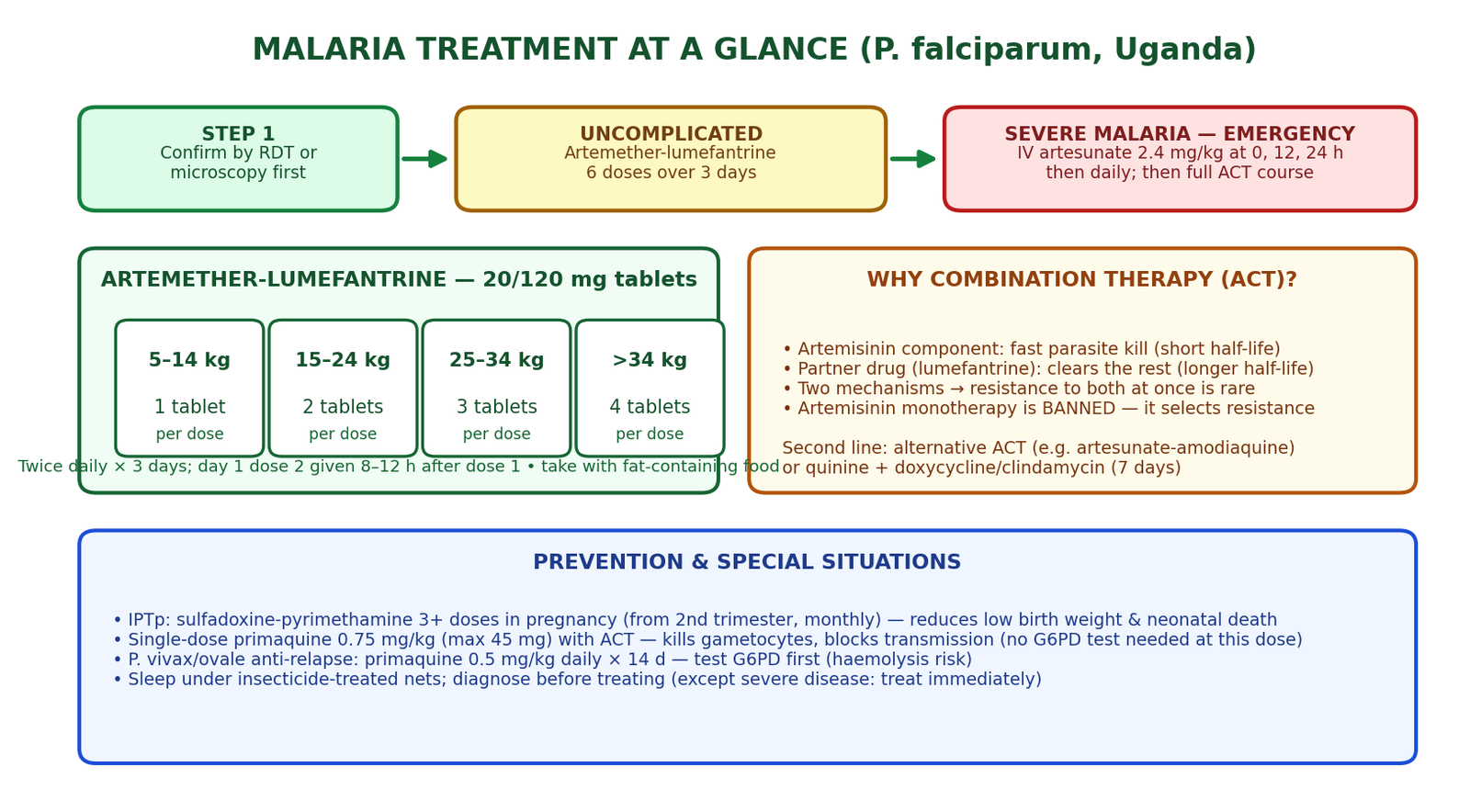
Artemisinin-based combination therapy (ACT) pairs a fast, short-lived artemisinin derivative with a slower, longer-lived partner drug. The artemisinin component drops the parasite biomass by ~10,000-fold in the first 3 days; the partner drug clears the survivors. Artemisinin monotherapy is banned because sub-curative exposure selects partial resistance (delayed parasite clearance has emerged in the Greater Mekong region and is being watched closely in Africa).
Scroll the table sideways on a smaller screen.
| Item | Details |
|---|---|
| Composition | Artemether 20 mg + lumefantrine 120 mg per tablet (fixed-dose combination, dispersible paediatric formulation available) |
| Dose (weight bands) | 5–14 kg: 1 tablet per dose ・ 15–24 kg: 2 tablets ・ 25–34 kg: 3 tablets ・ >34 kg (adult): 4 tablets per dose |
| Schedule | Twice daily for 3 days (6 doses); day-1 dose 2 is given 8–12 hours after dose 1, then morning/evening on days 2 and 3 |
| Administration | Take with fat-containing food or milk (lumefantrine absorption is fat-dependent — a starving patient under-doses); repeat the dose if vomiting occurs within 30 minutes |
| Adverse effects | Generally well tolerated: headache, dizziness, anorexia, GI upset, transient QT prolongation; hypersensitivity rare |
| Contraindications / cautions | Hypersensitivity to components; caution with known QT prolongation or on other QT drugs (amiodarone, some antipsychotics); avoid in first-trimester pregnancy unless alternatives unavailable (national policy per current guidance); weak CYP3A4 interactions (rifampicin reduces levels; avoid St John's wort) |
| Counselling | Complete all 6 doses even when fever resolves; take with food; return if fever returns within 14 days (possible resistance, adherence failure, or wrong diagnosis) |
Second-line ACTs and alternatives: Artesunate-amodiaquine (2nd line in Uganda; same artemisinin principles, amodiaquine is the partner) and quinine + doxycycline or clindamycin (7 days) for treatment failures and where ACT is contraindicated — doxycycline is not for children under 8 years or pregnant women (use clindamycin instead).
Severe malaria: IV artesunate
Severe P. falciparum malaria is a medical emergency with high mortality — impaired consciousness, repeated convulsions, prostration, acidotic breathing, severe anaemia, hypoglycaemia, renal impairment, jaundice, shock, or hyperparasitaemia. Do not wait for confirmation to treat suspected severe malaria — give the first dose immediately.
Scroll the table sideways on a smaller screen.
| Item | Details |
|---|---|
| Dose | 2.4 mg/kg IV (3 mg/kg if <20 kg) at 0, 12 and 24 hours, then once daily; minimum of 3 doses / 24 hours parenteral and until the patient can take oral medication |
| Route | IV (dilute in 5% dextrose); may be given IM into the anterior thigh if no IV access — absorption is reliable |
| Follow-on | Once the patient tolerates oral intake: complete a full 3-day ACT course (parenteral artesunate alone does not give partner-drug cover — parasite recrudescence follows) |
| Adverse effects | Remarkably safe; transient neutropenia, delayed haemolysis ~1–3 weeks after treatment (monitor Hb at follow-up in severe cases), injection-site pain IM |
| Alternatives | IM artemether, or quinine (IV loading 20 mg/kg then 10 mg/kg 8-hourly with ECG monitoring where possible) where artesunate is unavailable — inferior and more toxic (hypoglycaemia, cinchonism) |
| Adjuncts | Monitor and treat hypoglycaemia, acidosis, seizures (rectal diazepam/lorazepam), anaemia (transfusion per criteria), renal failure; no steroids, no heparin |
Quinine, chloroquine, SP and primaquine
Scroll the table sideways on a smaller screen.
| Drug | Dose | Current role | Adverse effects & cautions |
|---|---|---|---|
| Quinine (+ doxycycline/clindamycin) | Treatment: 10 mg/kg salt (600 mg adult) 8-hourly oral × 3/7 days in combination; severe: IV as above | Second-line for ACT failure; severe malaria where artesunate unavailable | Cinchonism (tinnitus, deafness, headache, nausea), hypoglycaemia (dangerous in pregnancy — monitor), QT prolongation; doxycycline not in pregnancy/<8 y |
| Chloroquine | 25 mg base/kg total over 3 days (10, 10, 5 mg/kg) | P. vivax/P. ovale blood stages (still usually sensitive); some countries use for P. falciparum where fully sensitive | Pruritus (common, esp. in dark skin), GI upset, headache, retinopathy and cardiotoxicity only with chronic use; NOT reliable against Ugandan falciparum |
| Sulfadoxine-pyrimethamine (SP) | 3 tablets (1500/75 mg) single dose; IPTp: at least 3 doses of 3 tablets from 2nd trimester, ≥1 month apart under direct observation | IPTp in pregnancy; IPTi in infants where policy applies; occasional combination therapy partner | Hypersensitivity (sulfa), GI upset; widespread falciparum resistance for curative use; avoid in late 3rd trimester sulfa allergy context per local guidance; give with folate caution discussions per ANC protocol |
| Primaquine | Transmission-blocking single dose: 0.75 mg base/kg (max 45 mg) with ACT — no G6PD test needed. Anti-relapse (vivax/ovale): 0.5 mg/kg daily × 14 days — test G6PD first | Gametocyte clearance to interrupt transmission; radical cure of liver hypnozoites | Haemolysis in G6PD deficiency (test before 14-day course); methaemoglobinaemia; avoid in pregnancy (fetal G6PD status unknown) |
| Artesunate-amodiaquine | Weight-banded FDC tablets once daily × 3 days (per national protocol) | Second-line ACT in Uganda | As ACT class; amodiaquine partner adds agranulocytosis/hepatotoxicity risk in repeated courses |
Chemoprevention and vector control
- Insecticide-treated nets (ITNs) — the backbone of prevention: sleep under an ITN every night; re-treat/replace per programme; the single most cost-effective child-survival intervention.
- IPTp-SP — ≥3 doses of SP from the second trimester, at least a month apart, under directly observed therapy; reduces low birth weight, maternal anaemia and neonatal mortality even in areas of partial SP resistance.
- Seasonal malaria chemoprevention (SMC) — monthly amodiaquine + SP courses for children 3–59 months in defined high-transmission seasons (applied in parts of the Sahel; per national policy where introduced).
- Intermittent preventive treatment in infants (IPTi) — SP alongside EPI vaccinations where policy applies.
- Indoor residual spraying (IRS) and larval source management — public-health programme measures.
- Traveller prophylaxis (non-immune visitors): atovaquone-proguanil daily starting 1–2 days before, during, and 7 days after travel; alternatives doxycycline (daily, 4 weeks after) or mefloquine (weekly) — rarely relevant for residents of endemic Uganda.
Choosing a regimen in Uganda
Scroll the table sideways on a smaller screen.
| Situation | Regimen | Key checks |
|---|---|---|
| Uncomplicated P. falciparum (RDT/microscopy positive) | Artemether-lumefantrine × 3 days by weight band | Parasitological confirmation first (in any febrile patient, test before treating); dose with food; assess for danger signs |
| Treatment failure / ACT contraindicated | Artesunate-amodiaquine (2nd-line ACT) or quinine + doxycycline/clindamycin × 7 days | Exclude non-adherence and vomiting before declaring failure; doxycycline if ≥8 y and not pregnant |
| Severe malaria (any species) | IV/IM artesunate 2.4 mg/kg (3 mg/kg if <20 kg) at 0/12/24 h then daily + supportive care; complete oral ACT after | Treat immediately without waiting for confirmation; check glucose, Hb; manage seizures, acidosis, fluids carefully |
| P. vivax/P. ovale malaria | Chloroquine or ACT for blood stages + primaquine 0.5 mg/kg daily × 14 days (G6PD-tested) | Ask about travel/relocation history; exclude pregnancy before primaquine |
| Pregnancy — uncomplicated | ACT in 2nd and 3rd trimester per current WHO/national guidance (quinine + clindamycin 1st trimester) | IPTp-SP at ANC; severe malaria in any trimester → artesunate (life-saving; benefit outweighs risk) |
| Prophylaxis | ITN + IPTp-SP in pregnancy; SMC/IPTi per national programme | ANC documentation of SP doses; net usage counselling |
Clinical scenarios
Scenario 1 — The unconscious child on arrival
A 4-year-old (16 kg) is brought in deeply unconscious (Blantyre coma score 2) with fever and a positive RDT. You recognise severe malaria with cerebral involvement and immediately give IV artesunate 3 mg/kg = 48 mg at 0, 12 and 24 hours then daily (children <20 kg get 3 mg/kg), plus a bedside blood glucose of 1.8 mmol/L → IV dextrose (hypoglycaemia is both a feature of severe malaria and a quinine/artesunate-adjacent danger). You check Hb (5.8 g/dL — severe anaemia → transfuse per criteria), control the temperature, and monitor breathing for acidosis. He wakes on day 2, takes oral fluids, and you complete a full 3-day AL course after the last parenteral dose. No steroids, no fluid boluses beyond correction of shock.
Scenario 2 — Dosing AL on the paediatric ward
A 10-kg toddler has uncomplicated malaria confirmed by RDT. Weight band 5–14 kg → 1 tablet of artemether-lumefantrine per dose, twice daily for 3 days (6 doses total), with the second day-1 dose 8–12 hours after the first. The mother says the child "hates food when febrile" — you explain that even milk or a small fatty snack with each dose markedly improves lumefantrine absorption, and that if he vomits within half an hour the dose should be repeated. You counsel her to return if fever returns within 14 days or he develops danger signs, and you do not add antibiotics — the cough is from the malaria itself.
Scenario 3 — The pregnant woman at ANC
A 26-year-old at 20 weeks' gestation attends ANC. She had malaria last month and worries about "those strong tablets harming the baby." You reassure her that in the 2nd and 3rd trimester, ACT is the recommended treatment and that untreated malaria is far more dangerous to the fetus than the drug. You check her ANC card: only one IPTp-SP dose so far — you give her the 2nd dose of 3 SP tablets under observation and schedule a 3rd at ≥1-month intervals, reinforce sleeping under an ITN nightly, and remind her that if she develops fever she must attend immediately for testing — quinine + clindamycin remains the option if treatment is needed in the first trimester.
Key points
References
- WHO Guidelines for Malaria (updated recommendations), including the severe malaria artesunate guidance (Library reference.)
- Uganda Malaria Control Programme treatment policy; Uganda Clinical Guidelines 2023 (Library reference.)
- WHO policy brief: single-dose primaquine as a gametocytocide in P. falciparum malaria (Library reference.)
- Katzung's Basic & Clinical Pharmacology — chemotherapy of malaria chapter (Library reference.)
- Goodman & Gilman's The Pharmacological Basis of Therapeutics (Library reference.)
- WHO Model List of Essential Medicines: antimalarial agents (Library reference.)
Further reading
For deeper study, compare this lesson with current guidance and standard references from recognised medical and pharmaceutical organisations.
- WHO Global Malaria Programme — treatment guidelines
- WHO Model List of Essential Medicines 2023
- Uganda MoH Knowledge Management Portal (UCG 2023)
- MSF Clinical Guidelines — malaria chapter
- DCM Year One Semester Two curriculum
For education only. Malaria regimens follow the Uganda Malaria Control Programme and Uganda Clinical Guidelines — always verify against current national policy in practice.