
On this page
What pharmaceutics means
Definition
Pharmaceutics is the science of turning a drug substance into a medicine that can be prepared consistently, stored appropriately and used by a patient.
- Knowing that a chemical kills bacteria is not enough.
- We must also decide how to deliver an accurate amount, protect it during storage and release it where it can work.
Components of a finished medicine
- A medicine is a preparation intended to prevent, diagnose or treat disease, or modify a body function.
- The drug substance or active pharmaceutical ingredient (API) provides the intended activity.
- The finished medicine also has a formulation, a dosage form, packaging and instructions.
- Two products containing the same API may behave differently if their release characteristics or other important properties differ.
Learning outcomes
By the end of this lesson, you should explain the scope of pharmaceutics, distinguish preformulation from formulation, interpret basic solubility and stability findings, and connect those findings to sensible product-design decisions.
Related lesson
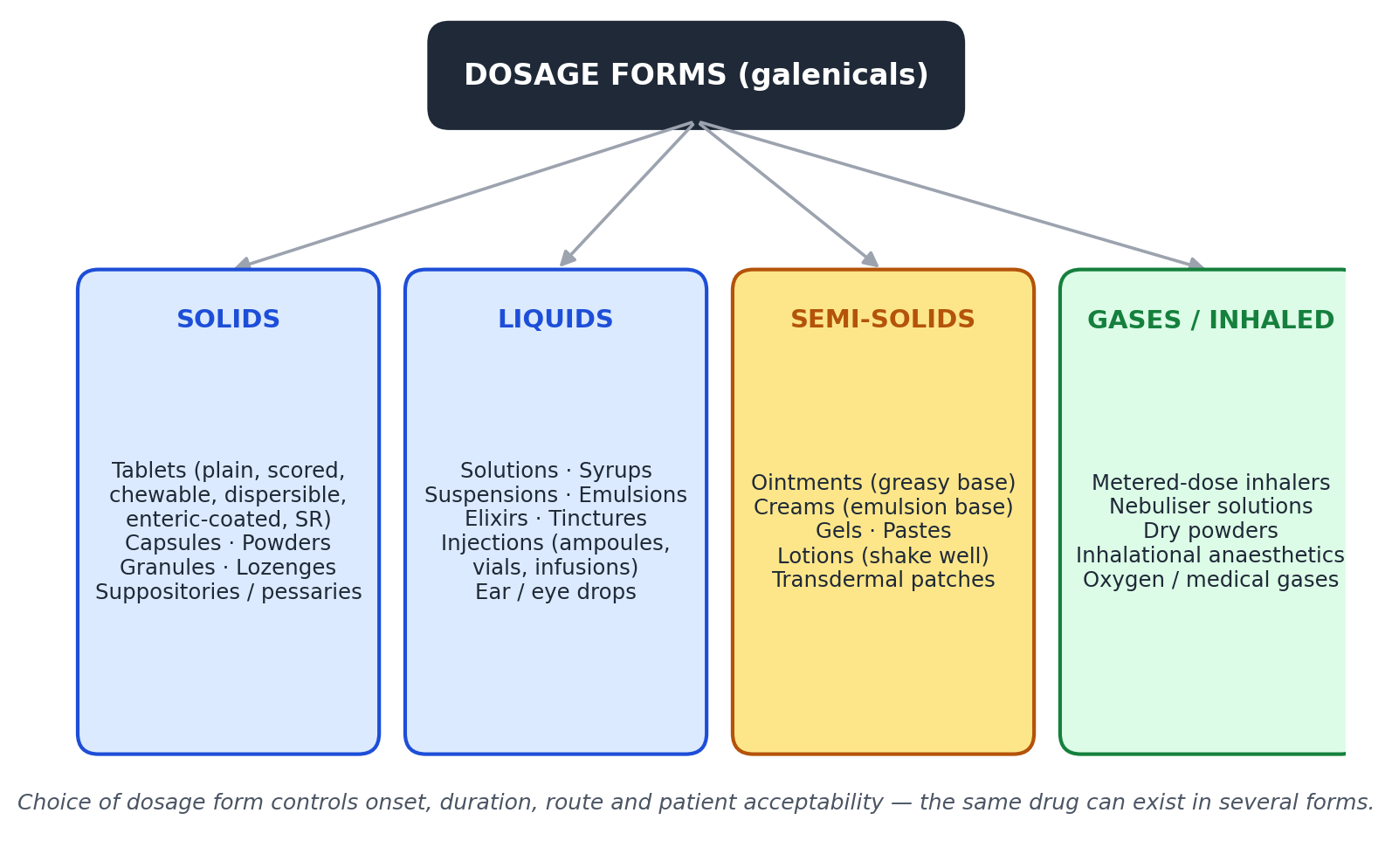
Read the companion dosage-forms note for the detailed classification of tablets, liquids, semi-solids and inhaled preparations.
Scope: from a drug substance to a usable product
Design, preparation and supply
Formulation design chooses the ingredients and how they will work together.
- Manufacturing converts that design into a reproducible product.
- Packaging protects the product and helps the user measure or administer it.
- Distribution must maintain the required conditions until use.
- At each stage, quality assurance aims to prevent errors, while quality-control tests check selected properties of materials or products.
Applications in practice
- Pharmaceutics therefore connects physical chemistry, material science, microbiology, manufacturing and patient care.
- In a hospital, a pharmacist may recognise that a patient cannot swallow a particular tablet.
- In industry, a development team may investigate why that tablet releases its drug too slowly.
- Both questions concern how the product delivers the medicine.
Scroll the table sideways on a smaller screen.
| Term | Meaning | Question it answers |
|---|---|---|
| Formulation | The ingredients, their quantities and the way the product is designed | What is in this preparation, and why? |
| Dosage form | The physical presentation, such as a tablet or suspension | In what form is the medicine supplied? |
| Dose | The amount administered on one occasion | How much API is given? |
| Strength | The amount of API per unit or stated volume | How much API does each tablet or 5 mL contain? |
| Route | The path by which a medicine is administered | Oral, topical, inhaled or another route? |
Dose, strength and volume
- A 125 mg/5 mL suspension illustrates the distinction: suspension is the dosage form, 125 mg/5 mL is the strength, and the prescribed amount in mg is the dose.
- The volume needed depends on the prescribed dose and the product strength.
Preformulation: concept and purpose
Definition
Preformulation is the systematic study of a drug substance and its possible interactions before, and alongside, detailed formulation development.
- It asks: what properties could prevent this substance from becoming a reliable medicine?
Properties investigated
- The study may examine solubility, particle size, crystal form, moisture uptake, chemical stability and compatibility.
- The result is a body of evidence that guides choices.
- A poorly soluble drug may be difficult to put into a true solution.
- A moisture-sensitive drug may need protective packaging and a process that limits water exposure.
When studies are revisited
- Preformulation is not a rigid stage completed once and forgotten.
- A later manufacturing problem may send the team back to study a material property.
- A change in supplier or crystal form may require investigation even when the chemical name is unchanged.
Preformulation versus formulation
- Preformulation establishes what the materials are like and what problems they present.
- Formulation uses that knowledge to design a preparation.
- Product testing then asks whether the actual preparation meets its intended requirements.
- A promising result for the pure API does not prove that the finished product will perform well.
A practical preformulation workflow
- Define the intended product. Identify the patient group, route, dose range, release pattern, storage needs and likely conditions of use.
- Confirm material identity and quality. Record the source, batch, purity information and relevant analytical findings. Study materials must be traceable.
- Characterise the drug substance. Examine the physical, chemical and biological properties relevant to the proposed route and dosage form.
- Investigate possible interactions. Consider the API with proposed excipients, other APIs in a combination product and the packaging.
- Build and test trial formulations. Compare performance rather than choosing ingredients only because they are familiar.
- Use the results to control quality. Decide which material attributes and process conditions need particular attention, document the rationale and review new findings.
This is a teaching sequence, not a substitute for a validated laboratory procedure.
- Tests and acceptance criteria depend on the particular substance and intended product.
Solubility and dissolution
Solubility versus dissolution
Solubility describes how much substance can dissolve in a stated solvent under stated conditions.
- Always specify conditions such as temperature and pH.
- Dissolution describes the process by which a solid enters solution; its rate concerns how quickly this happens.
- A substance may eventually dissolve sufficiently but dissolve too slowly for the intended product.
Solution versus suspension
- A solution contains the drug dissolved at the molecular or ionic level.
- A suspension contains dispersed solid particles.
- Making particles very small does not automatically turn a suspension into a solution.
Factors to investigate
- Solvent: water and other solvents interact differently with the drug. A solvent must also be appropriate for the route and patient.
- Temperature: solubility may change with temperature. A clear hot preparation can precipitate after cooling.
- pH and ionisation: weak acids and bases can change their degree of ionisation as pH changes. This can alter aqueous solubility, but improving solubility alone does not guarantee better absorption.
- Solid form: different crystal arrangements or amorphous material can have different behaviour.
- Particle size and wetting: these can influence dissolution and dispersion, even without changing the equilibrium solubility of the same solid form.
Worked screening example
- Suppose an illustrative API has an equilibrium solubility of 2 mg/mL in the proposed aqueous vehicle at the intended storage conditions.
- A planned strength of 100 mg in 5 mL requires:
Required concentration = 100 mg ÷ 5 mL = 20 mg/mL.
- The target is ten times the measured solubility.
- A true solution cannot be assumed to work under those same conditions.
- Investigate a different justified approach, such as another vehicle, salt/form strategy or a suspension, then assess safety, stability and performance.
- Merely adding more powder cannot create the intended stable solution.
- These numbers are a teaching example, not a compounding formula.
Particle size, crystals and powder behaviour
Powder mixing and dose uniformity
Powders must be handled and processed as materials, not just chemical names.
- Large differences in particle size or density can promote separation during handling.
- If the API separates from the other powder ingredients, individual dosage units may contain different amounts despite a correct total batch calculation.
Crystalline and amorphous forms
- Polymorphism means that a substance can exist in more than one crystal arrangement.
- A different arrangement can affect properties such as dissolution and stability.
- Amorphous material lacks the long-range order of a crystal.
- Its behaviour must be measured; a potentially useful dissolution advantage can come with physical-stability difficulties.
Powder tests
- Powder studies may examine particle-size distribution, flow, bulk and tapped density, and how particles respond to pressure.
- A powder that flows badly may fill capsules or dies inconsistently.
- A powder that does not compact appropriately may produce weak tablets.
- These are reasons to study the intended manufacturing process with the actual materials.
Limits of reducing particle size
- A smaller particle is not always better.
- Fine particles may clump, flow poorly, create handling difficulties or expose more surface to degradation.
- Choose a controlled size range for a defined purpose.
Stability: keeping the product suitable over time
Meaning of stability
Stability concerns whether a material or product retains its relevant quality attributes under specified conditions for a specified time.
- It includes more than keeping the stated amount of API.
- Appearance, degradation products, release behaviour, microbial quality and packaging performance can also matter.
Scroll the table sideways on a smaller screen.
| Problem | Simple explanation | Possible design question |
|---|---|---|
| Hydrolysis | A chemical reaction involving water may break down a susceptible substance | Should water exposure be reduced or a dry presentation considered? |
| Oxidation | Reaction involving oxidising conditions may change the molecule | Do oxygen exposure, formulation ingredients or packaging need investigation? |
| Light sensitivity | Light may cause chemical change | Is protection from light needed? |
| Moisture uptake | A material absorbs water from the surroundings | Could this change powder flow, tablet properties or degradation? |
| Physical instability | Settling, crystal growth, precipitation or phase separation changes the preparation | Can the intended dose still be delivered consistently? |
| Microbial deterioration | Microorganisms may grow where the formulation and conditions allow | What microbial controls and in-use studies are needed? |
Why appearance is insufficient
- Do not decide a shelf life from appearance alone.
- A preparation can look normal while important chemical changes occur.
- Conversely, a change in colour or separation is a reason to investigate, not a precise measurement of remaining potency.
Interpreting accelerated studies
- Accelerated studies expose products to specified stress conditions to help understand change and support stability assessment.
- They do not justify a simple rule that one week in heat equals a fixed number of months on a shelf.
- Valid shelf-life decisions require appropriate studies, methods and interpretation.
Compatibility, excipients and packaging
Types of compatibility
Compatibility means that the proposed combination is suitable for its intended use without an unacceptable interaction.
- Consider API–excipient, API–API, excipient–excipient and product–container interactions.
Functions of excipients
- An excipient may dilute a powder, help particles bind, promote tablet breakup, control release, improve wetting or protect against deterioration.
- “Inactive ingredient” means that it is not the intended therapeutic API; it does not mean that it has no effect on product performance or no possible risk to a patient.
Compatibility screening
- Screening can compare individual materials with mixtures under defined conditions.
- Analytical methods may include chromatography, thermal analysis or spectroscopy, depending on the question.
- A change in a screening result is a signal to investigate; one test alone does not automatically establish a clinically important incompatibility.
Packaging and dosing devices
- The immediate container touches or directly contains the product.
- Its material, closure and any dosing device form part of the design.
- Ask whether moisture, oxygen or light can enter; whether components can move between product and packaging; whether the closure works during repeated use; and whether the device delivers an accurate dose.
- Packaging that protects an unopened product may behave differently after opening.
Quality targets and meaningful tests
Tests for different products
Start with what the product must do for its intended patient and route.
- For an immediate-release tablet, relevant concerns may include identity, API amount, uniformity between units and appropriate release.
- For a suspension, particle behaviour, ease of redispersion and dose delivery also matter.
- For a sterile product, sterility-related requirements are central.
Disintegration versus dissolution
- Disintegration is breakup into smaller pieces.
- Dissolution is entry of drug into solution.
- A tablet can break apart while its drug dissolves poorly.
- Neither result alone proves what blood concentration a patient will achieve.
Specifications and process control
- A specification combines selected tests, analytical procedures and acceptance criteria.
- A product must be designed and manufactured to meet relevant requirements consistently.
- Testing a few samples at the end cannot compensate for an uncontrolled process.
- Record important material properties, manufacturing conditions and the evidence supporting each choice.
Related lessons
- For bioavailability and bioequivalence, continue to Pharmacokinetic Principles.
- For discovery and clinical evaluation, use the existing drug-development lesson.
Applying the ideas: three cases
Case 1: the liquid that forms crystals
- A trial liquid is clear when prepared warm but crystals appear after cooling.
- Explain the likely physical problem.
- Answer: the intended concentration may exceed solubility at the lower temperature, or the material may be changing its solid form.
- Check the actual conditions, identity of the crystals and measured solubility.
- Do not assume that shaking a precipitated solution restores a uniform solution dose.
Case 2: the suspension with a hard sediment
- A suspension settles and cannot be readily redispersed.
- Why does this matter?
- Answer: the withdrawn portion may not contain the intended amount of drug.
- Investigate particle properties, wetting, vehicle and storage effects.
- A “shake well” label cannot fix a formulation that cannot be adequately redispersed.
Case 3: changing the container
- A supplier proposes a cheaper container of the same size.
- Can it be accepted solely because the product fits?
- Answer: no.
- Protection, compatibility, closure performance and dose delivery may change.
- Evaluate the proposed container–product system with suitable evidence before accepting the change.
Recap and self-test
- Pharmaceutics connects material properties, formulation, manufacture, packaging and use.
- Preformulation characterises problems; formulation designs a preparation in response.
- Solubility is a capacity under stated conditions; dissolution concerns entry into solution over time.
- Particle and solid-state properties can affect processing and performance.
- Stability, compatibility and microbiological quality must be considered together.
- A dosage form, a dose and a strength describe different things.
Why is a suspension not necessarily an inferior solution?
It is a different design. A properly developed suspension can be appropriate when a useful concentration cannot be maintained as a solution, provided stability and reliable dose delivery are established.
Does complete tablet disintegration prove complete absorption?
No. Drug dissolution, intestinal conditions, permeability and other pharmacokinetic factors still influence exposure.
What three things should accompany a solubility result?
The substance/solid form tested, the solvent or vehicle and relevant conditions such as temperature and pH. The analytical method and equilibration approach should also be documented.
References and next reading
Foundational teaching synthesis. Regulatory documents support the development framework and should be read in their applicable context.
- ICH Q8(R2), Pharmaceutical Development: components, product development, packaging, microbiological attributes and compatibility.
- WHO pharmaceutical development guidance.
- WHO TRS 1060 Annex 3: GMP for pharmaceutical excipients.
- Drug Formulations and Dosage Forms; Pharmacokinetic Principles.
Teaching note prepared and source links checked: 25 November 2026.