
Anti-Tuberculosis and Anti-Leprosy Drugs
On this page
Overview
The 2HRZE/4HR regimen
Drug-susceptible TB is treated with 2HRZE/4HR: four drugs (isoniazid, rifampicin, pyrazinamide, ethambutol) for 2 months (intensive phase), then isoniazid + rifampicin for 4 months (continuation phase), all dosed daily by weight bands and preferably given as fixed-dose combination tablets.
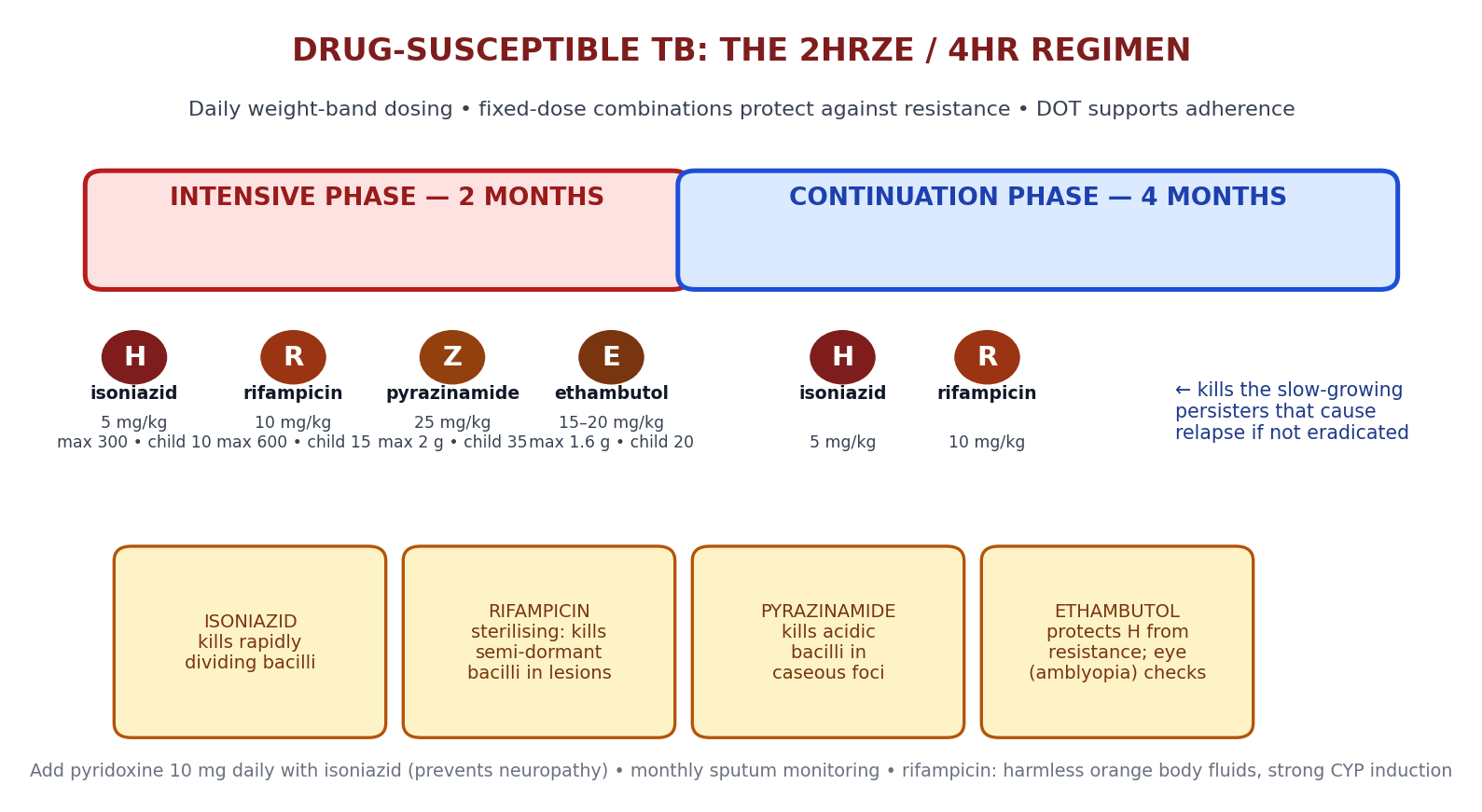
Why four drugs? M. tuberculosis mutates to resistance at a fixed, low rate per division. A bacillus resistant to one drug exists in every large population; a bacillus spontaneously resistant to four drugs is vanishingly rare. Combining drugs with different mechanisms therefore protects the regimen — provided adherence is good, because erratic single-drug exposure is how resistance emerges. Each drug also covers a different bacterial subpopulation (figure 1): isoniazid kills rapidly dividing bacilli, pyrazinamide kills acidic semi-dormant bacilli in caseous foci, rifampicin sterilises lesions by killing semi-dormant persisters, and ethambutol protects isoniazid from resistance while smear results are pending. The continuation phase then eliminates the slow-growing persisters that cause relapse if not eradicated.
First-line anti-TB drugs in detail
Scroll the table sideways on a smaller screen.
| Drug | Adult dose | Paediatric dose | Mechanism | Role / bactericidal niche | Adverse effects & monitoring | Key interactions / counselling |
|---|---|---|---|---|---|---|
| Isoniazid (H) | 5 mg/kg once daily (max 300 mg), oral/IM | 10 mg/kg once daily (max 300 mg); higher mg/kg in young children | Inhibits mycolic-acid synthesis (InhA, katG activation) — bactericidal against dividing bacilli | Most potent early bactericide; core of every regimen; also used alone for TB preventive therapy (6–9 months) | Hepatotoxicity (transaminitis — check LFTs; stop if jaundice), peripheral neuropathy (pyridoxine/vitamin B6 10 mg daily prevents, especially in pregnancy, diabetes, HIV, malnutrition), CNS effects, hypersensitivity | Alcohol ↑ hepatotoxicity; phenytoin, carbamazepine, warfarin levels ↑ (monitor); avoid tyramine-rich food reactions (weak MAO inhibition); orange sweat/tears may stain (with combination products) |
| Rifampicin (R) | 10 mg/kg once daily (max 600 mg); <50 kg usually 450 mg | 15 mg/kg once daily (max 600 mg) | Inhibits DNA-dependent RNA polymerase (rpoB) — bactericidal against semi-dormant bacilli; sterilising activity | The sterilising drug that permits the 6-month duration; also leprosy and staphylococcal prosthetic-device infection | Orange discoloration of urine, tears, sweat (harmless — counsel!), hepatotoxicity, flu-like syndrome with intermittent dosing, thrombocytopenia (rare), renal impairment (rare) | Potent CYP3A4/P-gp inducer — reduces levels of oral contraceptives (use condoms/implant), antiretrovirals (DTG dose ↑, PIs ↓↓), warfarin, many anticonvulsants, azoles; orange soft contact lenses permanently stained |
| Pyrazinamide (Z) | 25 mg/kg once daily (weight bands: 1–1.5–2 g) | 35 mg/kg once daily (max 2 g) | Converted by bacterial pyrazinamidase to pyrazinoic acid; active only in acidic pH — kills bacilli in caseous foci | Intensive phase only (2 months); allowed shortening from 12 to 6 months | Hepatotoxicity, hyperuricaemia → gouty arthritis (monitor urate; analgesia), nausea, flushing | Renal excretion of urate ↓ (allopurinol interaction); avoid in severe hepatic impairment, acute gout |
| Ethambutol (E) | 15–20 mg/kg once daily (max 1.6 g); weight-band tablets | 20 mg/kg once daily (max 1.2 g) | Inhibits arabinosyl transferase — blocks arabinogalactan (cell-wall) synthesis; bacteriostatic | Protects companion drugs from resistance during the intensive phase until susceptibility known; children: can be omitted in low-HIV, low-isoniazid-resistance settings | Optic neuritis (red-green colour blindness, reduced acuity — baseline and monthly visual questioning/testing; reversible if caught early), dose-related; peripheral neuropathy; hyperuricaemia (mild) | Renal impairment: extend interval to 48 h or reduce dose; ask about vision at every visit |
| Streptomycin (S) | 15 mg/kg IM once daily (max 1 g); retreatment regimens only | 15–20 mg/kg IM once daily | Aminoglycoside — binds 30S ribosome | Formerly first line; now reserved (retreatment per national programme, some forms of TB meningitis adjunct) | Vestibular/ototoxicity, nephrotoxicity — see aminoglycosides post | Never with other ototoxins; pregnancy — avoid (fetal VIII-nerve) |
Preventing and managing toxicity
- Hepatotoxicity (isoniazid, rifampicin, pyrazinamide — all three): check baseline and monthly symptoms; stop the regimen if ALT/AST ≥3× upper limit with symptoms or jaundice, or ≥5× without. Reintroduce sequentially under specialist guidance once resolved.
- Peripheral neuropathy (isoniazid): give pyridoxine 10 mg daily to all patients (routine in most programmes), higher risk in pregnancy, diabetes, HIV, alcohol use, malnutrition.
- Optic neuritis (ethambutol): ask about blurred vision and red-green confusion monthly; test acuity/colour vision where possible; stop if optic neuritis develops.
- Hyperuricaemia/gout (pyrazinamide, ethambutol): usually asymptomatic; treat gout attacks without stopping TB therapy where possible.
- Orange body fluids (rifampicin): reassure — urine, tears, sweat turn orange; harmless and expected; it is not blood in urine.
Second-line and drug-resistant TB
Drug-resistant TB (resistance to isoniazid = Hr-TB; multidrug-resistant, MDR = resistant at least to H and R) requires prolonged regimens built from second-line agents under the national TB programme — never improvised at peripheral level.
Scroll the table sideways on a smaller screen.
| Group / agent | Mechanism / class | Key adverse effects | Note |
|---|---|---|---|
| Fluoroquinolones — levofloxacin, moxifloxacin | DNA gyrase | Tendinopathy, QT prolongation, CNS | Backbone of MDR regimens; also Hr-TB |
| Injectable agents — amikacin, capreomycin, streptomycin | Aminoglycosides / cyclic peptide (30S) | Nephro- and ototoxicity (monitor levels) | Largely phased out of shorter regimens; injectable-sparing preferred |
| Linezolid | Oxazolidinone (50S) | Marrow suppression (thrombocytopenia, anaemia), neuropathy, lactic acidosis; weak MAOI | Highly effective vs MDR-TB; monitor FBC weekly early |
| Bedaquiline | ATP synthase inhibitor (novel) | QT prolongation (monitor ECG), hepatotoxicity | Core of the 6-month BPaLM regimen (bedaquiline + pretomanid + linezolid + moxifloxacin) |
| Pretomanid | Nitroimidazole (blocks mycolic-acid synthesis) | Hepatotoxicity, peripheral neuropathy | BPaLM component |
| Clofazimine | Imminophenazine (membrane/ respiratory chain) | Skin discoloration (red-black, reversible), GI, QT prolongation | Also a leprosy drug |
| Cycloserine | Cell-wall (D-alanine analogue) | Psychosis, depression, seizures — neuropsychiatric | Pyridoxine co-prescription; avoid in epilepsy/psychiatric illness |
| Delamanid | Nitroimidazole | QT prolongation, GI | Alternative in children/special situations |
Anti-leprosy drugs and MDT
Leprosy (Mycobacterium leprae) is cured with multidrug therapy (MDT), provided free by WHO. The 2018 WHO guidelines use the same three drugs for all patients — dapsone, rifampicin, clofazimine — for 6 months in paucibacillary (PB) and 12 months in multibacillary (MB) disease. MDT cured millions and broke dapsone monotherapy resistance.
Scroll the table sideways on a smaller screen.
| Drug | Adult dose in MDT | Child dose | Mechanism / role | Adverse effects & counselling |
|---|---|---|---|---|
| Dapsone (DDS) | PB: 100 mg daily, self-administered ×6 months. MB: 100 mg daily ×12 months | <5 y: 25 mg/day; 6–14 y: 50–100 mg/day | Sulphone — PABA antagonist blocking folate synthesis; bacteriostatic; daily backbone of MDT | Haemolytic anaemia (dose-related; avoid in G6PD deficiency — screen where possible), agranulocytosis (fever/sore throat — stop, check FBC), methaemoglobinaemia (cyanosis), allergic rash/exfoliative dermatitis (sulphonamide-allergic patients must not receive it); hepatotoxicity (rare) |
| Rifampicin (R) | 600 mg once monthly, supervised (450 mg if <35 kg) | <5 y: 150–300 mg monthly; 6–14 y: 300–450 mg monthly | RNA-polymerase inhibitor; bactericidal — monthly supervised dose kills a huge fraction of bacilli | Orange urine (counsel), flu-like syndrome with monthly dosing, hepatotoxicity; same CYP induction as in TB (shorter relevance on monthly dosing) |
| Clofazimine (CLF) | MB: 50 mg daily self-administered + 300 mg once monthly supervised ×12 months | <5 y: 100 mg monthly + 100 mg/week; 6–14 y: 150–200 mg monthly + 50 mg/day | Imminophenazine dye; bactericidal slowly; anti-inflammatory — controls type 2 reactions (ENL) | Red-black skin discoloration and dryness (reversible months after stopping — counsel, crucial for adherence), GI upset, QT prolongation (rare at MDT doses) |
- Reactions are immunological, not drug toxicity: type 1 (reversal) reactions — neuritis, new skin lesions; treat with prednisolone promptly to prevent permanent nerve damage. Type 2 (ENL, erythema nodosum leprosum) — painful nodules, fever, neuritis; thalidomide (specialist; teratogenic) ± clofazimine/steroids.
- Single-dose rifampicin post-exposure prophylaxis (SDR-PEP) is recommended for eligible adult contacts of index cases.
- Monthly supervised doses + daily self-administration: adherence support and reaction surveillance are the clinic pillars.
TB–HIV co-treatment principles
- Start ART within 2–8 weeks of TB treatment (earlier in profound immunosuppression per guidelines); watch for TB-associated immune reconstitution inflammatory syndrome (IRIS) — paradoxical clinical worsening as immunity recovers.
- Rifampicin + dolutegravir: rifampicin induces DTG clearance → give dolutegravir 50 mg twice daily during and for 2 weeks after rifampicin.
- Rifampicin + protease inhibitors (LPV/r, ATV/r): rifampicin lowers PI levels markedly — use rifabutin or programme-approved adjustments instead.
- Rifampicin reduces oral contraceptive efficacy — counsel alternative methods.
- Continue cotrimoxazole prophylaxis per HIV guidelines; treat opportunistic infections before/while starting ART.
Clinical scenarios
Scenario 1 — New smear-positive pulmonary TB
A 35-year-old, 60 kg, HIV-negative man has cavitary smear-positive TB confirmed by Xpert (rifampicin-sensitive). You start 2HRZE/4HR with weight-band fixed-dose combinations: isoniazid 300 mg, rifampicin 600 mg, pyrazinamide 1.5 g, ethambutol ~1 g daily; add pyridoxine 10 mg. You counsel on orange urine, the danger of stopping early, and arrange a treatment supporter for DOT. At 2 months he is smear-negative and clinically better — continue isoniazid + rifampicin for 4 more months. At month 3 he reports nausea but no jaundice: check LFTs; if ALT <3× with no symptoms, continue with monitoring.
Scenario 2 — The jaundiced patient on TB therapy
Two months into treatment a patient develops anorexia, vomiting and dark urine with jaundice; ALT 6× upper limit. All three hepatotoxic drugs are stopped. Rule out other causes (viral hepatitis, alcohol, ART). Once LFTs fall, drugs are reintroduced one at a time (usually rifampicin first, then isoniazid ± pyrazinamide under specialist guidance), because abandoning effective TB therapy entirely risks relapse and resistance.
Scenario 3 — Multibacillary leprosy at the clinic
A 40-year-old has multiple asymmetric anaesthetic skin patches and a thickened ulnar nerve — MB leprosy (smear/BI per programme). You start MDT: dapsone 100 mg daily + clofazimine 50 mg daily, plus supervised monthly rifampicin 600 mg + clofazimine 300 mg, for 12 months. You counsel explicitly about the red-black skin discoloration from clofazimine — harmless and reversible — because unexplained, it destroys adherence and fuels stigma. Three weeks later he returns with a painful new patch and wrist drop: a type 1 reversal reaction with neuritis — start prednisolone urgently and refer; protecting nerve function is the treatment goal.
Key points
References
- WHO Guidelines for Tuberculosis Treatment, drug-susceptible and drug-resistant modules (Library reference.)
- WHO Guidelines for the Diagnosis, Treatment and Prevention of Leprosy, 2018 (Library reference.)
- Uganda National Tuberculosis and Leprosy Programme guidelines; Uganda Clinical Guidelines 2023 (Library reference.)
- Katzung's Basic & Clinical Pharmacology — chemotherapy of tuberculosis chapter (Library reference.)
- Goodman & Gilman's The Pharmacological Basis of Therapeutics (Library reference.)
Further reading
For deeper study, compare this lesson with current guidance and standard references from recognised medical and pharmaceutical organisations.
- WHO: Tuberculosis
- WHO: Leprosy (MDT regimens)
- Uganda MoH Knowledge Management Portal (UCG 2023)
- DCM Year One Semester Two curriculum
For education only. TB and leprosy treatment must follow national programme protocols (NTLP) and the current Uganda Clinical Guidelines — never improvise regimens in practice.