
On this page
Overview
Much of what you know, you never practised until after you had already learned it: you watched. Albert Bandura's social (observational) learning theory showed that people acquire behaviours, attitudes and fears by watching models and the consequences those models receive — no direct reinforcement required. It is the bridge between behaviourism (learning through consequences) and cognitive theory (learning through thinking), and it quietly runs both sides of medicine: how patients learn health habits from family and media, and how students become doctors by watching senior clinicians — including the bad habits, through what is called the hidden curriculum.
Learning objectives
- Define social/observational learning and state how it differs from classical and operant conditioning.
- Describe the Bobo doll experiment and its conclusions.
- Name and explain the four processes of observational learning and the types of models.
- Apply the theory to patient education, behaviour change, medical training and the hidden curriculum.
What is social (observational) learning?
Social learning — also called observational learning or modelling — is acquiring new behaviours, attitudes or information by watching other people (models) and observing the consequences that follow their behaviour. Its defining feature: the learner neither performs the behaviour nor receives direct reinforcement during learning — observation alone creates a stored, cognitive representation that can be performed later, when motivated.
Albert Bandura (1925–2021) developed the theory as a deliberate bridge between behaviourism (we learn through reinforcement) and cognitive theory (we learn through thinking). Classical and operant conditioning demanded the learner act and be rewarded; Bandura showed that a child who merely watches a sibling get burned by the stove learns "stoves are dangerous" without ever touching it.
Scroll the table sideways on a smaller screen.
| Theory | Mechanism | Learner | Example |
|---|---|---|---|
| Classical (Pavlov) | Stimulus association; involuntary responses | Passive | Fear of white coats after painful injections |
| Operant (Skinner) | Consequences of own behaviour | Active; must act and be reinforced | Practising ECG interpretation for praise and marks |
| Social (Bandura) | Observation of models and their consequences | Active observer; no direct reinforcement needed | Learning to insert a cannula by watching a senior; a teen starting smoking after watching friends enjoy it |
The Bobo doll experiment
Bandura, Ross and Ross (1961) proved observational learning experimentally using nursery-school children and an inflatable "Bobo doll." The design had three stages:
- Stage 1 — Modelling. Children watched an adult behave aggressively toward the doll (hitting it with a mallet, kicking it, shouting "Pow!"). Control children watched a non-aggressive model or no model at all.
- Stage 2 — Arousal. All children were mildly frustrated (told they could not play with attractive toys) to prime any aggression.
- Stage 3 — Test. Each child was left alone with the doll and observed through a one-way mirror.
Key results: children who had watched the aggressive model imitated the aggressive acts — including novel actions and words they had never performed before; boys showed more physical aggression than girls; and children were more likely to imitate same-sex models. Those who saw the model punished imitated less (the effect of observed consequences — vicarious punishment).
The four processes of observational learning
Bandura identified four processes that must all operate for observation to become behaviour:
Scroll the table sideways on a smaller screen.
| Process | Definition | How to strengthen it in teaching |
|---|---|---|
| 1. Attention | Noticing and attending to the model's behaviour | Reduce distractions; use skilled, respected, similar or high-status models |
| 2. Retention | Encoding and storing the behaviour as mental images or verbal symbols | Summarise, repeat, use mnemonics; encourage mental rehearsal |
| 3. Motor reproduction | Being physically capable of converting the stored representation into action | Break complex skills into steps; supervised practice with feedback |
| 4. Motivation (reinforcement) | Having a reason to perform the behaviour — direct or vicarious | Show benefits; use praise; model success stories and peer exemplars |
A teaching failure at any one process fails the whole chain: a perfect demonstration watched by a distracted student (no attention), a well-attended demonstration never rehearsed (no retention), knowledge a student cannot yet physically perform (no reproduction), or a mastered skill with no reason to use it (no motivation). "See one, do one, teach one" is this table compressed into ward slang.
Models and vicarious reinforcement
Scroll the table sideways on a smaller screen.
| Type | Definition | Examples |
|---|---|---|
| Live models | Real people observed directly | Teachers, parents, senior clinicians, peers, community health workers |
| Symbolic models | People or characters in media | Television, films, radio dramas, instructional videos, health posters |
| Verbal/instructional models | Descriptions and explanations of a behaviour without demonstration | A narrated description of how to do breast self-examination |
What makes a model effective? Models are imitated more when they are perceived as competent, prestigious, similar to the observer (age, sex, background), warm and nurturing, and when their behaviour leads to rewarding outcomes for them. This is why a respected village health worker who quit smoking is worth ten government posters, and why same-age peer educators work in adolescent health programmes.
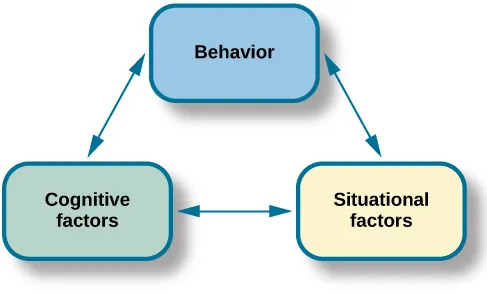
Vicarious (observational) reinforcement and punishment. Watching a model be rewarded increases the observer's likelihood of imitating the behaviour; watching a model be punished decreases it — even though the observer experienced neither. In the Bobo study, children who saw the aggressor reprimanded imitated less. Bandura's later work added reciprocal determinism: behaviour, personal-cognitive factors and environment continuously influence each other — you are neither purely shaped by the world nor purely its shaper.
Applications in healthcare
Scroll the table sideways on a smaller screen.
| Application | How it uses the theory |
|---|---|
| Skills teaching (procedures) | Demonstration (live model) + mental rehearsal (retention) + stepwise practice with feedback (reproduction) + praise (motivation) |
| Behaviour-change campaigns | Radio dramas and testimonial videos use symbolic models; vicarious reinforcement shows the rewarded outcome ("he tested, he protected his family") |
| Peer education | Similarity makes peer models powerful for adolescents — safer sex, drug refusal, clinic attendance |
| Support groups | Recovered patients model coping and hope — vicarious proof that change is possible (alcoholics anonymous, HIV support groups) |
| Reducing procedure fear | A calm "coping model" (a child who handles an injection bravely) is imitated more than a flawless "perfect model" |
| Professional training | Students acquire examination technique, communication style and ethics by watching seniors — hence the duty to model well |
Scenarios and the hidden curriculum
- The student who learned bad habits. A clinical officer interrupts patients, charts one-handed while walking away, and jokes about a psychiatric patient — because three seniors modelled exactly that. No lecture taught it; observation installed it. That is the hidden curriculum, and it out-teaches the formal one.
- The diabetic who learned from his father. His father injected insulin secretly, hid his sweets and eventually died of renal failure. The son, watching, learned diabetes = secrecy and doom. Counselling must re-model: introduce him to a well-controlled patient who lives openly and fully.
- The village that learned hand-washing. A respected midwife demonstrates hand-washing before deliveries at a community meeting and visibly praises two mothers who copy her. Within a month the practice spreads — attention, retention, reproduction and vicarious reinforcement, no posters budget required.
- The teenager who did not smoke. Her close friends tried cigarettes; one coughed violently and was mocked, not praised. Observed punishment (social, vicarious) protected her better than any health talk.
- Your own teaching checklist. Before any demonstration, ask Bandura's four questions: Will they attend? What helps them retain it? Can their hands reproduce it yet? What will motivate them to do it without me?
Examination and viva points
- Define observational learning; attribute it to Bandura and state that it needs no direct reinforcement.
- Outline the Bobo doll experiment (three stages) with its three key results, including vicarious punishment.
- Name the four processes — attention, retention, motor reproduction, motivation — and give a teaching example of strengthening each.
- Define vicarious reinforcement, the three types of models, and reciprocal determinism.
- Apply: design a patient-education or behaviour-change intervention using model selection and the four processes.
Key points
- Social learning: behaviours are acquired by observing models and the consequences models receive — no direct reinforcement needed (Bandura).
- The Bobo doll experiment proved imitation of novel aggression, same-sex model preference, and vicarious punishment.
- Four processes convert observation into behaviour: attention, retention, motor reproduction, motivation.
- Effective models are competent, prestigious, similar, nurturing and visibly rewarded — the theory behind peer education, testimonials and the hidden curriculum.
References and further reading
- Bandura A. Social Learning Theory (1977) — the foundational text. (Library reference.)
- Bandura A, Ross D, Ross SA. Transmission of aggression through imitation of aggressive models. Journal of Abnormal and Social Psychology 1961;63:575–582 — the Bobo doll study. (Library reference.)
- Kalat JW. Introduction to Psychology — learning chapter (observational learning). (Library reference.)
For education only. Apply current Uganda Clinical Guidelines, local protocols and specialist advice in clinical practice.