Personality Trait Theories
A comprehensive study of classical and modern personality theories, detailing the evolution from categorical "Type" theories to dimensional "Trait" theories, featuring the work of Hippocrates, Sheldon, and Eysenck.
1. Introduction to Trait and Type Theories
Personality psychology differentiates between two fundamental conceptual frameworks:
- Type theories: These classify individuals into discrete, non-overlapping categories (e.g., being either an introvert or an extravert).
- Trait theories: These describe personality as a set of continuous dimensions or scales. Every person can be placed at a specific point along these dimensions rather than being "boxed" into a single category.
The three classical approaches—Hippocrates (humours), Sheldon (body build), and Eysenck (dimensions)—illustrate how our understanding of personality types and traits has transitioned from biological fluids to constitutional builds and finally to empirical dimensions.
2. Hippocrates: The Humoral (Four Temperament) Theory
Proposed by the Greek physician Hippocrates (c. 460–370 BC), this theory suggests that both personality and physical health depend on the balance of four primary body humours (fluids). An excess of any one humour produces a distinct characteristic temperament.
| Humour | Temperament | Characteristic Traits |
|---|---|---|
| Blood | Sanguine | Cheerful, active, sociable, talkative, optimistic, easily aroused but interest fades quickly. |
| Yellow bile | Choleric | Irritable, hot-tempered, ambitious, energetic, leader-type, quick to anger. |
| Black bile | Melancholic | Sad, pensive, analytical, perfectionist, quiet, prone to low mood. |
| Phlegm | Phlegmatic | Calm, relaxed, slow to react, patient, reliable, unemotional. |
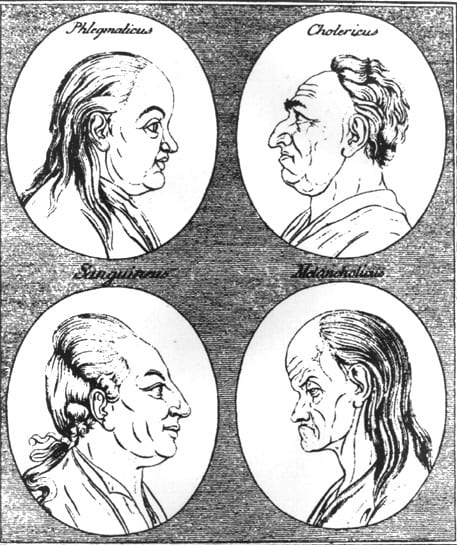
The humoral theory represented the first historical attempt to link personality to internal biological processes. While the specific labels are still used descriptively today, the theory is considered pre-scientific. Its proposed mechanisms are biologically unsupported, and it largely ignores the roles of environmental learning, culture, and individual variation.
3. Sheldon: Somatotype Theory
In the 1940s, William Sheldon postulated that body build (somatotype) is directly linked to temperament. He argued that physique reflects the dominance of one of the three embryonic tissue layers, which in turn determines personality.
| Somatotype | Body Build | Associated Temperament |
|---|---|---|
| Endomorph | Soft, round, plump; predominance of digestive viscera. | Viscerotonic — sociable, comfort-loving, tolerant, even-tempered, loves food and people. |
| Mesomorph | Hard, muscular, rectangular, strong. | Somatotonic — assertive, competitive, energetic, adventurous, risk-taking. |
| Ectomorph | Thin, fragile, linear, delicate. | Cerebrotonic — quiet, reserved, sensitive, self-conscious, prefers mental activity. |
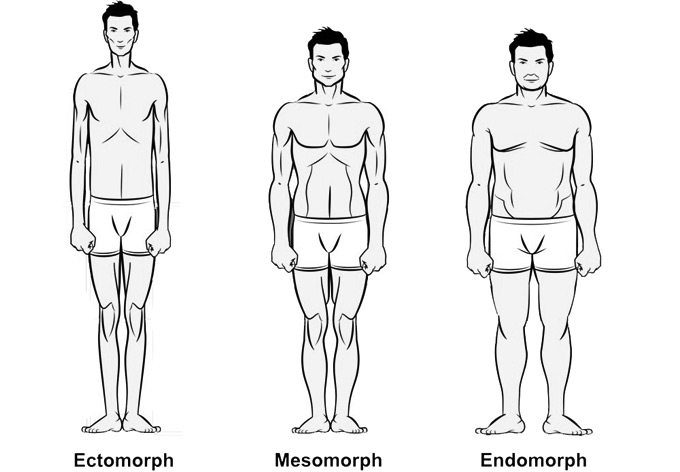
Sheldon's observations influenced early constitutional medicine. However, modern psychology heavily criticizes the theory for overstating the link between physique and personality. Research suggests that temperament is only weakly predicted by body build, and Sheldon's original findings were likely confounded by social expectations and stereotypes regarding appearance.
4. Eysenck: Dimensional Trait Theory
Hans Eysenck developed a more scientifically rigorous model based on statistical analysis. He proposed that personality is composed of two primary super-dimensions:
- Introversion–Extraversion: Concerns the degree of outward vs. inward orientation.
- Neuroticism–Stability: Concerns emotional excitability and instability vs. calmness.
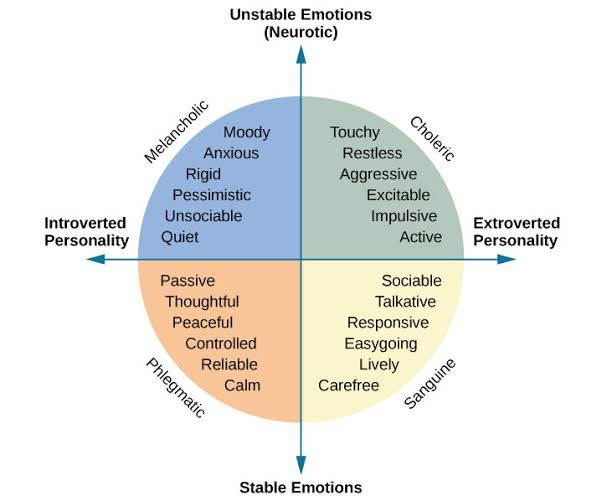
These dimensions define four quadrants that map closely onto the ancient Hippocratic temperaments:
- Stable-Extraverted: Corresponds to Sanguine.
- Unstable-Extraverted: Corresponds to Choleric.
- Stable-Introverted: Corresponds to Phlegmatic.
- Unstable-Introverted: Corresponds to Melancholic.
This convergence demonstrates how a modern, questionnaire-based dimensional model can account for ancient clinical observations.
5. Comparison of the Three Approaches
| Feature | Hippocrates | Sheldon | Eysenck |
|---|---|---|---|
| Basis | Four body humours (fluids) | Body build (somatotype) | Questionnaire-measured dimensions |
| Categories | Sanguine, choleric, melancholic, phlegmatic | Endomorph, mesomorph, ectomorph | Introversion–Extraversion; Neuroticism–Stability; Psychoticism |
| Nature of theory | Type (categorical) | Type/Constitutional (categorical) | Trait (dimensional) |
| Scientific status | Historical; mechanisms disproven | Largely unsupported; correlations weak | Empirically supported; biological grounding |
Key Points
- Hippocrates linked four temperaments to an excess of specific humours: blood, yellow bile, black bile, and phlegm.
- Sheldon linked three body builds to temperament: endomorph (viscerotonic), mesomorph (somatotonic), and ectomorph (cerebrotonic).
- Eysenck identified super-traits (dimensions) such as Extraversion and Neuroticism, providing an empirical bridge to historical type theories.
- Modern personality psychology prefers dimensional trait models over rigid type categories as they provide a more accurate representation of human diversity.