Instrumental/Operant Learning: Principles and Application
A comprehensive study of operant conditioning, detailing the historical foundations, mechanisms of reinforcement and punishment, schedules of delivery, and the practical integration of behavior modification within clinical practice.
1. Definition and Historical Background
Operant conditioning (also known as instrumental learning) is a process where the consequences of a voluntary behavior determine the likelihood of that behavior being repeated. Unlike classical conditioning, which deals with involuntary reflexes, operant learning involves an active learner whose goal-directed actions operate on the environment to produce specific outcomes.
1.1 Thorndike and the Law of Effect
The groundwork was laid by Edward L. Thorndike through his observations of cats in "puzzle boxes." He formulated the Law of Effect, stating that behaviors followed by satisfying consequences are "stamped in," while those followed by discomfort are "stamped out." This established that trial-and-error leads to a faster successful response over time.
1.2 Skinner and the Operant Chamber
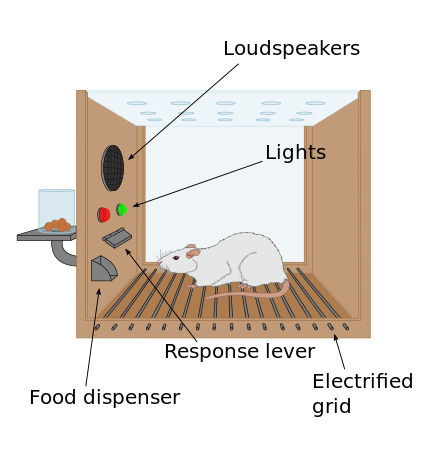
B.F. Skinner refined these principles by developing the Skinner Box. Using rats and pigeons, he demonstrated that behavior could be precisely shaped and modified entirely by its consequences. He introduced the cumulative recorder to provide objective, measurable data on learning rates.
1.3 Comparison with Classical Conditioning
| Feature | Classical Conditioning | Operant Conditioning |
|---|---|---|
| Behavior | Involuntary, reflexive | Voluntary, goal-directed |
| Learning Basis | Association between two stimuli | Association between behavior and consequence |
| Sequence | Stimulus precedes the response | Consequence follows the behavior |
| Learner's Role | Passive | Active |
2. Mechanisms of Operant Procedures
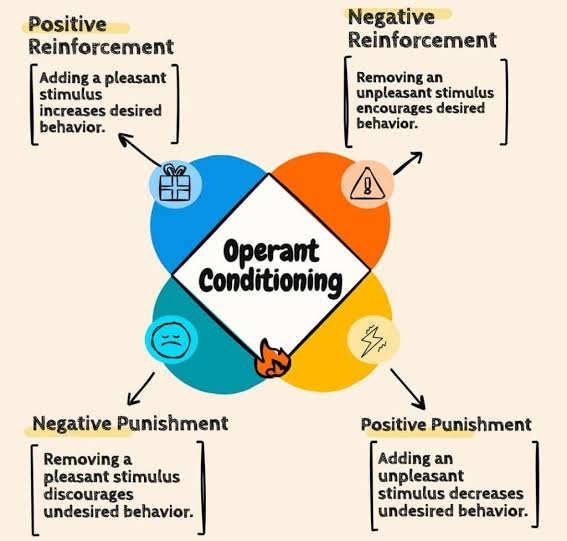
The core of operant conditioning lies in the relationship between an action and its outcome. Any consequence that makes a behavior more likely is a reinforcer; any that makes it less likely is a punishment.
2.1 Reinforcement vs. Punishment
| Procedure | Stimulus Action | Effect on Behavior |
|---|---|---|
| Positive Reinforcement | Add a pleasant stimulus (e.g., praise) | Increase frequency |
| Negative Reinforcement | Remove an unpleasant stimulus (e.g., stopping a buzzer) | Increase frequency |
| Positive Punishment | Add an aversive stimulus (e.g., scolding) | Decrease frequency |
| Negative Punishment | Remove a pleasant stimulus (e.g., time-out) | Decrease frequency |
Negative reinforcement is NOT punishment. Reinforcement (both positive and negative) always aims to increase a behavior. Punishment always aims to decrease a behavior.
2.2 Specialized Reinforcers and Stimuli
- Primary Reinforcers: Naturally satisfying without learning (food, water, relief from pain).
- Secondary Reinforcers: Acquire power through association with primary reinforcers (money, grades, approval).
- Discriminative Stimulus ($S^D$): A cue that signals reinforcement is available (e.g., a nurse's presence cues a patient to take medication).
- Extinction: The decline of a behavior when reinforcement is withdrawn. This is often preceded by an extinction burst (a temporary increase in the behavior).
3. Schedules of Reinforcement
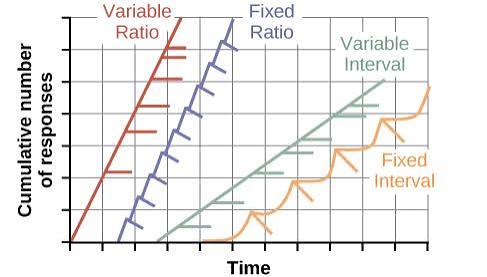
The timing and frequency of reinforcement dictate how quickly a behavior is learned and how resistant it is to extinction.
| Schedule | Rule | Response Pattern |
|---|---|---|
| Fixed Ratio (FR) | Reinforce after a set number of responses | High, steady rate with a brief post-reinforcement pause. |
| Variable Ratio (VR) | Reinforce after an unpredictable number | Highest and most persistent response rate (e.g., gambling). |
| Fixed Interval (FI) | Reinforce after a set time period | "Scalloped" pattern; responses increase as the time for reward nears. |
| Variable Interval (VI) | Reinforce after unpredictable time | Slow, steady, and very persistent responding. |
4. Advanced Behavioral Techniques
Complex clinical behaviors often require more than simple reinforcement.
- Shaping: Reinforcing successive approximations toward a target goal. Used to teach complex tasks or help a stroke patient relearn walking.
- Chaining: Linking a sequence of independent behaviors into a complex chain where each step cues the next.
- Token Economy: A system where desired behaviors earn tokens (secondary reinforcers) that are later exchanged for privileges or goods.
Behavior is shaped by reinforcing small improvements. Successive approximation is the governing principle behind physical rehabilitation and skill training.
5. Applications in Clinical Medicine
Operant principles are the foundation of behavior modification programs across various medical specialties.
| Clinical Application | Principle Used | Practical Example |
|---|---|---|
| Psychiatric Rehabilitation | Token economies | Earning tokens for self-care in chronic schizophrenia wards. |
| Addiction Medicine | Contingency management | Vouchers awarded for negative drug screens. |
| Treatment Adherence | Positive reinforcement | Praise and adherence charts for chronic disease management. |
| Pediatric Management | Extinction | Strategically ignoring tantrums while maintaining safety. |
| Neuro-rehabilitation | Shaping and Chaining | Graded steps for relearning ADLs after a stroke. |
| Quality Improvement | Feedback and Praise | Hand-hygiene audits to reinforce safe clinical practice. |
5.1 Clinical Cautions and Ethics
- Inadvertent Reinforcement: Clinicians must be wary of reinforcing "illness behavior" (e.g., excessive attention given only when a patient complains).
- Consistency: Behavior modification fails if different staff members or family members apply different rules.
- Ethical Standards: Programs must respect patient donomy and dignity. Aversive procedures are strictly restricted and require informed consent.
6. Strengths and Limitations
| Strengths | Limitations |
|---|---|
| Highly objective and measurable outcomes. | Focuses only on observable behavior. |
| Directly applicable to voluntary behavior change. | May underplay internal thoughts, feelings, and insight. |
| Provides the basis for evidence-based interventions. | Over-reliance on extrinsic rewards can undermine intrinsic motivation. |
Interested In Getting Lunch On Friday?
Used to remember the core lumbar plexus/clinical outcomes (re-purposed here for behavioral consistency):
— Interval/Ratio determines rate.
— Individual differences exist.
— Goal-directed nature.
— Learner is active.
— Objective measurement.
— Feedback is essential.