Concept of Attitude: Definition, Components, and Types
A comprehensive psychological study covering the definition, characteristics, ABC model, functions, and clinical relevance of attitudes in medical practice.
1. Definition of Attitude
An attitude is a relatively enduring, learned predisposition to evaluate an object, person, group, event, or issue in a favourable or unfavourable way, and to behave toward it consistently with that evaluation.
Classic definitions include Allport's (1935): "a mental and neural state of readiness, organized through experience, exerting a directive or dynamic influence upon the individual's response to all objects and situations with which it is related," and the description by Krech and Crutchfield of attitude as an enduring organization of motivational, emotional, perceptual, and cognitive processes with respect to some aspect of the individual's world.
In simpler terms, an attitude is what a person thinks and feels about something, and how that predisposes them to act. The "something" toward which the attitude is held is the attitude object (e.g., immunisation, doctors, a disease, a political idea).
1.1 Characteristics (nature) of Attitudes
- Learned: Attitudes are acquired through experience, learning, and socialisation; they are not innate.
- Relatively enduring: Attitudes persist over time, although they can be changed by new information, persuasion, or experience.
- Evaluative: They involve a favourable or unfavourable judgment about the attitude object (like-dislike, approve-disapprove, for-against).
- Predispositional: An attitude is a readiness to respond in a particular way; it is not the behaviour itself.
- Directed toward an object: Every attitude has an object — a person, thing, event, idea, or institution.
- Organized: The components of an attitude tend to be internally consistent, though conflict between them is possible (cognitive dissonance).
- Influential: Attitudes guide how information is perceived and interpreted and how the person behaves toward the object.
- Vary in strength: Some attitudes are central and highly resistant to change; others are weak and easily modified.
2. Components of Attitude: The ABC Model
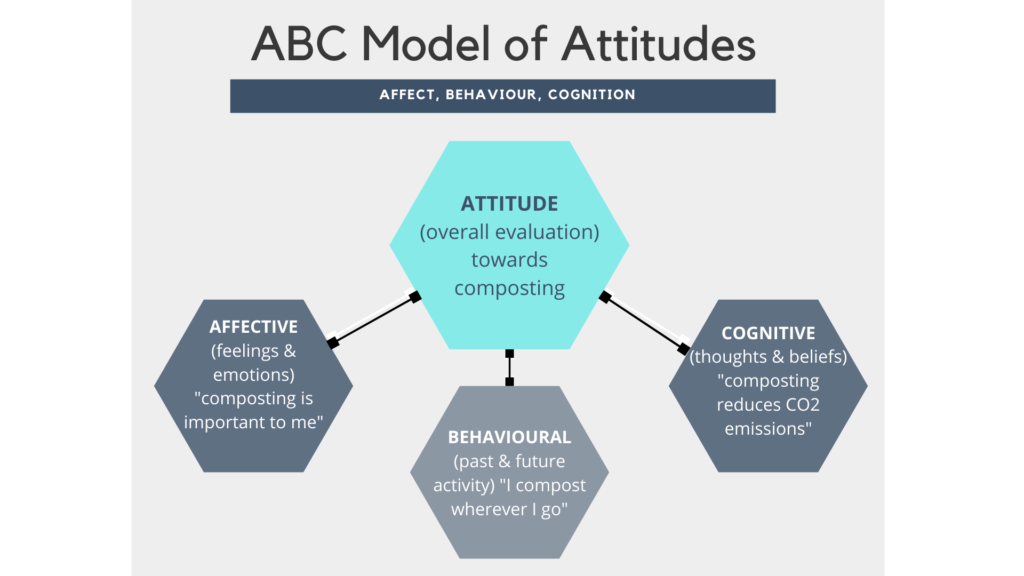
Every attitude consists of three components, conventionally arranged in the ABC model:
| Component | Also called | What it consists of | Example (object: childhood immunisation) |
|---|---|---|---|
| Affective | Emotional component | Feelings and emotions toward the object (like, dislike, fear, anger, trust) | "I feel anxious when my child is vaccinated." |
| Behavioural | Conative component | The tendency or predisposition to act toward the object in a particular way | "I will take my child for vaccination" / "I will refuse it." |
| Cognitive | Belief component | Thoughts, beliefs, and knowledge about the object | "I believe vaccination protects my child from dangerous diseases." |
The three components are usually consistent with one another (believing vaccination is safe, feeling positive about it, and vaccinating the child). When they conflict, the affective component often dominates; persistent inconsistency produces cognitive dissonance.
Attitudes predict behaviour best when all three components are aligned, when the attitude is strong and specific, and when situational pressures are weak.
3. Functions of Attitudes
According to Katz (1960), attitudes serve four psychological functions; understanding them explains why people hold and defend their attitudes:
| Function | Purpose the attitude serves | Example |
|---|---|---|
| Knowledge (cognitive) | Organizes and simplifies the world; provides a frame for interpreting information quickly | "Clinics are for sick people" — organizes how a person views health facilities |
| Utilitarian (adjustive) | Helps obtain rewards and avoid punishments by conforming to social expectations | A student expresses attitudes approved by the clinical teacher |
| Ego-defensive | Protects self-esteem and justifies behaviour the person feels guilty about | A smoker belittles anti-smoking evidence to defend the habit |
| Value-expressive | Expresses the person's core values and identity | Supporting community health programs expresses a value of compassion |
4. Types of Attitudes
4.1 Based on direction (evaluation)
- Positive attitudes: favourable evaluations that approach the object — e.g., optimism, trust in health services, openness to change.
- Negative attitudes: unfavourable evaluations that avoid or oppose the object — e.g., prejudice, fear of hospitals, distrust of medication.
4.2 Based on awareness
- Explicit attitudes: attitudes the person is aware of and can report consciously (e.g., stating a preference for traditional medicine).
- Implicit attitudes: automatic, unconscious evaluations revealed indirectly through behaviour or reaction-time tests; they may conflict with explicit attitudes.
4.3 Based on importance to the self
- Central attitudes: closely connected to core values and identity; strong, stable, and highly resistant to change (e.g., religious attitudes, professional ethics).
- Peripheral attitudes: less important and weakly held; easily changed by new information (e.g., preference for one brand of soap).
4.4 Based on ownership
- Individual attitudes: held by a single person, based on personal experience.
- Group (shared) attitudes: common to a social, cultural, occupational, or religious group; transmitted by socialisation and reinforced by group norms (e.g., community attitudes toward blood donation).
4.5 Based on the attitude object
| Type | Description | Example |
|---|---|---|
| Attitude toward persons | Evaluations of individuals or groups | Trust or distrust of doctors; prejudice toward people with HIV |
| Attitude toward self | Self-evaluation; the basis of self-esteem and self-image | A patient's belief in their ability to manage diabetes (self-efficacy) |
| Attitude toward events/situations | Evaluations of occurrences or circumstances | Fear of surgery; attitude toward ageing |
| Attitude toward ideas/issues | Evaluations of concepts or policies | Attitude toward contraception, organ donation, vaccination |
| Attitude toward objects/institutions | Evaluations of things or organizations | Attitude toward hospitals, traditional healers, the government |
4.6 Health-related attitudes
In clinical practice, attitudes are usefully classified by their effect on health behaviour:
- Facilitating (positive) attitudes support health — e.g., belief in the value of immunisation, trust in the treatment team, willingness to change lifestyle.
- Blocking (negative) attitudes hinder health — e.g., fatalism about disease, stigma toward mental illness, distrust of orthodox medicine, denial of illness.
Identifying whether a patient's attitude is facilitating or blocking is the first step in adherence counseling: blocking attitudes must be explored and respectfully challenged, not ignored.
5. Attitude vs Belief vs Value vs Behaviour
| Concept | Definition | Example |
|---|---|---|
| Belief | A conviction that something is true or false, without necessarily involving strong feeling or evaluation | "Smoking causes lung cancer." |
| Attitude | A learned evaluative predisposition combining beliefs, feelings, and behavioural tendencies toward an object | "I disapprove of smoking and avoid smokers." |
| Value | A deep, enduring standard about what is good, right, or desirable, guiding attitudes across many situations | "Health is more important than pleasure." |
| Behaviour | The observable action itself | Refusing a cigarette; attending an antenatal clinic |
Values shape attitudes, and attitudes shape behaviour — but the link is not automatic: behaviour is also influenced by habits, social pressure, cost, access, and opportunity.
6. Clinical Relevance of Attitudes
- Patient attitudes toward illness, treatment, and health workers strongly influence help-seeking, adherence, and outcomes — e.g., fatalism delays presentation; distrust of medication leads to poor adherence.
- Provider attitudes directly affect quality of care: prejudice or stigma toward patients with HIV, TB, mental illness, or substance-use disorders results in disrespectful care and poorer outcomes.
- Community attitudes determine acceptance of public-health programs (immunisation, family planning, safe water) and the social support available to patients.
- Because attitudes are learned, they can be changed by education, persuasion, modelling, and experience — the basis of health promotion and behaviour-change counseling.
7. Summary
- An attitude is a learned, relatively enduring, evaluative predisposition toward an attitude object, with cognitive, affective, and behavioural components (ABC model).
- Attitudes serve knowledge, utilitarian, ego-defensive, and value-expressive functions.
- Types of attitudes include positive/negative, explicit/implicit, central/peripheral, individual/group, and attitudes toward persons, self, events, ideas, and institutions; in health they are classified as facilitating or blocking.
- Values shape attitudes and attitudes predispose to behaviour, though the attitude-behaviour link is modified by situational factors.
- Patient, provider, and community attitudes markedly affect health behaviour, quality of care, and the success of public-health programs.