Composition and Functions of Blood
Complete study notes covering the definition, general characteristics, detailed composition of plasma and formed elements, hematopoiesis, and clinical correlations.
1. Composition and Functions of Blood
1.1 Definition and General Characteristics
Blood is a specialized connective tissue consisting of cells suspended in a liquid extracellular matrix called plasma. It circulates through the heart, arteries, capillaries, and veins, maintaining homeostasis throughout the body.
Key Parameters:
- Total blood volume: ~7-8% of body weight (5-6 L in a 70 kg adult male).
- pH: 7.35-7.45 (slightly alkaline).
- Temperature: ~38°C (slightly higher than core body temperature).
- Viscosity: 3-5 times greater than water.
- Color: Bright red (oxygenated) to dark red (deoxygenated).
- Specific gravity: 1.055-1.065.
1.2 Composition of Blood
Blood consists of two principal components:
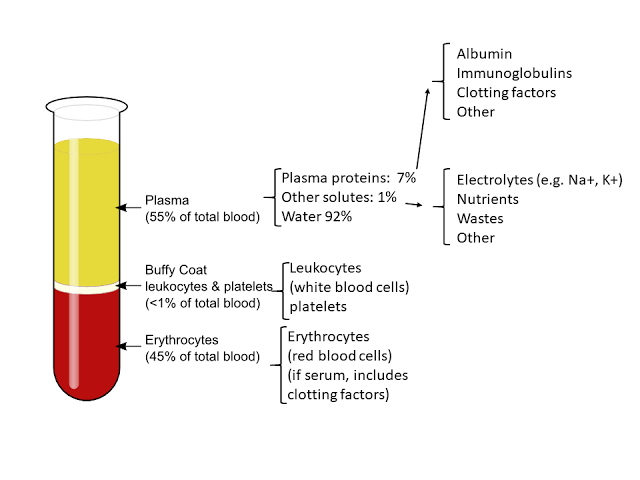
| Component | Percentage | Constituents |
|---|---|---|
| Plasma | 55% | Water (92%), proteins (7%), solutes (1%) |
| Formed elements | 45% | Erythrocytes (99%), leukocytes, platelets |
| Buffy coat | <1% | Leukocytes and platelets (after centrifugation) |
1.2.1 Plasma
Plasma is the straw-colored liquid portion of blood.
- Water (92%): Serves as solvent for transport.
- Plasma Proteins (7%):
- Albumin: Liver origin; maintains colloid osmotic pressure; transports fatty acids, bilirubin, and drugs.
- Globulins: Alpha/beta transport lipids, iron, copper; gamma = immunoglobulins.
- Fibrinogen: Liver origin; essential for blood clotting (converted to fibrin).
- Other Solutes (1%):
- Electrolytes (Na+, K+, Ca2+, Mg2+, Cl-, HCO3-, HPO4^2-)
- Nutrients (glucose, amino acids, fatty acids, vitamins)
- Waste products (urea, uric acid, creatinine, bilirubin)
- Respiratory gases (O2, CO2) and hormones
1.2.2 Erythrocytes (Red Blood Cells)
Structure:
- Biconcave disc shape; 7-8 um in diameter.
- Anucleate (no nucleus) and lack organelles in mature form.
- Cell membrane contains spectrin and actin for flexibility through capillaries.
- Cytoplasm filled with hemoglobin (~280 million molecules per cell).
Hemoglobin:
- Molecular weight: 64,458 Da.
- Four polypeptide chains (2 alpha, 2 beta in adults = HbA) + four heme groups.
- Each heme contains Fe2+ binding one O2 molecule.
- Normal types: HbA (95-98%), HbA2 (2-3%), HbF (<1% in adults).
Function: Transport of O2 from lungs to tissues and CO2 from tissues to lungs.
Normal Values:
| Parameter | Adult Male | Adult Female |
|---|---|---|
| RBC count | 4.5-5.5 x 10^12/L | 4.0-5.0 x 10^12/L |
| Hemoglobin | 13.5-17.5 g/dL | 12.0-16.0 g/dL |
| Hematocrit | 40-54% | 37-47% |
| MCV | 80-100 fL | 80-100 fL |
| MCH | 27-33 pg | 27-33 pg |
| MCHC | 32-36 g/dL | 32-36 g/dL |
Lifespan: 120 days. Senescent RBCs removed by macrophages in spleen, liver, and bone marrow.
1.2.3 Leukocytes (White Blood Cells)
Leukocytes are nucleated cells critical for immune defense.
| Type | % | Key Features | Functions |
|---|---|---|---|
| Neutrophils | 50-70% | Multilobed nucleus (2-5); Fine lilac granules | Phagocytosis of bacteria; first responders to acute inflammation |
| Eosinophils | 1-4% | Bilobed nucleus; red-orange granules | Defense against parasites; modulate allergic responses |
| Basophils | 0.5-1% | S-lobed nucleus; deep blue granules | Release histamine and heparin; mediate allergic reactions |
| Lymphocytes | 20-40% | Large round nucleus; scant cytoplasm | B cells = antibodies; T cells = cellular immunity; NK cells = tumors |
| Monocytes | 2-8% | Kidney-shaped nucleus; gray cytoplasm | Differentiate into macrophages; phagocytosis; antigen presentation |
Normal total WBC count: 4,000-11,000 cells/uL (4.0-11.0 x 10^9/L).
1.2.4 Platelets (Thrombocytes)
- Small cell fragments (2-4 um) derived from megakaryocytes in bone marrow.
- Anucleate but contain mitochondria, lysosomes, and granules.
- Normal count: 150,000-400,000/uL (150-400 x 10^9/L).
- Lifespan: 8-10 days.
Functions:
- Formation of platelet plugs during hemostasis.
- Clot retraction through actin and myosin filaments.
- Release of growth factors (PDGF) promoting tissue repair.
1.3 Hematopoiesis
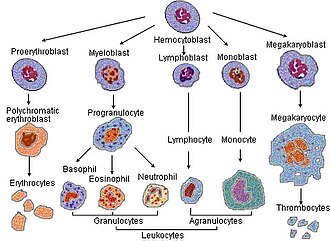
Hematopoiesis is the process of blood cell formation. In adults, it occurs primarily in red bone marrow (sternum, ribs, vertebrae, pelvis, proximal femurs, and humeri).
Stages:
- Pluripotent hematopoietic stem cells — self-renewal and differentiation.
- Multipotent progenitor cells — myeloid and lymphoid lineages.
- Committed progenitor cells — specific cell lines.
- Precursor cells (blasts) — immature forms with specific morphology.
- Mature cells — released into circulation.
Key Regulatory Factors:
- Erythropoietin (EPO): Kidney production; stimulates erythropoiesis.
- Colony-stimulating factors (CSFs): Stimulate granulocyte/monocyte production.
- Thrombopoietin (TPO): Stimulates megakaryocyte and platelet production.
- Interleukins: Regulate lymphocyte development and immune responses.
1.4 Functions of Blood
| Function | Mechanism | Clinical Relevance |
|---|---|---|
| Transport | Carries O2, CO2, nutrients, hormones, waste products, heat | Hypoxia in anemia; uremia in renal failure |
| Regulation | Buffers pH (bicarbonate); regulates temperature; maintains osmotic pressure | Acid-base disorders; edema in hypoalbuminemia |
| Protection | Immune function (WBCs, antibodies); hemostasis (platelets, clotting factors) | Immunodeficiency; bleeding disorders |
1.5 Clinical Correlation: Complete Blood Count (CBC)
The CBC is the most commonly ordered hematological investigation. It provides:
- RBC count, hemoglobin, hematocrit.
- RBC indices (MCV, MCH, MCHC, RDW).
- WBC count with differential.
- Platelet count.
- Peripheral blood smear morphology.
A peripheral blood smear examination remains essential for confirming automated CBC findings and identifying morphological abnormalities such as sickle cells, schistocytes, or blast cells.
Summary — Composition and Functions of Blood
- Blood volume: 5-6 L in adults.
- Plasma vs Formed elements: 55% vs 45%.
- RBC Lifespan: 120 days.
- Platelet Lifespan: 8-10 days.
- Hematopoiesis: Occurs in red bone marrow, regulated by EPO, TPO, and cytokines.
- Primary functions: Transport, Regulation, and Protection.