Theory of Cognitive and Moral Development
A comprehensive study of Jean Piaget's stages of intellectual growth and Lawrence Kohlberg's levels of moral reasoning, with exhaustive detail on milestones, core concepts, and clinical applications in pediatric and adolescent medicine.
PART A: JEAN PIAGET'S THEORY OF COGNITIVE DEVELOPMENT
1. Introduction
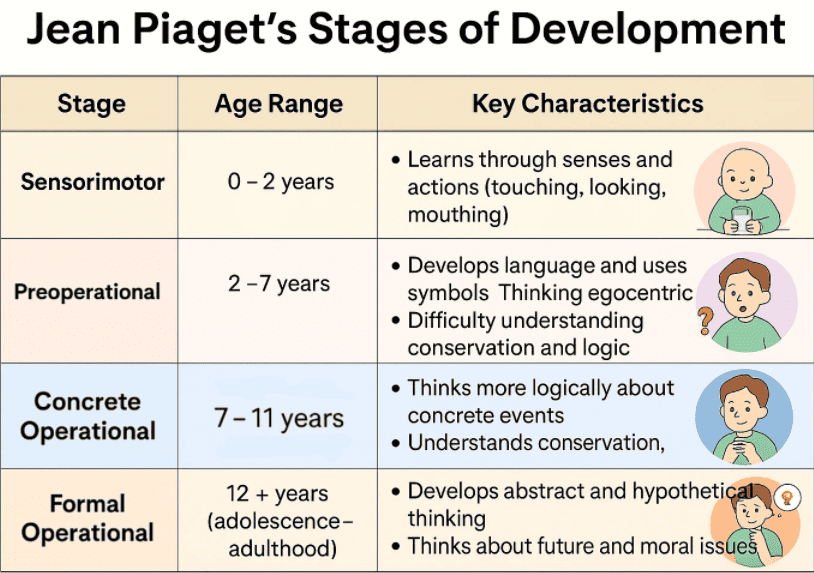
Jean Piaget (1896–1980) proposed that cognitive development occurs through an invariant sequence of four qualitatively distinct stages. Each stage represents a fundamentally different way of understanding and interacting with the world. Progression is driven by the interaction between maturation, experience, and equilibration—the process of balancing existing knowledge with new information.
1.1 Core Concepts
- Schemas: Mental frameworks or categories that organize knowledge. These become increasingly complex as children develop.
- Assimilation: The process of incorporating new information into existing schemas.
- Accommodation: Modifying existing schemas or creating new ones to fit new information that does not fit current frameworks.
- Equilibration: The internal drive to maintain cognitive balance through the processes of assimilation and accommodation.
2. SENSORIMOTOR STAGE (BIRTH TO 2 YEARS)
In this stage, infants learn about the world through sensory experiences and motor actions. Knowledge is limited to what can be directly perceived and manipulated. The child progresses from reflexive behavior to intentional, goal-directed action.
2.1 Key Achievements and Substages
- Reflexes (0–1 month): Newborns respond to environmental stimuli with innate reflexes such as sucking, grasping, rooting, and the Moro reflex.
- Primary circular reactions (1–4 months): Infants repeat pleasurable actions centered on their own bodies (e.g., thumb-sucking).
- Secondary circular reactions (4–8 months): Infants repeat actions that produce interesting effects on the environment (e.g., shaking a rattle to hear the sound).
- Coordination of secondary schemes (8–12 months): Infants begin to combine actions to achieve specific goals (e.g., removing a cover to reach a hidden toy).
- Tertiary circular reactions (12–18 months): Toddlers experiment actively with "trial and error" to discover new outcomes (e.g., dropping objects from different heights).
- Mental representation (18–24 months): The child develops symbolic thought and deferred imitation.
Object Permanence: The understanding that objects continue to exist even when they are out of sight. This typically develops fully toward the end of the sensorimotor stage.
2.2 Clinical Relevance
Object permanence is assessed clinically through the peek-a-boo game and hidden object tasks. Failure to develop this by 12–18 months may indicate cognitive impairment. Encouraging sensory-motor play and object permanence games supports healthy development.
3. PREOPERATIONAL STAGE (2 TO 7 YEARS)
This stage is characterized by the emergence of symbolic thought and language. Children begin to use words, images, and symbols to represent objects; however, thinking remains egocentric and illogical by adult standards.
3.1 Key Characteristics
- Symbolic function: Children engage in pretend play, use language to represent absent objects, and draw pictures symbolically.
- Egocentrism: The inability to distinguish one's own perspective from that of others. Demonstrated by the "three mountains task," where the child assumes a doll sees exactly what they see.
- Centration: Focusing on only one aspect of a situation while ignoring others.
- Irreversibility: The inability to mentally reverse actions (e.g., failing to realize that a ball of clay rolled into a "snake" can be rolled back into a ball).
- Animism: Attributing life and intentions to inanimate objects (e.g., "the moon follows me").
- Artificialism: Believing that natural phenomena are created by humans (e.g., "someone made the sun").
Health education for preoperational children must be concrete and visual. Abstract explanations are not understood. Use play therapy, picture books, and role-playing to help them process medical experiences. Clinicians should counsel caregivers that egocentrism is developmental, not a sign of defiance.
4. CONCRETE OPERATIONAL STAGE (7 TO 11 YEARS)
Children develop the ability to think logically about concrete, tangible events. They can perform mental operations—actions carried out in the mind rather than through physical manipulation.
4.1 Key Achievements
- Conservation: Understanding that quantity (number, mass, volume) remains constant despite changes in appearance.
- Classification: The ability to group objects into categories and subcategories based on multiple attributes (e.g., sorting by color AND shape).
- Seriation: The ability to arrange objects in a logical quantitative order (e.g., ordering sticks by length).
- Reversibility: Understanding that mental operations can be reversed (e.g., 3 + 5 = 8, therefore 8 - 5 = 3).
- Decentration: The ability to consider multiple aspects of a problem simultaneously.
4.2 Limitations and Clinical Relevance
Thinking remains tied to concrete reality; "what if" scenarios and abstract metaphors are not yet accessible. School-age children benefit from hands-on learning, diagrams, and step-by-step instructions. Informed assent for medical procedures should be concrete.
5. FORMAL OPERATIONAL STAGE (12 YEARS AND ABOVE)
Represents mature, abstract reasoning. Adolescents can think hypothetically, reason deductively, and consider multiple variables simultaneously.
5.1 Key Achievements
- Hypothetical-deductive reasoning: The ability to formulate hypotheses and systematically test them.
- Abstract thought: Understanding complex concepts such as justice, love, freedom, and identity.
- Propositional logic: Reasoning about statements without reference to concrete reality.
- Metacognition: Thinking about one's own thinking processes.
- Idealism: Constructing idealized visions of society.
Newfound abstract thought may produce the "imaginary audience"—the belief that others are constantly observing and evaluating them. This is critical when discussing sensitive health topics like substance use or sexual health.
PART B: LAWRENCE KOHLBERG'S THEORY OF MORAL DEVELOPMENT
6. Introduction
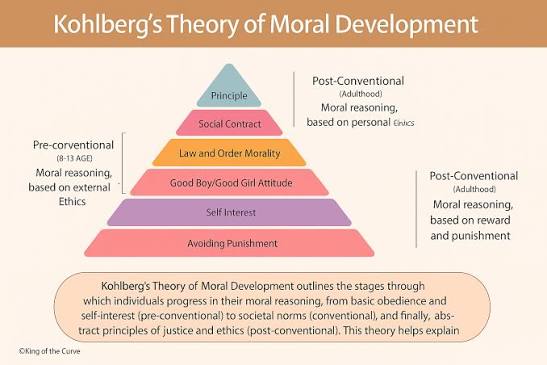
Lawrence Kohlberg (1927–1987) proposed that moral reasoning progresses through three levels, each containing two stages. He assessed this through hypothetical moral dilemmas, most notably the Heinz dilemma (deciding whether to steal a drug to save a life).
7. LEVEL 1: PRECONVENTIONAL MORALITY
Typical of young children (4–10 years). Moral reasoning is based on direct consequences to the self.
- Stage 1: Obedience and Punishment Orientation: Behavior is defined by authority. An action is wrong if it results in punishment. Reasoning: "Heinz should not steal because he will go to jail."
- Stage 2: Individualism and Exchange: Behavior is guided by self-interest and "fair deals." Recognizes different viewpoints based on personal needs. Reasoning: "It's fair to steal if he promises to pay back later."
8. LEVEL 2: CONVENTIONAL MORALITY
Typical of adolescents and most adults. Reasoning is based on conformity to social norms and laws.
- Stage 3: Good Interpersonal Relationships: Emphasis is on being a "good person" and maintaining trust, caring, and loyalty. Reasoning: "Heinz should steal because a good husband protects his wife."
- Stage 4: Maintaining the Social Order: Respect for authority and social institutions. Laws are seen as necessary for society to function. Reasoning: "Laws must be obeyed unless they conflict with other duties."
9. LEVEL 3: POSTCONVENTIONAL MORALITY
Achieved by a minority of adults. Reasoning is based on abstract principles of justice and ethics.
- Stage 5: Social Contract and Individual Rights: Laws are viewed as social contracts that should be changed if they don't serve the greater good. Reasoning: "The right to life is more fundamental than property rights."
- Stage 6: Universal Principles: Moral reasoning is guided by self-chosen ethical principles (justice, equality). These apply even when they conflict with laws. Reasoning: "Preserving human life is a universal moral imperative."
10. SUMMARY TABLE: PIAGET AND KOHLBERG
| Theorist | Stage/Level | Age Range | Key Characteristics |
|---|---|---|---|
| Piaget | Sensorimotor | 0–2 years | Object permanence; sensory-motor exploration |
| Piaget | Preoperational | 2–7 years | Symbolic thought; egocentrism; lack of conservation |
| Piaget | Concrete Operational | 7–11 years | Logical reasoning about concrete events; conservation |
| Piaget | Formal Operational | 12+ years | Abstract reasoning; hypothetical-deductive thought |
| Kohlberg | Preconventional | 4–10 years | Obedience to avoid punishment; self-interest |
| Kohlberg | Conventional | Adol.–Adult | Social norms; law and order; good relationships |
| Kohlberg | Postconventional | Adult (Minority) | Universal ethical principles; social contract |
11. CLINICAL RELEVANCE & KEY POINTS
Understanding these stages informs patient communication and consent. Adolescents in the formal operational stage can engage in abstract risk-benefit discussions, whereas concrete operational children need physical demonstrations of equipment.
Key Summary Points
- Piaget's stages are invariant; children must pass through them in order.
- Core Piagetian concepts include schemas, assimilation, accommodation, and object permanence.
- Kohlberg’s levels move from self-interest to social conformity to abstract ethics.
- Most adults function at the Conventional Level of moral reasoning.