THEORIES OF MOTIVATION
1. Categorization of Motivation Theories
This document explores the foundational theories in management and psychology used to understand employee and human motivation.
- NEED OR CONTENT THEORY
- Need hierarchy theory - Maslow
- Two factor theory - Frederick Herzberg
- ERG theory - Clayton Alderfer
- Acquired-needs theory - David C. McClelland
- COGNITIVE THEORIES
- Equity theory - J. Stacy Adams
- EXPECTANCY THEORIES
- Expectancy theory - Victor H. Vroom
- Porter and Lawler model
- REINFORCEMENT & BEHAVIOURAL THEORIES
- Reinforcement theory - B.F. Skinner
- Theory X and Theory Y - McGregor
- Theory Z - Ouchi
To remember the Content Theories: Need ERG Expectancy (Cognitive) Douglas (McGregor) Equity Reinforcement. (Or simply recall: Maslow, Herzberg, Alderfer, McClelland.)
2. Douglas McGregor's Theory X and Theory Y
- Theory X and Theory Y are two sets of assumptions about human nature. They describe two contrasting models of workforce motivation.
- Theory X and Theory Y have to do with the perceptions managers hold on their employees, not the way they generally behave.
Assumptions of Theory X
- The average human being is inherently lazy by nature and desires to work as little as possible.
- He avoids accepting responsibility and prefers to be led or directed by some other.
- He is self-centered and indifferent to organizational needs.
- He has little ambition, dislikes responsibility, prefers to be led but wants security.
- He is not very intelligent and lacks creativity in solving organizational problems.
- He is, by nature, resistant to change of any type.
Theory X = "X-out Creativity": Managers assume employees are lazy, avoid responsibility, and resist change. They need constant direction and punishment.
Assumptions of Theory Y
- An average man is not really against doing work.
- People can be self-directed and creative at work if they are motivated properly.
- External control and threats of punishment alone do not bring out efforts towards organizational objectives.
- People have capacity to exercise imagination and creativity.
- People are not by nature passive or resistant to organizational needs.
- An average human being learns under proper conditions. He is also willing to accept responsibility.
Theory Y = "Yes to Growth": Managers assume employees are self-directed, creative, and seek responsibility. Motivation comes from proper conditions, not threats.
3. Abraham Maslow’s Hierarchy of Needs Theory
Maslow's theory is based on the Hierarchy of Human Needs. According to Maslow, human behavior is related to his needs. It is adjusted as per the nature of needs to be satisfied. In hierarchy of needs theory, Maslow identified five types / sets of human need arranged in a hierarchy of their importance and priority:
- Physiological Needs
- Security / Safety Needs
- Social Needs
- Esteem Needs
- Self-actualization Needs
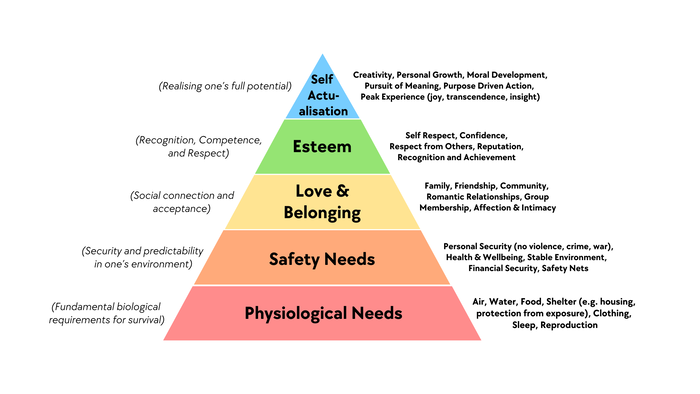
Physiological, Safety, Social, Esteem, Self-actualization. "Please Stop Seeking Empty Satisfaction" (to remember the progression).
4. Clayton Alderfer’s ERG Theory
- This theory, like Maslow's theory, describes needs as a hierarchy. Maslow's Five needs have been condensed into Three needs:
- Existence needs: These include need for basic material necessities. In short, it includes an individual's physiological and physical safety needs.
- Relatedness needs: Maslow's social needs and external component of esteem needs fall under this class of need.
- Growth needs: Maslow's self-actualization needs and intrinsic component of esteem needs fall under this category of need.
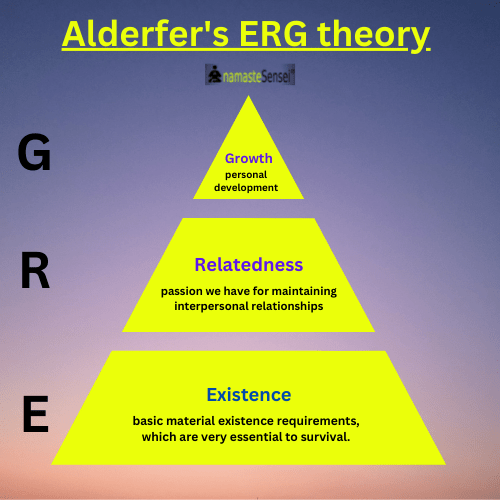
Existence, Relatedness, Growth. "Energy, Relationships, Growth."
5. David McClelland’s Acquired Needs Theory
- McClelland classified three basic motivating needs:
- Need for achievement (nACH): The n-ach person is 'achievement motivated' and therefore seeks achievement, attainment of realistic but challenging goals, and advancement in the job.
- Need for Power (nPWR): The n-pow person is 'authority motivated'. This driver produces a need to be influential, effective and to make an impact. There is a strong need to lead and for their ideas to prevail.
- Need for Affiliation (nAFF): The n-affil person is 'affiliation motivated', and has a need for friendly relationships and is motivated towards interaction with other people.
Achievement, Power, Affiliation. The APA model of acquired needs.
6. Frederick Herzberg’s Two-Factor Theory
- This Theory was propounded by American Psychologist Frederick Herzberg.
- It is also known as "Herzberg's motivation-hygiene theory" and "Dual-Factor Theory".
- The Theory states that there are certain factors in the workplace that cause job satisfaction, while a separate set of factors cause dissatisfaction. In other words, factors that cause job dissatisfaction are different from the factors that lead to job satisfaction.
- The opposite of satisfaction is not dissatisfaction but 'No Satisfaction'.
- Similarly, The opposite of dissatisfaction is not satisfaction but 'No Dissatisfaction'.
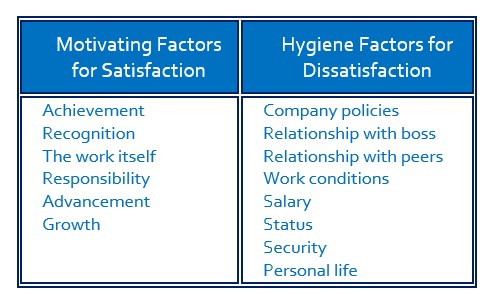
Motivators vs. Hygiene Factors
- Motivators: (e.g. challenging work, recognition, responsibility) that give positive satisfaction, arising from intrinsic conditions of the job itself, such as recognition, achievement, or personal growth.
- Hygiene factors: (e.g. status, job security, salary, fringe benefits, work conditions) that do not give positive satisfaction, though dissatisfaction results from their absence. These are extrinsic to the work itself, and include aspects such as company policies, supervisory practices, or wages/salary.
Hygiene factors keep you from being Hurt (Dissatisfaction). Motivators get you More (Satisfaction).
7. Equity Theory (J. Stacy Adams)
- First developed in 1963 by John Stacey Adams, a workplace and behavioral psychologist, the equity theory is based on the human instinct of comparison with others.
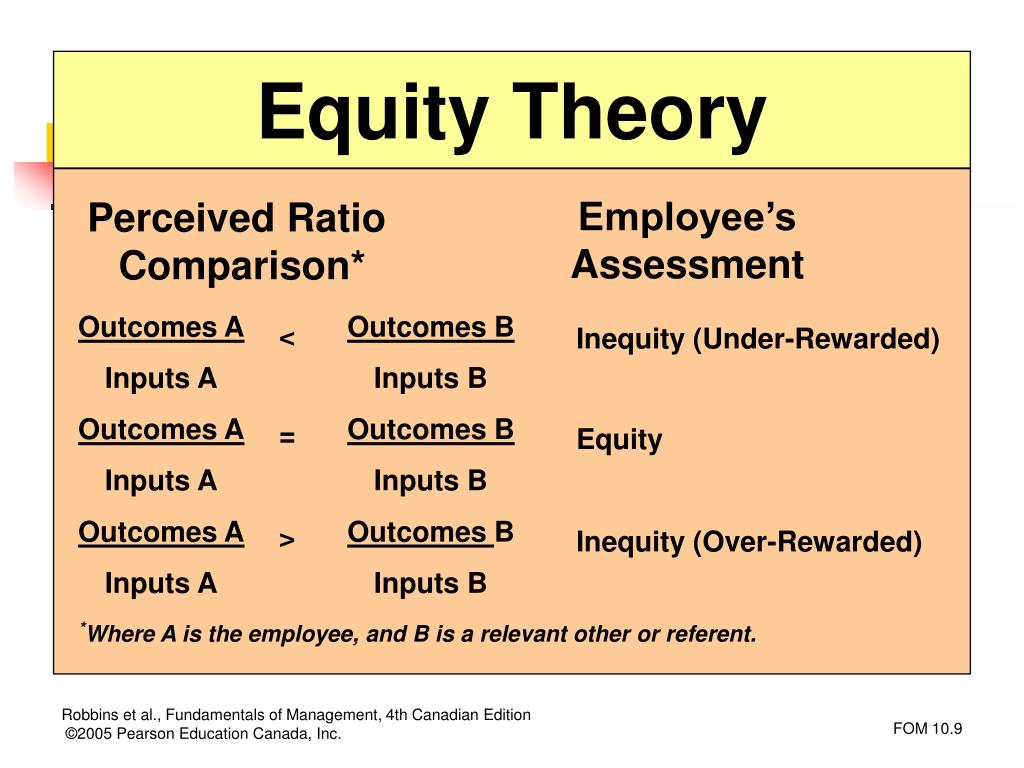
- Equity theory states that employees seek to maintain equity between the inputs that they bring to a job and the outcomes that they receive from it against the perceived inputs and outcomes of others.
- While evaluating fairness, employee compares the job input (in terms of contribution) to outcome (in terms of compensation) and also compares the same with that of another peer of equal cadre/category. O/I ratio (output-input ratio) is used to make such a comparison.
- The persons, system or selves against which individuals compare themselves are known as Referents.
- Referents can be classified as: 1. Persons, 2. Systems, 3. Self.
8. B.F. Skinner’s Reinforcement Theory
- According to this theory, past actions and their outcomes influence a person's present and future actions.
- Past behaviours associated with positive outcomes are repeated in future and behaviours associated with negative outcomes are not repeated.
- Therefore, the behaviour of a person is not influenced by his inner needs and desires but by the external environment.
Kinds of Reinforcements
- Positive Reinforcement: Such as a pay raise or promotion, is provided as a reward for positive behavior with the intention of increasing the probability that the desired behavior will be repeated.
- Negative Reinforcement: An attempt to show an employee what the consequences of improper behavior will be. If an employee does not engage in improper behavior, he or she will not experience the consequence.
- Punishment: Such as suspensions, threats, etc., is an attempt to decrease the likelihood of a behavior recurring by applying negative consequences.
- Extinction Behaviour: Basically ignoring the behavior of a subordinate and not providing either positive or negative reinforcement.
9. Edwin Locke’s Goal Setting Theory
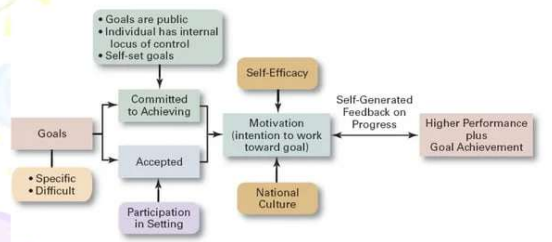
- Goal-Setting Theory: Proposes that setting specific goals increase performance, and difficult (challenging) goals result in higher performance than easy goals.
- Benefits of Goal-Setting: The specificity (particularity) of the goal itself acts as an internal stimulus (stimulation).
- Example: When a sales representative commits (promises) to making eight sales calls daily, this commitment gives him/her a specific goal to attain.
10. William Ouchi’s Theory Z
- Theory Z is an approach to management based upon a combination of American and Japanese management philosophies and characterized by, among other things, long-term job security, consensual decision making, slow evaluation and promotion procedures, and individual responsibility within a group context. Proponents of Theory Z suggest that it leads to improvements in organizational performance.
| Feature | American Org | Japanese Org | Theory Z |
|---|---|---|---|
| Employment | Short-term | Lifetime | Lifetime |
| Decision Making | Individual | Collective | Collective |
| Responsibility | Individual | Collective | Individual |
| Promotion | Rapid | Slow | Slow |
| Control | Explicit | Implicit | Implicit |
11. Victor Vroom’s Expectancy Theory
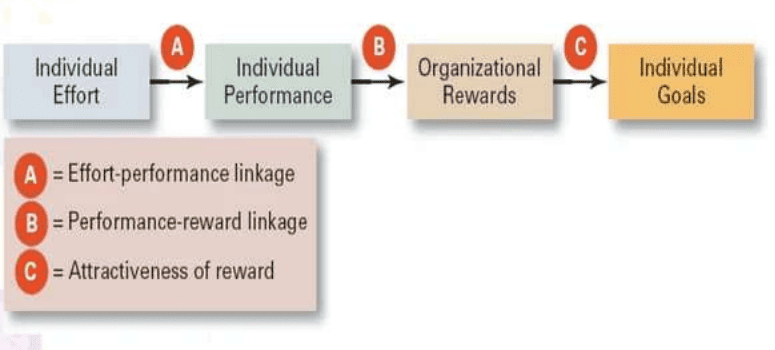
- This theory states that an individual tends to act in a certain way based on: a) the expectation that the act will be followed by a given outcome and b) the attractiveness of that outcome to the individual.
- Key to the theory is understanding employee goals and the linkages (relationships) between effort, performance and rewards.
Motivation = Expectancy X Instrumentality X Valence
The Three Linkages:
- Expectancy (effort-performance linkage): How hard do I have to work to achieve a certain level of performance? And Can I actually achieve that level?
- Instrumentality (performance-reward linkage): What reward will that level of performance get me?
- Valence or attractiveness of reward: How attractive is the reward to me?
12. The Porter-Lawler Model of Motivation
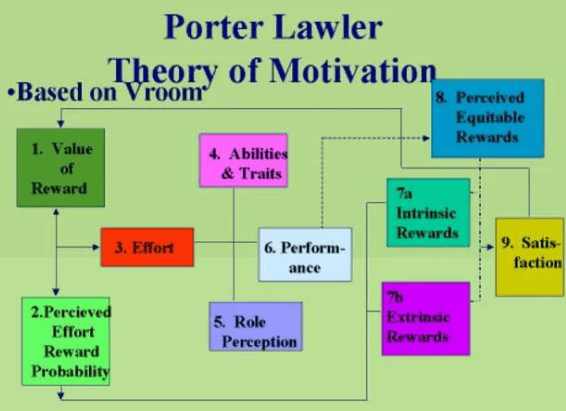
- Lyman W. Porter and Edward E. Lawler developed a more complete version of the expectancy theory.
- The theory states actual performance in a job is primarily determined by the effort spent. But it is also affected by the person's ability to do the job and also by individual's perception of what the required task is. So performance is the responsible factor that leads to intrinsic as well as extrinsic rewards. These rewards, along with the equity of individual leads to satisfaction. Hence, satisfaction of the individual depends upon the fairness of the reward.
13. Job Design Theory
- The Theory states that managers should design jobs deliberately and thoughtfully to reflect the demands of the changing environment, the organization's technology and employees' skills, abilities, and preferences.
- When jobs are designed like that, employees are motivated to work hard.
- Managers can design motivating jobs in the following ways:
- Job Enlargement
- Job Enrichment
- Job Characteristic model.
Job Characteristics Model
Given by Richard Hackman and Greg Oldham. Elements:
- Core job characteristics: Skill variety, tasks identity, tasks significance, autonomy, feedback.
- Critical Psychological states: Feeling that the work is meaningful, knowing that they are responsible, actually finding out the results.
- Outcomes: High internal work motivation, high satisfaction of growth needs, high degree of job satisfaction, high degree of work effectiveness.