Behaviour and Health Behaviour
A comprehensive study on the definition, classification, and models of behavior, specifically focusing on the critical role of health-related behaviors in clinical medicine and diagnostics.
1. Definition of Behaviour
Behaviour is any observable and measurable activity or response of an organism to internal or external stimuli. It is the way an individual acts or conducts themselves and results from the interaction of biological makeup, learning, personality, and the environment.
Classification of Behaviour
| Basis | Types | Description |
|---|---|---|
| Origin | Innate vs. Learned | Innate = Reflexes and instincts; Learned = Behaviour is acquired through experience. |
| Visibility | Overt vs. Covert | Overt = Directly observable actions; Covert = Internal (thoughts, feelings). |
| Mode | Verbal vs. Non-verbal | Spoken/written language versus posture, gestures, facial expression, tone. |
| Function | Adaptive vs. Maladaptive | Promotes adjustment and health versus maintains dysfunction or harm. |
| Control | Conscious vs. Reflexive | Deliberate actions versus automatic, habituated, or driven by reflexes. |
Non-verbal behaviour, especially eye contact, posture, facial expression, and gestures, conveys emotional states that patients may not verbalise, and they contribute significantly to doctor-patient communication.
2. Health Behaviour
Health behaviour refers to any action undertaken by a person to maintain, promote, or restore health, or to prevent disease. The related concept of illness behaviour describes how people perceive, evaluate, and act upon symptoms.
Kasl and Cobb’s Classification
| Category | Definition | Examples |
|---|---|---|
| Preventive health behaviour | Activity by a healthy person to prevent disease or detect it early. | Immunisation, balanced diet, exercise, condom use, screening (BP, cervical smear). |
| Illness behaviour | Activity by a person who feels ill to define the illness and seek relief. | Interpreting a headache, self-medication, consulting a traditional healer or clinic. |
| Sick-role behaviour | Activity of a person diagnosed with illness to get well. | Adhering to prescribed treatment, attending follow-up, modifying lifestyle. |
3. Models Explaining Health Behaviour
Understanding why people engage in specific health behaviors is vital for clinical intervention. Several psychological models provide frameworks for this analysis.
A. The Health Belief Model (HBM)
The Health Belief Model posits that demographic and psychological variables shape perceptions which determine the likelihood of action.
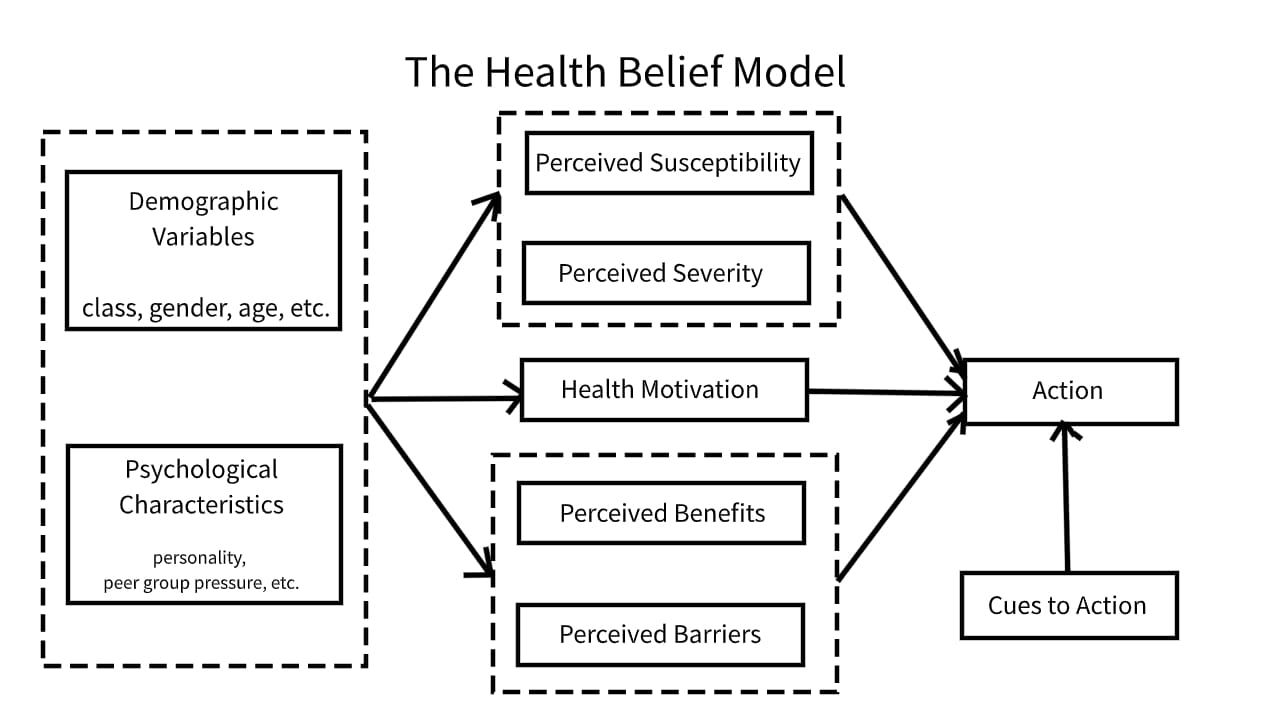
- Perceived Susceptibility: One's opinion of chances of getting a condition.
- Perceived Severity: One's opinion of how serious a condition and its consequences are.
- Perceived Benefits: One's belief in the efficacy of the advised action to reduce risk or seriousness of impact.
- Perceived Barriers: One's opinion of the tangible and psychological costs of the advised action.
- Cues to Action: Strategies to activate "readiness" (e.g., reminders, media reports).
- Self-Efficacy: Confidence in one's ability to take action.
B. Theory of Planned Behaviour
Behaviour is predicted by intention, which depends on:
- Attitude toward the behaviour: Personal evaluation of the behavior.
- Subjective norms: What important others think of the behavior.
- Perceived behavioural control: Self-efficacy or belief in one's control over the action.
C. Social Cognitive Theory (Bandura)
Behaviour is shaped by self-efficacy, outcome expectations, observational learning of role models, and facilitating or hindering environmental factors.
D. Transtheoretical (Stages-of-Change) Model
Behaviour change progresses through discrete stages:
- Pre-contemplation: No intention to take action in the foreseeable future.
- Contemplation: Intending to start the healthy behavior in the next 6 months.
- Preparation: Ready to take action within the next 30 days.
- Action: Recently changed behavior (less than 6 months).
- Maintenance: Sustained behavior change (more than 6 months).
- Relapse: Falling back to previous behaviors (a possible stage at any point).
4. Role of Health Behaviour in Clinical Medicine
Health behavior is central to the effectiveness of clinical outcomes and the sustainability of health systems.
- Disease Prevention: Non-communicable diseases (hypertension, diabetes, ischaemic heart disease, cancers) and many communicable diseases (HIV/AIDS, TB, malaria, hepatitis) are strongly influenced by behaviour; modifying risk behaviour is the most cost-effective intervention available.
- Treatment Adherence: Drug-taking, dietary, and lifestyle prescriptions succeed only when behaviour supports them; non-adherence is a leading cause of treatment failure.
- Health Education and Promotion: Clinics are ideal settings for counselling on immunisation, nutrition, exercise, safe sex, smoking cessation, and alcohol reduction.
- Illness Behaviour and Care-seeking: Understanding how patients interpret symptoms and why they may delay or bypass formal care helps clinicians design acceptable services.
- Community Health: Health behaviour spreads through social networks; role models and community mobilisation amplify prevention efforts.
- Cost Containment: Preventing disease and complications through behaviour change reduces the burden on families and health systems.
Key Points
- Behaviour is an observable response to stimuli; its health-related forms include preventive, illness, and sick-role behaviour.
- The Health Belief Model explains why people take action based on perceived susceptibility, severity, benefits, and barriers.
- The Stages-of-Change Model recognises that behaviour change is a process, not an event, and interventions should match the patient's current stage.
- Modifying health behaviour is the most cost-effective intervention for managing the global burden of both chronic and infectious diseases.