Disorders of Skin Appendages
A comprehensive clinical study of the most common dermatological conditions affecting the pilosebaceous unit and skin structures, specifically covering Psoriasis, Acne Vulgaris, and various forms of Alopecia.
1. OVERVIEW
Disorders of skin appendages represent a significant portion of dermatological consultations. Psoriasis, acne vulgaris, and alopecia affect millions globally, carrying profound physical, psychological, and social impacts. This guide details the etiology, pathophysiology, clinical classification, and multidisciplinary management of these conditions.
2. PSORIASIS
Psoriasis is a chronic, immune-mediated inflammatory skin disease characterized by well-demarcated erythematous plaques with a silvery scale. It affects 2–3% of the global population, typically peaking between ages 15 and 35. It is recognized as a systemic disease associated with psoriatic arthritis, cardiovascular disease, and metabolic syndrome.
2.1 Etiology and Pathophysiology
- Genetics: Strong familial clustering; ~30% of patients have a first-degree relative with the condition. Key susceptibility loci include PSORS1 (HLA-Cw6) on chromosome 6p21.
- Immune Mechanisms: T-cell-mediated autoimmunity. Activation of Th1, Th17, and Th22 pathways leads to the production of IL-17 and IL-22, which stimulate keratinocyte hyperproliferation.
- Keratinocyte Hyperproliferation: Normal epidermal turnover (28–40 days) is accelerated to 3–5 days. This results in incomplete keratinization (parakeratosis), retained nuclei in the stratum corneum, and neutrophil accumulation (Munro microabscesses).
- Environmental Triggers: Streptococcal pharyngitis (triggers guttate psoriasis), physical trauma (Koebner phenomenon), stress, smoking, and medications (Lithium, Beta-blockers, Antimalarials).
2.2 Clinical Features and Types
- Plaque Psoriasis (Psoriasis Vulgaris): The most common type (80–90%). Presents as thick, silvery-white scales on extensor surfaces (elbows, knees), scalp, and lumbosacral region.
- Guttate Psoriasis: Sudden onset of small (0.5–1.5 cm) drop-like papules; often follows a streptococcal infection in young adults.
- Inverse Psoriasis: Affects skin folds (axilla, groin, inframammary); lacks scale due to moisture, appearing smooth and shiny.
- Pustular Psoriasis: Characterized by sterile pustules on an erythematous base. The von Zumbusch type is a systemic medical emergency with fever and leukocytosis.
- Erythrodermic Psoriasis: Generalized erythema and scaling involving >90% of body surface area. High risk of hypothermia, dehydration, and cardiac failure.
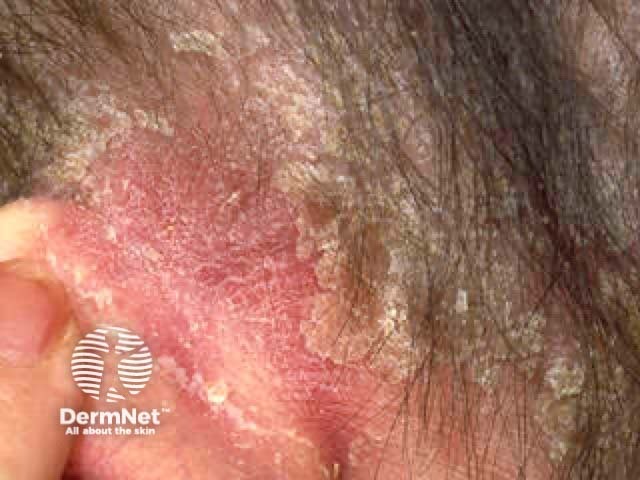
• Auspitz Sign: Pinpoint bleeding after the removal of a scale.
• Koebner Phenomenon: Development of new psoriatic lesions at sites of skin trauma (scratches, surgical scars).
2.3 Assessment and Diagnosis
Diagnosis is usually clinical. Skin biopsy findings include regular acanthosis, parakeratosis, elongation of rete ridges, and Munro microabscesses.
- PASI (Psoriasis Area and Severity Index): Quantifies extent and severity.
- Nail Involvement: Pitting, onycholysis (separation of nail from bed), subungual hyperkeratosis, and oil-drop signs.
2.4 Management
Topical Therapy (Mild to Moderate)
- Corticosteroids: First-line treatment; potency based on site.
- Vitamin D Analogues (Calcipotriene): Slows keratinocyte proliferation.
- Tazarotene: Topical retinoid that normalizes differentiation.
- Coal Tar/Salicylic Acid: Reduces inflammation and removes scales.
Systemic and Biologic Therapy (Moderate to Severe)
- Phototherapy: Narrowband UVB (311 nm) or PUVA.
- Oral Agents: Methotrexate (folate antagonist), Cyclosporine (calcineurin inhibitor), or Acitretin (oral retinoid).
- Biologics: TNF-α inhibitors (Adalimumab, Infliximab), IL-17 inhibitors (Secukinumab), and IL-23 inhibitors.
3. ACNE VULGARIS
Acne vulgaris is a chronic inflammatory disease of the pilosebaceous unit. It affects ~85% of adolescents and can persist into adulthood in 50% of cases.
3.1 Etiology and Pathophysiology
Acne results from four primary pathogenic factors:
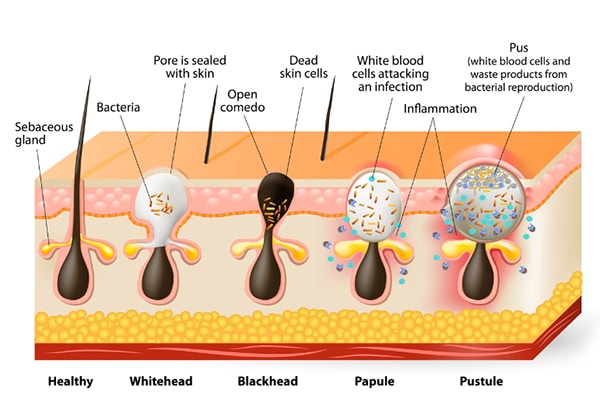
- Follicular Hyperkeratinization: Abnormal desquamation plugs the follicle, creating a microcomedone.
- Sebum Production: Androgens (Testosterone/DHT) stimulate sebaceous glands.
- Cutibacterium acnes Colonization: Anaerobic bacteria proliferate in the obstructed follicle, breaking down triglycerides into free fatty acids.
- Inflammation: *C. acnes* activates Toll-like receptor 2 (TLR2), triggering the release of pro-inflammatory cytokines (IL-1, TNF-α).
3.2 Clinical Classification
- Non-inflammatory: Open comedones (blackheads) and Closed comedones (whiteheads).
- Inflammatory: Papules, pustules, nodules, and cysts.
| Severity | Characteristics |
|---|---|
| Mild | Few comedones and occasional papules/pustules. |
| Moderate | Multiple comedones, papules, and pustules; limited nodules. |
| Severe | Numerous inflammatory lesions with nodulocystic changes and significant scarring risk. |
3.4 Management
- Topical Retinoids: Tretinoin, Adapalene. First-line for comedones; normalizes keratinization.
- Benzoyl Peroxide: Antibacterial (reduces *C. acnes*); prevents antibiotic resistance.
- Systemic Antibiotics: Doxycycline, Minocycline (limit to 3–6 months).
- Hormonal Therapy: Combined oral contraceptives or Spironolactone (females only).
Isotretinoin (Accutane)
The most effective treatment for severe cystic acne. It reduces sebum production by 90%. It is highly teratogenic; female patients must have two negative pregnancy tests and use two forms of contraception (iPLEDGE program).
4. ALOPECIA
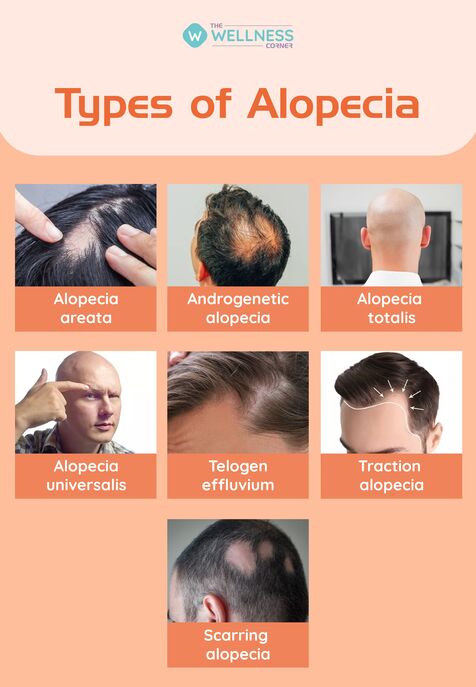
Alopecia refers to hair loss from the scalp or body. It is classified as non-scarring (reversible) or scarring/cicatricial (permanent).
4.1 Androgenetic Alopecia (Pattern Hair Loss)
The most common form of hair loss. Genetic predisposition leads to androgen sensitivity, causing miniaturization of terminal hairs into vellus hairs.
- Men: Bitemporal recession and vertex thinning (Hamilton-Norwood scale).
- Women: Diffuse thinning over the crown with preserved frontal hairline (Ludwig scale).
- Management: Minoxidil (topical), Finasteride (oral 5α-reductase inhibitor).
4.2 Alopecia Areata
An autoimmune disorder where T-cells attack hair follicles. Presents as smooth, well-circumscribed patches of hair loss. Pathognomonic feature: "Exclamation mark hairs" (short, broken hairs wider at the distal end).
- Subtypes: Totalis (whole scalp), Universalis (whole body), Ophiasis (band-like loss along occipital margin).
- Management: Intralesional corticosteroid injections are first-line.
4.3 Telogen Effluvium
Diffuse hair shedding caused by a shift of follicles into the telogen (resting) phase. Triggered 2–3 months prior by stressors: high fever, surgery, childbirth, or severe illness. Characterized by a positive hair pull test (>10% of hairs removed).
4.5 Tinea Capitis (Scalp Ringworm)
Fungal infection of the scalp. Presents with patchy alopecia, scaling, and pruritus.
— Black dot pattern: Broken hairs at the scalp surface.
— Kerion: Severe inflammatory, painful boggy mass.
— Diagnosis: KOH preparation or Wood's lamp examination.
— Management: Oral antifungal (Griseofulvin or Terbinafine) is required; topicals are insufficient.
5. SUMMARY COMPARISON TABLE
| Disorder | Etiology | Key Clinical Features | Primary Management |
|---|---|---|---|
| Psoriasis | Autoimmune (IL-17/23) | Silvery scale, Auspitz sign, extensors | Topical steroids, Biologics |
| Acne Vulgaris | *C. acnes*, Sebum, TLR2 | Comedones, papules, pustules | Retinoids, BPO, Isotretinoin |
| Alopecia Areata | T-cell mediated | Exclamation mark hairs, smooth patches | IL Corticosteroids |
| Tinea Capitis | Dermatophyte fungi | Scaling, black dots, Kerion | Oral Griseofulvin |