Personality: Definition, Theories, and Development
A comprehensive study of the relatively stable, consistent, and enduring patterns of thoughts, feelings, and behaviours that characterise an individual. This guide covers psychological determinants, major theoretical frameworks, developmental stages, and clinical assessment methods.
1. Definition of Personality
Personality refers to the relatively stable, consistent, and enduring pattern of thoughts, feelings (emotions), and behaviour that characterises an individual and distinguishes that individual from others. The term derives from the Latin persona, meaning the mask worn by actors in classical theatre.
- It is the sum total of a person’s characteristic reactions to the environment and to other people.
- It includes both temperament (inborn, biologically based tendencies such as activity level and emotional reactivity) and character (morals, values, and attitudes acquired through learning and experience).
- Personality is relatively stable across situations and over time, but it is not rigid—it matures and adapts throughout life.
Determinants of Personality
| Factor | Contribution to Personality |
|---|---|
| Genetic/Biological | Approximately 40–60% of personality variation is heritable; temperament, logical intelligence, and neurotransmitter systems (e.g., dopamine, serotonin) contribute. |
| Family and Upbringing | Parenting style, attachment, discipline, and family relationships shape character and self-concept. |
| Culture and Society | Norms, religion, education, and peer groups influence behaviour and values. |
| Life Events | Illness, bereavement, success, and failure modify personality expression and coping style. |
| Physical Environment | Climate, nutrition, and housing affect development, especially in childhood. |
2. Theories of Personality
A. Psychoanalytic Theory (Sigmund Freud)
Focuses on unconscious processes and early childhood experiences. Freud suggested that personality is formed through stages of psychosexual development. For example, fixation at the anal stage may produce traits of orderliness, obstinacy, or miserliness.
B. Type Theories
These theories classify people into discrete categories. Historical and modern examples include:
- Hippocrates’ Humoral Temperaments: Sanguine, choleric, melancholic, and phlegmatic.
- Sheldon’s Somatotypes: Relating body build to personality.
- Jung’s Types: Focused on introversion versus extraversion.
C. Trait Theories
Traits are relatively stable dimensions in which individuals vary by degree. Major trait theorists include:
- Allport: Distinguished between cardinal traits (those that dominate a life), central traits (5–10 core descriptors), and secondary traits (situation-specific preferences).
- Cattell: Identified 16 source traits using factor analysis, leading to the 16PF Questionnaire.
- Eysenck: Proposed three major dimensions: Psychoticism, Extraversion, and Neuroticism (PEN model).
- The Big Five (OCEAN): Currently the most widely accepted trait model, consisting of Openness, Conscientiousness, Extraversion, Agreeableness, and Neuroticism.
D. Humanistic Theory
- Maslow: Personality is directed toward growth and the progressive satisfaction of a hierarchy of needs, culminating in self-actualisation (realising one’s full potential).
- Carl Rogers: The self-concept develops through interactions; people strive toward self-actualisation when they receive unconditional positive regard. Incongruence between the real self and ideal self produces anxiety.
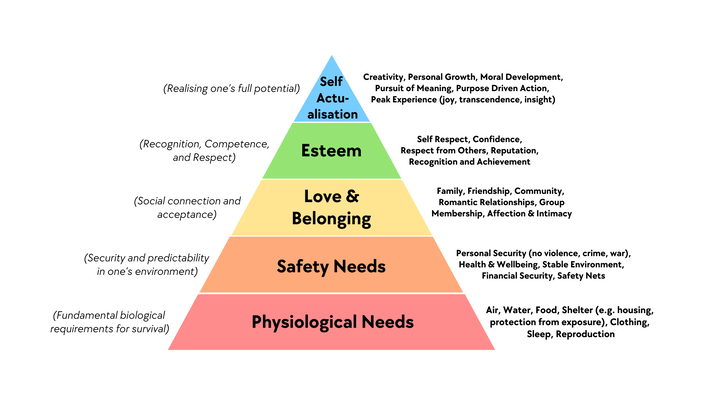
Maslow's hierarchy suggests that physiological and safety needs must be largely satisfied before belonging, esteem, and self-actualisation needs can direct behaviour.
E. Behavioural and Social-Learning Theory
- Skinner: Personality is the sum of learned behaviour maintained by its consequences (reinforcement and punishment).
- Bandura: Personality develops through observational learning (modelling). Behaviour results from reciprocal interaction among personal factors, behaviour, and the environment. Belief in one’s capability (self-efficacy) is central.
- Rotter: Focused on locus of control—internality (events result from one's own actions) versus externality (events result from chance or powerful others).
3. Development of Personality
Personality develops through the continuous interaction of nature (heredity) and nurture (environment). Temperament is evident in infancy, while character matures through childhood and adolescence.
Erikson’s Psychosocial Theory
Erikson describes eight stages, each presenting a conflict whose resolution shapes personality:
| Stage (age) | Conflict | Favourable outcome |
|---|---|---|
| Infancy (0–1 yr) | Trust vs. Mistrust | Hope; security in caregivers |
| Toddler (1–3 yrs) | Autonomy vs. Shame/Doubt | Willpower; self-control |
| Preschool (3–6 yrs) | Initiative vs. Guilt | Purpose; direction |
| School age (6–12 yrs) | Industry vs. Inferiority | Competence; mastery |
| Adolescence | Identity vs. Role confusion | Fidelity; sense of self |
| Young adulthood | Intimacy vs. Isolation | Love; close relationships |
| Middle adulthood | Generativity vs. Stagnation | Care; productivity |
| Old age | Ego integrity vs. Despair | Wisdom; acceptance |
Adolescence is a critical period for rapid physical change, identity formation, and peer influence, producing the near-adult personality observed in clinical practice.
4. Assessment of Personality
Clinical assessment of personality is used to understand individual differences and screen for psychopathology.
| Method | Examples | Use |
|---|---|---|
| Interview & observation | Clinical interview | Understanding the whole person in context |
| Questionnaires (inventories) | Eysenck Personality Inventory (EPI), 16PF, MMPI | Objective measurement of traits; screening for psychopathology |
| Projective tests | Rorschach inkblot, Thematic Apperception Test (TAT) | Exploring unconscious conflicts (interpretation is subjective) |
Key Points
- Consistency: Personality describes the stable patterns of an individual across time and situations.
- The Big Five: Openness, Conscientiousness, Extraversion, Agreeableness, and Neuroticism provide a comprehensive framework for traits.
- Humanistic View: Emphasises the drive toward self-actualisation and personal growth.
- Clinical Utility: Personality assessment aids in diagnosing personality disorders and planning therapeutic interventions.