Social (Observational) Learning: Principles and Application in Healthcare
An exhaustive study of observational learning theory, exploring Bandura’s foundational research, the cognitive processes underlying modelling, and the critical role of social learning in clinical education and patient behaviour change.
1. Definition and Background
Social learning, also referred to as observational learning or modelling, is the process of acquiring new behaviours, attitudes, or information by watching the behaviour of other people (models) and observing the consequences that follow. Unlike classical or operant conditioning, social learning does not require the learner to perform the behavior directly during the learning phase.
Albert Bandura (1925–2021) developed social learning theory as a bridge between behaviourism (learning through reinforcement) and cognitive theory (learning through thinking). Bandura demonstrated that observation creates a cognitive representation of a behaviour that the individual can store and execute later when motivated.
In social learning, the observer neither performs the behaviour nor receives direct reinforcement during the learning process. Learning occurs through observation; performance occurs later, if motivated.
2. The Bobo Doll Experiment (1961)
Bandura, Ross, and Ross (1961) experimentally demonstrated observational learning using nursery-school children and an inflatable "Bobo doll." The study proved that children could learn complex aggressive behaviours simply by watching an adult model.
The Experimental Stages:
- Stage 1 — Modelling: Children watched an adult model behave aggressively toward the doll (hitting with a mallet, kicking, shouting). A control group saw a non-aggressive model or no model.
- Stage 2 — Arousal: All children were mildly frustrated by being told they could not play with certain attractive toys to prime potential aggression.
- Stage 3 — Test: Children were left alone with the Bobo doll. Their behaviour was observed through a one-way mirror.
Key Results:
- Children who observed the aggressive model imitated the aggressive acts, including novel actions and words.
- Boys showed significantly more physical aggression than girls.
- Children were more likely to imitate same-sex models.
This experiment established that aggressive and health-risk behaviours (like smoking or risky sexual behaviour) can be acquired through social environments. In medicine, this applies to how patients acquire health attitudes from relatives and how medical students acquire professional behaviours from observing senior clinicians—often referred to as the "hidden curriculum."
3. The Four Processes of Observational Learning
Bandura identified four cognitive and physical processes that must operate for observational learning to be successful:
| Process | Definition | How to Strengthen in Teaching |
|---|---|---|
| 1. Attention | Noticing and attending to the model’s behaviour. | Reduce distractions; use skilled, respected, or similar models. |
| 2. Retention | Encoding and storing the behaviour as verbal or visual symbols in memory. | Summarise, repeat, and encourage mental practice or rehearsal. |
| 3. Motor Reproduction | Being physically capable of converting the stored representation into action. | Break complex skills into steps; allow supervised practice with feedback. |
| 4. Motivation | Having a reason to perform the behaviour. | Show benefits; use praise/rewards; use successful peer models. |
4. Models and Vicarious Processes
4.1 Types of Models
- Live models: Real people observed directly (e.g., teachers, parents, senior clinicians, peers).
- Symbolic models: Characters or people represented in media (e.g., television, films, internet videos, or instructional health posters).
- Verbal instructional models: Detailed descriptions and explanations of a behaviour without a physical demonstration.
4.2 Characteristics of Effective Models
Learning is strongest when the model possesses the following traits:
- Similarity: Observers are more likely to imitate models they perceive as similar to themselves (age, sex, background, or medical condition).
- Competence and Prestige: Skilled, confident, and high-status models (e.g., a respected Consultant) are imitated more.
- Warmth and Nurturance: Friendly and caring models attract more attention and identification.
- Relevance: Behaviours seen to bring valued consequences are more likely to be copied.
4.3 Vicarious Reinforcement and Punishment
- Vicarious reinforcement: Seeing a model rewarded for a behaviour increases the observer's tendency to perform it.
- Vicarious punishment: Seeing a model punished for a behaviour decreases the observer's tendency to perform it.
- Disinhibition: Seeing a model punished lightly or rewarded for a normally inhibited behaviour (e.g., breaking a safety rule) "releases" the observer to perform it.
5. Reciprocal Determinism
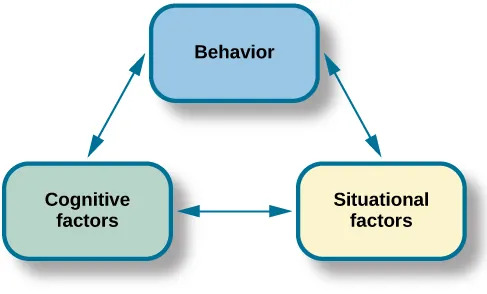
Bandura proposed that behavior is not just a result of the environment, but an interaction of three factors. Reciprocal determinism holds that these three components continuously and mutually influence one another:
- Personal Factors: Cognitive abilities, beliefs, self-efficacy, and knowledge.
- Behaviour: Physical actions, habits, and skills.
- Environmental Factors: Situational context, social support, and access.
6. Applications in Healthcare
6.1 Professional Education and the Hidden Curriculum
Medical and nursing students learn professional ethics, communication styles, and bedside manner largely by observing role models. Clinical teachers must be aware that their "unspoken" actions—the hidden curriculum—are often more influential than formal lectures. Disrespectful shortcuts or unsafe practices are easily imitated if seen in senior staff.
6.2 Skills Teaching
Clinical skills training follows the four processes. A standard effective method is the return demonstration:
— Model: The teacher demonstrates the procedure clearly.
— Observe: The learner pays attention and retains steps.
— Perform: The learner performs while the teacher observes and provides feedback, which serves as reinforcement.
6.3 Patient Education and Behaviour Change
| Application | Principle Used | Clinical Example |
|---|---|---|
| Peer Educators | Similarity; Vicarious reinforcement | A diabetic patient teaching newly diagnosed patients about insulin management. |
| Reducing Procedure Anxiety | Symbolic modelling | Showing a child a film of a calm patient receiving a vaccination. |
| Health Promotion | Prestige; Identification | Using respected community figures in campaigns for immunisation or smoking cessation. |
| Self-care & Rehab | Graded modelling; Self-efficacy | A video of a patient successfully managing stoma care or a prosthesis. |
7. Practical Guidance for Clinicians
- Be a deliberate role model: Ensure students and patients observe high standards in hand hygiene and respectful communication.
- Match the model to the learner: Whenever possible, use peer models (similar age/background) for patient education to increase self-efficacy.
- Stepwise demonstration: Keep demonstrations clear, focused, and broken into manageable steps to aid retention.
- Visible Rewards: Ensure that positive health behaviours or professional clinical actions are seen to be valued and rewarded.
8. Summary: Strengths and Limitations
- Strengths: It explains how complex learning occurs without trial-and-error; it successfully integrates behavioural and cognitive approaches; and it is highly applicable to education and health promotion.
- Limitations: It is harder to study objectively than direct conditioning; imitation can be selective and cognitively mediated; and it does not fully account for biological maturation or innate capacities.
Social learning is strongest when models are similar, competent, and warm. In healthcare, it underlies everything from the hidden curriculum of professional training to the effectiveness of peer-led support groups and health-promotion campaigns.