Introduction to the Learning Process and Factors That Affect It
Comprehensive medical psychology notes covering the structural stages of learning, types of conditioning, memory basis, and the diverse learner, environmental, and task-related factors influencing behavioral change in clinical practice.
1. Definition and Characteristics of Learning
Learning is a relatively permanent change in behaviour, knowledge, or skill that results from experience, practice, or training, and which cannot be explained by maturation, fatigue, injury, or the temporary effects of drugs.
In medical psychology, learning is central because a large part of human behaviour — including health behaviour, coping responses, habits, fears, and adherence to treatment — is learned. Behaviour that has been learned can, in principle, be modified, which is the foundation of behaviour therapy and patient education.
1.1 Key characteristics of learning
- Change in behaviour or behavioural potential: Learning produces a change in what a person does or is capable of doing (e.g., a student can now interpret an ECG).
- Relatively permanent: The change endures; performance that disappears quickly (e.g., due to fatigue or motivation) is not true learning.
- Results from experience or practice: Learning arises from interaction with the environment, not from genetic maturation alone.
- Not due to temporary states: Changes caused by fatigue, drugs, illness, or sensory adaptation are excluded.
- Involves active processing: The learner actively attends to, encodes, and stores information; learning is not a passive recording.
- Progressive and goal-directed: Learning builds on previous learning and moves the organism towards adaptation to its environment.
1.2 Learning compared with related concepts
| Concept | Meaning | How it differs from learning |
|---|---|---|
| Maturation | Genetically programmed biological growth and development of the nervous system and body. | Occurs without specific experience or practice; follows a predictable sequence and timetable. |
| Performance | The observable demonstration of what has been learned at a given moment. | Performance is influenced by motivation, fatigue and illness; learning may exist without being demonstrated. |
| Memory | The storage and retrieval of learned information. | Memory is the mechanism by which learning is retained; learning is the process of acquiring the change. |
| Instinct | An unlearned, inborn pattern of behaviour. | Requires no prior experience, whereas all learning requires experience. |
2. The Learning Process Step by Step
Learning is a sequence of interrelated stages. Understanding these stages helps the clinician design effective teaching for patients, students, and communities.
| Stage | Description | Clinical Application |
|---|---|---|
| 1. Motivation | An internal state (need, drive, incentive) that energises and directs behaviour toward a goal. | In clinical practice, the patient’s own motivation (e.g., fear of complications, desire for recovery) largely determines the success of health education. |
| 2. Attention | The selective focusing of awareness on particular stimuli while ignoring others. | Attention is limited; fatigue, anxiety, pain, and a noisy environment reduce it. Material must therefore be presented clearly, one point at a time. |
| 3. Perception | The interpretation of attended sensory input. | Influenced by past experience, expectations, culture, and emotional state. Two learners exposed to the same information may perceive it differently. |
| 4. Encoding | Organising information and transferring it into memory. | Meaningful organisation (chunking, classification, association with existing knowledge) greatly improves retention. |
| 5. Storage | Retention of the encoded information in memory over time. | Spaced repetition and rehearsal are necessary to move information from short-term to long-term storage. |
| 6. Retrieval & Use | Learned material must be recalled and used in real situations. | Practice, rehearsal, feedback, and application in real situations strengthen retrieval and allow transfer to new situations (generalisation). |
Effective teaching of patients or students requires arousing motivation, securing attention, presenting material in an organised and meaningful way, and providing repetition, practice, and feedback.
3. Types of Learning
Learning may be classified in several ways. A practical classification for clinical medicine is shown below:
| Type | Definition | Clinical Example |
|---|---|---|
| Non-associative learning | Change in response to a single repeated stimulus, without pairing with another stimulus. | Habituation: a nurse becomes accustomed to the sound of alarms; Sensitisation: a burn patient becomes highly reactive to any touch. |
| Classical conditioning | Learning by association between two stimuli; a neutral stimulus comes to evoke a reflex response. | A patient feels nauseated at the sight of the chemotherapy room; white-coat hypertension. |
| Operant conditioning | Learning from the consequences of voluntary behaviour; behaviour followed by reward increases. | A child cooperates with physiotherapy when praised; a patient adheres to medication when given positive feedback. |
| Observational learning | Learning by watching and imitating models. | Medical students acquire attitudes and procedures by observing senior clinicians; patients learn coping skills from peers. |
| Cognitive learning | Learning through understanding, insight, problem-solving and information processing rather than direct reinforcement. | A student understands the physiology of shock and then applies the principles to manage different cases. |
4. The Memory Basis of Learning
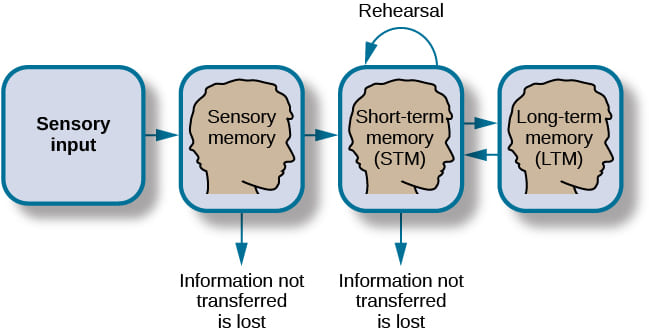
Learning depends on memory. The classic information-processing model (Atkinson-Shiffrin) describes three stores through which information passes:
- Sensory memory: A very brief register of sensory impressions (fractions of a second to a few seconds). Only attended information passes further.
- Short-term (working) memory: Limited capacity (about 5–9 items) and short duration (seconds) unless rehearsed. Chunking and rehearsal keep information available.
- Long-term memory: A large-capacity, durable store. Transfer from short-term to long-term memory requires elaboration, organisation, repetition, and association with existing knowledge.
Anxiety, pain, sleep deprivation, and illness reduce working-memory capacity, so education of sick or anxious patients should be brief, simple, and reinforced with written instructions. Repetition and spaced review consolidate memory.
5. Factors That Affect Learning
Learning is influenced by three broad groups of factors: characteristics of the learner, the environment, and the task or teaching method.
5.1 Learner-related factors
| Factor | Effect on Learning | Clinical/Educational Implication |
|---|---|---|
| Age and maturation | Readiness for particular learning depends on developmental stage; very young and elderly learners process information more slowly. | Match teaching content and pace to the learner’s developmental level. |
| Intelligence and prior knowledge | Higher cognitive ability and relevant background knowledge facilitate new learning. | Assess baseline knowledge before teaching; build on what is known. |
| Motivation | Drives attention, effort, and persistence; intrinsic motivation (personal relevance) is more durable than extrinsic reward. | Link learning to the patient's own goals, e.g., returning to work or preventing complications. |
| Health status | Pain, fever, hypoxia, malnutrition, depression, and dementia impair concentration and memory. | Treat the illness, control pain, and schedule teaching when the patient is most alert. |
| Fatigue and sleep deprivation | Reduce attention, encoding, and recall. | Keep teaching sessions short; use spaced (distributed) sessions. |
| Anxiety and stress | Moderate arousal improves learning (Yerkes–Dodson law); severe anxiety impairs it. | Reduce fear before procedures through explanation, reassurance, and familiarisation. |
| Sensory deficits | Poor hearing or vision blocks input. | Correct with glasses, hearing aids, and clear, large-print material. |
| Emotions and attitudes | Positive attitudes toward the subject and teacher enhance learning; negative attitudes block it. | Establish rapport; respect cultural beliefs about illness and treatment. |
| Self-efficacy | Belief in one's ability to succeed determines effort and persistence. | Set small, achievable goals so the learner experiences success. |
5.2 Environmental factors
- Physical environment: Adequate lighting, ventilation, comfortable temperature, low noise, and comfortable seating support attention. A busy, noisy ward is a poor classroom.
- Psychological climate: An atmosphere of acceptance, respect, and emotional safety encourages questions and participation; fear of ridicule suppresses learning.
- Social environment: Family, peers, teachers, and community influence attitudes and reinforce behaviours. Family involvement improves adherence to long-term treatment (e.g., TB therapy, diabetes care).
- Cultural and language factors: Teaching in a language the learner understands, with culturally appropriate examples, greatly improves comprehension and recall.
5.3 Task and teaching-method factors
| Principle | Explanation | Practical Application |
|---|---|---|
| Meaningfulness | Meaningful, logically organised material is learned faster and retained longer than meaningless material. | Explain why information matters; connect new facts to prior knowledge and real clinical situations. |
| Association | New learning is anchored to existing knowledge. | Use analogies and comparisons (e.g., the heart as a pump). |
| Repetition and rehearsal | Practice consolidates memory traces. | Repeat key messages; encourage the learner to restate instructions. |
| Distributed practice | Spaced short sessions are superior to one long session (massed practice). | Give brief daily teaching rather than one long lecture. |
| Active participation | Doing and problem-solving produce deeper learning than passive listening. | Use demonstrations, return-demonstration, and case discussions. |
| Feedback and reinforcement | Knowledge of results corrects errors and motivates; rewards strengthen correct behaviour. | Praise correct behaviour; correct errors kindly and promptly. |
| Multisensory presentation | Combined seeing, hearing, and doing improves retention. | Use models, diagrams, and hands-on practice together with verbal explanation. |
| Whole versus part learning | Complex skills are best learned in meaningful parts, then integrated. | Break procedures (e.g., insulin injection) into steps, then combine them. |
6. Principles (Laws) of Learning
Thorndike and later educational psychologists formulated general principles that summarise the conditions under which learning occurs efficiently:
- Law of readiness: Learning is best when the learner is prepared and motivated to learn.
- Law of exercise: Practice strengthens learning (law of use); disuse weakens it (law of disuse).
- Law of effect: Behaviours followed by satisfying consequences are repeated; those followed by unpleasant consequences are weakened.
- Law of primacy: What is learned first is remembered best — first impressions and first instructions are critical.
- Law of recency: The most recently learned material is best remembered — reinforce key messages at the end of a session.
- Law of intensity: Vivid, dramatic experiences are learned more readily than dull ones.
- Law of freedom: Learning is more effective when the learner participates voluntarily rather than under coercion.
7. Clinical Relevance for the Clinician
- Patient Behaviour: Most patient behaviour — including smoking, diet, medication adherence, fear of procedures, and help-seeking — is learned and can be re-learned.
- Health Education: Should arouse motivation, secure attention, be brief and simple, use repetition and demonstrations, and end with feedback and written reinforcement.
- Unlearning Habits: Unlearning harmful habits (e.g., smoking, alcohol misuse) requires more than information: it requires behaviour-change techniques based on the principles of conditioning and learning.
- Bedside Teaching: Understanding how students and patients learn allows the clinician to be an effective teacher at the bedside and in the community.
Summary
- Learning is a relatively permanent change in behaviour or behavioural potential resulting from experience; it differs from maturation, performance, and temporary states.
- The learning process moves through motivation, attention, perception, encoding, storage, and retrieval/application; learning is retained through memory.
- Main types of learning are non-associative (habituation, sensitisation), classical conditioning, operant conditioning, observational learning, and cognitive learning.
- Learning is affected by learner factors (age, health, motivation, anxiety, intelligence), environmental factors (physical, psychological, social), and method factors (meaningfulness, repetition, feedback, active participation).
- The principles of readiness, exercise, effect, primacy, recency, intensity, and freedom guide effective teaching and behaviour change in clinical practice.