Types of Blood Groups
Complete study notes covering the genetics, biochemistry, compatibility, and clinical significance of the ABO and Rh systems, as well as minor blood group systems and cross-matching procedures.
2.1 Introduction
Blood groups are determined by antigenic substances (glycoproteins and glycolipids) present on the surface of erythrocytes. The two most clinically significant systems are the ABO and Rh systems.
- ABO system: Discovered by Karl Landsteiner in 1900 (Nobel Prize, 1930).
- Rh system: Identified by Landsteiner and Wiener in 1939.
2.2 ABO Blood Group System
The ABO system is governed by three alleles (I^A, I^B, and i) located on chromosome 9.
2.2.1 Genetics and Biochemistry
| Genotype | Phenotype | RBC Antigens | Plasma Antibodies |
|---|---|---|---|
| I^A I^A or I^A i | A | A antigen | Anti-B |
| I^B I^B or I^B i | B | B antigen | Anti-A |
| I^A I^B | AB | A and B antigens | None |
| ii | O | None (H only) | Anti-A and Anti-B |
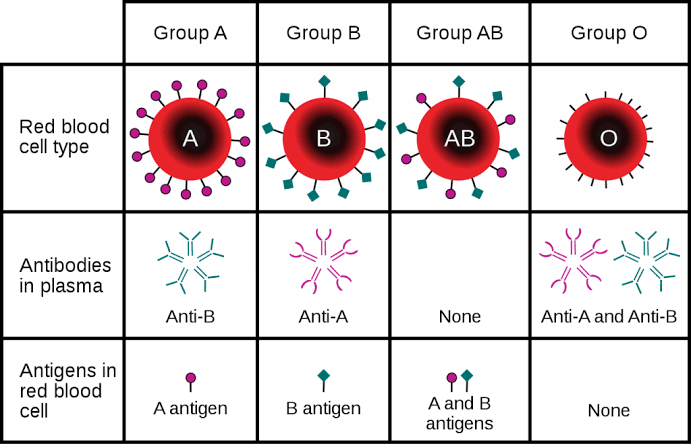
Biochemical Basis:
- The H antigen (precursor) is present on all RBCs.
- I^A allele codes for an enzyme adding N-acetylgalactosamine = A antigen.
- I^B allele codes for an enzyme adding galactose = B antigen.
- i allele is non-functional; no modification of H antigen occurs.
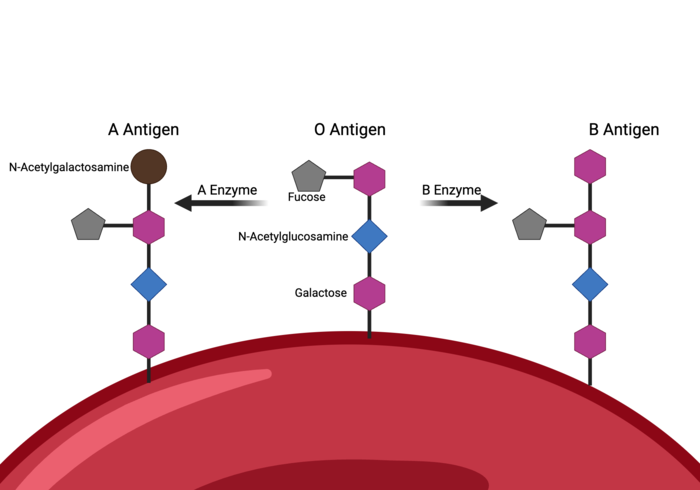
Antibody Characteristics:
- Anti-A and Anti-B are naturally occurring (develop by 3-6 months of age).
- They are IgM antibodies, capable of fixing complement.
- Cause rapid intravascular hemolysis.
- Primary cause of acute hemolytic transfusion reactions.
Rare individuals lack H antigen due to FUT1 gene mutations. They type as O but possess anti-H, anti-A, and anti-B antibodies, making blood transfusion extremely difficult as they can only receive blood from other Bombay phenotype donors.
2.2.2 ABO Compatibility for Transfusion
| Recipient | Can Receive From | Can Donate To |
|---|---|---|
| A | A, O | A, AB |
| B | B, O | B, AB |
| AB | A, B, AB, O (univ. rec) | AB only |
| O | O only | A, B, AB, O (univ. donor) |
**Universal donor:** O negative (no A, B, or D antigens).
**Universal recipient:** AB positive (no anti-A, anti-B, or anti-D antibodies).
2.3 Rh Blood Group System
The Rh system is the second most important blood group system clinically, particularly in obstetrics.
2.3.1 Genetics and Antigens
- Determined by RHD and RHCE genes on chromosome 1.
- The D antigen is the most immunogenic Rh antigen.
- Rh-positive: D antigen present on RBCs.
- Rh-negative: D antigen absent.
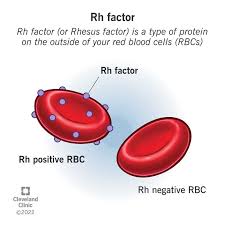
Prevalence:
- Rh-positive: ~85% Caucasians, 92% African Americans, 99% East Asians.
- Rh-negative: ~15% Caucasians, 8% African Americans, <1% East Asians.
2.3.2 Rh Antibodies
- No natural antibodies (unlike ABO).
- Immune antibodies form only after exposure (sensitization).
- Rh antibodies are IgG, which can cross the placenta.
- Can cause hemolytic disease of the newborn (HDN).
2.3.3 Clinical Significance: Hemolytic Disease of the Newborn (HDN)
Pathophysiology:
- Step 1: Rh-negative mother carries Rh-positive fetus (inherited from father).
- Step 2: Fetal RBCs cross placenta during delivery, trauma, or procedures.
- Step 3: Mother produces anti-D antibodies (primary immune response).
- Step 4: In subsequent pregnancies with Rh-positive fetuses, IgG anti-D crosses the placenta and destroys fetal RBCs.
- Step 5: Results in anemia, jaundice, hydrops fetalis, or stillbirth.
Prevention:
- Anti-D immunoglobulin (RhoGAM) administered to Rh-negative mothers.
- Given at 28-30 weeks gestation and within 72 hours after delivery, abortion, or invasive procedures.
- Mechanism: Anti-D binds fetal D-positive RBCs before maternal immune recognition occurs.
2.4 Other Blood Group Systems
Over 300 blood group antigens exist. Other clinically relevant systems include:
| System | Key Antigen | Clinical Relevance |
|---|---|---|
| Kell | K, k | Severe HDN and transfusion reactions |
| Duffy | Fy^a, Fy^b | Fy(a-b-) confers resistance to P. vivax malaria |
| MNS | M, N, S, s | Transfusion reactions and HDN |
| Kidd | Jk^a, Jk^b | Delayed hemolytic transfusion reactions |
2.5 Blood Typing and Cross-Matching
Blood typing: Determines ABO group and Rh status using known antisera (anti-A, anti-B, anti-D).
Cross-matching (compatibility testing):
- Major cross-match: Donor RBCs + recipient serum (detects antibodies against donor RBCs).
- Minor cross-match: Recipient RBCs + donor serum (rarely performed).
- Indirect antiglobulin test (IAT): Detects unexpected antibodies.
Type and screen for patients who may need blood; type and cross-match when transfusion is anticipated.
2.6 Summary Table: Blood Group Characteristics
| Feature | ABO System | Rh System |
|---|---|---|
| Chromosome | 9 | 1 |
| Number of antigens | 2 main (A, B) | 50+ (D most important) |
| Natural antibodies | Yes (anti-A, anti-B) | No |
| Antibody class | IgM (complement-fixing) | IgG (crosses placenta) |
| Major clinical concern | Acute hemolytic transfusion reaction | Hemolytic disease of the newborn |
| Universal donor | O negative | — |
| Universal recipient | AB positive | — |
KEY CLINICAL PEARLS
- Always perform ABO and Rh typing plus antibody screen before transfusion.
- Cross-match donor blood with recipient serum.
- Administer anti-D to Rh-negative mothers at 28-30 weeks and postpartum.
- Bombay phenotype individuals can be misclassified as Group O.