Mental Processes
A comprehensive study of higher-order cognitive functions including Thinking, Reasoning, Consciousness, Sleep, Sensation, and Perception.
1. Thinking
Definition: Thinking is a cognitive process involving the manipulation of mental representations (images, concepts, symbols, and ideas) to form new associations, solve problems, make decisions, and create new knowledge. It is a higher-order mental process that goes beyond immediate perception and memory.
1.1 Types of Thinking
| Type of Thinking | Description | Example |
|---|---|---|
| Perceptual/Concrete | Thinking based on direct sensory experience and immediate reality. | A child sorting objects by color or shape. |
| Conceptual/Abstract | Thinking using ideas, concepts, and symbols rather than concrete objects. | Understanding justice, freedom, or democracy. |
| Reflective Thinking | Deliberate, careful consideration of ideas and experiences. | A clinician analyzing a complex case before making a diagnosis. |
| Creative Thinking | Generation of novel, original ideas and solutions. | An artist developing a new painting style. |
| Critical Thinking | Objective analysis and evaluation of information to form judgments. | Evaluating the strength of evidence in a research study. |
| Directed/Associative | Thinking that follows a logical sequence or makes free associations. | Problem-solving vs. daydreaming. |
1.2 Elements of Thinking
Thinking involves several key structural elements:
- Concepts: Mental categories that group objects, events, or ideas based on shared characteristics.
- Propositions: Statements that express relationships between concepts.
- Mental Images: Visual representations of objects or events in the mind.
- Schemas: Organized frameworks of knowledge that help interpret new information.
1.3 Problem-Solving and Decision-Making
Problem-Solving Steps: (1) Identifying and defining the problem, (2) generating possible solutions, (3) evaluating alternatives, (4) selecting and implementing the best solution, and (5) assessing the outcome.
Common Obstacles: Mental set (fixation on familiar solutions), functional fixedness (inability to see new uses for objects), and confirmation bias.
Heuristics (Mental Shortcuts):
— Availability Heuristic: Judging probability by ease of recall.
— Representativeness Heuristic: Judging by similarity to prototypes.
Impaired Thinking
Impaired thinking is a hallmark of several psychiatric and neurological conditions. In Schizophrenia, thought disorder manifests as disorganized speech and delusions. In Dementia, thinking becomes concrete and inflexible. Cognitive rehabilitation aims to restore or compensate for these impaired abilities.
2. Reasoning
Definition: Reasoning is the cognitive process of drawing inferences, conclusions, or judgments from evidence, premises, or principles. It enables prediction, explanation, and justification of beliefs.
2.1 Types of Reasoning
| Type | Description | Clinical Relevance |
|---|---|---|
| Deductive | Drawing specific conclusions from general principles; must be true if premises are true. | Applying general medical knowledge to a specific patient. |
| Inductive | Drawing general conclusions from specific observations; conclusions are probable. | Formulating a diagnosis from presenting symptoms. |
| Abductive | Inferring the most likely explanation from incomplete observations. | Differential diagnosis in clinical practice. |
| Analogical | Solving problems by comparing to similar situations. | Using analogies to explain medical conditions to patients. |
2.2 Errors in Reasoning (Cognitive Biases)
- Confirmation Bias: Seeking information that confirms pre-existing beliefs while ignoring contradictory evidence.
- Availability Heuristic: Overestimating the likelihood of events that are easily recalled (e.g., overdiagnosing a rare condition recently seen).
- Anchoring Bias: Relying too heavily on the first piece of information encountered.
- Attribution Bias: Attributing behavior to internal characteristics rather than situational factors.
3. Consciousness
Definition: Consciousness is the state of awareness of oneself and the environment, including the ability to perceive, think, feel, and respond to stimuli.
3.1 Levels of Consciousness
| Level | Characteristics | Clinical Significance |
|---|---|---|
| Alert | Fully aware, oriented to time, place, and person. | Normal baseline state. |
| Confusion | Disorientation, difficulty following commands. | Seen in delirium, infections, metabolic disturbances. |
| Lethargy | Drowsy but arousable; reduced alertness. | Early sign of CNS depression. |
| Obtundation | Difficult to arouse; requires strong stimulation. | Moderate CNS impairment. |
| Stupor | Unresponsive except to vigorous, repeated stimuli. | Severe CNS dysfunction. |
| Coma | Unarousable, unresponsive to all stimuli. | Severe brain injury, overdose, stroke. |
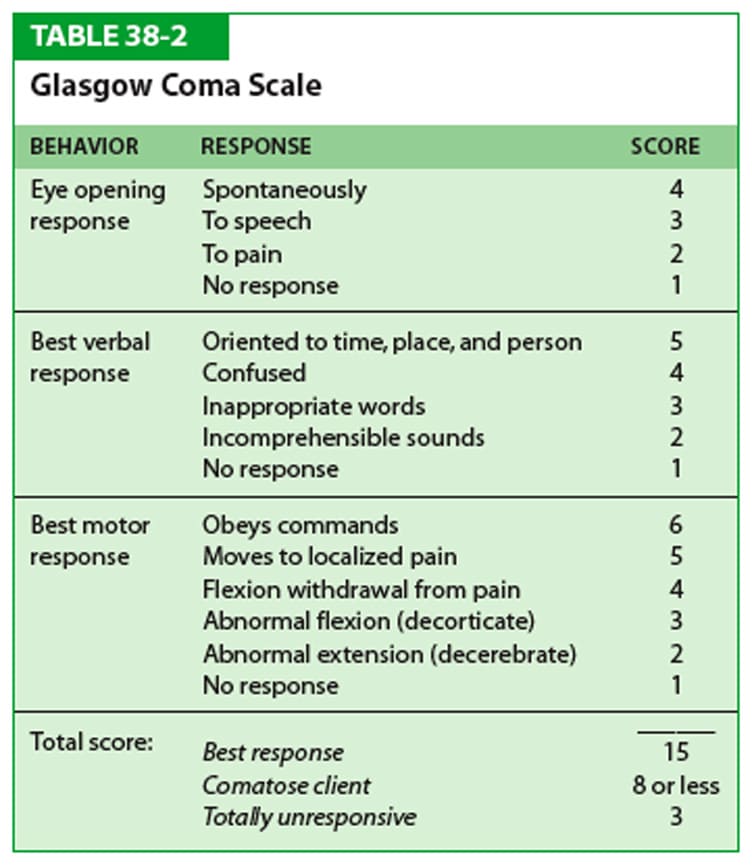
Glasgow Coma Scale (GCS)
The standard tool for assessing level of consciousness across three domains: Eye opening (1-4), Verbal response (1-5), and Motor response (1-6). Scores range from 3 (deep coma) to 15 (fully alert).
4. Sleep
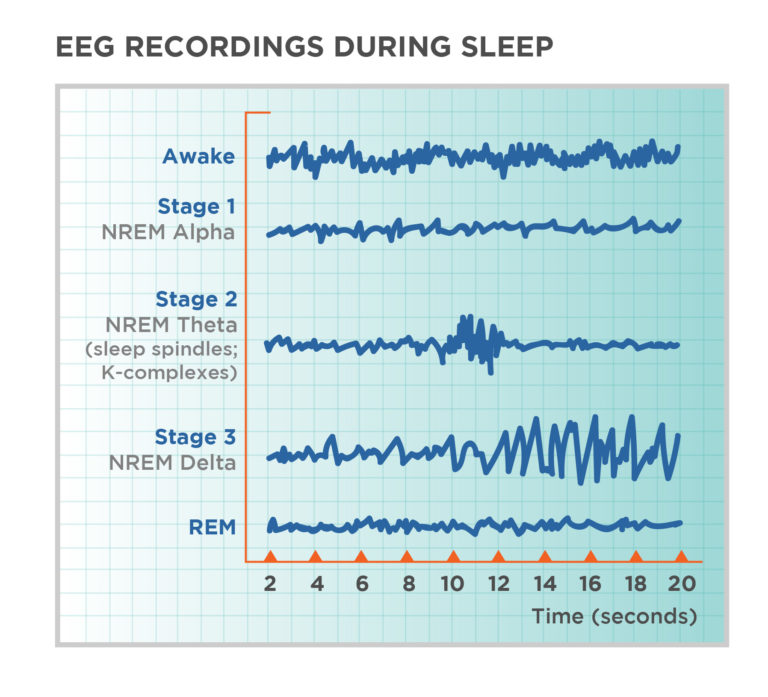
Definition: A naturally recurring state of altered consciousness characterized by reduced responsiveness, decreased muscle activity, and distinct brain activity patterns.
4.1 Stages of Sleep
| Stage | Brain Waves | Function |
|---|---|---|
| N1 (Light Sleep) | Theta waves (4-7 Hz) | Onset of sleep; relaxation. |
| N2 (True Sleep) | Theta with sleep spindles | Memory consolidation; motor skill learning. |
| N3 (Deep/Slow-Wave) | Delta waves (0.5-4 Hz) | Physical restoration; growth hormone release. |
| REM Sleep | High-frequency waves | Vivid dreaming; muscle atonia; emotional processing. |
4.3 Sleep Disorders
- Insomnia: Difficulty falling or staying asleep; causes daytime fatigue.
- Sleep Apnea: Repeated pauses in breathing; characterized by loud snoring.
- Narcolepsy: Sudden, uncontrollable daytime sleep episodes; includes cataplexy.
- Restless Legs Syndrome (RLS): Irresistible urge to move legs, worsening at rest.
- Parasomnias: Abnormal behaviors like sleepwalking or night terrors.
5. Sensation
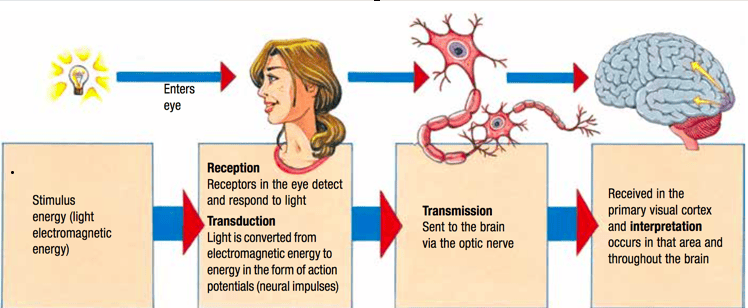
Definition: The process by which sensory receptors detect, transduce, and transmit physical energy from the environment into neural signals.
5.1 The Process of Sensation
- Reception: Detection of energy by specialized receptors.
- Transduction: Conversion of energy into electrochemical signals.
- Transmission: Relay of signals through pathways to the CNS.
5.2 The Five Classical Senses
| Sense | Receptor | Pathway/Cortex |
|---|---|---|
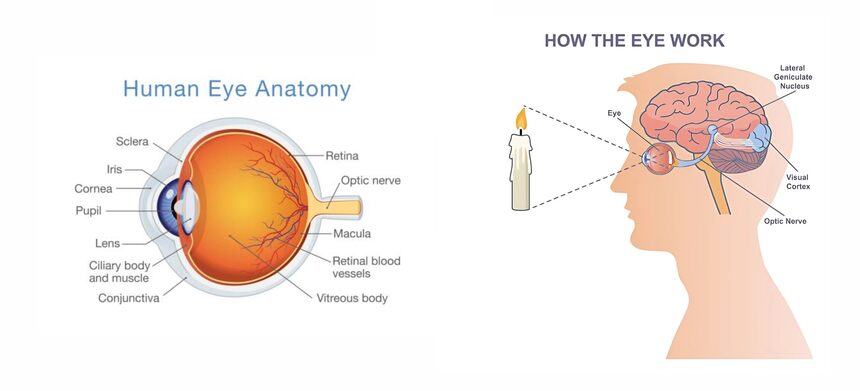
| Vision | Rods and Cones (Retina) | Optic nerve → Lateral geniculate nucleus |
| Hearing | Hair cells (Cochlea) | Auditory nerve → Cochlear nucleus |
| Touch | Mechano/Thermo/Nociceptors | Spinal cord → Thalamus → Somatosensory cortex |
| Taste | Taste buds (Tongue) | CN VII, IX, X → Solitary nucleus |
| Smell | Olfactory receptors | Olfactory bulb → Piriform cortex |
6. Perception
Definition: The process by which the brain organizes, interprets, and gives meaning to sensory information. It is an active, constructive process.
6.1 Principles of Perceptual Organization (Gestalt)
- Figure-Ground: Separation of an object from its background.
- Proximity: Near elements are perceived as a group.
- Similarity: Similar elements are grouped together.
- Continuity: Preference for smooth, continuous patterns.
- Closure: Filling in gaps to perceive complete objects.
- Common Fate: Elements moving in the same direction are seen as a unit.
6.3 Perceptual Constancies and Illusions
Constancies: Size, Shape, and Color constancy allow stable perception despite changes in sensory input.
Illusions: Errors in interpretation, such as the Mueller-Lyer (line length) or Ponzo (size-distance) illusions.
Perceptual Disturbances
- Hallucinations: Perceptions in the absence of external stimuli.
- Illusions: Misperceptions of real stimuli.
- Agnosia: Inability to recognize sensory information despite intact pathways (seen in stroke).
- Neglect: Failure to attend to one side of space (right parietal lobe damage).
8. Key Points Summary
- Thinking involves manipulating mental representations to solve problems.
- Reasoning moves from known to unknown via deductive or inductive logic.
- Consciousness exists on a continuum from full alertness to coma (GCS assessment).
- Sleep stages (N1-N3, REM) have distinct brain activity and restorative functions.
- Sensation is data detection; Perception is the active interpretation of that data.
