Mental Processes
A comprehensive study on the internal activities of the mind, their categories, neurobiological foundations, and their profound influence on human behavior within a clinical context.
1. Introduction to Mental Processes
Mental processes represent the internal activities of the mind that enable individuals to interpret, organize, and respond to information from the environment. These processes form the foundation of human cognition and are essential for adaptation, learning, and survival. Understanding these is fundamental to clinical medicine, as disturbances in these processes underlie numerous psychiatric and neurological conditions.
For the clinical medicine student in Uganda, knowledge of mental processes provides the basis for assessing cognitive function, diagnosing mental health disorders, and formulating management plans for patients presenting with altered mental states.
2. Definition and Characteristics
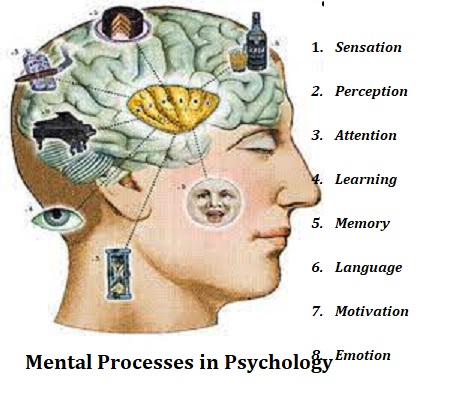
Mental Processes (also called cognitive or psychological processes) are the internal, dynamic activities of the mind through which an individual acquires, stores, retrieves, and uses information. They include thinking, reasoning, perception, memory, attention, consciousness, and emotion, operating both consciously and unconsciously.
2.1 Characteristics of Mental Processes
- Internal: They occur within the individual and are not directly observable; they must be inferred from behavior, self-report, or physiological measures.
- Dynamic: They are active and continuously changing to adapt to new information.
- Interactive: simultaneous operation where one affects the other (e.g., attention affecting perception).
- Goal-Directed: They serve adaptive functions to help organisms respond to challenges.
- Individual Variation: Efficiency and style vary based on genetics, experience, and health status.
Mental processes are distinct from mental states. A mental state (like anxiety) is a temporary condition, whereas a mental process is the ongoing operation that produces or maintains that state.
3. Components and Types of Mental Processes
| Category | Description | Examples |
|---|---|---|
| Cognitive | Activities involved in acquiring and using information. | Thinking, reasoning, problem-solving. |
| Perceptual | Organization and interpretation of sensory data. | Sensation, perception, recognition. |
| Memory | Encoding, storing, and retrieving information. | Short-term, long-term, recall. |
| Attentional | Selection and focus of mental resources. | Selective, divided, and sustained attention. |
| Consciousness | Awareness of oneself and the environment. | Wakefulness, sleep, altered states. |
| Emotional | Experiencing and regulating feelings. | Emotion recognition, mood. |
| Motivational | Initiating and sustaining goal-directed behavior. | Drive, incentive, goal-setting. |
3.1 Cognitive Processes
Thinking involves manipulating mental representations to form concepts and solve problems. Reasoning is the process of drawing conclusions from evidence. These rely heavily on the prefrontal cortex for executive functions.
3.2 Perceptual Processes
Sensation is the detection of physical energy by receptors. Perception is the subsequent organization of these signals into meaningful experiences, influenced by prior knowledge and expectations.
3.3 Memory Processes
Includes Encoding (conversion to storable form), Storage (maintenance over time), and Retrieval (accessing info). It comprises subsystems like sensory memory, working memory, and long-term memory.
4. Relationship Between Mental Processes and Behavior
Mental processes serve as the mediators between environmental stimuli and behavioral responses. No behavior occurs without underlying mental activity.
4.1 Mediators of Behavior
- Appraisal: Evaluating a stimulus for relevance or threat (e.g., appraising a snake as dangerous triggers avoidance).
- Decision-Making: Weighing alternative responses based on goals.
- Learning and Memory: Past rewards increase the likelihood of repeated behavior; punishments suppress them.
4.2 How Specific Processes Affect Behavior
- Perception: Shapes responses; two people may react differently to the same medical procedure based on expectations.
- Emotion: Fear triggers flight; anger triggers aggression. The amygdala modulates these responses.
- Motivation: Directs behavior toward goals like hunger (biological) or achievement (psychological).
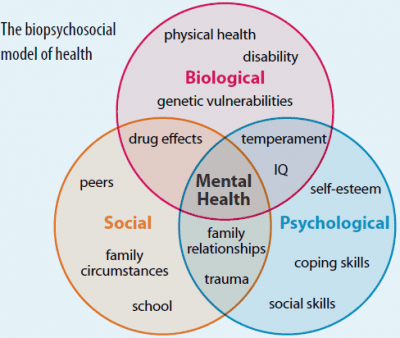
Behavior results from the interaction of Biological factors (genetics, brain structure), Psychological factors (mental processes, coping styles), and Social factors (culture, family, SES).
5. Neurobiological Basis of Mental Processes
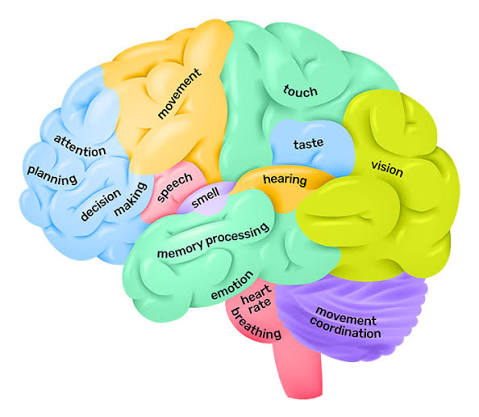
| Brain Structure | Primary Mental Processes | Clinical Relevance |
|---|---|---|
| Prefrontal Cortex | Executive functions, planning, working memory | Impaired in ADHD, Schizophrenia |
| Hippocampus | Memory encoding and consolidation | Damaged in Alzheimer’s disease |
| Amygdala | Emotion processing, fear conditioning | Hyperactive in Anxiety/PTSD |
| Thalamus | Sensory relay, attention modulation | Altered consciousness in Thalamic stroke |
| Cerebellum | Motor learning, procedural memory, timing | Ataxia |
| Temporal Lobes | Auditory processing, language comprehension | Wernicke’s aphasia |
| Parietal Lobes | Spatial perception, sensory integration | Neglect syndrome |
| Occipital Lobes | Visual processing, pattern recognition | Visual agnosia, cortical blindness |
| Reticular Activating System | Arousal, wakefulness, attention | Coma |
Role of Neurotransmitters
- Dopamine: Reward, motivation, and executive function.
- Serotonin: Mood regulation and sleep.
- Acetylcholine: Essential for memory and attention.
- Norepinephrine: Modulates arousal and alertness.
6. Clinical Relevance
- Cognitive Impairment: Assessed via tools like MMSE (Mini-Mental State Examination) and MoCA (Montreal Cognitive Assessment) in dementia or brain injury.
- Psychiatric Disorders: Depression involves negative cognitive biases; Schizophrenia involves disorganized thinking and hallucinations.
- Substance Use: Alcohol impairs judgment by depressing CNS activity; stimulants increase dopamine, potentially causing paranoia.
- Pain Management: Pain perception is modulated by attention and anxiety. Cognitive-behavioral approaches target these mental processes.
7. Summary Table: Mental Processes and Behavioral Effects
| Mental Process | Effect on Behavior | Clinical Example |
|---|---|---|
| Perception | Guides response to environmental stimuli | Hallucinations in Schizophrenia |
| Attention | Determines what info guides behavior | ADHD: impaired sustained attention |
| Memory | Past experiences shape current responses | Amnesia: inability to form new memories |
| Thinking | Enables problem-solving and planning | Dementia: disorganized thinking |
| Reasoning | Supports decision-making and judgment | Frontal lobe damage: impaired judgment |
| Emotion | Motivates approach or avoidance | Depression: persistent low mood |
| Motivation | Influences goal pursuit and persistence | Anhedonia: loss of motivation |
8. Key Points
- Mental processes are internal, dynamic mind activities mediating between stimuli and behavior.
- They include cognitive, perceptual, memory, attentional, consciousness, emotional, and motivational categories.
- Key structures include the prefrontal cortex, hippocampus, amygdala, and thalamus.
- Neurotransmitters like dopamine and serotonin are critical modulators.
- Clinical assessment of these processes is essential for diagnosing psychiatric and neurological conditions.