Developmental Theories: Freud & Erikson
Comprehensive notes on the stages of human development, contrasting Sigmund Freud’s psychosexual model with Erik Erikson’s psychosocial framework, with specific focus on clinical implications and the Ugandan context.
PART A: Sigmund Freud's Psychosexual Stages
1. Introduction to Freud's Theory
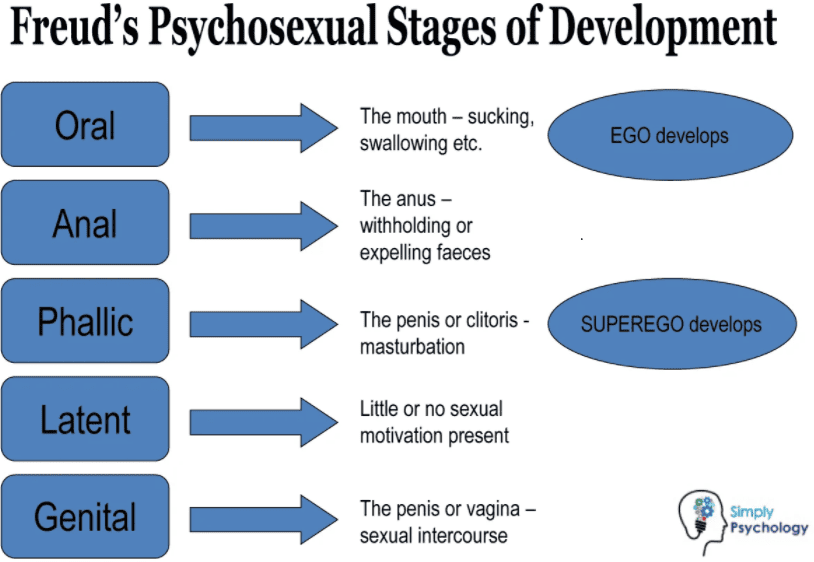
Sigmund Freud (1856–1939) proposed that personality development occurs through five sequential stages. Each stage is defined by the concentration of libidinal (psychosexual) energy on a specific erogenous zone. Successful navigation results in a healthy personality, while failure to resolve conflicts leads to fixation—a persistent focus that influences adult behavior.
1.1 Structural Model of the Psyche
- The Id: Primitive, pleasure-seeking instincts.
- The Ego: Rational mediator between the id and reality.
- The Superego: Internalized moral standards and values.
2. The Psychosexual Stages
The Oral Stage (Birth to 1 Year)
Erogenous Zone: Mouth (lips, tongue, gums).
Tasks: Weaning and establishing trust through feeding. Development of the ego begins.
Fixation: Overindulgence or frustration leads to overeating, smoking, alcohol dependence, or excessive dependency in adulthood.
The Anal Stage (1 to 3 Years)
Erogenous Zone: Anus (bowel and bladder control).
Tasks: Toilet training and delaying gratification.
Fixation: Harsh training results in anal-retentive traits (perfectionism, rigidity). Lenient training results in anal-expulsive traits (disorganization, cruelty).
The Phallic Stage (3 to 6 Years)
Erogenous Zone: Genitals.
Complexes: Oedipus Complex (boys) and Electra Complex (girls). Boys experience castration anxiety, leading them to identify with their father, through which the superego forms.
Fixation: Results in sexual dysfunction, difficulty with authority, or narcissistic traits.
The Latent Stage (6 Years to Puberty)
Erogenous Zone: None (sexual feelings are dormant).
Tasks: Development of social competence, intellectual pursuits, and defense mechanisms.
The Genital Stage (Puberty to Adulthood)
Erogenous Zone: Genitals (mature sexual expression).
Tasks: Establishing identity, balancing personal desires with social responsibility, and consensual relationships.
PART B: Erik Erikson's Psychosocial Stages
7. Introduction to Erikson's Theory
Erik Erikson expanded Freud's work into a lifespan model. He proposed eight stages, each defined by a central crisis. Successful resolution produce a basic virtue—a psychological strength. Erikson emphasized the role of social and cultural influences over biological drives.
8. The Pediatric Psychosocial Stages
Trust vs. Mistrust (0–1 Year)
Virtue: Hope.
Clinical Relevance: Critical for promoting breastfeeding and kangaroo mother care. In Uganda, early skin-to-skin contact is vital for establishing this trust.
Autonomy vs. Shame and Doubt (1–3 Years)
Virtue: Will.
Clinical Relevance: Toilet training must be patient. Forceful methods contribute to encopresis or enuresis.
Initiative vs. Guilt (3–6 Years)
Virtue: Purpose.
Clinical Relevance: Children benefit from play therapy and preschool education. Community-based development programs in Uganda support this stage.
Industry vs. Inferiority (6–12 Years)
Virtue: Competence.
Clinical Relevance: Monitor school performance. Deworming initiatives and health programs in schools support physical and mental industry.
Identity vs. Role Confusion (12–18 Years)
Virtue: Fidelity.
Clinical Relevance: Risk behaviors (substance use, unsafe sex) may signal role confusion. Comprehensive sexuality education is essential for healthy identity formation.
9. Comparison Table: Freud vs. Erikson
| Feature | Freud (Psychosexual) | Erikson (Psychosocial) |
|---|---|---|
| Focus | Libidinal energy / Biological instincts | Social and cultural context |
| Span | Childhood only (5 stages) | Lifespan (8 stages) |
| Driving Force | Id, Ego, Superego | Social crises and cultural demands |
| Failure Outcome | Fixation on erogenous zone | Failure to acquire basic virtue |
| Application | Uncovering repressed conflicts | Developmental assessment and counseling |
10. Key Points Summary
- Freud: Focused on biological drives; unresolved childhood conflicts lead to adult fixations.
- Erikson: Emphasized conscious choice and social environment across the entire lifespan.
- Clinical Use: Erikson’s framework is more widely applied in modern counseling and developmental assessment.
- Early Experience: Both theories agree that early childhood experiences are the foundation for adult personality.