Pediatric Growth and Development
Understanding the fundamental concepts of growth, development, and developmental milestones forms the cornerstone of pediatric and adolescent medicine. These definitions enable clinicians to identify deviations that may signal underlying pathology.
1. Definition of Growth
Growth refers to the quantitative, measurable increase in physical size and mass of the body or its parts over time. It is a biological process characterized by an increase in cell number (hyperplasia), cell size (hypertrophy), and deposition of intercellular materials.
1.1 Parameters of Growth
- Height (Length): Measured using a stadiometer or length board. Infants under two years are measured in the supine position (length); older children stand upright (height).
- Weight: Measured in kilograms using calibrated scales. Weight is the most sensitive indicator of acute nutritional status.
- Head Circumference: Measured using a non-stretchable tape around the occipital prominence and supraorbital ridges. Reflects brain growth, particularly during the first two years of life.
- Chest Circumference: Measured at the level of the nipples. In newborns, head circumference exceeds chest circumference by 2–3 cm; they become equal by 1–2 years of age.
- Body Mass Index (BMI): Calculated as weight (kg) / height² (m²). Used to assess nutritional status in children over 2 years, plotted on age- and sex-specific percentile charts.
1.2 Patterns of Growth
Growth follows predictable biological pathways:
- Cephalocaudal pattern: Describes development from head to toe (the head develops before the lower limbs).
- Proximodistal pattern: Describes development from the midline outward (trunk control precedes finger dexterity).
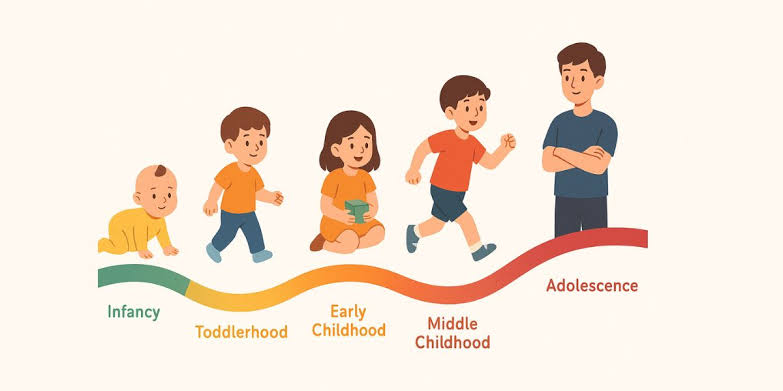
Growth is not uniform; rapid bursts occur during infancy and adolescence, with slower periods during middle childhood.
2. Definition of Development
Development refers to the qualitative, progressive series of changes in functional capacity and skill acquisition. It encompasses the maturation of physical, cognitive, social, and motor capacities, reflecting the interaction between genetic programming and environmental influences.
2.1 Domains of Development
- Gross Motor: Involves large muscle groups and whole-body movements (e.g., head control, sitting, walking, jumping).
- Fine Motor: Involves small muscle groups, particularly hands and fingers (e.g., grasping, pincer grip, drawing).
- Language: Encompasses receptive (understanding) and expressive (speaking) language.
- Cognitive: Refers to intellectual processes such as memory, problem-solving, and reasoning.
- Social and Emotional: The ability to form relationships, regulate emotions, and adapt to social norms.
2.2 Principles of Development
- Continuous: Proceeds from conception to death without interruption.
- Predictable Sequence: All children acquire skills in the same order, though the rate varies.
- General to Specific: Early responses are global; later responses become refined.
- Interrelated: Progress in one domain (e.g., motor) influences progress in others (e.g., cognitive).
- Individual Differences: Each child develops at their own pace within normal limits.
3. Developmental Milestones
Milestones are specific skills or behaviors that most children achieve by a particular age. They serve as standardized benchmarks for evaluation.
3.1 Characteristics of Milestones
- They represent the median age (50% of children achieve the skill) and the limit age (90% have achieved it).
- Milestones are culturally influenced; some skills vary across different societies.
- They are not rigid deadlines; temporary delays may occur without pathology.
Clinicians must investigate significant delays, regression (loss of previously acquired skills), or marked asymmetry in development. These may indicate neurological, genetic, or metabolic pathology.
4. Distinction Between Growth and Development
| Aspect | Growth | Development |
|---|---|---|
| Nature | Quantitative (Measurable) | Qualitative (Functional) |
| Focus | Increase in size and mass | Acquisition of skills and abilities |
| Measurement | Objective (cm, kg, BMI) | Subjective/Objective (Observation/Tests) |
| Reversibility | Generally irreversible | Can be modified with intervention |
| Domains | Physical only | Physical, Cognitive, Social, Emotional |
5. Clinical Relevance
Accurate assessment is fundamental to pediatric practice. Monitoring is conducted through:
- Growth Charts: WHO Child Growth Standards identify deviations like stunting, wasting, or obesity.
- Screening Tools: The Denver Developmental Screening Test (DDST) and Ages and Stages Questionnaire (ASQ).
In Uganda, where malnutrition, malaria, and HIV/AIDS are prevalent, vigilant monitoring of growth and development is essential for reducing child morbidity and mortality. Access to early stimulation remains a critical factor.
6. Key Points Summary
- Growth: Quantitative increase in size; Development: Qualitative acquisition of capacity.
- Milestones: Age-specific benchmarks for normal progression.
- Parameters: Include height, weight, head/chest circumference, and BMI.
- Domains: Gross motor, fine motor, language, cognitive, and social-emotional.
- Early Identification: Enables timely intervention and significantly improves long-term outcomes.

when are you loading notes for other course units
But this is absolutely amazing
Which ones exactly