Relevant Theories of Medical Psychology
Detailed notes covering Cognitive Theory, Biological Theory, Psychodynamic Theory, and Application of Schools of Thought to Health Care
Chapter 1: Cognitive Theory
1.1 Definition
Cognitive psychology is the branch of psychology that studies mental processes including attention, perception, memory, language, problem-solving, reasoning, and decision-making. It views the mind as an information-processing system analogous to a computer, receiving input, processing it, storing it, and producing output.
1.2 Historical Background
Cognitive psychology emerged in the 1950s and 1960s as a reaction against the dominance of behaviorism, which had rejected the study of internal mental processes. The "cognitive revolution" was fueled by advances in computer science, linguistics, neuroscience, and mathematics. Researchers began to argue that behavior could not be fully explained without understanding the mental processes that mediate between stimulus and response.
Key milestones include:
- Noam Chomsky's (1959) critique of B.F. Skinner's verbal behavior, arguing that language acquisition requires innate cognitive structures.
- George Miller's (1956) paper on the "magical number seven," demonstrating limits on human information processing capacity.
- The development of the first digital computers, which provided a metaphor for understanding mental processes.
- Ulric Neisser's (1967) book Cognitive Psychology, which formally named and defined the field.
1.3 Core Concepts
1.3.1 The Information-Processing Model
The dominant framework in cognitive psychology is the information-processing model, which compares the human mind to a computer. Information flows through a series of stages:
- Input (Sensory Register): Information from the environment is briefly held in sensory memory (approximately 0.5–3 seconds).
- Attention and Pattern Recognition: Relevant information is selected and recognized.
- Short-Term Memory (Working Memory): Information is temporarily held and manipulated (capacity: approximately 7±2 items; duration: approximately 20–30 seconds without rehearsal).
- Long-Term Memory: Information is encoded and stored for extended periods, potentially indefinitely.
- Output (Response): Retrieved information guides behavior, decisions, and responses.
1.3.2 Schemas
A schema is a mental framework or organized pattern of knowledge that helps individuals interpret and organize information about the world. Schemas include what we know and how we come to know it. They influence what we notice, how we interpret experiences, and how we remember events.
For example, a person who has a schema for "doctor" may include attributes such as white coat, stethoscope, clinic, and authority. When encountering someone who fits this schema, the person quickly recognizes them as a doctor. However, schemas can also lead to biases and stereotypes when they are inaccurate or overly rigid.
1.3.3 Assimilation and Accommodation
Jean Piaget introduced two key processes of cognitive adaptation:
- Assimilation: The process of incorporating new information into existing schemas. For example, a child who has a schema for "dog" (four-legged, furry, barks) may initially call a cat a "dog" because it fits the existing schema.
- Accommodation: The process of modifying existing schemas or creating new ones in response to new information that does not fit. The child eventually learns to distinguish cats from dogs, accommodating the schema.
1.3.4 Piaget's Stages of Cognitive Development
Jean Piaget (1896–1980) proposed that cognitive development occurs through a series of qualitative stages, each characterized by distinct ways of thinking:
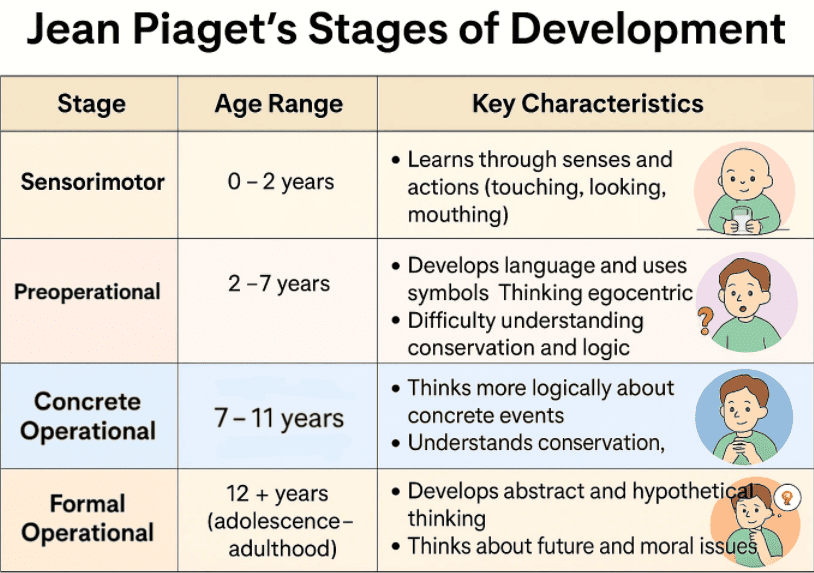
| Stage | Age Range | Key Characteristics |
|---|---|---|
| Sensorimotor | 0–2 years | Learns through senses and motor actions; develops object permanence and causality. |
| Preoperational | 2–7 years | Develops language and symbolic thought; egocentric thinking; difficulty with conservation and logic. |
| Concrete Operational | 7–11 years | Thinks logically about concrete events; understands conservation, classification, and seriation. |
| Formal Operational | 12+ years | Develops abstract and hypothetical thinking; considers future, moral issues, and idealistic concepts. |
1.3.5 Cognitive Biases and Heuristics
Daniel Kahneman and Amos Tversky demonstrated that human thinking is subject to systematic cognitive biases and heuristics (mental shortcuts):
- Availability Heuristic: Judging the likelihood of events based on how easily examples come to mind.
- Representativeness Heuristic: Judging probability based on how similar an event is to a prototype.
- Confirmation Bias: The tendency to seek, interpret, and remember information that confirms pre-existing beliefs.
- Anchoring Bias: Relying too heavily on the first piece of information encountered.
1.4 Cognitive Therapy
Cognitive therapy, developed by Aaron Beck, and cognitive-behavioral therapy (CBT), which integrates cognitive and behavioral principles, are among the most widely researched and practiced forms of psychotherapy. These approaches are based on the premise that distorted or maladaptive thinking patterns contribute to psychological distress.
Key techniques include:
- Cognitive restructuring: Identifying and challenging irrational or distorted thoughts.
- Behavioral activation: Increasing engagement in rewarding activities.
- Exposure therapy: Gradual confrontation with feared stimuli.
- Homework assignments: Practicing skills between sessions.
1.5 Clinical Relevance
Cognitive theory is fundamental to understanding patient health beliefs, treatment adherence, and health decision-making. Patients' schemas about illness (e.g., "diabetes means my life is over") strongly influence their coping behaviors. Cognitive biases affect how patients interpret symptoms (availability heuristic may lead to overestimating rare diseases seen in media) and how clinicians make diagnostic decisions (anchoring bias may cause fixation on an initial hypothesis). Cognitive-behavioral therapy is a first-line treatment for depression, anxiety, chronic pain, and many other conditions commonly encountered in clinical medicine. Understanding Piaget's stages helps clinicians communicate appropriately with pediatric patients at different developmental levels.
Chapter 2: Biological Theory
2.1 Definition
Biological psychology (also called biopsychology, behavioral neuroscience, or physiological psychology) is the branch of psychology that examines how biological processes — including the brain, nervous system, genetics, neurotransmitters, and hormones — influence behavior, thoughts, and emotions.
2.2 Historical Background
The biological perspective has roots extending back to ancient philosophers who debated the relationship between mind and body. However, modern biological psychology emerged in the 19th and 20th centuries through the integration of psychology with physiology, neurology, and genetics.
- Charles Darwin's theory of evolution provided the foundational logic: traits — including psychological traits — that increase reproductive fitness are preserved through natural selection.
- In the late 19th century, discoveries about the structure and function of neurons laid the groundwork for understanding the biological basis of behavior.
- Advances in the 20th and 21st centuries, including EEG, CT, MRI, PET, and genetic sequencing, have dramatically expanded the capacity to study behavior.
2.3 Core Concepts
2.3.1 The Nervous System
The nervous system is the body's primary communication network, consisting of:
- The Central Nervous System (CNS): The brain and spinal cord, which process and integrate information.
- The Peripheral Nervous System (PNS): Nerves outside the CNS that connect the CNS to the rest of the body. The PNS includes:
- Somatic Nervous System: Controls voluntary movements and transmits sensory information.
- Autonomic Nervous System (ANS): Controls involuntary functions. The ANS has two branches:
- Sympathetic Nervous System: Activates "fight or flight" responses during stress.
- Parasympathetic Nervous System: Promotes "rest and digest" functions during relaxation.
2.3.2 Neurons and Neural Communication
Neurons are the basic functional units of the nervous system. A typical neuron consists of:
- Dendrites: Branch-like structures that receive messages from other neurons.
- Soma (Cell Body): Maintains the life of the cell and processes incoming signals.
- Axon: A long, tube-like structure that carries the neural message to other cells.
- Axon Terminals: Rounded areas at the end of axon branches that communicate with other neurons.
Neurons communicate via neurotransmitters — chemical messengers released into the synapse (the microscopic gap between neurons) that bind to receptor sites on the receiving neuron. The action potential is an electrical impulse that travels down the axon, following the all-or-none principle (a neuron either fires completely or not at all).
2.3.3 Key Neurotransmitters
| Neurotransmitter | Primary Functions | Associated Disorders (imbalance) |
|---|---|---|
| Dopamine | Motor control, reward, motivation, pleasure | Parkinson's disease, schizophrenia, addiction |
| Serotonin | Mood regulation, sleep, appetite, pain perception | Depression, anxiety, obsessive-compulsive disorder |
| Norepinephrine (Noradrenaline) | Arousal, alertness, attention, "fight or flight" | Depression, anxiety, ADHD |
| Acetylcholine | Muscle activation, memory, learning | Alzheimer's disease, myasthenia gravis |
| GABA (Gamma Aminobutyric Acid) | Primary inhibitory neurotransmitter; reduces neuronal excitability | Anxiety disorders, epilepsy, insomnia |
| Glutamate | Primary excitatory neurotransmitter; learning and memory | Stroke, epilepsy, neurodegeneration |
| Endorphins | Pain relief, pleasure, stress reduction | Chronic pain, addiction |
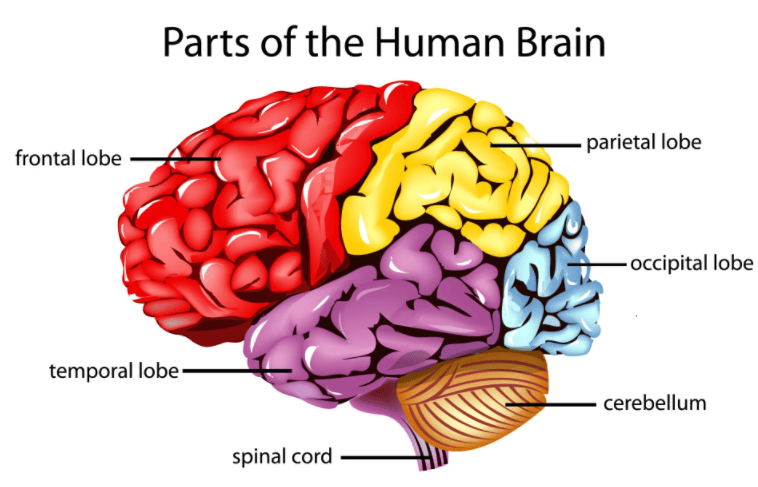
2.3.4 Brain Structures and Functions
| Structure | Primary Functions | Clinical Relevance |
|---|---|---|
| Frontal Lobe | Executive function, decision-making, planning, impulse control, motor control (motor cortex), speech production (Broca's area) | Damage causes personality changes, poor judgment, Broca's aphasia |
| Parietal Lobe | Somatosensory processing, spatial awareness, body orientation, sensory integration | Damage causes neglect syndrome, difficulty with spatial relationships |
| Temporal Lobe | Auditory processing, language comprehension (Wernicke's area), memory (hippocampus), emotion (amygdala) | Damage causes Wernicke's aphasia, memory impairment, seizures |
| Occipital Lobe | Visual processing and interpretation | Damage causes visual agnosia, cortical blindness |
| Cerebellum | Balance, coordination, fine motor control, procedural learning | Damage causes ataxia, tremor, impaired motor learning |
| Brainstem | Vital functions: breathing, heart rate, blood pressure, arousal, sleep-wake cycles | Damage is life-threatening; controls reflexes |
| Hippocampus | Memory formation, spatial navigation, consolidation of short-term to long-term memory | Damage causes anterograde amnesia (inability to form new memories) |
| Amygdala | Emotion processing, especially fear and aggression; emotional memory | Overactivity linked to anxiety; damage reduces fear response |
| Hypothalamus | Homeostasis, hormone regulation, hunger, thirst, temperature, circadian rhythms | Dysfunction affects sleep, appetite, temperature regulation, endocrine function |
| Thalamus | Sensory relay station; directs sensory information to appropriate cortical areas | Damage causes sensory disturbances, thalamic pain syndrome |
2.3.5 Genetics and Behavior
The biological perspective emphasizes the role of genetics in shaping behavior:
- Genotype: The genetic makeup inherited from parents.
- Phenotype: The observable expression of genetic traits, influenced by both genes and environment.
- Heritability: The proportion of variation in a trait attributable to genetic differences among individuals.
Research methods include: Twin studies (monozygotic vs. dizygotic), Adoption studies, Family studies, and Molecular genetics.
2.3.6 The Endocrine System
Communicates through hormones — chemical messengers released into the bloodstream. Key hormones affecting behavior include:
- Cortisol: The primary stress hormone; elevated during "fight or flight" responses.
- Adrenaline (Epinephrine): Prepares the body for emergency action; increases heart rate and alertness.
- Thyroid Hormones: Regulate metabolism, energy, and mood.
- Insulin: Regulates blood glucose levels.
- Sex Hormones: Estrogen, progesterone, and testosterone influence sexual behavior, mood, and cognitive function.
2.4 Criticisms
- Reductionism: Reducing complex behaviors to purely biological factors, neglecting psychosocial/cultural influences.
- Determinism: Suggesting behavior is entirely governed by genetics/chemistry, potentially undermining free will.
- Correlational ambiguity: Brain abnormalities observed in disorders could be effects rather than causes.
- Ecological validity: Laboratory studies (scans) may not reflect natural activity.
2.5 Clinical Relevance
The biological perspective is foundational to modern medicine. Understanding neurotransmitter systems explains the mechanisms of action of psychiatric medications (e.g., SSRIs for depression, antipsychotics for schizophrenia). Knowledge of brain anatomy and function is essential for interpreting neurological examinations, localizing lesions, and understanding the behavioral consequences of stroke, trauma, and neurodegenerative diseases. Genetic counseling and pharmacogenomics increasingly guide personalized treatment. The stress response system (HPA axis, cortisol) explains the physiological impact of chronic stress on health and disease. Biological psychology also informs understanding of substance use disorders, sleep disorders, and pain management.
Chapter 3: Psychodynamic / Psycho-analytic Theory
3.1 Definition
Psychoanalytic theory (also called psychodynamic theory) is a comprehensive theory of personality and psychotherapy developed by Sigmund Freud. It emphasizes the role of unconscious processes, early childhood experiences, and internal conflicts in shaping behavior, personality, and psychological disorders.
3.2 Historical Background
Sigmund Freud (1856–1939) was an Austrian neurologist who founded psychoanalysis. Working in Vienna in the late 19th and early 20th centuries, Freud developed his theories through clinical work with patients suffering from "hysteria" and other neurotic disorders. His methods included free association, dream analysis, and the analysis of "Freudian slips".
Major figures who extended or revised Freud's ideas include Carl Jung (analytical psychology), Alfred Adler (individual psychology), Melanie Klein (object relations), and Erik Erikson (psychosocial development).
3.3 Core Concepts
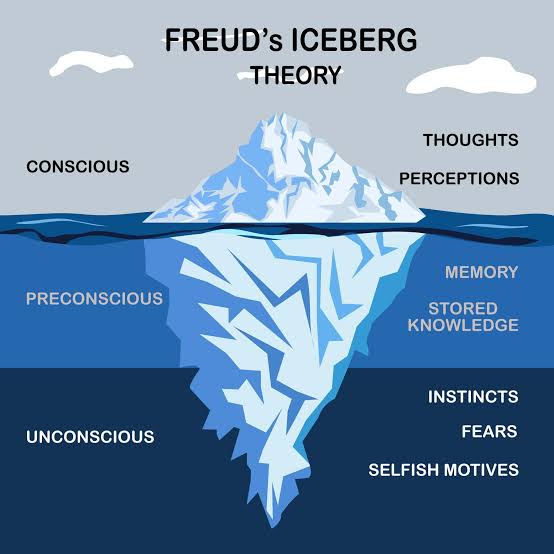
3.3.1 The Topographical Model: Levels of Consciousness
Freud proposed that the mind operates at three levels of awareness:
- The Conscious Mind: Contains thoughts, memories, feelings, and wishes of which we are aware at any given moment.
- The Preconscious Mind: Contains material that is not currently in awareness but can be easily retrieved and brought into consciousness (e.g., a phone number).
- The Unconscious Mind: A vast reservoir of feelings, thoughts, urges, and memories that are outside of conscious awareness. It contains unacceptable or unpleasant contents (pain, anxiety, conflict). Freud believed the unconscious is the primary determinant of behavior.
3.3.2 The Structural Model: Id, Ego, and Superego
| Structure | Principle | Description | Analogy |
|---|---|---|---|
| Id | Pleasure Principle | The primitive, instinctive part present from birth. Contains sexual and aggressive drives (libido and thanatos). Operates entirely unconsciously. | "I want it now!" |
| Ego | Reality Principle | The rational, decision-making part that mediates between the id and reality. Operates at conscious and preconscious levels. | "Let's find a safe way to get it." |
| Superego | Morality Principle | The internalized moral standards acquired from parents/society. Includes the conscience (punishes with guilt) and ego-ideal (rewards with pride). | "You shouldn't want that." |
When the ego is unable to manage the conflicting demands of the id, superego, and reality, anxiety results. The ego then employs defense mechanisms.
3.3.3 Defense Mechanisms
| Defense Mechanism | Definition | Clinical Example |
|---|---|---|
| Repression | Pushing threatening thoughts/memories out of conscious awareness | A patient with childhood trauma has no memory of the abusive events |
| Denial | Refusing to accept reality or facts that are too painful | A patient with terminal cancer insists, "The doctors are wrong" |
| Projection | Attributing one's own unacceptable impulses or feelings to someone else | A person who feels hostile toward a colleague claims the colleague is hostile toward them |
| Displacement | Redirecting emotional responses from the true source to a safer substitute | A man angry at his boss yells at his family instead |
| Sublimation | Channeling unacceptable impulses into socially acceptable activities | A person with aggressive impulses becomes a competitive athlete |
| Rationalization | Creating logical explanations to justify behavior or feelings | A student who fails an exam blames the teacher rather than lack of preparation |
| Intellectualization | Using excessive abstract thinking to avoid disturbing emotions | A patient diagnosed with HIV focuses entirely on medical statistics rather than emotional impact |
| Regression | Reverting to an earlier stage of development when faced with stress | An adult hospitalized for surgery begins sucking their thumb |
3.3.4 Psychosexual Stages of Development
| Stage | Age | Erogenous Zone | Key Conflict | Adult Fixation Characteristics |
|---|---|---|---|---|
| Oral | 0–1 year | Mouth | Weaning | Smoking, overeating, dependence, passivity, sarcasm |
| Anal | 1–3 years | Anus | Toilet training | Orderliness/stinginess (over-control) or messiness/rebellion (under-control) |
| Phallic | 3–6 years | Genitals | Oedipus/Electra complex | Vanity, promiscuity, sexual dysfunction; authority issues |
| Latency | 6–puberty | None | Social development | Generally no fixation; period of relative calm |
| Genital | Puberty+ | Genitals | Mature relationships | Fixation results in difficulty forming adult relationships |
3.3.5 The Oedipus and Electra Complexes
During the phallic stage, young boys experience the Oedipus complex — unconscious sexual desire for the mother and rivalry with the father (castration anxiety). Young girls experience the Electra complex — unconscious desire for the father and rivalry with the mother, complicated by penis envy.
3.5 Criticisms
- Lack of empirical support: Many concepts are difficult to test scientifically.
- Overemphasis on sexuality as a motivation.
- Determinism: Humans seen as driven by unconscious forces with limited free will.
- Gender bias in concepts like penis envy.
3.6 Clinical Relevance
Psychodynamic concepts remain highly relevant. Understanding defense mechanisms helps clinicians recognize how patients cope with illness (e.g., denial in newly diagnosed patients, regression during hospitalization). Awareness of unconscious motivations helps explore non-adherence. The therapeutic relationship (transference and countertransference) is a central concept in all forms of psychotherapy. Psychodynamic theory also informed the understanding of psychosomatic medicine — how unconscious conflicts manifest as physical symptoms.
Chapter 4: Application of Schools of Thought to Health Care
4.1-4.11 Summary of Applications
- Idealistic Theory: Encourages a holistic vision (beyond surface symptoms) and informed self-management.
- Structuralism: Informs the systematic clinical history (breaking experience into quality, intensity, location) and element-by-element physical exams.
- Functionalism: Views symptoms as adaptive responses (e.g., fever as defense). Central to rehabilitation medicine and disability assessment.
- Humanism: Emphasizes empathy, unconditional positive regard, and patient autonomy. Maslow's hierarchy reminds clinicians to meet basic needs (nutrition, safety) before complex plans.
- Behaviourism: Uses operant conditioning for programs like smoking cessation and weight management. Classical conditioning explains iatrogenic illness (conditioned medical anxiety).
- Gestalt Theory: Informs holistic diagnosis ("the whole is greater than the sum of parts") and pattern recognition in radiology/dermatology.
- Evolutionary Theory: Explains diseases through the thrifty gene hypothesis (obesity/diabetes) and mismatch theory (ancestral adaptations vs. modern sedentary lifestyle).
- Cognitive Theory: First-line for CBT. Helps in presenting information within the limits of working memory capacity.
- Biological Theory: Foundational to psychopharmacology (neurotransmitter systems) and neurorehabilitation.
4.12 Integrated Summary Table
| School of Thought | Core Contribution to Health Care | Specific Clinical Application |
|---|---|---|
| Idealistic Theory | Holistic vision; deeper understanding | Comprehensive assessment; health education |
| Structuralism | Systematic analysis of components | Structured history-taking; physical exam |
| Functionalism | Adaptive perspective on symptoms | Rehabilitation; quality-of-life measurement |
| Humanistic Theory | Patient dignity, autonomy, and growth | Patient-centered care; motivational interviewing |
| Behaviourism | Observable behavior modification | Smoking cessation; systematic desensitization |
| Gestalt Theory | Pattern recognition; holistic perception | Diagnostic imaging; holistic patient assessment |
| Evolutionary Theory | Disease vulnerability and adaptation | Lifestyle medicine; public health planning |
| Cognitive Theory | Mental processes in health and illness | CBT; adherence interventions |
| Biological Theory | Physical basis of behavior and disorder | Psychopharmacology; neurology; stress management |
| Psychodynamic Theory | Unconscious processes in illness | Understanding non-adherence; transference |
Summary Tables and Key Points
Comparative Summary of Cognitive, Biological, and Psychodynamic Theories
| Aspect | Cognitive Theory | Biological Theory | Psychodynamic Theory |
|---|---|---|---|
| Founder(s) | Piaget, Neisser, Beck | Darwin (foundations); modern neuroscientists | Sigmund Freud |
| Core Focus | Mental processes: memory, perception, thinking | Brain, neurotransmitters, genetics, physiology | Unconscious processes, early experiences, conflict |
| Key Method | Information-processing models; experiments | Neuroimaging, genetic studies, psychopharmacology | Free association, dream analysis, case studies |
| View of Disorder | Distorted thinking, maladaptive schemas | Neurochemical imbalance, brain abnormalities, genetics | Unconscious conflict, fixation, defense mechanisms |
| Therapeutic Approach | Cognitive restructuring, CBT | Pharmacotherapy, neurostimulation, lifestyle mod | Psychoanalysis, psychodynamic psychotherapy |
- Cognitive Theory: Views the mind as an info-processor. CBT is first-line for numerous conditions.
- Biological Theory: Explains behavior through brain function, neurotransmitters (Dopamine, Serotonin, etc.), and the endocrine system.
- Psychodynamic Theory: Emphasizes the unconscious mind and the structural model (id, ego, superego).
- Application to Health Care: An integrated biopsychosocial approach combining these perspectives provides the most comprehensive framework for patient care.